I Put a $249 Pop-Up Gazebo in Our Backyard. Two Months Later, Here’s the Shade Math.
I Put a $249 Pop-Up Gazebo in Our Backyard. Two Months Later, Here’s the Shade Math.
Our backyard has a wasp problem and a sun problem, and for three summers those two kept us inside. The lot faces southwest: from 3 p.m. on there is no shade anywhere — no tree, no overhang, nothing. And whatever we set on the patio table, the yellowjackets found first. We had the chairs and the grill. We had no reason to sit out there.
Two months ago I bought the 11×11 pop-up gazebo on FLNORW MALL for $249, hauled it into the yard on a Saturday, and put it to work. This is the honest accounting: the shade math, the mosquito-netting verdict, the storm test, and where a gazebo sits against the pergola and umbrella I already own.
Why a pop-up gazebo won the lineup
I did not start with a gazebo. I started with quotes, because I had already bought a retractable pergola for the front patio last year ($468 — 130 square feet of shade at $3.60 a square foot). For the backyard I wanted something freestanding, positioned exactly where the sun is worst, with bug protection the pergola never had.
Here is the honest scorecard, all real numbers from my own research:
- Custom cedar gazebo, installed: $6,000+ — my contractor quoted $5,200 for a pergola, and a closed-roof gazebo runs higher. Permanent, permitted, a commitment.
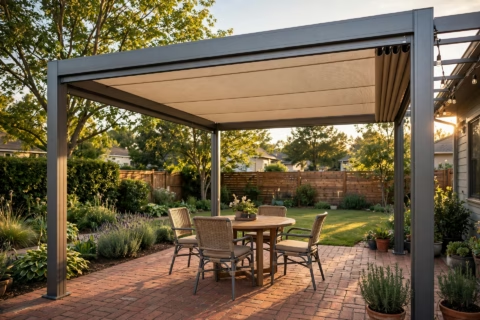
- 13×10 retractable pergola kit: $468 — the one I bought last year. Excellent shade, but no bug protection and no real rain cover.
- 10×6.5 solar LED patio umbrella: $129 — from my solar LED patio umbrella review. Right tool for a dining table, wrong tool for a seating area plus a grill.
- 11×11 pop-up gazebo: $249 — freestanding, roofed, with zippered mesh walls for the bugs.
The deciding factor was not price per square foot, though the gazebo wins that too. It was the mesh netting. A pergola gives you shade. An umbrella gives you shade. This gives you shade plus a screened room — and in a yard with yellowjackets, that is the whole ballgame.
The shade math: 121 square feet at $2.06 each
The footprint is 11 by 11 feet: 121 square feet of covered ground. At $249, that works out to $2.06 per square foot — cheaper than the retractable pergola’s $3.60, cheaper than any installed structure by an order of magnitude, and it includes the frame, the roof, and the screens.
Then the payback math, flagged as rough because it is. We used to spend about $60 a week eating out on summer weekends, partly because our own yard was unusable. This summer we ate outside roughly twice a week — grill nights, takeout on the patio table, one full cookout for eight. Call it $25 a dinner versus $60 out: $35 saved, twice a week, for 16 weeks, or $1,120 a summer against a $249 purchase. My estimate, and even halved it pays for itself before the first frost. If it lasts five summers — my estimate — the cost is $49.80 per summer, under a dollar a week across the warm months.
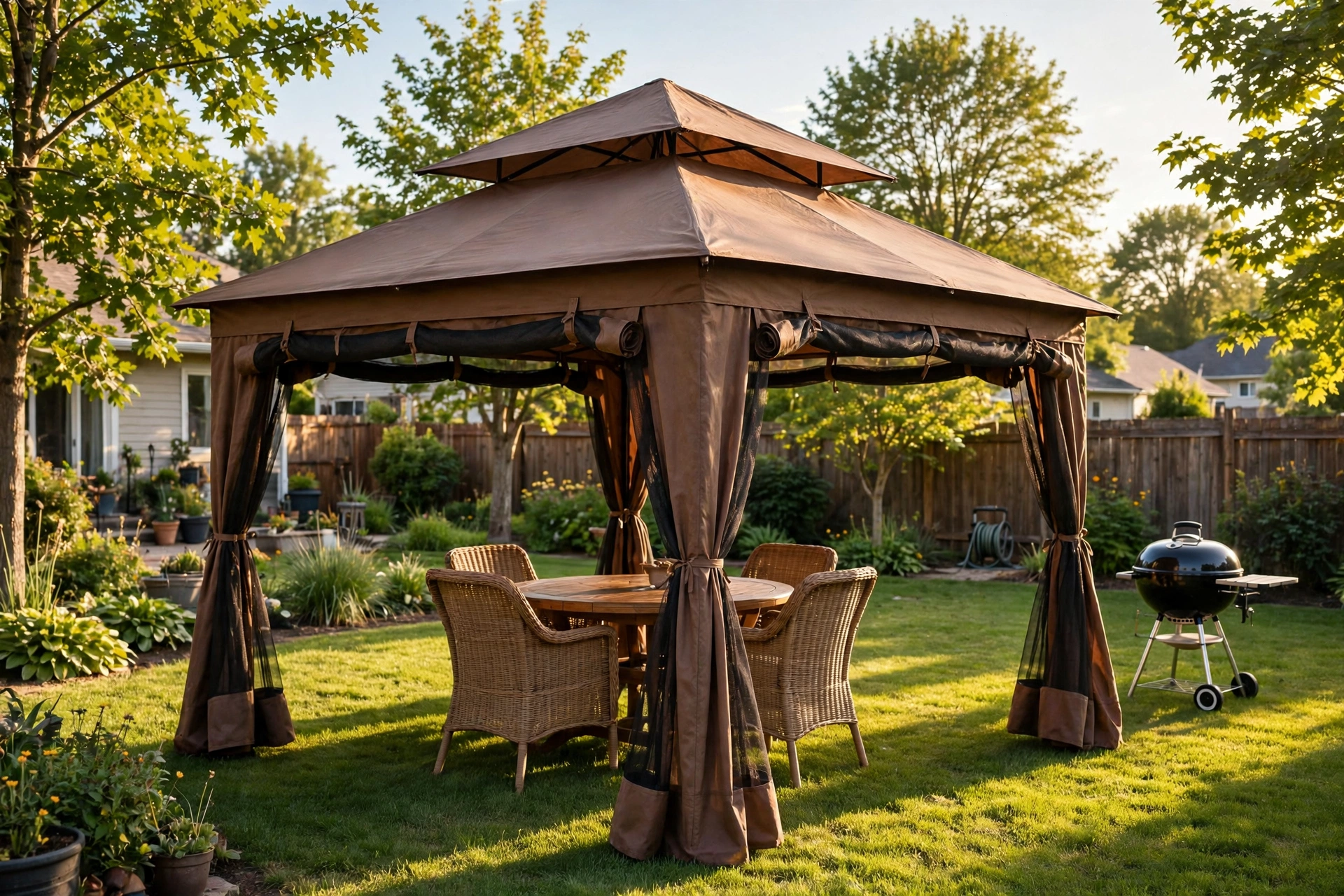
For scale on what 121 square feet holds: our 7-piece outdoor patio dining set (the $490 wicker set with the acacia top I reviewed last spring — 51.2 × 35.4 inches) sits on one side, the kettle grill on the other with three feet of clearance, and we seated eight for a cookout with walking room. The umbrella I own covers about 54 square feet and fits one table. This fits the table, six to eight chairs, and the grill. If your outdoor life is one table, the umbrella is the tool and half the price. If it is a table plus a grill plus people standing around talking, the gazebo is the tool. Be honest about which one you are.
What the $249 actually buys: the specs that matter
All of this comes from the product page, verified the day I ordered. The assembled gazebo measures 11 × 11 × 8.7 feet — the 8.7-foot peak means a 6-footer walks under it without ducking, even dead center. Interior space runs 108 × 108 inches (a true 9-by-9 usable square inside the legs). Total weight is 38.58 pounds: light enough that two people can carry it, and light enough that the anchoring rules below are non-negotiable.
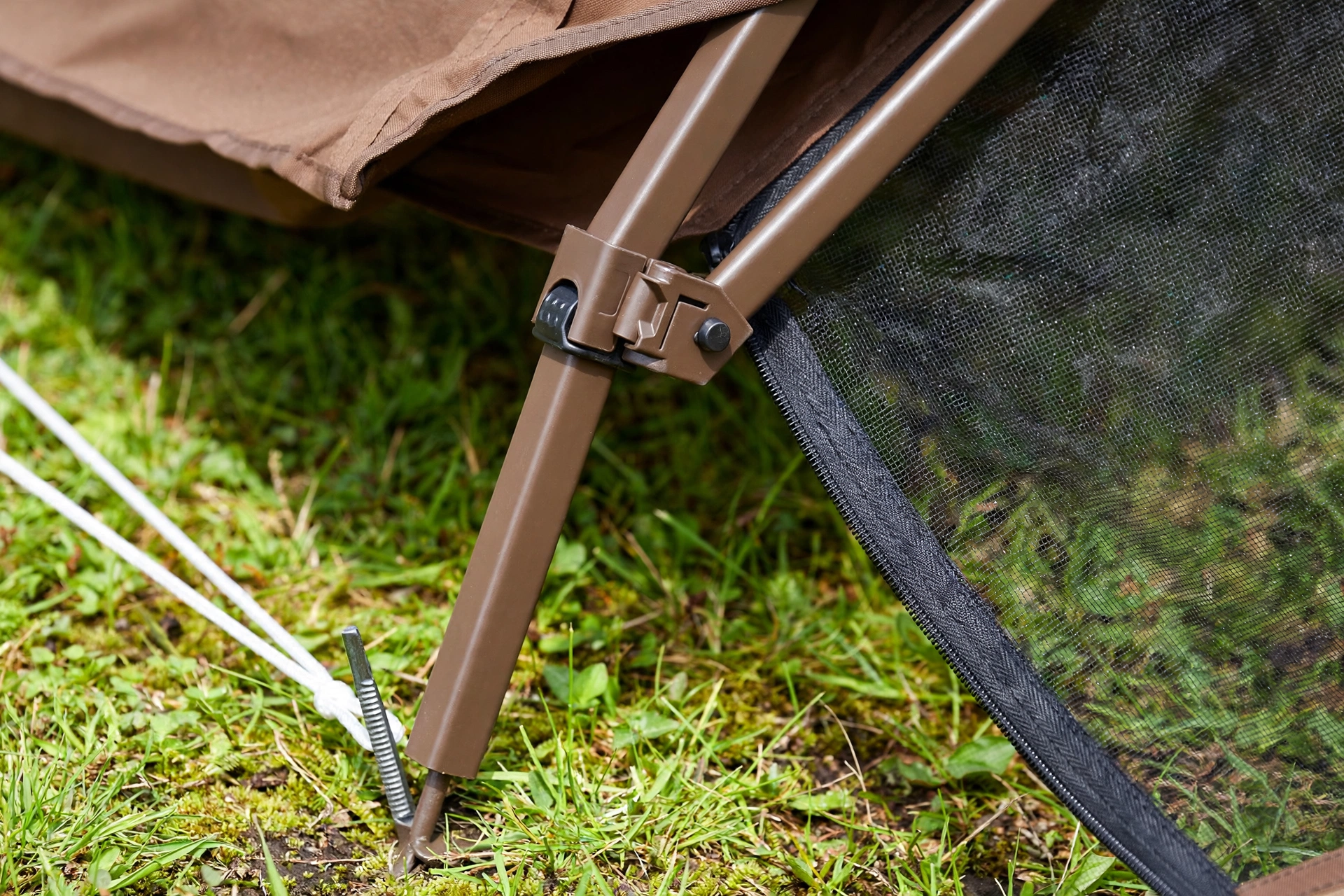
The frame is powder-coated steel, rated rust-resistant, in a brown finish. The roof is polyester in coffee, built as a 2-tier soft top — the gap between tiers vents hot air and takes load off the canopy in a gust. It is rated weather-resistant, water-resistant, and fire-resistant: honest language for sheds-a-drizzle, will not ignite from a candle, is not a storm shelter.
The mesh netting is the headline feature: full-sided mosquito netting with zippers, removable when you do not need it, plus solid side curtains. Snow load rating is 20 pounds and the roof handles 10 pounds of hanging weight — enough for string lights, not a chandelier. Ground nails and wind ropes come in the box, installation tools are included, and the product page calls for two adults. It ships small-parcel in a single carton, 48 × 9.45 × 9.45 inches at 40.79 pounds — it fit in my SUV with the seats down.
Assembly day: what “full assembly” actually took
The product page says full assembly required, tools included, two adults suggested. My reality, with my brother-in-law on a dry Saturday morning: about an hour and a half, including one argument about which way the roof panels face. The parts are straightforward and the included instructions are genuinely usable, which is not always true in this price bracket.
Two lessons from assembly day. First: do the roof frame on the ground, then lift it onto the legs. Second: stake it before you finish, not after. At 38.58 pounds, this gazebo is a sail the moment the roof goes on — ours shivered sideways in a gust before we got the ground nails in. The nails and wind ropes are in the box for a reason: use them on day one. On grass they bite fine; on a patio slab, plan on weighted bases or bolt-down feet, which the product page does not include.
And the rule every fabric shelter teaches: it is a shade product, not a storm product. A thunderstorm line came through that July, and with the netting unzipped to cut sail area, the staked frame rode it out. But the product page’s 20-pound snow load rating tells you the canopy is not meant to carry winter — my plan is to take the roof fabric off before first snow and put it back up in April, ten minutes of work to protect a $249 purchase. Light rain is fine — we ate through a twenty-minute drizzle and stayed dry. A real downpour would overwhelm the 2-tier vent and start pooling; know the trade before you buy.
The mosquito test: the mesh netting verdict
This is the section I was most curious about before buying, and it is where the gazebo earns its price. The netting zips closed on all four sides, and with the zipper shut, the yellowjackets simply stopped showing up at the table. Two months, a dozen meals under it, and I have not swatted a single wasp inside the screens.
The zippers run smoothly one-handed, which matters when you are carrying a platter. The mesh stops gnats — I checked on a muggy August evening, the real test — and the solid curtains double as a windbreak on cooler nights. Want the open-air feel? The netting unzips and pulls back in about two minutes. Screened room when you want it, open canopy when you do not.
One honest footnote: the netting does cut the breeze. On a still 90-degree afternoon, the inside runs a degree or two warmer than outside, my estimate from a cheap thermometer I hung from the frame. The 2-tier vent helps — hot air visibly shimmers out the top gap — but on the hottest week of August, run the screens open and take the breeze.
The industry numbers: pop-up shade is a real category
I looked up the market because I wanted to know whether $249 was a clearance fluke or the going rate. It is the going rate. Dataintelo’s 2025 report puts the global pop-up gazebo market at $2.8 billion, growing to $4.6 billion by 2034 — a 5.2% compound annual rate — with polyester canopy fabrics dominating every segment. Their commercial pop-up canopy report (2025) sizes that adjacent market at $1.36 billion, growing 5.8% a year. The 10×10 footprint is the industry’s default event size; this 11×11 sits one step up, which is why it swallowed our furniture so easily. I bought into a mature, competitive category at a commodity price. That is the best place to be as a buyer.
Three things I would tell my neighbor first
My neighbor watched the whole assembly from his fence and asked the questions you would ask:
- Anchor it on day one. I said it above and I will say it again: a 38-pound steel frame is a sail in a real gust. Stakes on grass, weights on concrete, before the first thunderstorm — not after.
- Water-resistant is not waterproof. The polyester sheds a drizzle beautifully and will lose a fight with a downpour. Check the forecast the way you would for any outdoor plan; the gazebo is shelter, not a guarantee.
- Coffee is the right color. It hides pollen, dust, and the general film of outdoor life. The pergola’s beige canopy shows everything for three weeks every spring; this one still looks clean after two months with zero maintenance. A hose-down in spring and it will look new.
The verdict
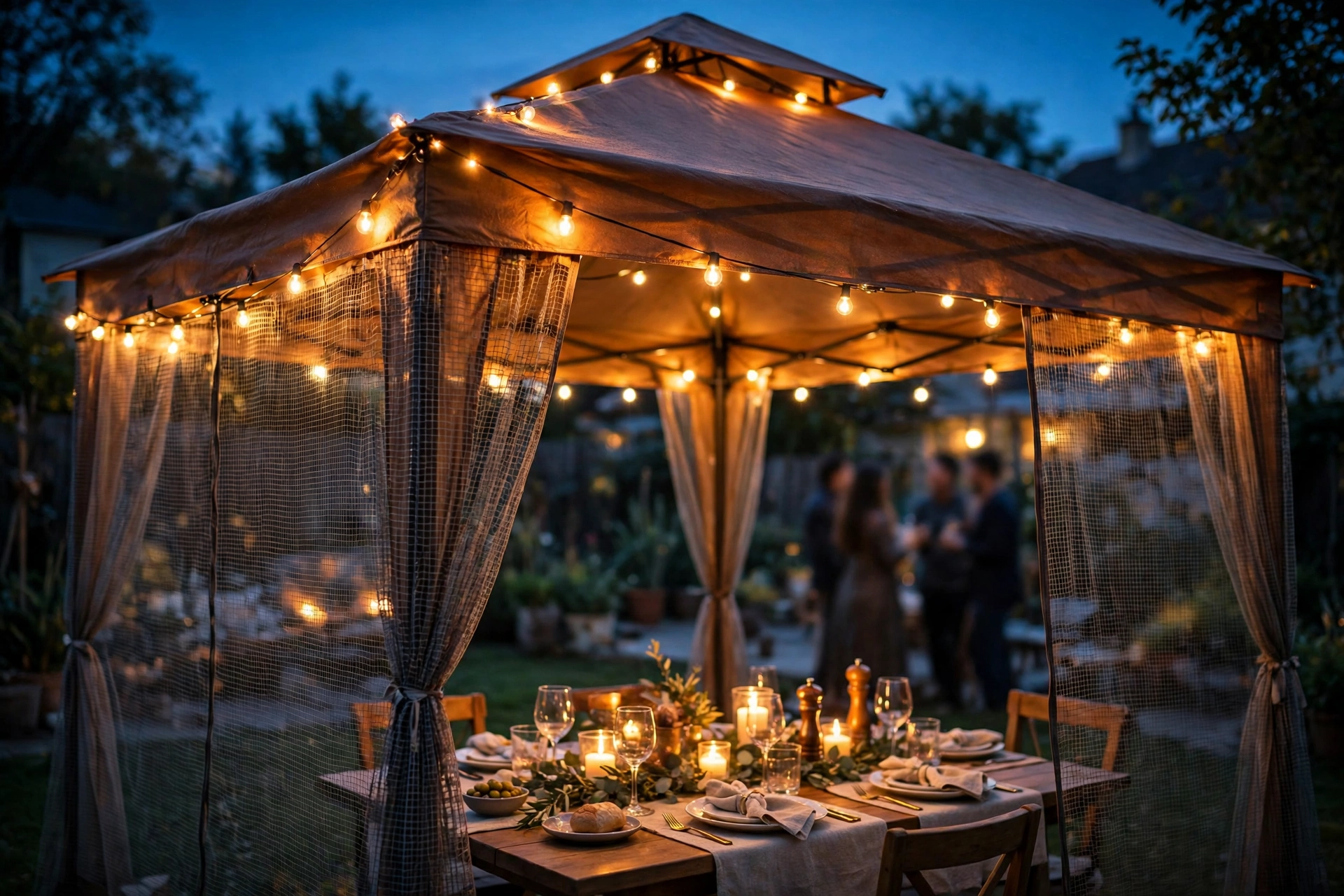
Two months in, the pop-up gazebo solved the two problems I bought it for: the backyard is usable from 3 p.m. to sunset, and the wasps eat elsewhere. At $2.06 a square foot, it is the cheapest roof I have ever put over outdoor furniture — cheaper than the pergola, a tenth of the contractor quote, and the only option in the lineup with a screened room. It will not survive a hurricane or carry snow, and it runs warm on still afternoons with the screens zipped. None of that is a surprise if you read the spec sheet first. For a household that wants the backyard back — shade, bugs handled, room for a table and a grill — this is the best-value tier in outdoor shade I have tested.
Ready to take your backyard back from the sun and the bugs? Shop the 11×11 pop-up gazebo canopy at FLNORW MALL — or read my retractable pergola shade math, my solar LED umbrella review, and my patio dining set review to pick the right shade for your setup. You can also browse the full FLNORW MALL collection.