Recliner Types Explained: I Compared a $299 Manual Chair, a $499 Power Glider, and a $600 Lift Chair
Recliner Types Explained: I Compared a $299 Manual Chair, a $499 Power Glider, and a $600 Lift Chair
Last winter I watched my 70-year-old father spend almost a full minute bracing against the coffee table just to stand up from the sofa. Bad knees, a cranky lumbar spine — “getting up” had quietly turned into hard work. That sent me down the recliner rabbit hole, and it turns out the word “recliner” covers three completely different machines. I ended up buying my dad a $600 power lift chair, spent a long afternoon testing a $499 power swivel glider at my sister’s place (she uses hers as a nursery chair), and ran the numbers on a $299 manual recliner for my own TV corner. Here is the honest breakdown of the three recliner types, who each one suits, and the math that actually decides.

The Three Recliner Types (and the One Question That Picks Yours)
Strip away the marketing and every recliner on the market is one of three things. A manual recliner moves by muscle: you pull a handle or push back with your legs, and a spring mechanism does the rest. A power recliner replaces the handle with a motor and buttons — push once and the backrest glides, sometimes with a rocking or swivel motion thrown in. A power lift recliner adds a second, more serious motor: the whole chair tilts forward and up, physically handing you to your feet.
The one question that picks your type: who is standing up out of it? If the answer is “someone with healthy knees,” a manual or power chair is plenty. If the answer is “my dad after knee trouble” or “me, eight weeks after back surgery,” the lift function is not a luxury — it is the entire point. Everything else (massage, heat, USB ports) is garnish.
Manual Recliners: The $299 Pull-Handle Workhorse
The $299 heated massage recliner from FLNORW MALL is the classic of the three. You pull a handle on the side, the backrest drops from 90° to 160°, and the footrest kicks out automatically. No outlet, no remote, no waiting for a motor. It is the kind of chair your grandfather had, minus the floral upholstery.
What surprised me is how much tech they pack into a manual chair now. This one has an 8-point vibration massage system with five modes across the back, waist, thighs, and legs, plus a lumbar heating element. It holds up to 350 lbs on a metal frame, measures 37.7 x 38.1 x 40.9 inches, and even throws in cup holders and side pockets. It ships in two boxes and goes together in about 20 minutes without tools.
The honest trade-offs: you need leg strength to push the recline open, and getting out of a deep recline at 160° takes core effort — my dad could not do it comfortably, which is why this chair was never for him. The 95-lb chair also stays where you put it; there is no swivel. But for $299, in blue fabric, as a dedicated TV chair for an able-bodied adult, the value is hard to argue with. It is the cheapest way into this comparison, and the massage-plus-heat combo genuinely takes the edge off a desk-bound back at nine in the evening.
Power Recliners: The $499 Push-Button Middle Ground
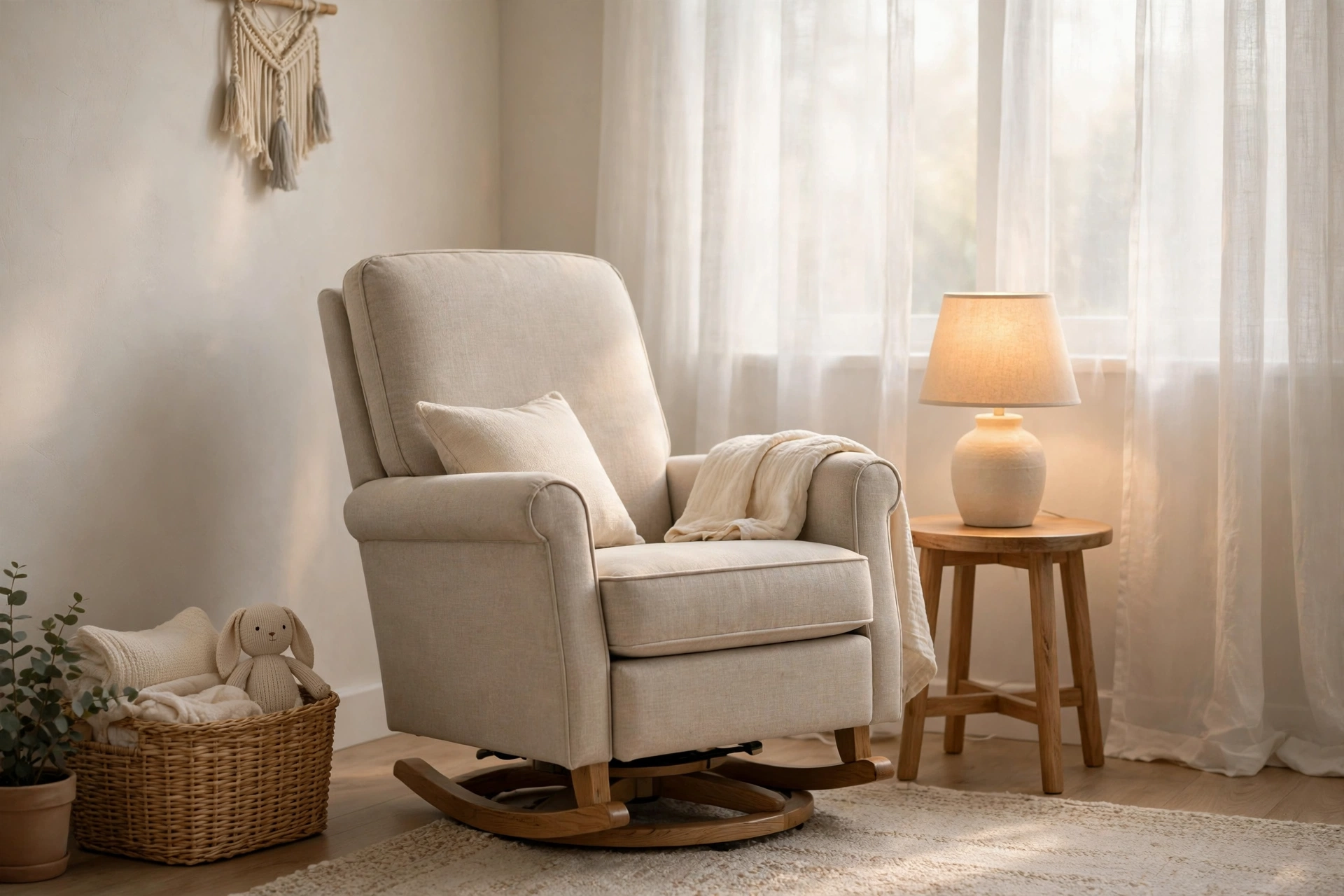
My sister bought the $499 270° power swivel glider when her daughter was born, and I spent a whole Sunday afternoon in it holding the baby. Press a button on the armrest and the backrest glides from 90° to 150° — no kicking, no pushing, one finger. The chair also swivels 270° and rocks 30°, which is the entire reason it exists: rocking a baby at 3 a.m. without waking her is a skill, and this chair does the skill for you.
The numbers: 29.92 x 27.56 x 41.73 inches, 99 lbs, seat height 18.5 inches with a deep 24.8-inch seat. Light gray PU upholstery that wipes clean — a detail that matters enormously with a newborn. It ships in two boxes (the heavier one is 71.5 lbs, so have someone home when it arrives) and comes in light gray or brown.
Compared with the $299 manual, you are paying $200 for the motor, the swivel, and the rocking motion. Compared with the $600 lift chair, you are missing the lift — nobody is going to hand you to your feet. It is the comfort-and-convenience chair, not the mobility chair. For a nursery, a reading corner, or anyone who wants to adjust position while holding a sleeping child (or a laptop, or a bowl of popcorn), it is the sweet spot. The PU also makes it the easiest of the three to keep clean.
Power Lift Recliners: The $600 Stand-Up Helper
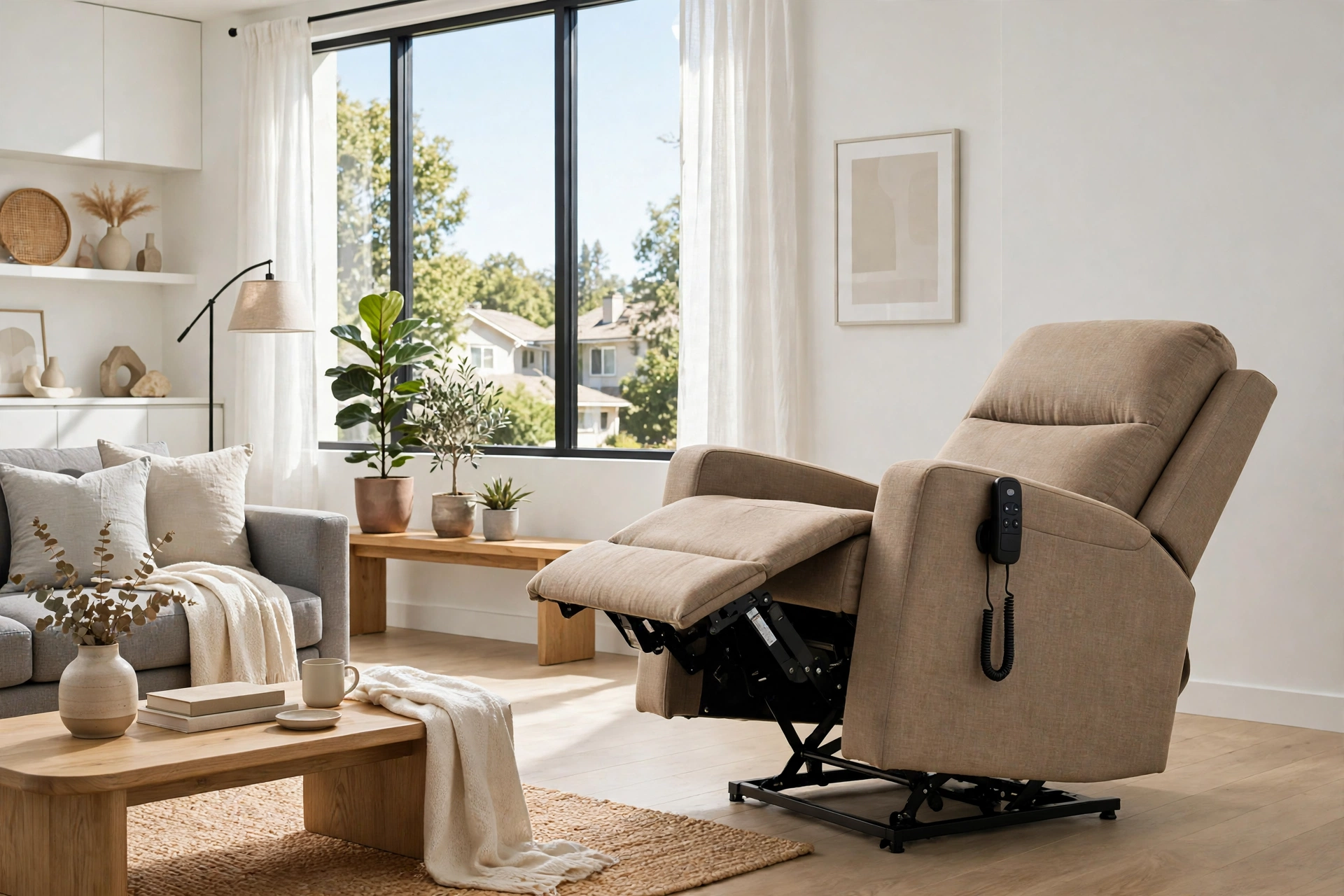
This is the one in my house. The $600 power lift recliner does everything the $299 manual does — 8-point vibration massage, three modes, lumbar heat, cup holders, side pockets, 350-lb capacity — and then adds the function my dad actually needed: an Okin motor that tilts the entire chair upward and hands you to your feet.
The chair reclines from 110° to 155°, so the nap geometry is nearly identical to the manual version. The seat is extra-wide at 24.8 inches, the backrest runs 27.55 inches tall, and the cushions — seat, back, armrest — all detach and wash, which has saved us twice with a grandkid and a juice box. There is a 15/30/60-minute massage timer, and USB-A plus Type-C ports for charging phones (low-power devices only — do not plan on a laptop).
The honest math I did before buying: a single massage session in the US runs $60 to $100. At $600, the chair “pays for itself” in six to ten parlor visits — my dad uses it twice a day, so roughly two months of daily use. After that it is gravy. But the real justification was never the massage. The first morning after it arrived, my dad stood up without bracing on anything, and said his legs felt less stiff. You cannot put a price on that, but $600 turned out to be the price anyway.
Recliner Cost Math: What a Year of Naps Really Costs
Prices mean nothing until you spread them over the years you will own the chair. A decent recliner lasts five to eight years of daily use — the motor is a wear part, like the compressor in a fridge, but standard Okin units are replaceable down the road. Using a rough seven-year estimate:
- $299 manual: about $43 per year, roughly $0.12 a day. The cheapest seat in the house.
- $499 power glider: about $71 per year, roughly $0.20 a day. The swivel-and-rock premium costs eight cents a day.
- $600 lift chair: about $86 per year, roughly $0.23 a day. The lift function — the one that gets an old man standing — costs about eleven cents a day over the manual.
Those are rough estimates, but the shape of the answer is what matters: the jump from manual to lift is a dime a day. The Bureau of Labor Statistics’ American Time Use Survey 2024 puts the average American at roughly 3 hours of TV a day — that is where most recliner hours go. At eleven cents a day, the lift chair is the cheapest comfort upgrade in the room if anyone in the house struggles to stand.
Who Should Buy Which Recliner Type
After living with one and borrowing two, here is my decision list:
- Buy the $299 manual if you are under 60 with working knees, want the cheapest real recliner with massage and heat, and do not need a power outlet near the chair. Best for: TV rooms, home offices, first apartments.
- Buy the $499 power glider if you are setting up a nursery, want one-finger reclining, or need swivel-plus-rock for reading, feeding, or just fidgeting. Best for: nurseries, living rooms, anyone who hates yanking a handle.
- Buy the $600 lift chair if anyone using it has knee, back, or balance trouble, is recovering from surgery, or is simply getting older. Best for: aging parents, post-surgery recovery, anyone who dreads the stand-up.
- Skip all three if you need a full-body massage chair — at this price you get vibration nodes, not rollers. The $999 zero-gravity models are a different category entirely.
One more honest note, from the product page of the lift chair and worth repeating: if you have real health concerns, check with your doctor first. A chair is comfort equipment, not medical equipment.
The Industry Numbers: Why Everyone Seems to Be Buying One Now
I looked up the market data because I wanted to know whether I was early or late to an obvious trend. TechSci Research puts the global massage chair market at $4.21 billion in 2025, growing around 6.29% a year through 2031; Reports and Data lands a little higher at $5.43 billion for 2025. Home use accounts for the bulk of it. And the demand driver is demographic, not fashionable: the U.S. Census Bureau’s 2024 projections put the 65+ population at roughly 82 million by 2050, up from about 58 million in 2022. More older knees means more lift chairs. The CDC reports roughly one in four Americans aged 65+ falls each year — a chair that hands you to your feet instead of asking you to lunge out of a low sofa is not a gadget, it is risk reduction.
The Verdict
There is no single best recliner type — there is only the right one for the person sitting in it. For my dad, the $600 power lift recliner was the only honest choice, and six months in his morning stiffness is genuinely better. For my sister’s nursery, the $499 power glider was the right call — one finger, one sleeping baby, zero drama. And the $299 manual? That is the chair I would buy myself tomorrow for the TV corner, because my knees still work and eleven cents a day buys a lot of peace of mind I do not yet need.
Pick by the stand-up, not by the feature list. Everything else is garnish.
Shop the three chairs: the $299 heated manual massage recliner, the $499 power swivel glider, and the $600 power lift recliner — all in stock at FLNORW MALL, with the full furniture collection and homepage if you want to browse.