I Turned My Guest Bedroom Into a Home Office. Here’s the Two-in-One Math.
My spare bedroom was the most expensive storage closet in my house. It sat empty roughly 330 days a year, collecting a guest I bought for twice-a-year visits and a stack of boxes I kept telling myself I would unpack. Then my job went hybrid, my kitchen table stopped cutting it, and I did the only thing that made sense: I turned the guest bedroom into a guest bedroom home office, one room that earns its rent twice.
Nine months later, I have worked from that room every weekday and hosted fourteen overnight guests, including my in-laws for a full week at Thanksgiving. The whole conversion cost $1,337 in furniture and took one Saturday. Here is exactly how I did it, what I would change, and the math that sold me.
My Guest Bedroom Was an Expensive Storage Closet
The room is 10 by 12 feet, with one window and a door that opens inward. For three years it held a queen air mattress, a folding table nobody used, and roughly a dozen boxes. A back-of-envelope calculation: at my mortgage, that 120 square feet costs me about $150 a month in space, and it contributed nothing back. A spare room you only use for guests is a part-time asset with a full-time mortgage.
The Bureau of Labor Statistics reported in October 2026 that about 36.9% of US workers can work from home at least some of the time. I am one of them. Meanwhile my guests were sleeping on an air mattress that hissed all night. Both problems pointed at the same room.
The One Rule That Made the Guest Bedroom Home Office Work
Every failed guest-room-office I have seen breaks the same rule: the office furniture eats the sleep space, or the bed furniture eats the desk space. My rule was simple: everything work-related must fit the desk wall, and everything sleep-related must fit the sofa wall. No overlap, no negotiations.
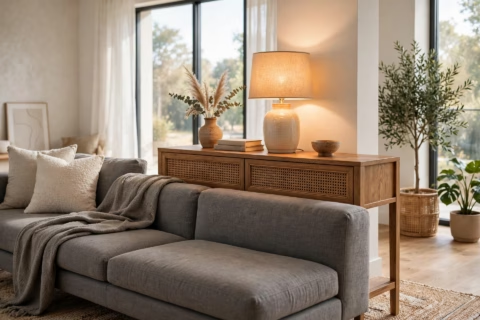
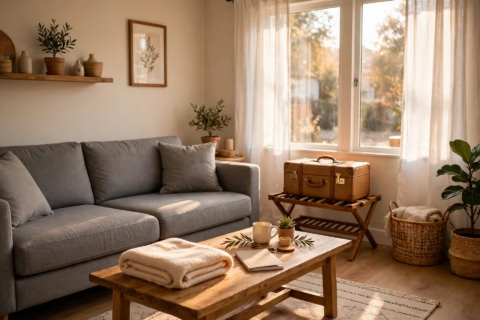
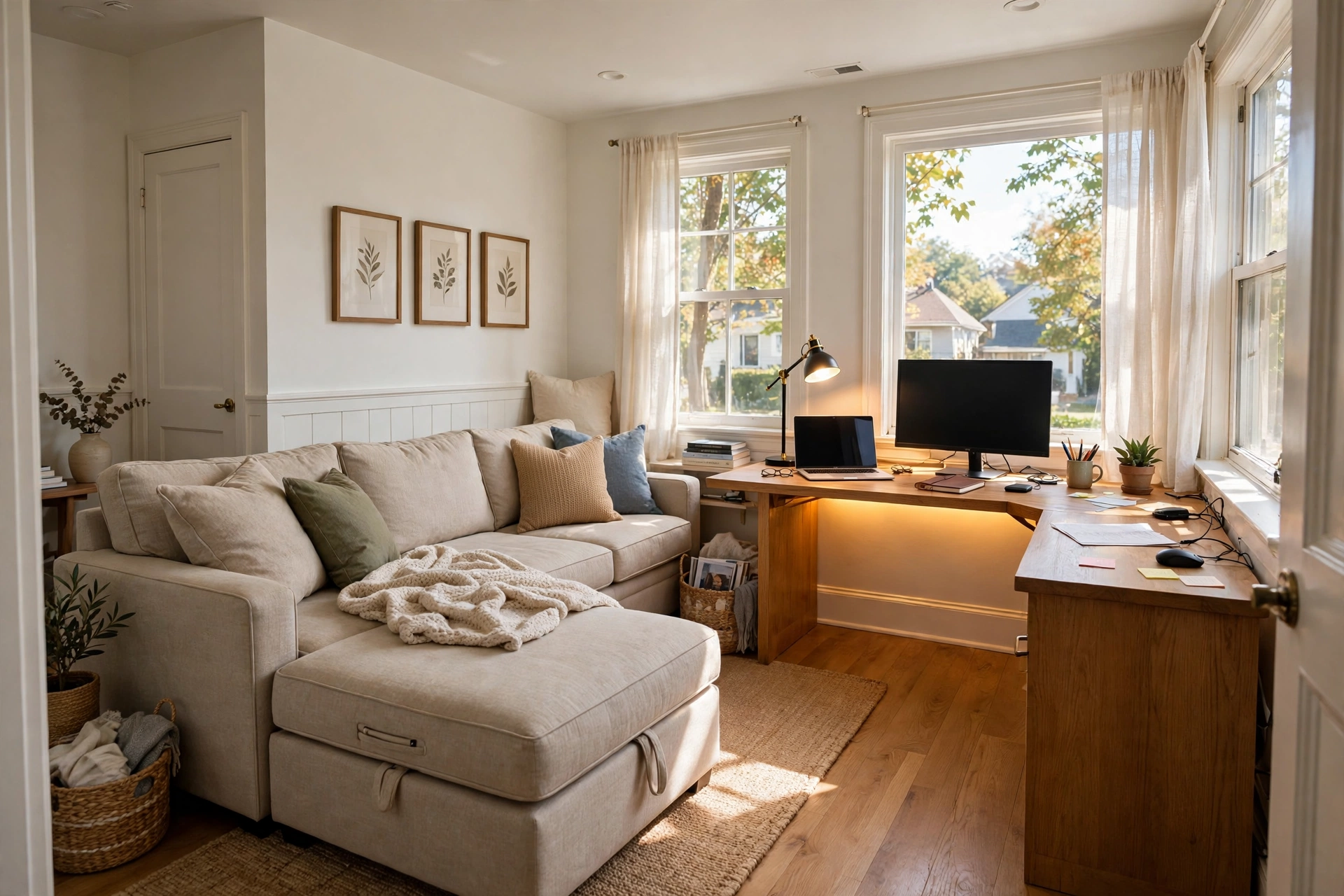
The sleep side needed to be a real bed for guests, not a futon that punishes visitors. I picked the 129.5-inch Sectional Sleeper Sofa with Pull-Out Bed at $999: chenille upholstery, a pull-out sleeper section, dual USB ports built into the side, and a 330-lb-per-seat capacity. At 129.5 by 82 inches it sounds huge, but in sofa mode the chaise tucks neatly along the long wall, and the pull-out section only deploys when guests arrive. Assembly took me about 40 minutes, alone, with one coffee break.
The $199 U-Shaped Desk That Anchors the Office Side
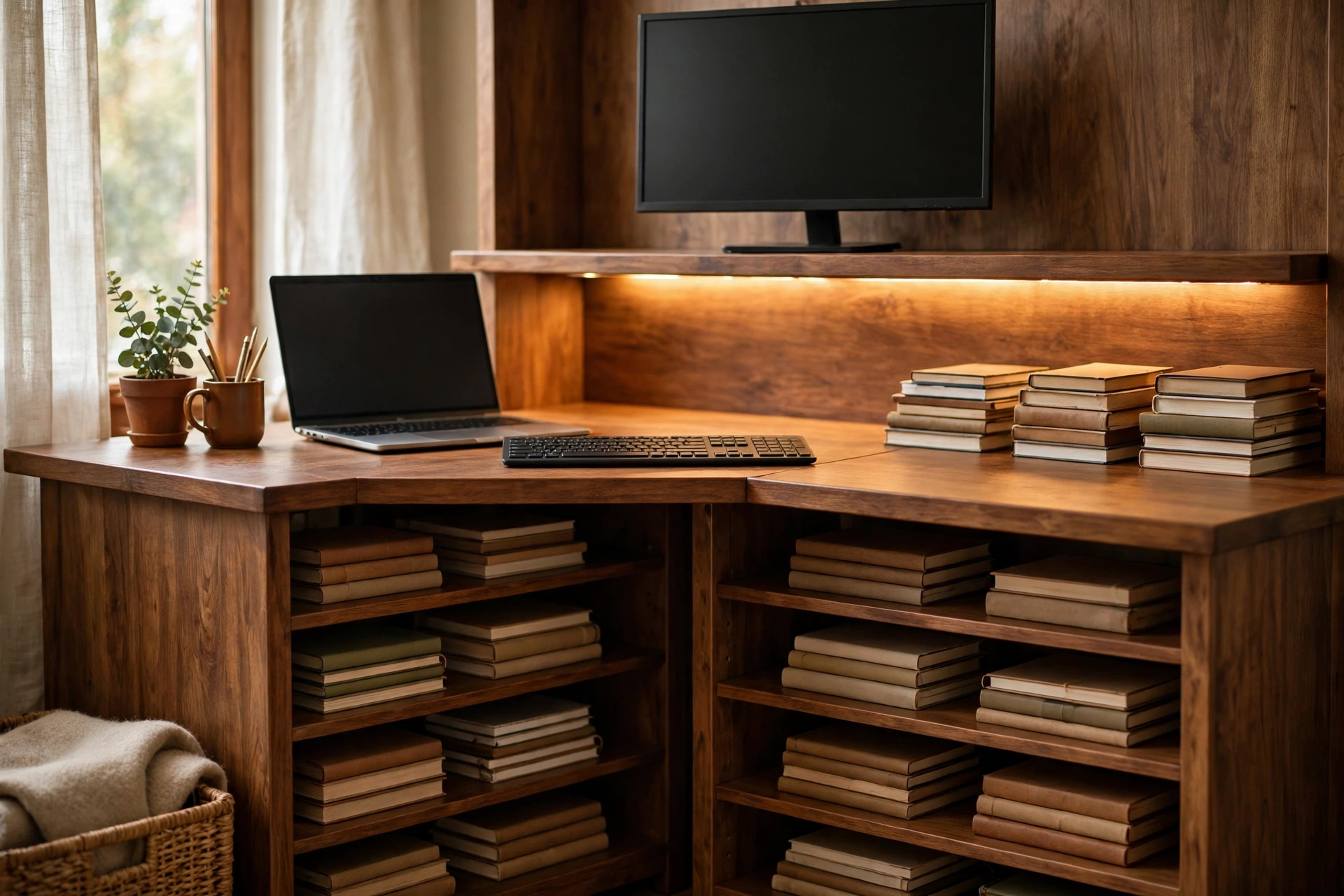
The desk wall faces the window. I wanted surface area for a monitor, a laptop, and paper, without the desk creeping into the sleeping zone. The U-Shaped Desk with LED lights at $199 is 82 by 43 inches, which works out to roughly 24.5 square feet of desktop, about double a typical straight desk. The raised middle shelf keeps my monitor at eye level, the four under-desk shelves swallow books and a printer, and the six-color LED strip means the corner stays lit in January gloom without a second lamp.
Two details sold me. First, the metal frame plus E1-graded MDF board is rated for 176 lbs, so it holds a 34-inch monitor, a dock, and my laptop without a wobble. Second, it ships in one box and assembled in about 20 minutes. I have lived with it for nine months of daily use and the LED strip still cycles through all six colors; my full 60-day verdict on this desk is in my earlier U-shaped desk review.
The Chair Choice: 360° Swivel, Zero Wheels
Wheels on a bedroom carpet are a daily annoyance. I chose the TS Teddy velvet desk chair in dark brown for $139: 360-degree swivel, ergonomic back, a carbon-steel frame rated at 250 lbs, and no wheels to fight the carpet. It swivels from the desk to the sofa for video calls, and when guests stay over, it reads as an accent chair, not office furniture I dragged in. At 16.5 lbs I move it one-handed.
This is the piece people underestimate. A desk chair that looks like office equipment makes a dual-purpose room feel like a cubicle. One that reads as furniture keeps the guest side of the bargain.
The Two-in-One Math: $1,337 vs Everything Else
Here is the full ledger, nine months in:
- $999 — sleeper sectional (sleep side, USB charging included)
- $199 — U-shaped LED desk (work side, 24.5 sq ft of surface)
- $139 — velvet swivel chair (works for both sides)
- $0 — a spare lamp and sheets I already owned
Total: $1,337. Compare that to the alternatives I priced out. A proper guest-room-plus-office addition would run tens of thousands. A mid-range hotel room near me averages about $160 a night; fourteen guest-nights would have cost roughly $2,240, so the setup paid for itself against hotel math by guest number nine. Against a $60-per-month coworking desk, it paid for itself in under two years, minus the commute.
Per-night cost for guests: $1,337 ÷ 14 nights = about $95 a night so far, dropping every time the sofa pulls out. Per workday cost: $338 for the desk and chair ÷ roughly 190 workdays = under $2 a day. Those are my numbers, rough but honest.
The 15-Minute Guest Conversion
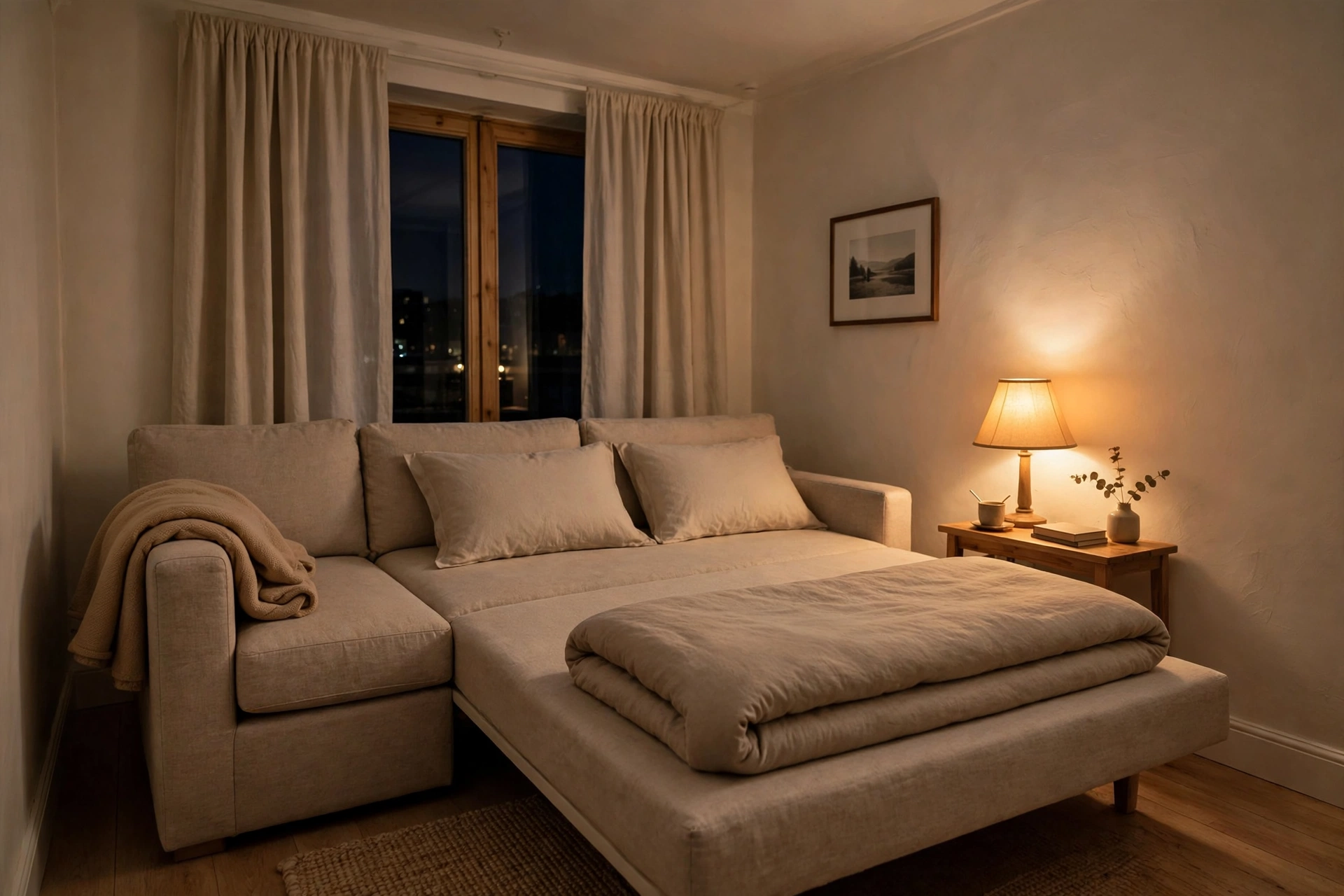
The whole reason the combo survives is that flipping the room from office to guest room takes under fifteen minutes. My checklist:
- Pull the sleeper section out and unfold the bed mechanism, about 3 minutes.
- Close the laptop, slide it onto the desk’s lower shelf, and stack the papers in the file tray, about 4 minutes.
- Swivel the chair to face the sofa so it reads as seating, 30 seconds.
- Put fresh sheets and the guest blanket on the bed, fluff two pillows, about 5 minutes.
- Plug a phone charger into the sofa’s USB port and turn the desk LED to its warmest color, 1 minute.
My mother-in-law’s exact words on night three: “This is better than our last Airbnb.” I have never received a higher furniture compliment, and I doubt I ever will.
The 7 Mistakes That Kill a Guest Room Office Combo
I made several of these before settling on the final layout. Learn from my wasted weekends:
- Putting the desk where the door swings. The first layout had the desk behind the door. Every entry was a shoulder-check into a monitor. Measure the door swing first; it is the most-forgotten 36 inches in any room.
- Buying a straight desk “to save space.” Straight desks save money, not space: the same footprint holds half the surface. The U-shape’s extra depth faces the wall, not the room.
- Skipping the chair’s weight rating. Cheap chairs sag within months. The 250-lb rating on a $139 chair is why it still feels new; check capacity before price.
- Ignoring the 18-inch rule. Keep at least 18 inches between the desk edge and the sleeper’s pull-out zone. Anything less and guests climb over furniture to get into bed.
- Forgetting cable management. A home office has cables. Bundle them along the desk’s back leg the day you assemble it; retrofitting later is miserable.
- Going full office-dark on the walls. Paint and bedding set the guest tone. Keep the office gear on one wall and the rest of the room warm and residential.
- Buying a sleeper that’s miserable to sleep on. Ask about the seat construction. Foam plus springs beats pure foam for guests who stay more than one night; a creaky mechanism will be remembered longer than the price.
My Verdict: One Room, Two Jobs, Zero Regret
Nine months and fourteen guest-nights in, the guest bedroom home office is the best room in my house. It works because each side keeps to its wall, each piece serves both jobs, and the total stayed under $1,400. The sleeper sectional turned guests from an apology into an invitation; the U-shaped desk turned my kitchen-table slouch into an actual workday; the swivel chair is the only piece I would buy twice.
If you have a spare room collecting boxes, stop treating it as storage with a door. Give it two jobs and it will pay you back every single week.
Shop the exact setup: 129.5″ Sectional Sleeper Sofa ($999) · U-Shaped LED Desk ($199) · TS Teddy Velvet Desk Chair ($139)
See more furniture for small rooms at FLNORW MALL.