Ceiling Fan Size Guide: Pick the Right CFM
Ceiling Fan Size Guide: Pick the Right CFM
I bought my ceiling fan the way most people do: I measured the price tag instead of the room. My bedroom is 12 by 14 feet, the ceiling is a flat eight feet, and the fan I brought home — FLNORW MALL’s $129 Ceiling Fan with Lights Dimmable LED, item W1340103783 — spans a modest 19.7 inches across its blades. Three months later I had a real review on my hands: sleep at speed 3, the thermostat raised from 72°F to 78°F, and the cooling line on the electric bill down by roughly a quarter (my own estimate, tracked month to month).
Then I found the ENERGY STAR sizing chart. My bedroom is 168 square feet, and the chart says a room that size wants a 44-to-50-inch fan. Mine is 19.7 inches — not even in the smallest bracket. So either I bought the wrong fan, or the chart was leaving something out. This guide is the answer I wish I had read first: the real CFM math, the room-by-room sizing rules, and the honest verdict on which one of us was wrong.

The ceiling fan size chart I measure everything against now
Every fan maker publishes some version of the same table, and the cleanest one comes from ENERGY STAR’s published ceiling-fan sizing guidance. Room size decides blade span:
- Up to 75 square feet — a 29-to-36-inch fan
- 76 to 144 square feet — a 36-to-42-inch fan
- 144 to 225 square feet — a 44-to-50-inch fan
- Over 225 square feet — a 50-inch fan or larger
My 168-square-foot bedroom sits squarely in the 44-to-50-inch band. My 19.7-inch fan is the chart’s cautionary tale. But the chart is calibrated for moving a room’s whole air mass — cooling the room itself. Sleep comfort is a different job: it only needs air moving across your skin. That distinction is why my undersized fan works fine at night, and it is also why the chart still matters for the rooms where you actually want the breeze to reach every corner.
Why blade span matters more than brand or price
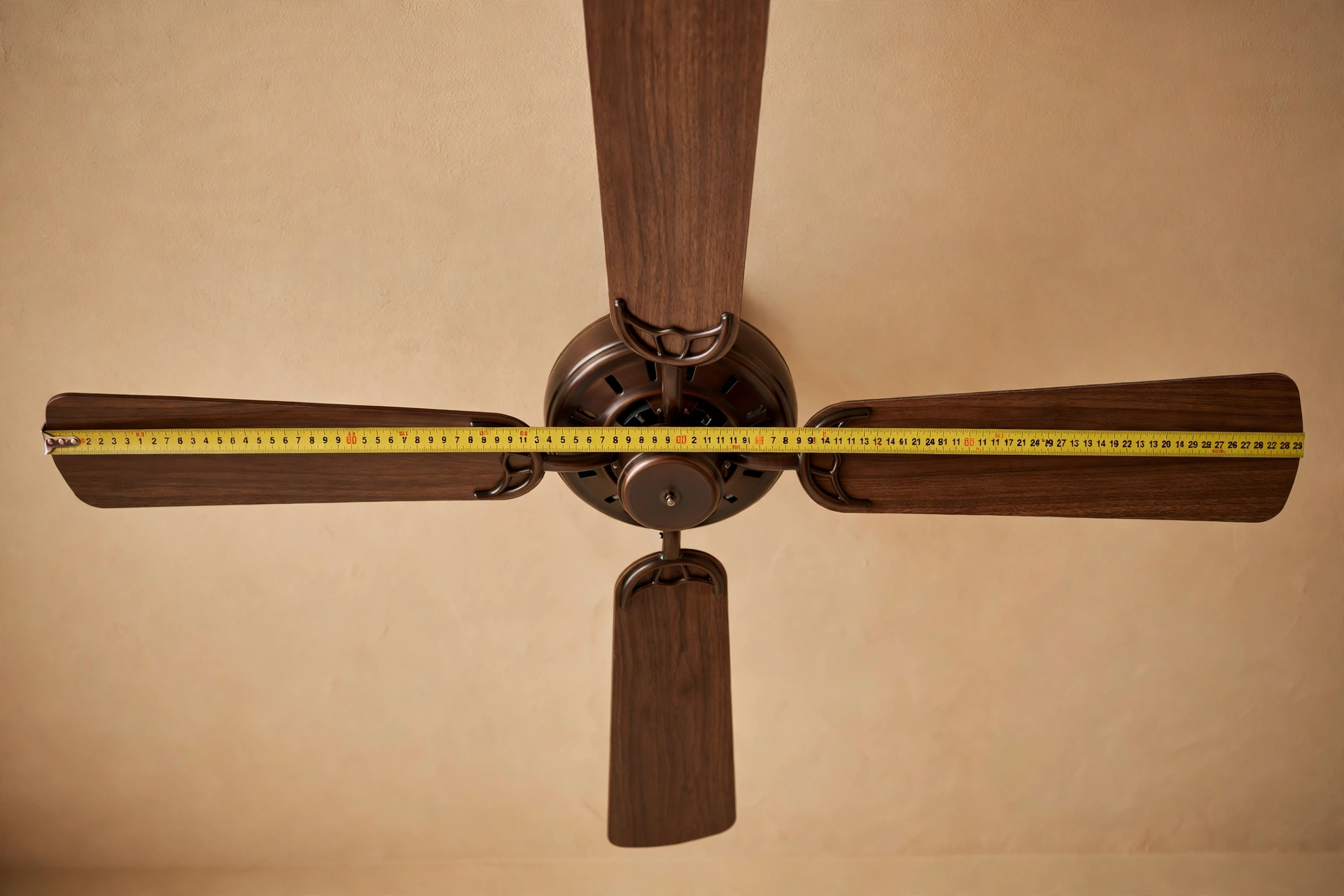
Airflow scales with swept area, and swept area scales with the square of the radius. My 19.7-inch fan sweeps a circle with a 9.85-inch radius — about 305 square inches. A 44-inch fan sweeps about 1,520 square inches. Roughly five times the air-moving area from a fan that costs, at FLNORW MALL, $168 instead of $129. That is the real price of sizing: for $39 more, the 52-inch bronze model moves roughly five times the air of my bedroom fan. The expensive part of a ceiling fan was never the motor; it is the square footage you are asking it to cover.
CFM in plain English: what the numbers actually mean
CFM — cubic feet per minute — is the only spec that tells you how much air a fan moves. Here is how to use it: my bedroom holds 168 square feet times an 8-foot ceiling, which is 1,344 cubic feet of air. A fan rated at 3,500 CFM on high would exchange that room’s entire air volume more than twice a minute. That sounds like plenty, until you remember that airflow falls off fast with distance from the blades. CFM is measured right under the fan; in the corner of a big room, you feel a fraction of it.
My honest rule after living with a small fan: for sleeping comfort, modest CFM is fine — you are cooling your skin, not the room. For daytime cooling of a living space, take the room’s cubic footage and aim for a fan whose high-speed CFM is at least three times that number. That one rule would have kept me out of trouble when I briefly considered my bedroom fan for the open living room downstairs. It is a bedroom tool, not a great-room tool, and now I know why.
Ceiling height: the 7-foot safety rule and the 8-to-9-foot math
The U.S. Department of Energy’s long-standing installation guidance sets two numbers that matter: blades should hang at least 7 feet above the floor and 8 to 10 inches below the ceiling. My ceiling is 8 feet; my fan drops 5.7 inches, which leaves the blades at about 7 feet 6 inches off the floor — comfortably above the minimum, and exactly why a low-profile fan was the right call for me. On a 9-foot ceiling, the same flush-mount fan would sit too high and waste airflow near the ceiling, which is where a downrod comes in: 6 inches of downrod per foot of ceiling above 8 feet is the standard rule of thumb, putting the blades back in the sweet spot.
Low-profile vs downrod: my 19.7-inch compromise
Here is the trade I actually made, and I would make it again: the 19.7-inch span and 5.7-inch flush profile of the $129 fan fit my 8-foot bedroom ceiling the way a downrod fan never could. The DC motor draws roughly 35 to 40 watts on speed 3 (my estimate, backed out from my electric bill, not a lab measurement), runs 6 speeds in forward and reverse, and the whole unit weighs only 5.2 pounds — light enough that the quick-fit installation was genuinely a one-person, one-ladder job.
The honest price of that compromise is coverage. The sizing chart says 44 to 50 inches for my room; I bought less than half of that because the low profile mattered more than the sweep. For a bedroom where the fan’s job is moving air across one sleeper, the trade was right. If the job were cooling my living room, the chart would have won — and I would have been shopping the 52-inch or 72-inch models instead.
Room-by-room picks from FLNORW MALL
With the math in hand, here is how I would size each room using the fans I can actually verify on the site:
Bedrooms up to about 200 square feet: the $129 Ceiling Fan with Lights Dimmable LED — 19.7-inch span, DC motor, 6 speeds, forward and reverse, dimmable LED, and a remote with a 1-hour/2-hour sleep timer. Undersized on paper for a 168-square-foot room, perfectly sized in practice for sleeping. I have three months of proof. If you want the sizing chart applied honestly, the $199 27-inch model adds app control and three color temperatures (6000K, 4500K, 3000K) for rooms in the 76-to-144-square-foot band.
Living rooms over 225 square feet: the $168 52-inch bronze fan — AC motor, five wood blades, remote control with reversible airflow and multi-speed settings, classic styling. This is the chart’s 50-plus-inch answer for big rooms.
Vaulted ceilings and dining rooms: the $299 72-inch farmhouse fan with plywood blades — the biggest span FLNORW MALL sells, built for the rooms where nothing smaller reaches the walls.
The pattern: buy the fan for the room’s square footage, not the ceiling you wish you had. And if you are on the fence between two sizes, the bigger one wins — an oversized fan run on low speed is quieter and cheaper to run than an undersized one maxed out.
Installation reality check: fan-rated boxes and one-ladder jobs
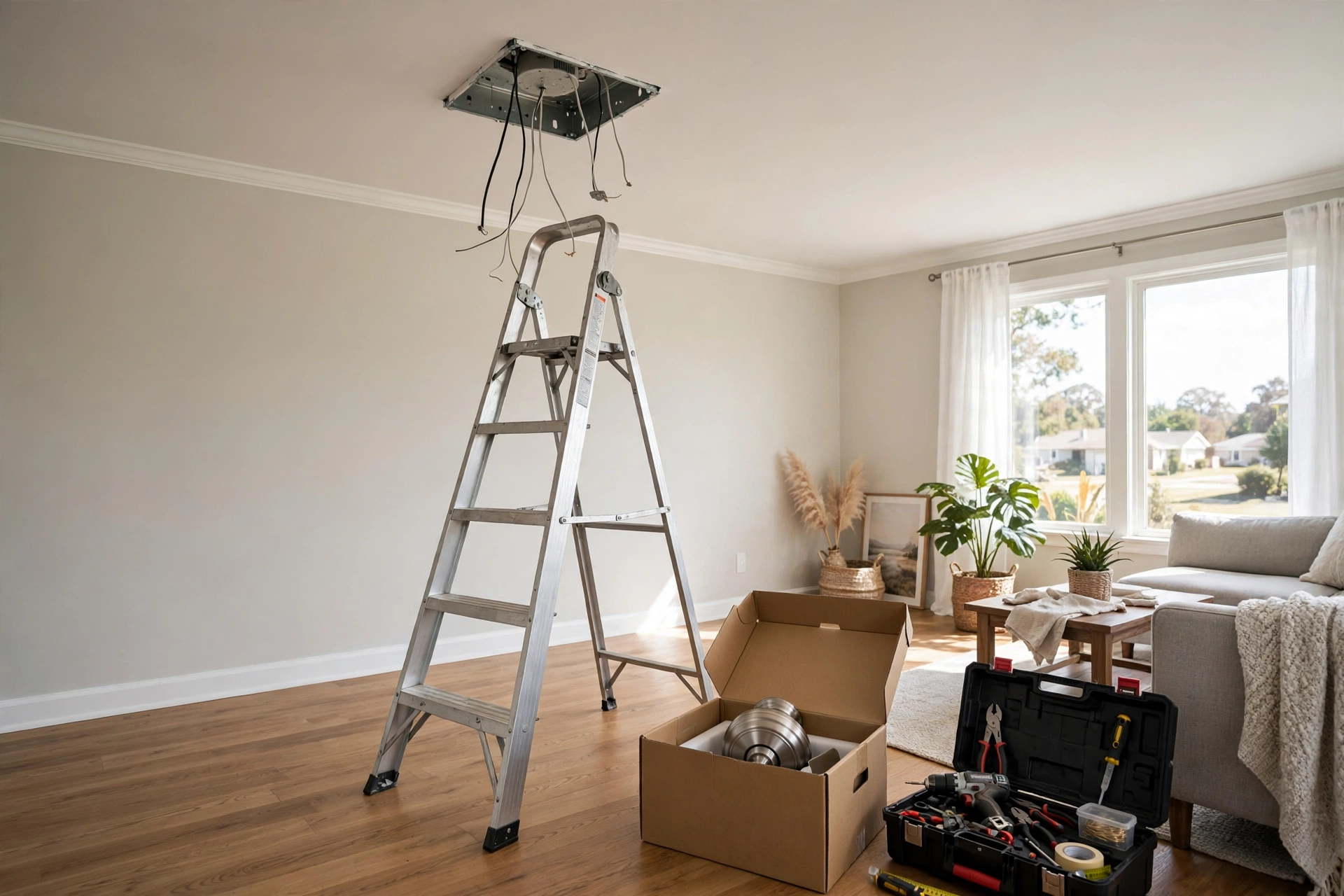
Three things I would tell anyone before they open the box. First, a ceiling fan is heavier and more dynamic than a light fixture — it must hang from a fan-rated junction box, not a standard light box. My 5.2-pound fan would have stressed a cheap box; the heavier 52-inch bronze needs one even more. If your ceiling only has a light-fixture box, budget for a fan-rated brace or an electrician. Second, check the 7-foot blade clearance before you buy: on an 8-foot ceiling, only a flush-mount fan like mine fits. Third, remote-only control is the norm at this price — there is no wall switch and no app on the $129 model. Lose the remote in the bedsheets (I have, twice) and you are getting up. None of these are dealbreakers. They are just the things the box does not say.
My verdict, six months of fan ownership in: the sizing chart was right and I was right, because we were answering different questions. For moving air across a whole room, the chart wins — buy the 44-to-50-inch span for a 168-square-foot room. For sleeping under one, my undersized 19.7-inch fan on speed 3 does the job at about $0.20 a month in electricity (my estimate) and let me push the thermostat to 78°F. Size the fan to the room’s job, not just its square footage — and when the job is a living room, respect the chart.
Ready to size yours? Start with the $129 bedroom ceiling fan with dimmable LED I have been testing for months, compare it with the $199 27-inch model with app control, read my full three-month review of the $129 fan, see how it fits the guest-bedroom setup under $1,230, or browse the whole FLNORW MALL furniture collection.