I Swapped My Nighttime AC for a $129 Ceiling Fan. The Electric Bill Answered.
My October electric bill was the one that finally got to me. Not a July bill — an October bill, after weeks of running the bedroom AC just because I sleep hot, my wife sleeps cold, and our thermostat negotiations had reached their annual stalemate. A ceiling fan with lights felt like a compromise device: air movement for me, a dimmable light for her late-night reading, and both of us pretending it would shrink the bill. Three months later, I have the numbers. Here is the honest version.
What $129 actually buys
FLNORW MALL sells it as the Ceiling Fan with Lights Dimmable LED — $129, item code W1340103783 — and the spec sheet is refreshingly straightforward. Five smoke-ash blades on a black iron body, a 19.7-inch blade span, and only 5.7 inches of drop, so it sits nearly flush against the ceiling. That last number matters if your bedroom ceiling is the standard eight feet and you are tall: I clear it with room to spare, and the low profile is why it works in rooms where a downrod fan would feel like a threat.
The functional headline is the DC motor: the listing claims up to 70% more energy efficiency than an AC motor fan, which lines up with what DC motor fans generally do — same airflow at a fraction of the wattage. It runs 6 speeds in forward and reverse, comes with a full remote control (no wall switch wiring gymnastics), and includes an integrated dimmable LED light kit so you get lighting and cooling from one fixture. There is also a 1-hour / 2-hour sleep timer built into the remote, and the whole thing weighs 5.2 lbs, which made the quick-fit installation genuinely a one-person, one-ladder job.
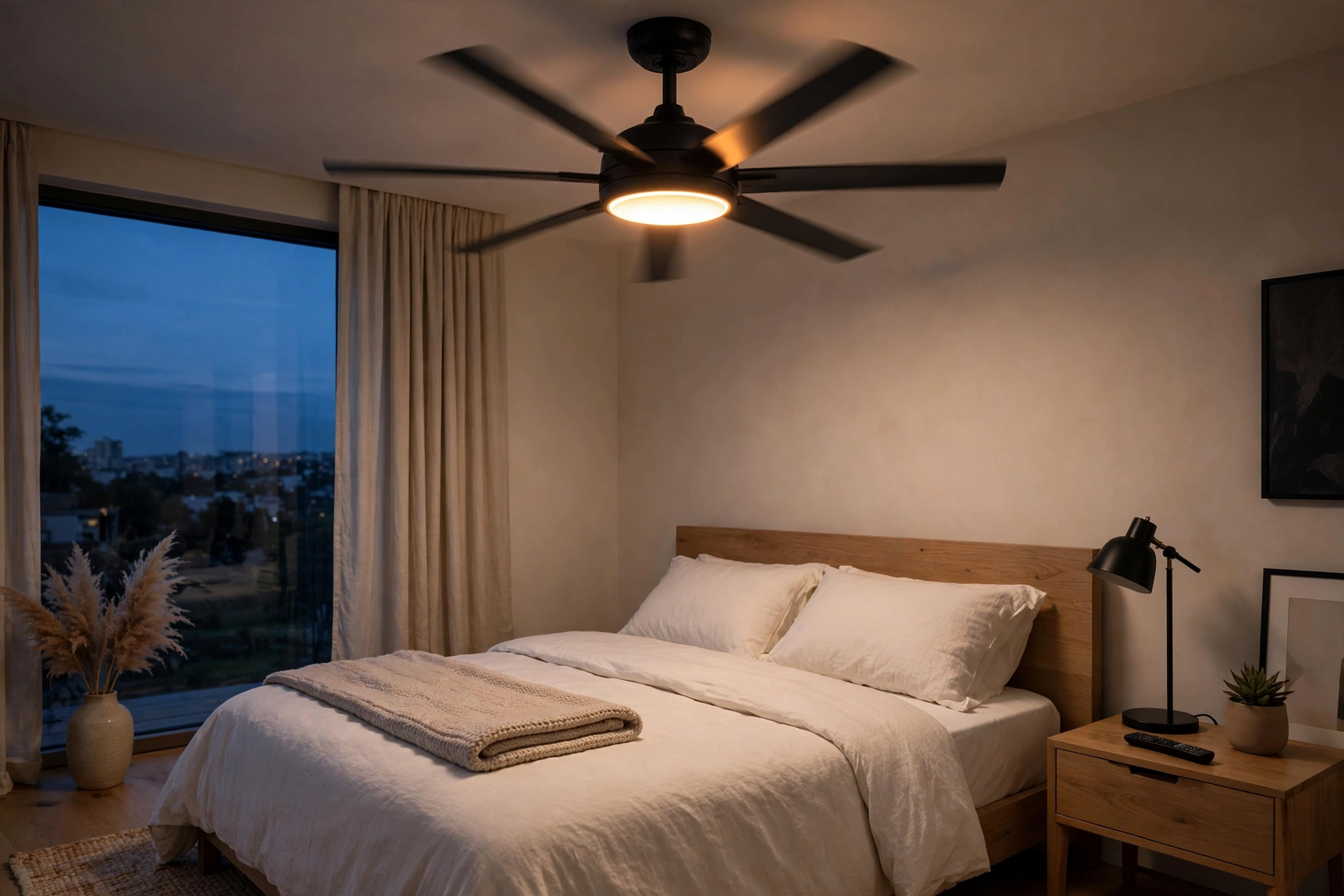
The sleep test: three months of fan plus cracked window
I am a hot sleeper. Before the fan, the bedroom AC ran most nights from about ten to six, set at 72°F, because lying still in warm air made my brain refuse to switch off. The ceiling fan changed the equation in a way I did not expect: moving air across your skin does not cool the room — it cools *you*. Two nights in, I turned the AC up to 78°F instead of off, and that turned out to be the right move.
This is where the 6-speed range earns its keep. Speed 3 is my sleeping speed — a steady, unbroken breeze you can feel on bare skin without paper-thin sheets fluttering like sails. The motor is quiet at that speed; from the bed, it is below the hum of the room itself. On the hottest stretch in late October, I pushed it to speed 5 for an hour before bed, then dropped to 3 and hit the 2-hour timer so the fan shut itself off around the time the night cooled down. My wife, who finds moving air irritating when she is reading, simply uses the remote to kill the fan and keep the dimmable LED on. One remote, zero negotiations.
The dimmable light is better than the light it replaced
I expected the LED to be a bonus feature and treated it like one for the first week. Then I started using it. The brightness steps down smoothly from full — bright enough to read by at the top end, down to a warm nightlight glow that does not wake the other person when someone gets up at 2 a.m. Our old setup was a ceiling fixture with a pull chain and a single harsh brightness, plus a bedside lamp each. The fan’s LED replaced the fixture entirely, and both bedside lamps now live in a closet.
One honest limit: it is a single integrated LED, so when it eventually dies you are replacing a module, not swapping a bulb. That is the trade-off for getting the light built in at $129.
The energy math (flagged as my own estimates)
Here is the part I actually tracked. Our central AC draws roughly 3,500 watts when the compressor is running. The ceiling fan on speed 3 draws, by my estimate, about 35–40 watts — DC motors sip power. At the US residential average of about 17 cents per kWh (my own bill sits close to that), eight hours of nighttime AC at 72°F was costing me on the order of $4.50 a night in compressor-heavy weather, before the fan entered the picture.
I did not turn the AC off — the fan does not remove heat from a room, only makes moving air feel cooler, so anyone promising you can just ditch the AC is selling something. What the fan did was let me raise the thermostat from 72°F to 78°F at night without losing sleep comfort. This tracks with ENERGY STAR’s long-standing guidance that a ceiling fan lets you raise the thermostat about 4°F with no reduction in comfort, and at 78°F my compressor cycles far less.
Rough arithmetic on a hot month: if the AC used to eat ~120 kWh a month for nighttime cooling, raising the thermostat six degrees cut that to something like 85–90 kWh — a 25–30% shave, roughly $5–6 off the monthly bill in my house. The fan itself costs about $0.20 a month to run all night. So the $129 pays for itself in electricity alone in about two years of warm months — and that ignores the part of the year where the fan handles the night entirely and the AC stays off.
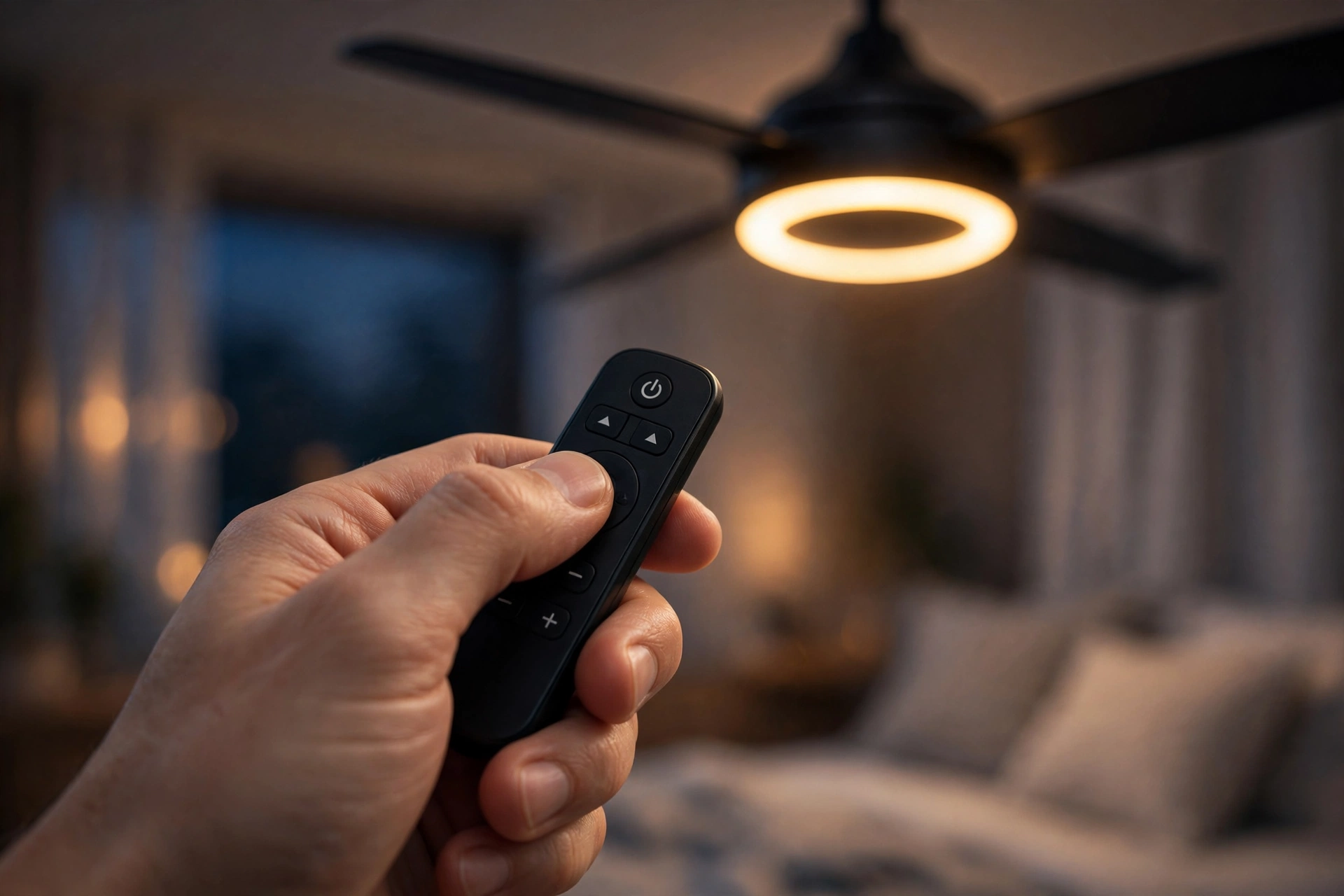
Reverse mode: the winter trick people forget
The remote has a reverse button, and in December it became the fan’s second job. Hot air rises; in winter it pools at the ceiling while your thermostat sits six feet lower. Run the blades in reverse on low speed and the fan pushes that warm layer back down along the walls. I measured nothing scientific — just noticed the bedroom holding its evening temperature noticeably longer after the heat kicked off. ENERGY STAR and most HVAC pros describe exactly this effect, and it is free: flip a button when the season changes.
If you have vaulted or tall ceilings, this matters even more — but for a standard 8-foot bedroom, a low-speed reverse run for an hour before bed is plenty.
What I would change: the honest downsides
No review is honest without these, so here they are. First, size: at 19.7 inches across, this is a small-to-medium-room fan. It is perfect for my 12-by-14 bedroom. It would be underwhelming as the primary airflow for a big open living room — for that, FLNORW MALL’s 52-inch bronze model exists for $168, with an AC motor and a retro look. Second, installation assumes an existing ceiling junction box rated for a fan; if your ceiling only has a light fixture box, you will need an electrician or a fan-rated brace, and that is true of every ceiling fan, not just this one. Third, control is remote-only — no wall control, no app. The remote is responsive and backlit, but if you lose it in the bedsheets (I have, twice), you are getting up.
None of these surprised me. They are the normal trade-offs of the category, and at $129 they feel priced in.
Specs worth checking before you buy
- 19.7″ blade span, 5.7″ flush profile. Built for bedrooms and offices, not great rooms.
- DC motor, 6 speeds, forward/reverse. The listing’s 70%-more-efficient claim is plausible for DC vs AC motors; wattage stays low across the speed range.
- Integrated dimmable LED. Replaces your ceiling light; single brightness temperature, so pick your room mood accordingly.
- 1-hour / 2-hour sleep timer. The feature I use most and would now refuse to live without.
- 5 smoke-ash blades, black iron, 5.2 lbs. Light enough for a true one-person install; quick-fit mounting included.
- $129, in stock. Item code W1340103783 on the FLNORW MALL product page.

The verdict
Three months in, the thermostat wars are over. I sleep at speed 3 with a cracked window, my wife reads under the dimmable LED, and the fan shuts itself off on the timer while we sleep. The October bill that started this whole thing dropped by roughly a quarter on the cooling line — my estimate, but the trend is unmistakable — and the bedroom simply feels better lived-in than it did with a pull-chain fixture and an AC vent doing all the work.
The $129 is doing three jobs — fan, light, and thermostat extender — that used to take two fixtures and a lot more electricity. If your bedroom is under about 200 square feet and your ceiling is standard height, this is the right-sized tool at a price that pays for itself. Go bigger only if the room is: the 27-inch model at $199 adds app control and three color temperatures, and the 52-inch bronze at $168 covers the big living room with classic styling. For the bedroom, though, the $129 one has stayed up and earned its place.
If you want the full spec sheet, it is on the ceiling fan with lights product page at FLNORW MALL. The 27-inch model with app control and the 52-inch bronze traditional fan cover the bigger rooms, and the FLNORW MALL homepage has the rest of the furniture collection.