How to Winterize Patio Furniture the Right Way
How to Winterize Patio Furniture the Right Way
Every year on the last weekend of October, right after the final cookout, I spend one Saturday doing something my neighbors probably think is overkill: I winterize my patio furniture. Last year’s finale was ribs for eight people, folding chairs from the garage, and my wicker dining set handling the whole spread without a wobble. Two days later, the forecast showed three straight weeks of cold rain, and I was out there with a brush, a bucket, and a box of storage bins.
I was not always this disciplined. In 2022 I left the cushions out “just until it got really cold,” and March found me unzipping a set of seat pads that smelled like a basement and looked like a science project. That mistake is what turned me into a winterizing person — and it is also why I now know exactly how to winterize patio furniture so a $490 set survives five winters instead of two.
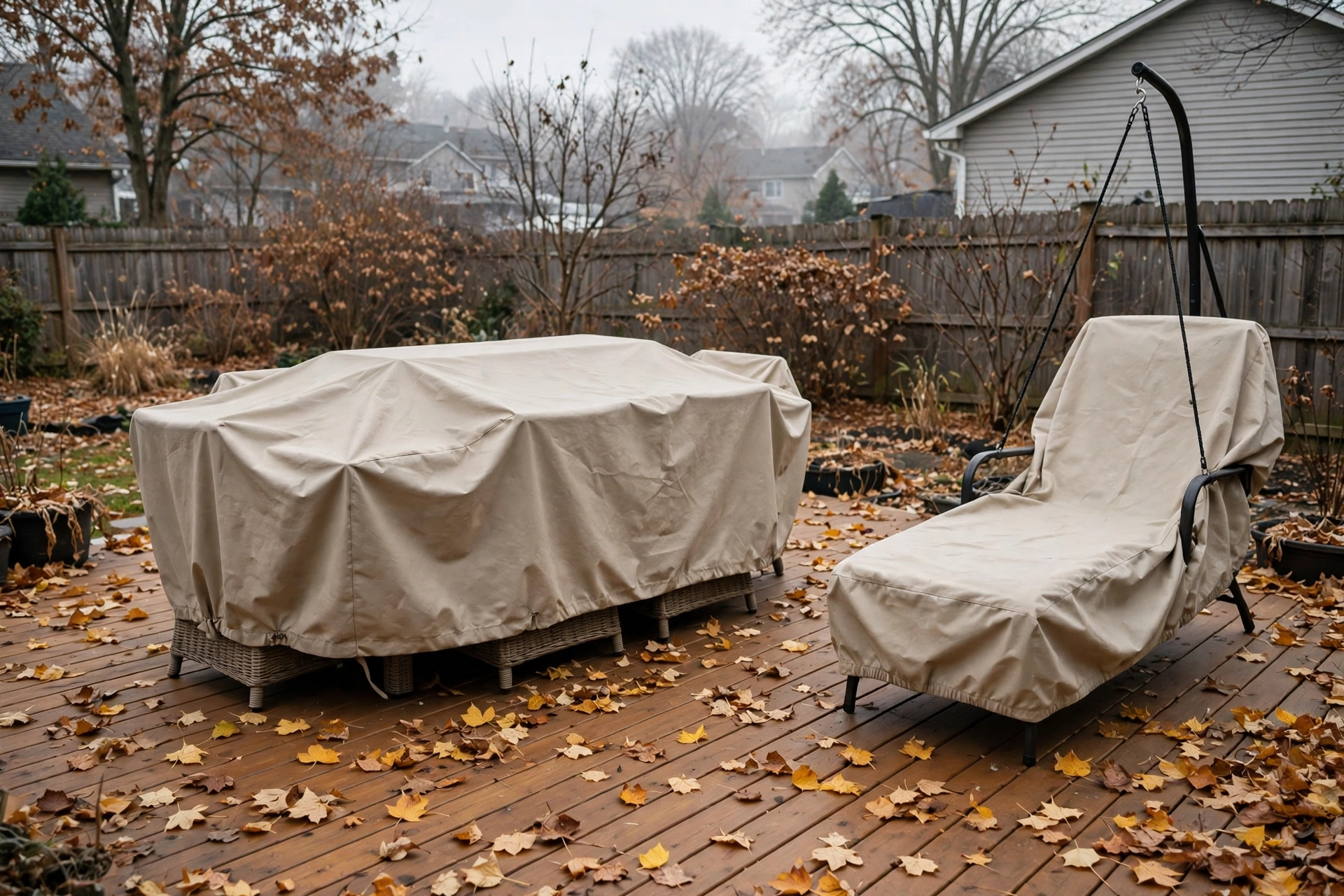
The timing matters more than the technique. Most guides say “before the first freeze,” but by then you are already behind. Wet October leaves sitting on chair seats for a month stain fabric, clog the weave, and hold moisture against metal joints. I aim for the last dry weekend of October — usually right around Halloween — while cleaning still means a hose and sunshine instead of numb fingers.
There is also a practical reason. Most damage to outdoor furniture does not happen in a dramatic ice storm. It happens slowly: water pooling in seat crevices, freeze-thaw cycles expanding tiny cracks in wood, mildew colonizing a damp cushion seam. The routine below takes me about four hours for two full sets, and it has kept my patio setup looking new into its fourth season.
The $489 lesson that made me a believer
My 7-piece wicker dining set cost $489.99 — powder-coated steel frame, hand-woven rattan, acacia wood table top, and mildew-resistant cushions. It is the workhorse of our backyard: birthdays, grill nights, homework sessions when the weather is nice. When I killed a cushion set in 2022, the replacements I priced were nearly half the cost of a whole new set. That is when the math clicked.
Rough math, marked rough: a decent fitted cover and a couple of storage bins cost me about $60–80 total. Spread over five winters of protection on a $490 set, that is roughly $14 a year to avoid re-buying a $490 set. If the covers buy me even one extra season — and they have bought me three — they pay for themselves several times over. Protecting is cheaper than replacing. It is not close.
Step one: deep-clean before anything sleeps
Never cover dirty furniture. Trapped dirt plus trapped moisture is a compost starter kit.
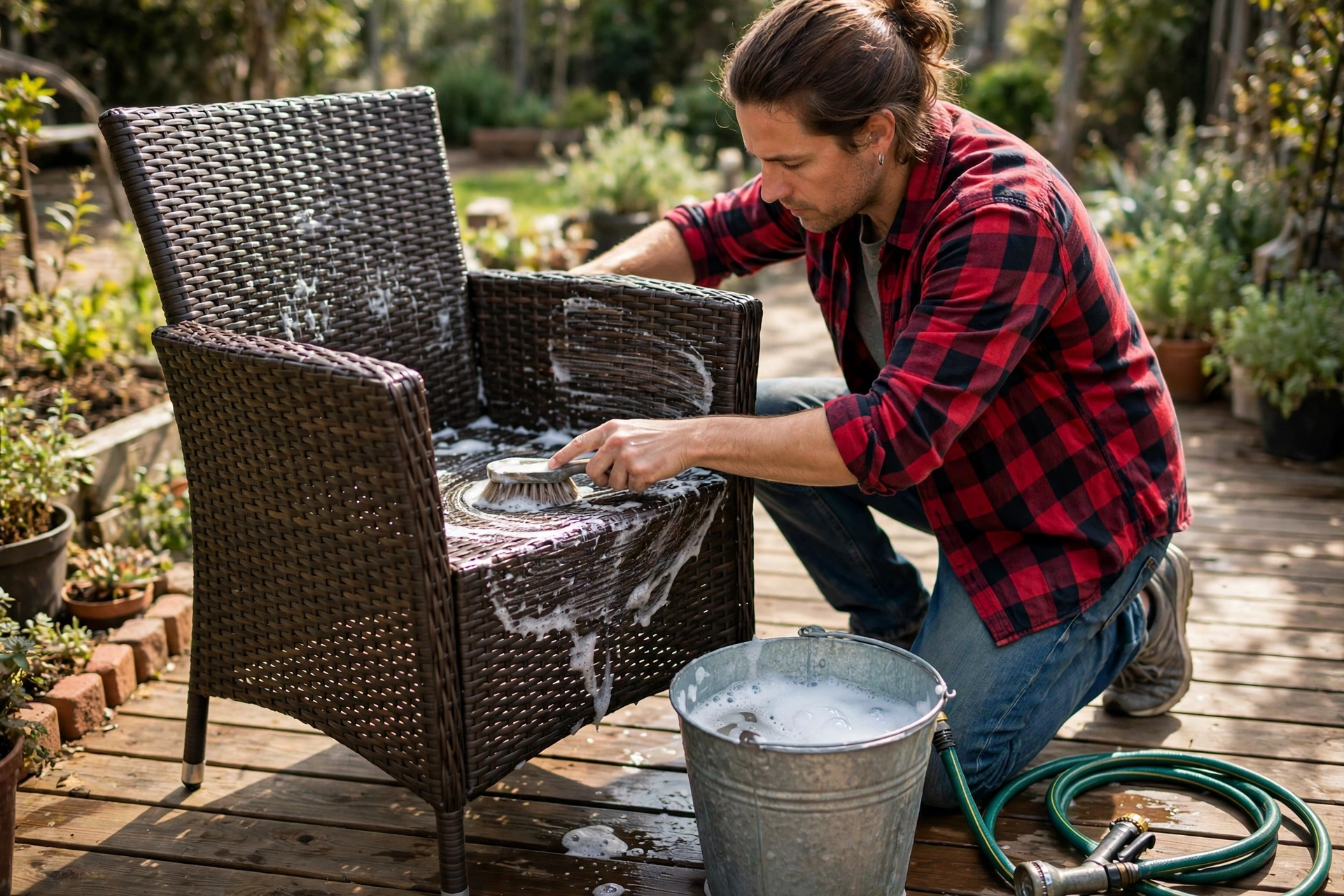
For wicker and rattan, I use a garden hose, a soft-bristle brush, and a bucket of warm water with a squirt of dish soap. The key word is soft: I once attacked a weave with a pressure washer on its medium setting and shredded a strand on the armrest of a chair. One careless afternoon, one permanently frayed armrest. Since then, the pressure washer stays in the garage for the driveway.
On the cast aluminum set — FLNORW MALL lists a $499 five-piece with a rust-proof, weather-resistant coating — I spend extra time on the crevices where the lattice-weave meets the frame, where pollen collects all summer. Rinse thoroughly, because soap residue left under a cover can leave ghost stains on the finish.
The acacia wood table top gets a different treatment: wipe it down, let it dry, and I give it a thin coat of teak oil once a year. You can skip the oil and let acacia weather to a silvery gray — that is a legitimate look and the wood does not care — but the oil keeps the color you paid for. The hanging chaise lounger ($268) has a removable canopy and a washable cushion cover, so both go through the laundry on gentle before storage. Its metal frame gets the same soap-and-water wipe as everything else.
Step two: treat each material like it deserves
“Outdoor-rated” is not one thing. Each material on my deck asks for slightly different winter care, and giving it fifteen extra minutes now is the whole difference between “looks new” and “looks tired” in April.
Wicker and rattan. After washing, leave the chairs in sun and wind for a full day — ideally two. Weave traps water invisibly. My rule: if the underside of the seat still feels cool to the back of your hand, it is not dry yet. Check each chair for loose strands and broken weave ends; a tiny dab of outdoor wood glue on a lifting strand now saves a whole armrest later.
Cast aluminum. Run a hand over every joint and leg, looking for chips in the powder coat — that is where rust starts. A $6 tube of touch-up enamel dabbed on chips each fall has kept my old aluminum set rust-free for years. Tighten the bolts; a full season of use loosens hardware.
Acacia wood. One decision to make: oil it or let it silver. Both are fine; what you cannot do is half-oil it and stop for two years, which gives you patchy gray-brown. Pick a lane. I oil the table top every October because I like the warm color against the wicker. The grain drinks it in over winter and looks brand-new when I unwrap in spring.
The hanging chaise. The canopy comes off — it is designed to, and two winters of wind whipping a fabric canopy against the frame will wear both. The pillow cover goes in the wash. The 73-pound metal frame stays on the deck under a cover; trying to haul it into the basement is a two-person job I do not need before the holidays.
Step three: cushions come inside, no exceptions
This is the hill I will die on. The product page for my wicker set says the cushions are mildew-resistant, and that is true — but resistant is not proof. A cushion can be perfectly engineered and still lose to five months of trapped humidity in a seam. The ones I ruined in 2022 were also “mildew-resistant.” They are sitting in a landfill now.
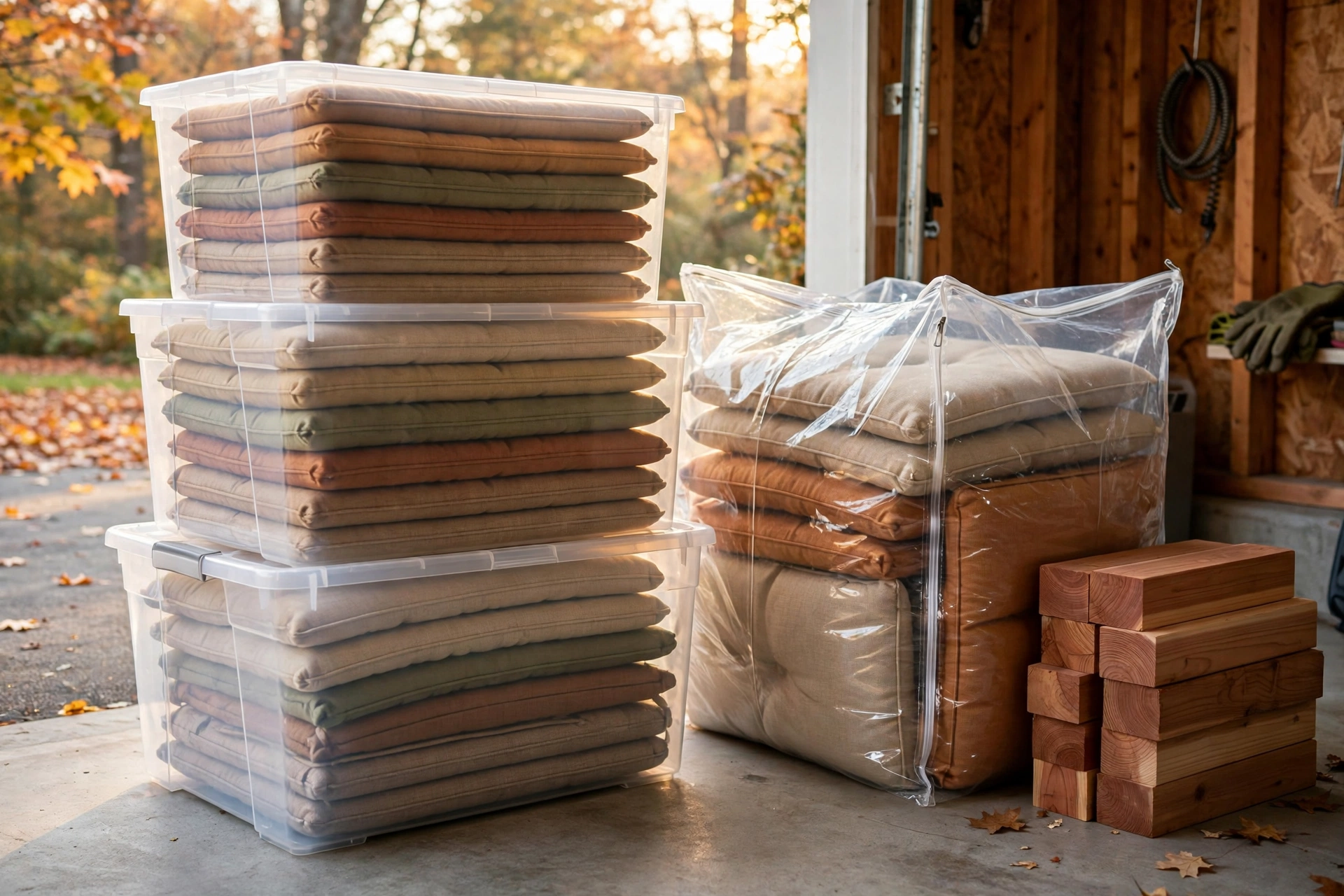
My system is boring and works: two vented plastic storage bins in the garage, one per chair pair, with a handful of cedar blocks tossed in. I leave the lids cracked an inch for airflow — sealing cushions airtight traps the moisture they already hold.
Wash the covers first if they are removable. I learned that storing a cover with last season’s sunscreen stains baked in means those stains set permanently over winter. Cold storage does not pause chemistry — it just slows it down while you are not looking.
Step four: cover it, or move it inside — the honest math
Here is the real decision tree. My 131-pound wicker dining set does not go in the basement; it gets fitted covers on the deck, strapped tight, positioned away from the drip line of the gutters. The cast aluminum five-piece, at about 23 pounds for the set, is light enough that I stack the chairs and roll them into the garage corner. The chaise lounger frame stays under a cover; its canopy and pillow live in the bins with the cushions.
A few honest caveats about covers. Cheap ones tear at the first windy night and trap more water than they shed. I look for three things: vented panels (breathability), drawstring hems plus straps (wind), and PU-coated polyester rather than plain vinyl, which cracks in cold. Fitted covers for my dining set cost me roughly $40. I replace them every three or four years. That is about $10–12 a year to keep a $490 set dry — the cheapest insurance in my house.
What about a storage unit? At roughly $60–150 a month in most US suburbs (a rough range, not a quote), a five-month winter rental starts at $300 — two-thirds of a new $490 set. For me the math does not work. The rule is simple: the protection budget should stay well under the replacement budget.
The industry keeps growing because people keep replacing
I checked the market data out of curiosity, and it confirmed something I had suspected. Grand View Research estimated the global outdoor furniture market at $53.3 billion in 2025, growing to $86.6 billion by 2033 at a 6.4% CAGR (2026 industry report). The US outdoor furniture and kitchen segment alone was $9.84 billion in 2024, growing 6.9% a year toward 2030.
A big slice of that spend is replacement demand — people buying new because the old set aged out early. Every set that gets covered in October and survives to May is one less set bought in June. The cheapest outdoor furniture upgrade I know is not a new set. It is the one you already own, given one Saturday of care.
My winterizing checklist, all in one place
- Timing: last dry weekend of October, before leaves and rain do the damage.
- Clean: hose, soft brush, dish soap. No pressure washer on weave. Rinse soap fully.
- Repair: wood glue on lifting weave, touch-up enamel on aluminum chips, tighten every bolt.
- Wood: oil the acacia top, or commit to the silver — no halfway.
- Cushions: wash covers, store indoors in vented bins with airflow, never sealed damp.
- Frames: vented, strapped covers on what stays out; garage for what is light enough to move.
- Small parts: canopy, pillows, umbrella-hole caps — indoors, all of them.
The verdict
Four hours, one Saturday, roughly $60–80 of supplies I mostly already owned. That is the whole job. My wicker set is entering its fourth winter looking like it did on delivery day, the cushions still smell like nothing — which is exactly what you want — and spring setup is a thirty-minute unwrap instead of a shopping trip. If you own patio furniture worth keeping, winterizing it is the highest-return chore of the year.
If you are shopping for a set that takes this routine well, my wicker set is the 7-piece wicker dining set with acacia wood top ($489.99) — the mildew-resistant cushions and rust-resistant frame are exactly what this guide is written around. The 5-piece cast aluminum set ($499) is the light, garage-friendly alternative with its rust-proof coating, and the hanging chaise lounger ($268) has the removable canopy that makes winterizing half the work. Browse the full outdoor selection anytime at FLNORW MALL — and give your furniture its Saturday before the first freeze.