I Measured Three TV Stands Against My 65-Inch TV. Here’s the Size Guide I Wish I’d Had.
I Measured Three TV Stands Against My 65-Inch TV. Here’s the Size Guide I Wish I’d Had.
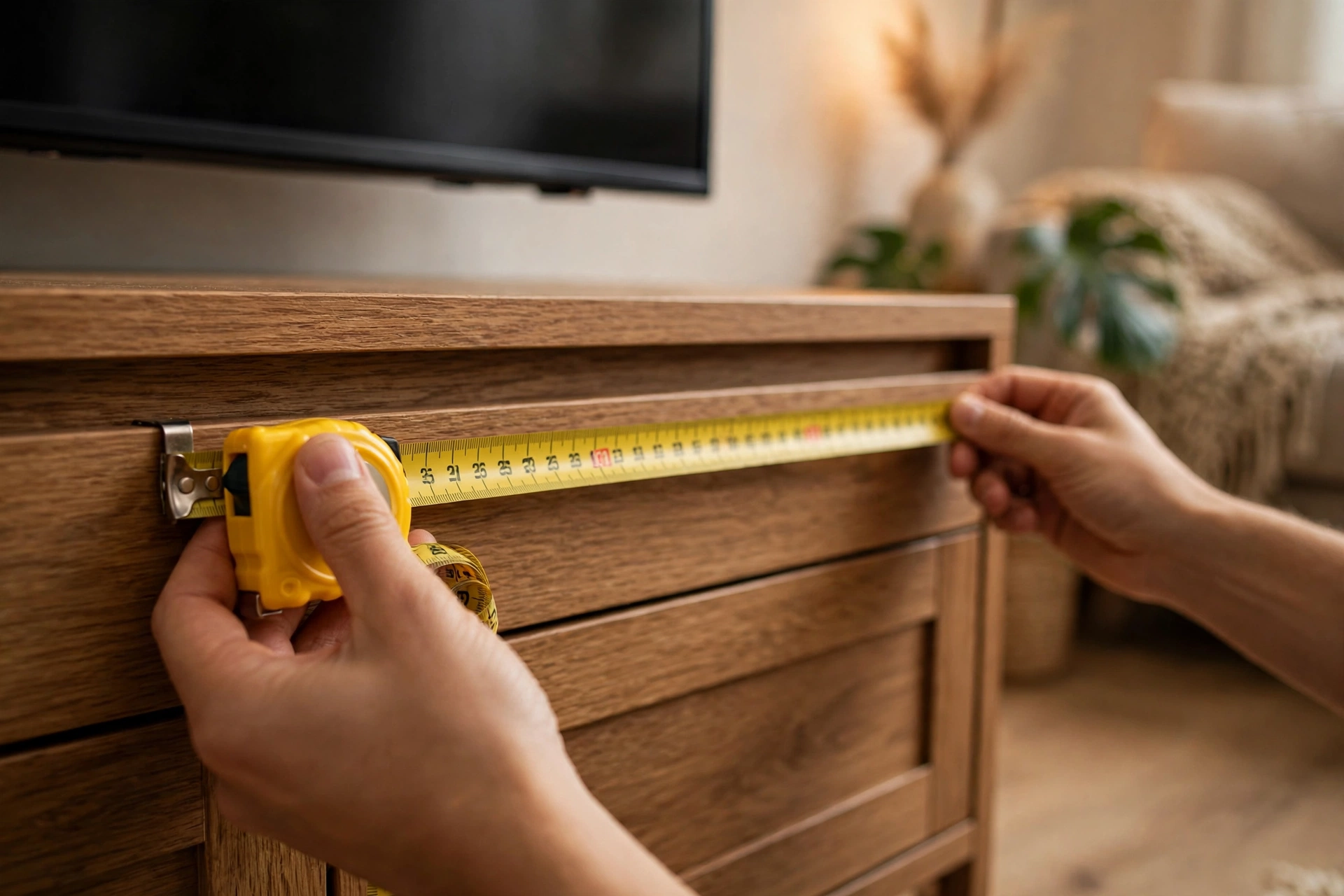
My 65-inch TV arrived on a Tuesday. The picture was gorgeous. The problem was underneath it: my old 48-inch stand, which the screen overhung by nearly four inches on each side. It looked like a grown man wearing his kid’s shoes. Two weeks later I returned the old stand, bought a tape measure, and spent an evening learning more about TV stand dimensions than I ever planned to know. This TV stand size guide is everything I measured, so you can skip the return trip.
The 10-Inch Rule: Your Stand Should Be Wider Than Your TV
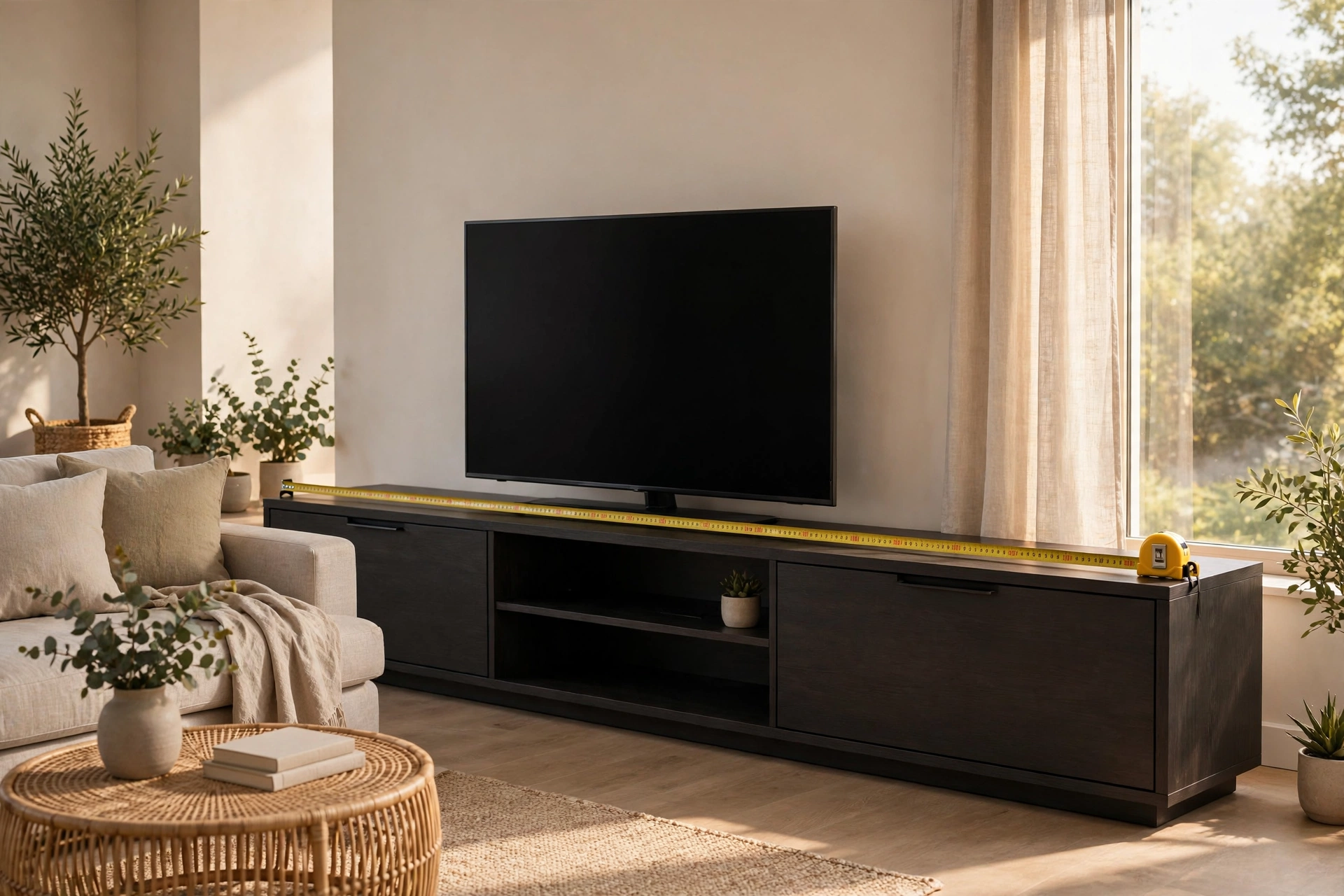
After an evening of forum threads, retailer buying guides, and my own tape measure, everything converged on one rule of thumb: your TV stand should be at least as wide as your TV, and ideally about 10 inches wider — roughly five inches of breathing room on each side. Not a law of physics, but the point where a setup stops looking accidental.
Three reasons it works. First, no overhang: a screen wider than its stand looks unbalanced and makes guests nervous. Second, stability: the feet sit well inside the edges, so a bumped coffee table does not become a catastrophe. Third, the styling surface: those extra inches are where the soundbar, the remote tray, and the plant that hides the cable box actually live.
TV Widths, Measured: Forget the Diagonal
TVs are sold by the diagonal; stands are sold by the width. The number on the box does not tell you what you need. A 65-inch 16:9 panel is about 56.7 inches wide — a fact I learned standing in my living room with a tape measure and a sinking feeling. Here is the cheat sheet I taped to my wall afterward (16:9 panels, widths computed from the diagonal; your bezel may add up to an inch, so treat these as close estimates):
- 43-inch TV: ~37.3 in wide → ideal stand ~47 in
- 50-inch TV: ~43.6 in wide → ideal stand ~54 in
- 55-inch TV: ~47.9 in wide → ideal stand ~58 in
- 65-inch TV: ~56.7 in wide → ideal stand ~67 in
- 75-inch TV: ~65.1 in wide → ideal stand ~75 in
But cabinet width is only half the story. Measure your TV’s feet, too — the span between the two feet, and how far front-to-back they reach. Some 65-inch TVs plant their feet 53 inches apart and 12 inches deep. The feet have to land on the stand, not dangle off it.
Three Real Stands, Measured Against the Rule
Armed with my tape measure, I ran three real FLNORW MALL stands through the math — all InStock, all with live prices checked this week:
1. The near-textbook fit: 57.1-inch LED TV stand, $188. This 57-inch LED TV stand is 57.1 inches wide and rated for 32–60 inch TVs. Pair it with a 55-inch TV (47.9 inches wide) and you get +9.2 inches — nearly exactly the 10-inch rule. The extras are doing real work here: plug-in LED with 16 RGB colors and 4 flashing modes, glass display shelves, a hidden side bookshelf, and a 250-lb weight rating on thickened board. At $188 it is the cheapest way to look deliberate.
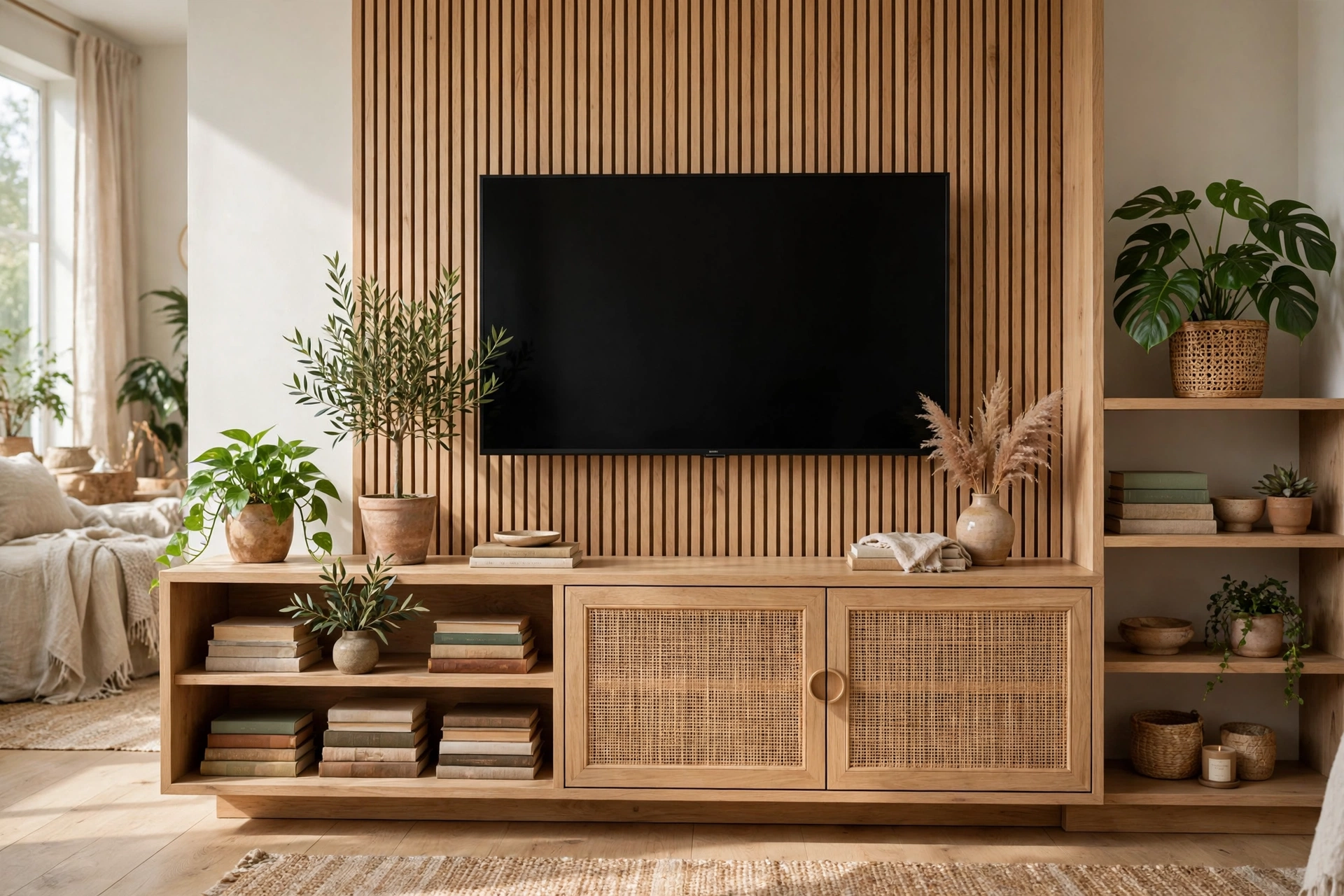
2. The snug fit: 59-inch wooden TV stand, $189. The 59-inch wooden TV stand is listed for TVs up to 65 inches, with two rattan decorated doors and two open shelves. Against my 65-inch panel (56.7 in) it gives +2.3 inches — inside the minimum, short of the ideal 10. Honest take: it is fine if your room is tight and the product is explicitly rated for it, but it will look full rather than airy. What sold me on it anyway: 15.7 inches of height, a roomy 26.4-inch depth, and that natural rattan front that hides a multitude of sins.
3. The big-room answer: 74.8-inch LED console, $289.99. This LED TV console for 75-inch TVs is 74.8 inches long and rated for 70–79 inch screens. Against a 75-inch TV (65.1 in) that is +9.7 inches — textbook. It also happens to be nearly 90% storage space, with app-controlled full RGB lighting across 31 modes. If your living room is the movie theater, this is the one.
A little cost math, marked rough: $188 ÷ 57.1 inches ≈ $3.29 per inch of stand; $289.99 ÷ 74.8 inches ≈ $3.88 per inch. The big console costs more per inch, but you are paying for the LED tech and seventeen extra inches of closed storage. The $189 wooden stand at $3.20 per inch is the value play for a 65-inch setup — assuming you can live with the snug fit.
Height: The Mistake Nobody Warns You About
Width gets all the attention; height is what ruins the evenings. The widely used guideline: the center of the screen should sit near your seated eye level — about 42 inches off the floor for an average couch. Measure your own; my couch seat is 19 inches and my eye level lands around 44.
The math is simple: screen center height = stand height + half the TV’s height. My 65-inch panel is about 31.9 inches tall, so half is ~16 inches. On the 59-inch wooden stand (15.7 in), the center lands at ~31.7 inches — a good ten inches below my eye level. I notice it during long gaming sessions, when my neck reminds me. During movies, never.
All three stands here are low-profile by design — 11.7, 13.7, and 15.7 inches tall. That look is modern and clean, and it is perfect with a low sofa or floor cushions. With a tall couch, either wall-mount the TV or shop a taller stand. On viewing distance, the cinema world has actual standards — SMPTE’s guidance works out to roughly a 30-degree field of view — and free tools like Rtings’ TV size-to-distance calculator will sanity-check your own room. I sit 9 feet from my 65-inch; right in the comfortable band.
Depth, Weight, and the Feet Problem
Two numbers people skip: stand depth and weight rating. My TV’s feet sit about 12 inches front-to-back. The 74.8-inch console is 13.78 inches deep — it fits, with under two inches to spare. The 57-inch stand is 15.7 inches deep (breathing room). The 59-inch wooden one is 26.4 inches deep — enough for a soundbar in front of the TV and the streaming boxes behind it.
Weight ratings matter more than they look. The 57-inch LED stand is rated to 250 lbs; a 65-inch TV runs around 50–60 lbs, leaving comfortable headroom for a soundbar, a console, and the stack of game cases you keep meaning to organize. Always leave margin — particle board and MDF creep under constant load, and a sagging top panel is how a “fine for years” setup slowly becomes a wobbly one.
The 6-Point Checklist I Run Before Buying Any Stand
Print this, or at least keep it on your phone in the store:
- Measure the TV cabinet width — not the diagonal, the actual left-to-right width.
- Measure the feet — the span between them and their front-to-back depth.
- Target stand width = TV width + 10 inches. Hard minimum: the TV’s width. Never buy a stand narrower than the screen.
- Do the eye-level math: stand height + half the TV height, compared against your seated eye level.
- Check the depth: feet should land with ~2 inches to spare, and decide where the soundbar goes before you buy.
- Count the storage: remotes, game consoles, the router, the remotes you already lost once. Closed doors beat open shelves for all of it.
When to Break the 10-Inch Rule
Rules have honest exceptions. If the TV is wall-mounted, the stand underneath is really a sideboard — width matters less than storage and cable management. In a corner setup, an angled stand can be narrower than the screen and still look right. And in a small room where the stand doubles as the main storage wall, I would take the extra cabinets over perfect symmetry every time. The rule is a starting point, not a building code.
The Verdict
Two weeks of measuring taught me the stand is not really furniture — it is a frame. Get the frame wrong and even a great TV looks like a mistake; get it right and nobody notices it, which is the whole point. For my 65-inch, the 59-inch wooden rattan stand at $189 is the honest pick: snug, but rated for the job, with the depth and storage to earn its footprint. If I ever go 75-inch, the 74.8-inch LED console at $289.99 is the textbook answer. And if you are outfitting a 55-inch on a budget, that $188 LED stand hits the 10-inch rule almost to the decimal.
Shop the size that fits your TV: the 57-inch LED TV stand ($188), the 59-inch wooden rattan TV stand ($189), or the 74.8-inch LED console for 75-inch TVs ($289.99) — or browse the full furniture collection at FLNORW MALL. Measure twice, buy once.