Reading Nook Ideas: My $484 Five-Piece Formula
Here are my reading nook ideas, built and paid for: a real cozy reading corner in the spare corner of my guest-room-office, five pieces of furniture, $483.88 total, every price verified on the listing the day I ordered. The reason I bothered: Gallup found that in 2021 Americans read an average of just 12.6 books over the year — the lowest number the pollster had measured since 1990 (Gallup, January 2022). Pew’s 2021 survey put the share of adults who had finished any book in the prior year at 75% (Pew Research Center, Jan 25–Feb 8, 2021, 1,502 adults). I love books and I was barely finishing one a month. My suspicion: I did not have anywhere comfortable to sit with one. So I built the nook first and let the habit follow.
My first two attempts failed, and both failures taught the whole formula. Attempt one was a floor cushion in a dark corner — my back lasted twenty minutes. Attempt two was the guest-room bed, where I fell asleep by page nine. The pattern: a reading nook needs exactly three things. A seat you can sink into without planning an exit. Light you can actually read by. And your next book within arm’s reach. Everything else is decoration.
The $484 Receipt: Five Pieces for a Cozy Reading Nook
Here is the complete list, prices checked the morning of publication, everything in stock:
- $68.88 — Macrame hammock swing chair, 330-lb rating, cotton, beige (the seat)
- $88 — Acacia round side stool, 250-lb capacity, 17.7 inches tall (the side table that moonlights as a guest seat)
- $99 — Narrow rattan console table with two drawers, 39.37 inches wide (the book storage)
- $129 — Dimmable LED ceiling fan light, remote, 6 speeds (the reading light)
- $99 — Acacia 3-tier plant stand, 24.8 inches tall (the green corner)
Total: $483.88. I round it to $484 when I tell friends, because nobody believes a whole reading corner cost less than a single decent armchair. The math that matters to me: I read about 30 minutes a day. That is 182.5 hours a year, about 912 hours over five years — which puts this nook at roughly $0.53 per reading hour (my estimate). A paperback costs more.
Reading Nook Chair Math: Why I Hung Mine
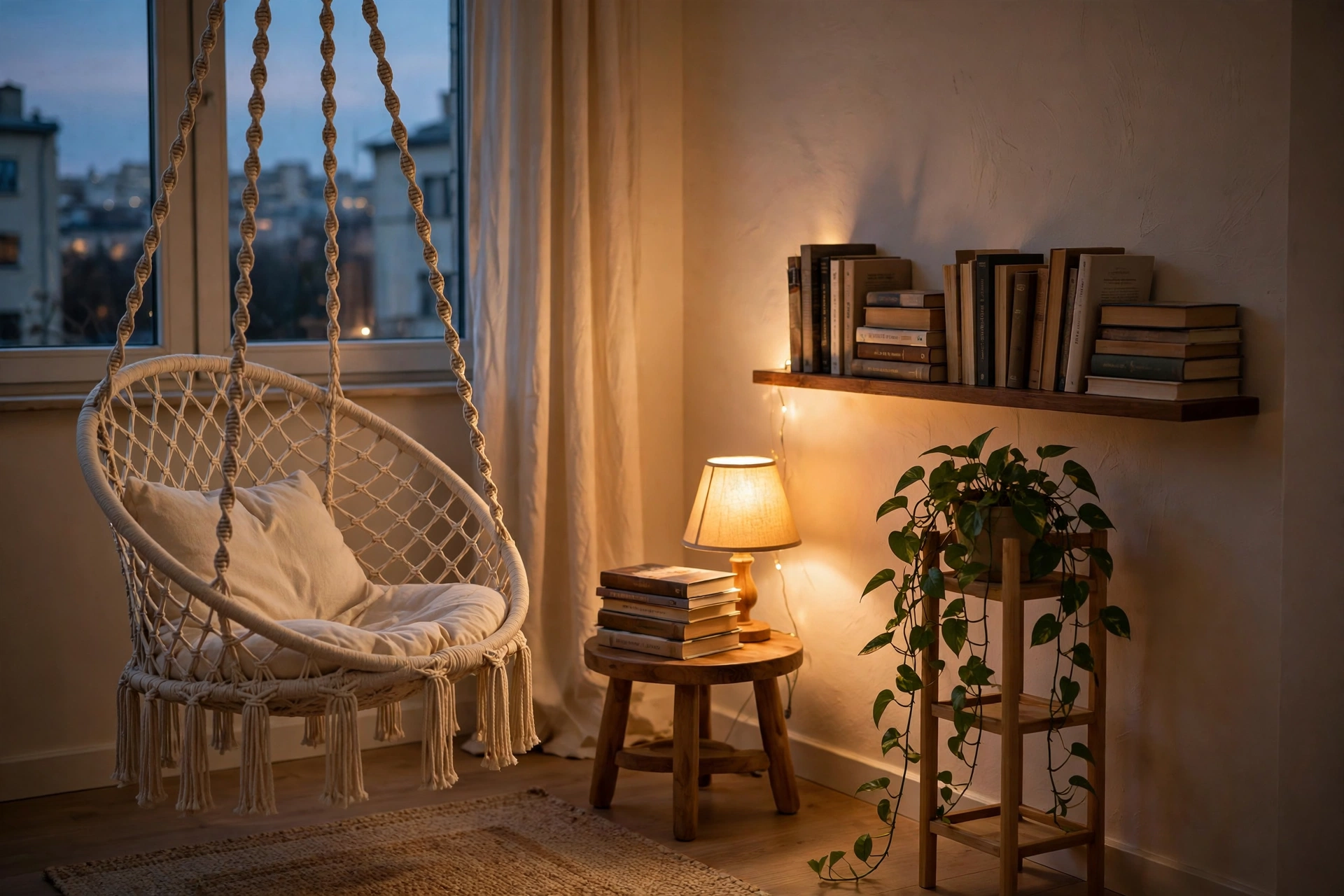
The chair is the piece everyone overspends on, and it is where I saved the most. A good upholstered reading armchair runs $300 to $500. The macrame hammock chair cost me $68.88 — about 79% less than the $328 velvet accent chair I had bookmarked — and it solved the problem the armchair would not: floor space. It hangs from the ceiling, so its footprint on my rug is zero square inches. The seat itself is 31.5 by 23.6 inches of woven cotton, rated for 330 pounds, and at 7 pounds it is light enough to take down and rehang alone.
The install is the part people overthink. I spent nine dollars on a stud finder, found the ceiling joist in the corner, drilled a pilot hole, and set a heavy-duty swivel mount with a lag bolt straight into the joist. Twenty minutes. If you rent, this is the one piece to check with your landlord — drywall anchors will not hold a swinging human, and no chair is worth a ceiling repair bill. The chair hangs 31.5 inches wide, and I keep a full 36 inches of clearance from the walls so it can sway without kissing the drywall.
One honest caveat: the chair ships without a cushion. I threw a $12 throw pillow I already owned into it, and the arched backrest does the rest. Total seating cost: $80.88, still cheaper than the delivery fee on most armchairs.

The $88 Side Table That Moonlights as a Guest Seat
A reading nook needs a landing spot for the book, the mug, and the reading glasses, and it needs to be exactly within reach of the chair. The acacia round stool is 15.4 inches across and 17.7 inches tall — side-table height for a chair that hangs with its seat around 20 inches off the floor. My paperback, a mug, and my glasses all fit on the 15-inch top with room to spare, and the footrest bars turn out to be exactly where my feet want to go.
The trick is the 250-pound weight rating. When my sister visits, this stool stops being a side table and becomes her seat. Solid acacia, water-resistant finish, footrest bars — it has survived two years of my coffee mug and one toddler. At $88 it is cheaper than any side table I found that could also hold a person, and at just 6 pounds I can slide it wherever the light is best.
The Reading Light Math: 30 to 50 Footcandles
This is the section I wish someone had written for me before attempt one. The Illuminating Engineering Society’s office-lighting practice (ANSI/IES RP-1-2013) recommends 300 to 500 lux — 30 to 50 footcandles at the reading surface for reading tasks. Most living rooms deliver a fraction of that in the corner, which is why reading there feels like work and your eyes give up first.
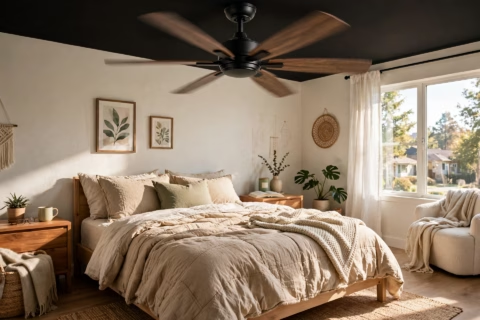
My corner is roughly 10 by 10 feet — 100 square feet. At 30 footcandles, that calls for about 3,000 lumens of light in the zone. I did not buy a lamp at all. I replaced the room’s bare bulb with the $129 dimmable LED ceiling fan light: 19.7 inches across, integrated dimmable LED, remote control, six fan speeds, DC motor. The dimmer is the whole point — full brightness hits the footcandle target for reading, and I dial it down to a glow for the last chapter. The remote lives on the side stool, which means I never get up to adjust the light, which means I never get up and decide to do something else.
Two layers, not one: the ceiling light is the task layer, and the window is the daylight layer. The nook sits in the corner next to the window, not under it, so the sun never glares on the page. Evening reading is the dimmed fan light alone. The fan’s 1-hour timer also doubles as my reading-nap timer, which I use more than I expected.
Book Storage Without a Bookshelf: the Reading Corner Library
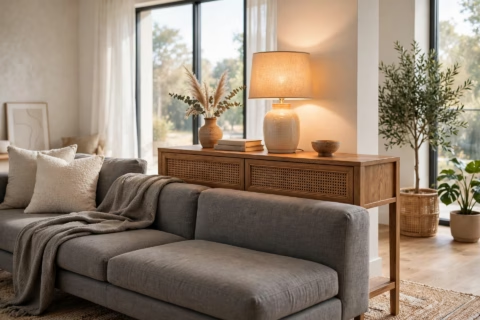
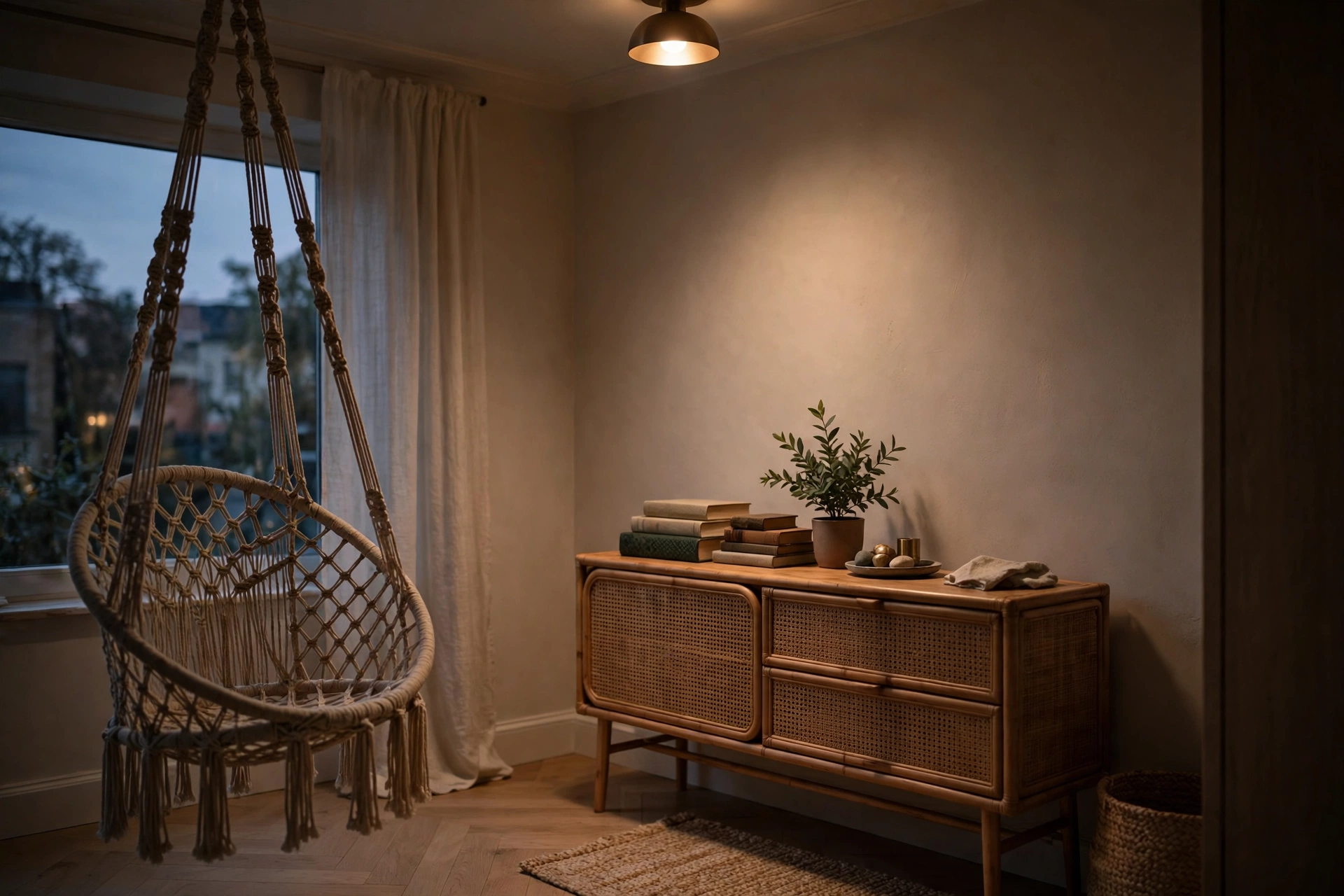
A reading nook dies when the next book lives in another room. I refused a full bookshelf — too big, too permanent — and used the narrow rattan console instead: 39.37 inches wide, 11.81 inches deep, 29.92 inches tall, two drawers, one open bottom shelf, $99. It stands against the wall beside the chair like it was measured for the spot, because at 11.81 inches deep it basically was.
The capacity math surprised me. The bottom shelf is 36.61 inches wide; a paperback spine runs about three-quarters of an inch thick, so one row holds roughly 45 books (my estimate). The tabletop holds the current stack, and the two drawers — 15.94 by 9.45 inches each — hold bookmarks, my reading glasses, and the remote. Call it 60 to 90 books within arm’s reach, which at my pace is more than a year’s reading. Gallup’s median American read five books in 2021; the shelf holds a decade of that.
The $99 Plant Corner (and Why It Earns Its Spot)
The last piece is the one I would have skipped, and the one guests comment on. The acacia 3-tier plant stand — 27.5 inches long, 12.2 inches deep, 24.8 inches tall, tiers 11.8 inches apart, $99 — sits in the dead corner behind the chair, the triangle of floor every room layout wastes. I put a pothos on top, a snake plant in the middle, and the watering can on the bottom tier.
Three honest reasons it stays. The green softens the corner so the nook reads as a room, not a furniture lineup. The stand is foldable and weighs under 9 pounds, so it moves when I rearrange — which renters do constantly. And a plant gives the nook a reason to be visited daily that is not a book: I water the pothos, I sit down, I read three pages. Habits need a trigger, and mine is a watering can.
Where I Put Mine: the 10-by-10 Corner Rules
Placement is the free half of the formula. My nook lives in the corner of the guest-room-office, and three rules run it:
- Light before furniture. I mapped the room’s light across a day before moving anything — window corner for afternoons, dimmable ceiling light for evenings. The chair went where the light already was.
- 36 inches of walkway. The swing needs 36 inches from the walls, and the room needs 36 inches of walkway in front. I taped the footprint with painter’s tape first, the way I do for every furniture decision now.
- Rug under, door free. A 6-foot round rug anchors the chair and stool — my rug sizing rules live in my living room rug size guide — and I checked the door swing before the rug order, because I have been burned by that one before.
Three mistakes I made so you can skip them. First: I bought the chair before checking the ceiling, and nearly mounted it into a drywall seam — joist finder first, always. Second: my first nook faced the TV, and the screen glow killed every evening session — face the chair toward the window or the wall, not the entertainment center. Third: I read for a month under a 40-watt-equivalent bulb and wondered why my eyes hurt — measure the light, not the vibe. Thirty to fifty footcandles is the number.
The Verdict
Six months in, the $484 reading nook is the most-used square footage in my apartment. I finished eleven books in the first half of the year — against a Gallup average of 12.6 for a full one — and the nook is the reason. The chair is the seat I reach for, the light is the light I read by, the console holds the queue, and the plant makes me show up. If your reading habit is a stack of half-finished paperbacks on a nightstand, the problem might not be discipline. It might be the absence of a chair, a light, and a shelf.
Shop the exact five pieces: the macrame hammock chair ($68.88), the acacia round side stool ($88), the narrow rattan console table ($99), the dimmable LED ceiling fan light ($129), and the acacia 3-tier plant stand ($99) — or start from the FLNORW MALL homepage and search the corner you have in mind.