Coffee Table Styling: 5 Rules I Swear By (Tested on a $99 Rattan Table)
Coffee Table Styling: 5 Rules I Swear By (Tested on a $99 Rattan Table)
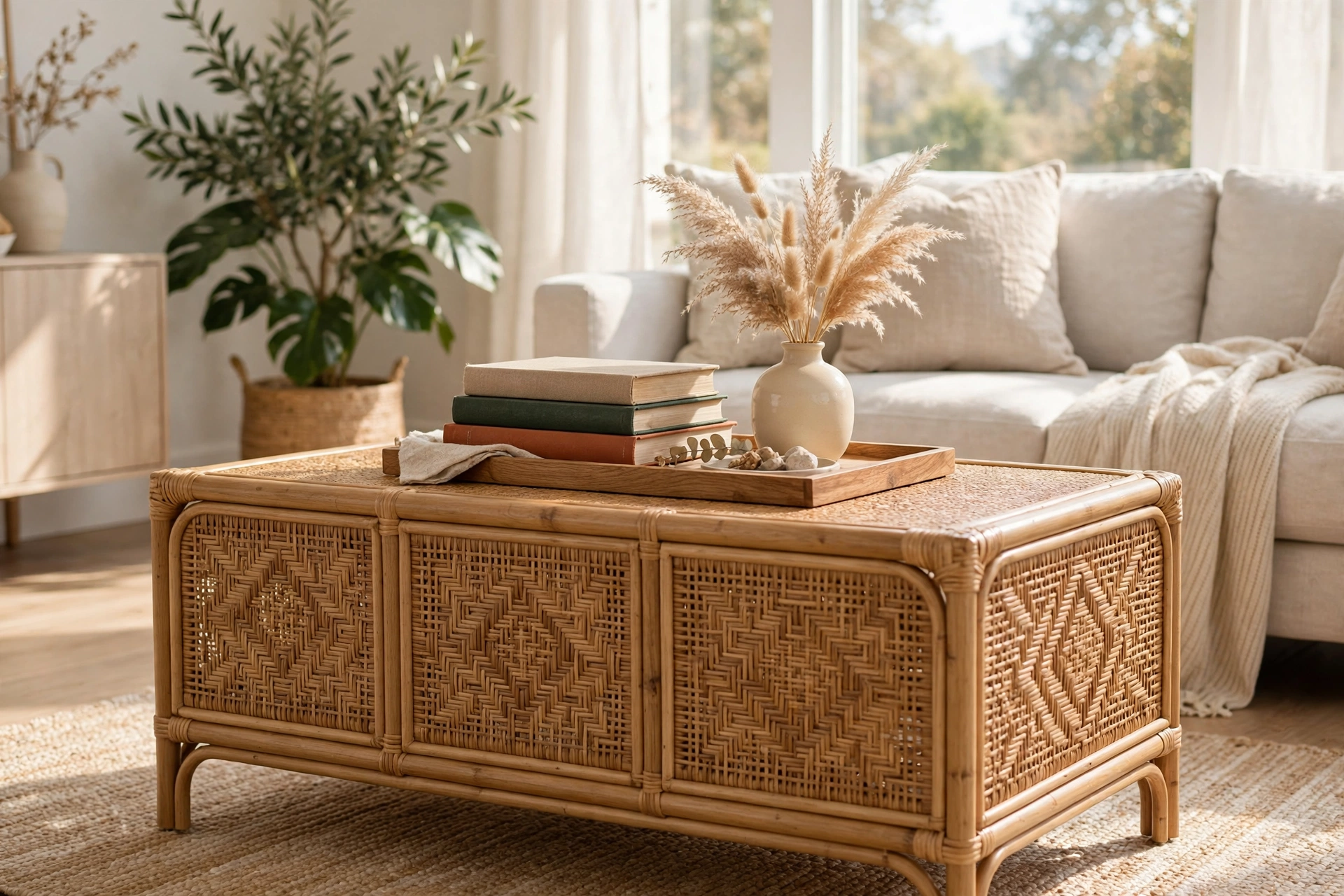
My coffee table styling education started with a bare table and a bruised ego. I had just finished assembling the 41.34-inch rattan coffee table I bought for $99 — MDF body, woven rattan sliding doors, solid wood legs, 220-pound capacity — and it looked fantastic empty. Then I put my actual life on it: two remotes, a stack of mail, a chipped mug, and a candle I never lit. It looked like a junk drawer with legs.
So I did what everyone does. I fell into a two-hour Pinterest hole, screenshotted twelve living rooms, and tried to reverse-engineer why some tables looked pulled-together and mine looked like a garage sale. Over one weekend I tested five rules on that $99 table, measuring everything with a tape I stole from my toolbox. Here is what actually worked — real numbers, no design degree required.
Rule one: style in odd numbers
The first thing I tested was the oldest rule in the book: group objects in threes. I tried two objects on the table — a vase and a candle — and it looked like a pair of bookends waiting for a shelf. Four objects looked cluttered no matter how I arranged them. Three looked intentional every single time.
My winning trio: a stack of two hardcover books, a ceramic vase with dried pampas stems, and one small candle. Three is the magic count because your eye cannot split an odd group down the middle, so it keeps moving across the arrangement instead of parking on it. On my 41.34-inch table, the trio occupies roughly the left third; the right two-thirds stays open for actual living. If you take one idea from this whole guide, take this one — odd-number grouping is the fastest of all coffee table decor ideas to learn and the hardest to mess up.
Rule two: coffee table styling with a tray that corrals the chaos
A tray is the difference between styled and scattered. Here is the coffee table tray styling math that finally made mine work: the tray should cover roughly one-quarter to one-third of the table surface. My table is 41.34 by 21.65 inches — about 895 square inches. My tray is 18 by 12 inches, or 216 square inches. That is 24 percent. Right in the zone.
The trio from rule one lives on the tray now. Remotes, coasters, and the candle I still never light live on it too. And here is the part nobody tells you: a tray with handles is a lifestyle upgrade, because the whole arrangement lifts off in one motion when you need the full surface for a board game or a laptop. Three steps, in order:
- Measure your table and pick a tray covering 25 to 33 percent of the surface.
- Load it with your odd-numbered trio — books, vase, candle.
- Give every loose everyday item (remotes, coasters) a home on the tray, not beside it.

Rule three: build in three heights
Flat styling is the number one reason a table looks boring even when the objects are nice. Everything sitting at the same 4-inch height reads as a lineup, not an arrangement. The fix is three distinct heights: tall, medium, and low.
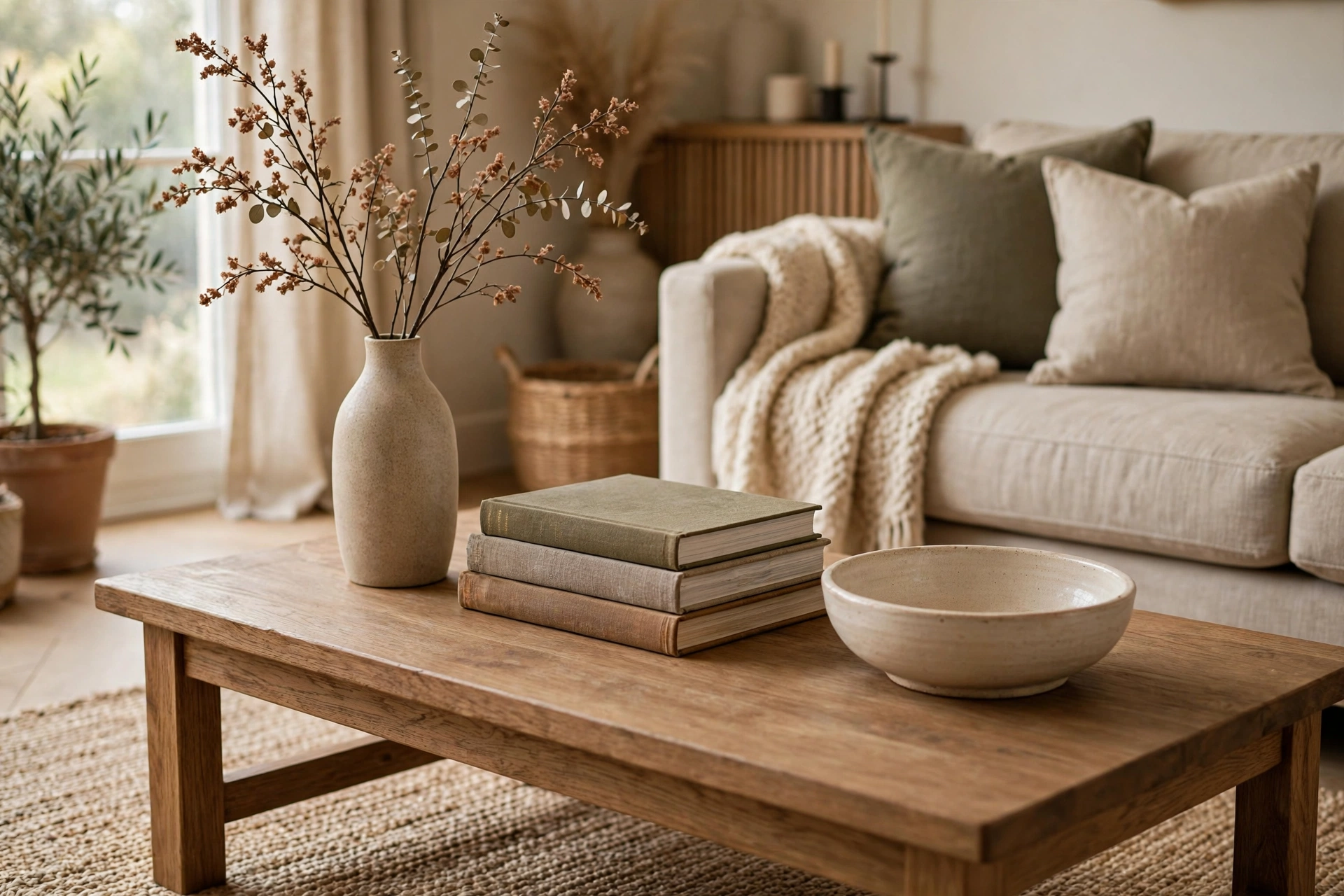
My numbers: the vase with dried stems stands 14 inches tall, the book stack measures 7 inches, and the ceramic bowl is 3 inches. Tall, medium, low — the eye travels up and down instead of sliding flat across. One hard constraint I learned the annoying way: if your table sits between the sofa and the TV, keep the tallest item under about 20 inches or it starts blocking the screen. My 14-inch vase clears it; the 22-inch branch arrangement I tried first did not survive movie night. If you have not measured your setup yet, my coffee table height guide covers the tape-measure rules for the table itself.
Rule four: leave 40 percent of the surface empty
This is the rule that separates a styled table from a display shelf. A coffee table is a working surface — mugs land here, laptops open here, feet rest here after long days. If every square inch is decorated, the decor becomes an obstacle course.
The math on my table: 895 square inches total, styled zone about 540, free zone about 355. That is 40 percent empty, and it passes the real test — two mugs and my 13-inch laptop fit without moving a single styled object. Before I adopted the 40-percent rule, I relocated a vase every movie night. Now nothing moves. Guests notice this rule without knowing it exists; the table just feels usable instead of precious.
Rule five: mix three textures
My table already brings two textures to the party — woven rattan doors and solid wood legs — so the styling needed contrast, not more of the same. I added a smooth ceramic vase, soft linen-bound books, and a small brass candle holder. Woven, smooth, soft, metallic: four textures, and the arrangement finally looked collected rather than purchased in one trip.
The all-one-material trap is real. An all-wood arrangement on a wood table looks like a furniture store display; an all-white arrangement looks afraid of living. Three textures minimum is my rule, and it costs almost nothing — my refresh totaled $52: a $24 tray, a $16 vase, and a $12 brass holder. The books were already mine. Fifty-two dollars for the single most-complimented surface in my living room.
Same five rules, three different tables
The rules hold up, but the application shifts with the table. I ran the same five-rule test mentally across three real tables, because the material changes what you should do:
The $99 rattan coffee table I styled is the easy mode — the woven texture does half the visual work, and the sliding rattan doors swallow the overflow (chargers, coasters, the mail I am ignoring). Style the top lighter than you think; the texture carries it.
A square table like the $228 farmhouse lift-top coffee table (31.5 inches square, 18.5 inches tall) loves a centered tray — symmetry suits squares. One warning from experience with lift-tops: keep the decor on the fixed half. Anything sitting on the lifting section has to move every time you raise it, and you will stop raising it.
The $128 black glass coffee table (39.37 by 23.62 inches, double-layer design) is the advanced class. You see through the top, so you are styling two surfaces — I would put the book stack on the lower shelf and keep the trio minimal up top. And the tray earns its keep twice over here, because glass shows every fingerprint and ring.
The 5 coffee table styling mistakes I keep seeing
- Styling for the photo, not the Tuesday. If the arrangement cannot survive remotes, mugs, and a kid’s homework, it is a museum exhibit.
- Everything at one height. Three objects all under 5 inches tall will always look flat. Add something tall.
- A centerpiece taller than the TV sightline. Anything above ~20 inches between sofa and screen becomes a very pretty obstruction.
- Dusty fake plants. Dried stems cost about the same, need zero maintenance, and never collect that gray film.
- Covering 100 percent of the surface. A table with nowhere to set a mug is a table nobody uses — which defeats the entire point.
The industry numbers say I am not the only one fussing over this surface. Grand View Research puts the U.S. home decor market at $237.9 billion in revenue for 2024, projected to reach $392.6 billion by 2030 — an 8.9 percent compound annual growth rate from 2025 to 2030 — with furniture as the largest product segment. We are collectively spending more on how our rooms feel, and the coffee table is the stage the whole living room performs on. My $52 refresh bought the feeling of a designer consult, which in many U.S. markets runs $150 to $300 an hour — a rough estimate, but directionally it tells you the return on a tray and a vase is absurd.
The verdict
Five rules, $52, one weekend: odd numbers, a tray covering a quarter of the surface, three heights, 40 percent left empty, three textures mixed. My $99 rattan table went from junk drawer with legs to the most complimented surface in the house, and nothing on it has moved for movie night since. Start with the tray — it is the only rule that also organizes your remotes — and let the rest follow.
Shop the setup: the $99 rattan coffee table with sliding storage doors I styled, the $228 farmhouse lift-top for square rooms, and the $128 double-layer glass table — plus sizing help in my coffee table height guide, all at FLNORW MALL.