Bunk Bed Safety Guide: The 7 Rules I Swear By
When my daughter turned five, she started campaigning for the top bunk — relentlessly, and with a drawing taped to the fridge: a bunk bed with two stick figures, one labeled ME on top. My wife looked at it and said the sentence that sent me down a three-week research hole: “Are bunk beds actually safe?”
I did what I do with every big purchase now: I read the bunk bed safety data first and the product pages second. What I found changed which bed I bought, how I assembled it, and the house rules I still enforce. Two years in, here are the seven rules I would hand any parent before the boxes arrive.
Bunk Bed Safety by the Numbers: Are Bunk Beds Actually Safe?
The honest answer is that bunk beds are safe the way stairs are safe. Millions of kids use them; a small but real number get hurt; and the injuries cluster in patterns so predictable you can design around them.
Start with the biggest dataset. Researchers analyzing the National Electronic Injury Surveillance System from 2001 to 2004 estimated about 23,000 children aged 0 to 9 treated in US emergency departments each year for bunk-bed fall injuries — including roughly 14,600 children under 6. About 3.2% were hospitalized. The head and neck were the most commonly injured body regions. The authors’ conclusion was blunt: bunk beds should meet CPSC standards, and the youngest children should not sleep or play in the upper bunk or on ladders. (Injury Prevention, 2007.)
The older CPSC record is grimmer. In the 1999 final rule that created the mandatory bunk bed safety standard — 16 CFR Parts 1213, 1500, and 1513, effective June 19, 2000 — the Commission reported 91 bunk-bed-related deaths of children under 15 between January 1990 and August 1999, and estimated about 34,300 injuries treated in emergency rooms in 1998 alone. Forty-one percent of the 1998 victims were younger than 5.
A retrospective study of 218 bunk-bed accidents breaks down where it goes wrong: falls from the top bed during sleep caused 35.1%, falls while playing caused 34.4%, and falling off the ladder caused 23.2% — with 41.7% of those children suffering major injuries. Canadian emergency department surveillance over twenty years tells the same story: more than 90% of upper-bunk injuries were falls, and children aged 3 to 5 were the most frequently injured group.
Read those numbers together and the pattern is unmistakable: the danger is overwhelmingly falls, and overwhelmingly to young kids on the top bunk. The fixes are boring, cheap, and almost entirely in your control.
Rule 1: Nobody Under 6 Sleeps Up Top — the Bunk Bed Age Limit
This is the one rule I would tattoo on the box if I could. The CPSC’s standing recommendation is that children under 6 should not sleep in the upper bunk. The Canadian data backs it — ages 3 to 5 are the most frequently injured — and the NEISS numbers show under-6s taking roughly two-thirds of fall injuries.
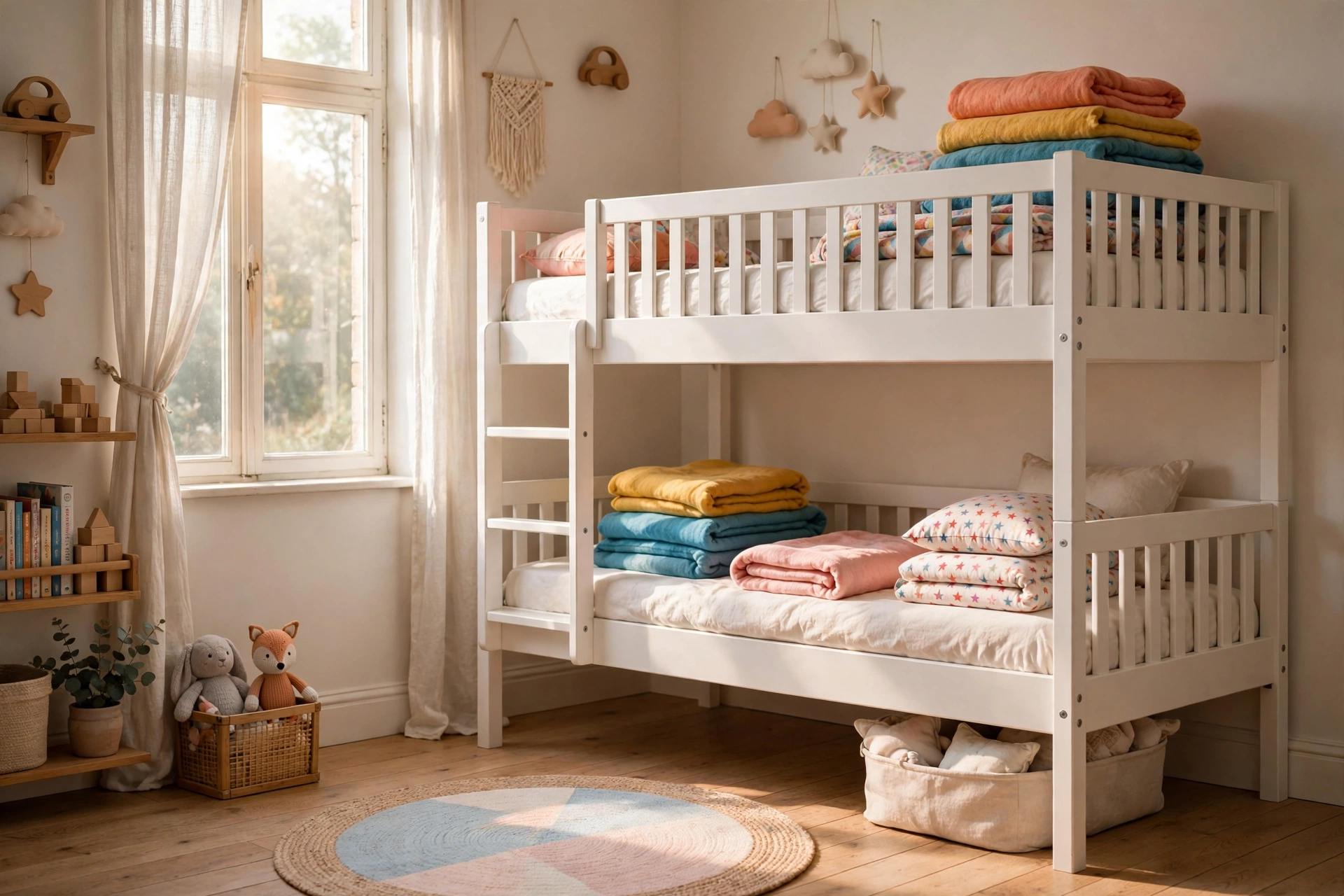
My daughter was five when she taped that drawing to the fridge. She got the bottom bunk. Her older brother got the top. She got to pick the sheets — a concession that worked better than any safety lecture — and she got the trundle as her guest-bed territory. The white pine bunk bed with trundle we bought separates into three standalone beds, so the arrangement is not permanent: when she turns six, the rotation changes.
If the little one is heartbroken, hand them the trundle. At floor level it is the safest bed in the house, and kids treat a pull-out bed like a secret fort.
Rule 2: The 5-Inch Guardrail Rule — Bunk Bed Guardrail Height
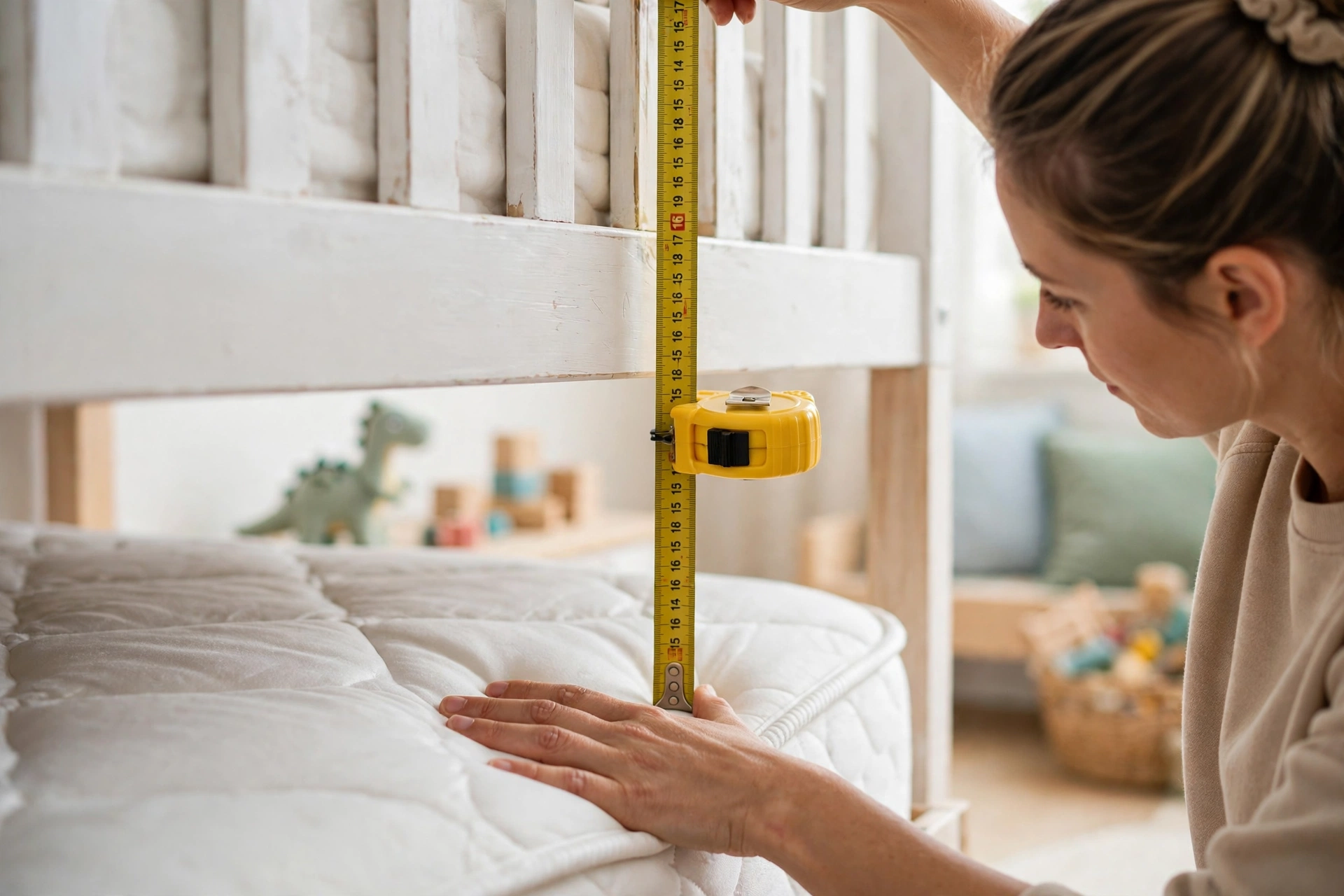
Here is the number that matters most and gets checked least. The CPSC’s consumer safety guidance says the guardrail must extend at least 5 inches above the top of the mattress — measured with the mattress and any foundation in place, on both sides of the upper bunk, even the side against the wall.
Why the wall side too? Kids wedge. The standard also targets entrapment between the bed and the wall, which I will get to in Rule 3, but the practical upshot is simple: both sides get rails, full length.
The trap is mattress thickness. A thick mattress eats rail height. This is exactly why the $699 house bunk bed’s product page recommends a 6-inch mattress for the upper bunk — that number is a safety calculation, not a suggestion. Put a 10-inch pillow-top up there and your 5 inches of rail become 1 inch of wishful thinking.
Do the tape-measure test the day the mattress arrives: lay the mattress down, press it flat, and measure from its top to the top of the rail. Under 5 inches? Thinner mattress or a different bed.
Rule 3: Mind the Gaps — Entrapment Is the Quiet Danger
Falls get the headlines, but the deaths in the CPSC’s 1990s data were overwhelmingly entrapment: kids wedged between the mattress and the frame, or stuck in openings in the headboard or footboard. The federal rule tests this with a wedge block and a 9-inch sphere — any opening below the upper-bunk mattress foundation that freely passes the sphere is a fail.
Do the fist-and-head check: if a gap between the mattress and the rail or frame admits your fist easily, a small child’s head can find it. Push the mattress tight against the rails and check the corners — that is where gaps open as bedding shifts.
This is not theoretical. In March 2025, the CPSC recalled about 1,172 Interior Resources children’s steel bunk beds because the guardrail spacing was wider than federal regulations allow — an entrapment hazard in beds already sitting in kids’ rooms. If a recall can slip through on a shipped product, a used or hand-me-down bunk bed deserves the same skepticism. Measure it.
When I was choosing between the $268 steel frame and the $399 pine one, the rail configuration was the deciding safety spec — the steel bed ships with guard rails on all four sides of the upper bunk, which is exactly what the injury data argues for. I wrote up the full metal vs pine bunk bed comparison separately if you are still deciding.
Rule 4: Stairs Beat Ladders at 2 A.M. — Bunk Bed Ladder vs Stairs
Remember the study numbers: 23.2% of bunk-bed injuries were falls off the ladder. Now run the 2 a.m. test. A half-asleep kid climbing down rungs in the dark, barefoot, needing the bathroom. In our house that trip happens a few times a month, and I lie awake listening to it.
We bought the ladder model first — the pine one — and I will be honest: the ladder is fine in daylight and sketchy at night. If I were buying again with a kid under eight on top, I would spend the extra for stairs. The house bunk bed with stairs replaces rungs with wide steps and drawers — I wrote up the full math in my bunk bed with stairs review: $699 for three beds plus a dresser and stairs a sleepy kid can walk down.
Whichever you own, add a night light at the climb — a six-dollar plug-in LED at the ladder base — and ban the book-under-one-arm descent. Stairs plus book is a non-event. Ladder plus book is a negotiation I never want to referee.
Rule 5: Weight Limits Are Real Numbers — Bunk Bed Weight Limit
The spec sheets print them and parents skim them. Do not. Our pine bunk is rated 400 lbs per sleeping surface. The house bunk with stairs is rated 300 lbs per bunk, trundle included. The steel frame: 250 lbs upper, 350 lower, 250 trundle.
The number that matters most is not the kid — it is you. When a six-year-old is sick at 2 a.m., a 180-lb parent climbs up top. At 180 lbs on a 300-lb-rated bunk, you are fine. On a cheap frame rated 150 or 200, you are not. And when the 140-lb teenager moves in five years, the 400-lb pine rating stops looking like overkill and starts looking like foresight.
Two corollaries. First: no jumping on the top bunk — dynamic loads multiply, and every weight rating on the page assumes a sleeping child, not a trampoline audition. Second: the trundle’s rating counts too, so read that line before the holidays, not during them.
Rule 6: The Monthly Five-Minute Bunk Bed Safety Check
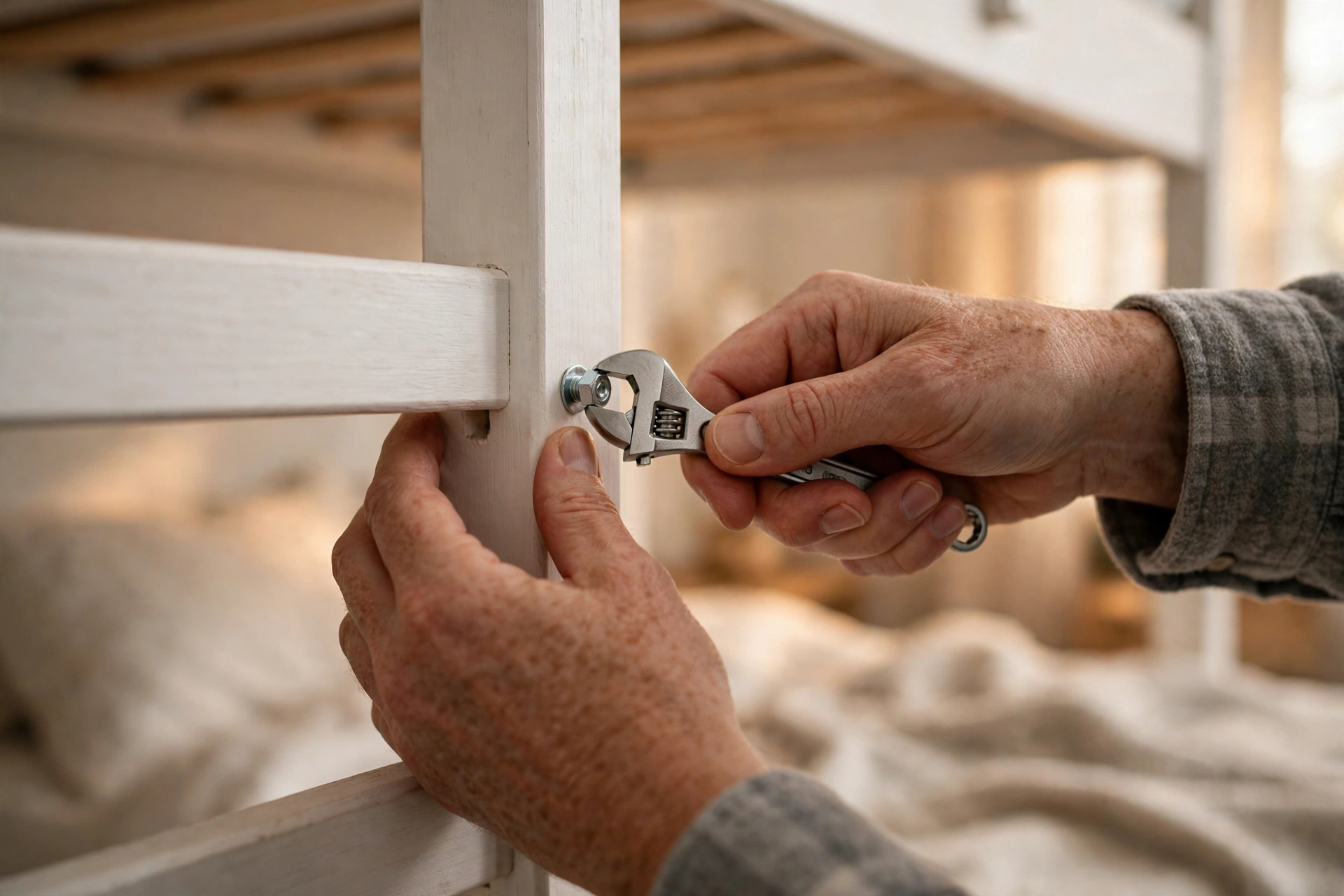
Wood moves. Bolts loosen. Kids are small earthquakes. The first time I checked our bunk — three months in, prompted by a faint creak — two bolts turned a full quarter-turn before snugging. That was the end of my complacency.
Now it is a house ritual, first Sunday of the month, five minutes: every bolt gets a quarter-turn test, slats get a press, ladder hooks get a wiggle, guardrails get a shove. The metal-to-metal connections on our pine frame have held perfectly; it is the wood screws that wander, so they get the attention.
Rule 7: Measure the Ceiling Before You Buy
The house bunk bed stands 94 inches tall. On a standard 8-foot ceiling that leaves about two inches — I measured twice, and a friend with 7-foot ceilings learned that “probably fine” is not a measurement. The kid sitting up top wants roughly 30 inches between mattress and ceiling — my own rough estimate — or mornings start with a forehead meeting the plaster.
And if the bed comes with a slide like the house model does, decide up front whether it stays. Ours would have eaten two feet of floor permanently; the bolts come out in minutes when the novelty fades.
The verdict. Two years in, here is my honest take: a bunk bed is as safe as the rules around it. The data says falls and young kids — both addressable with a tape measure, a night light, and five minutes a month. The quick version:
- Nobody under 6 on the top bunk — no exceptions, no “just for naps.”
- Guardrails on both sides, at least 5 inches above the mattress.
- Check the gaps: fist test at the rails, corners, and headboard.
- Stairs over ladders when you can; night light at the climb either way.
- Respect the weight limit — yours included.
- Bolt check, first Sunday, five minutes.
- Measure the ceiling before the boxes arrive.
Shop the beds in this guide: the $399 white pine bunk bed with trundle (400-lb sleeping surfaces, separates into three beds), the $699 house bunk bed with stairs (storage staircase, full-length guardrails, 300-lb bunks) — or browse the full kids’ bedroom range at FLNORW MALL.