Sofa Fabric Guide: What Living With Chenille, Velvet, and Polyester Taught Me
Last spring, my sister’s cat took exactly eleven days to ruin a chenille sofa arm. Not chewed, not stained — snagged. The nubby weave that felt so good under your hand turned out to be a perfect little ladder for claws, and every pulled thread stood up like a white flag. Around the same time, my own velvet armchair was collecting compliments from every guest while quietly developing a shiny pressure mark exactly where my elbows land. And my friend with three kids and a golden retriever? Her polyester sectional looks, five years in, almost exactly like the day the delivery truck left. Three fabrics, three households, three very different endings. This sofa fabric guide is everything I learned watching all three age in real time — plus the numbers I wish I had known before anyone in my family bought anything.

Chenille, velvet, and polyester: what these sofa fabrics actually are
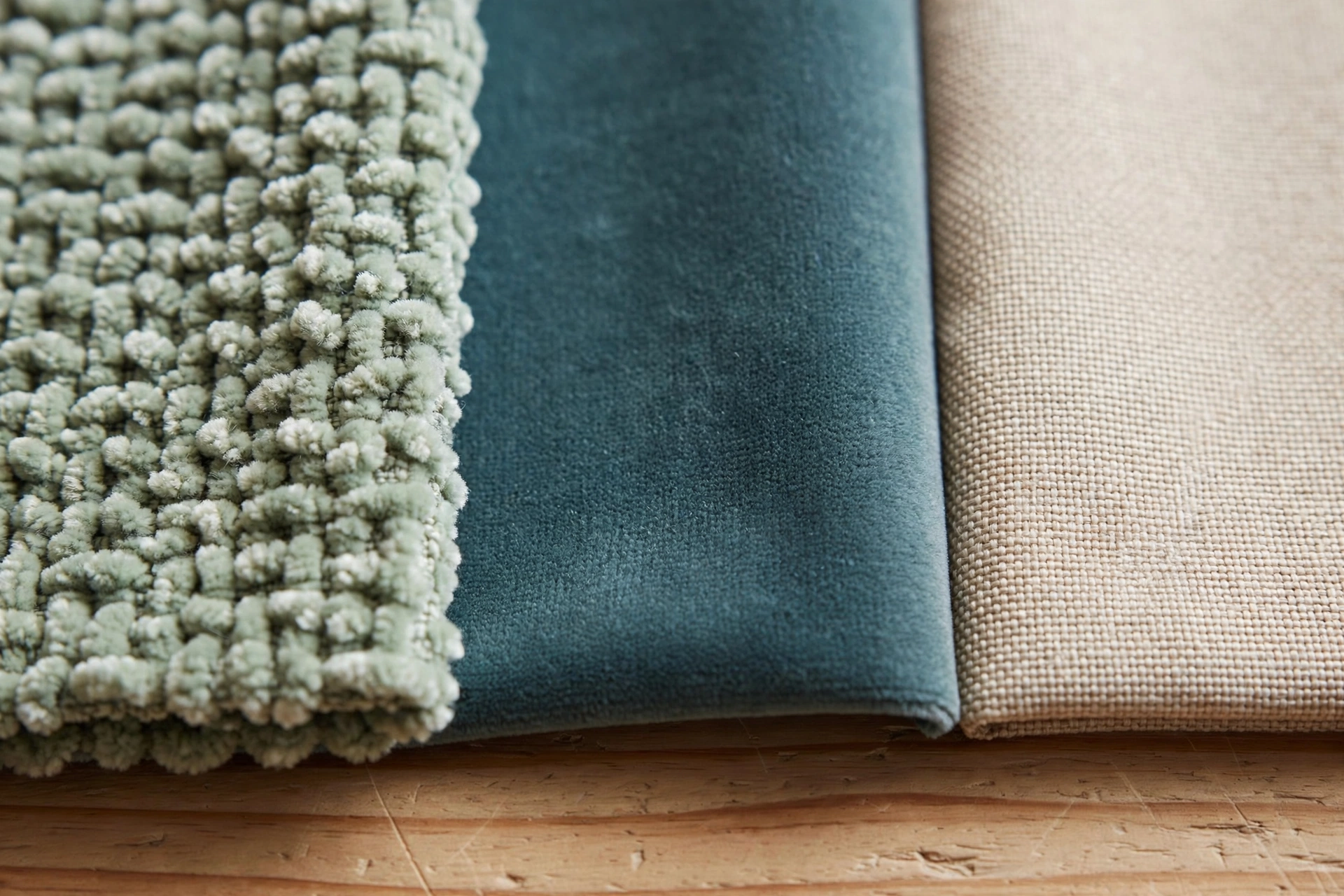
Before the comparisons, plain definitions, because sales tags are not much help. Chenille is a fuzzy, caterpillar-textured yarn (the name comes from the French word for caterpillar) woven into a soft, nubby fabric with a slightly iridescent pile. It feels plush the moment you sit, and it hides wrinkles and casual creasing well. Velvet is a dense, short pile that catches light, which is why it looks rich in person and flat in photos. Polyester upholstery is a synthetic woven fabric — engineered, in other words, for predictable strength and colorfastness rather than for a natural hand-feel.
All three show up on real sofas you can buy today. FLNORW MALL sells a 129.5-inch chenille sleeper sectional for $999 (330 lbs per seat, dual USB ports, pull-out bed), a grey velvet Chesterfield 3-seater for $599 (solid wood and plywood frame, 250 lbs per seat, 23.6-inch seat depth), and a 95-inch polyester sleeper sectional for $1,288 (eucalyptus wood frame, storage ottoman, heavy-duty abrasion rating). I used these three as my reference points all year, because the prices, specs, and materials are all printed on the product pages — no guessing.
Chenille sofa fabric: the cozy snag magnet
Nobody buys chenille for the spec sheet. You buy it because you sat on it once and did not want to get up. The nubby pile is warm, forgiving, and hides the small wrinkles that make a tight-weave fabric look sloppy after a month. It is also, I learned from my sister’s living room, a fabric with two real weaknesses.
The first is snagging. Chenille’s whole charm is its loose, loopy yarns, and claws, zippers, and belt loops all treat those loops as invitations. Eleven days, one cat, one armrest — gone past the point of steaming it back. The second is cleaning: the pile traps dust and pet hair the way a shag rug does, and a spilled glass of red anything does not come out of nubby texture so much as it moves in. You can live with both if your household is claw-free and spill-light. My sister now owns a lint roller the size of a flashlight and has accepted it as a permanent member of the coffee table.
Velvet sofa upholstery: the beautiful high-maintenance one
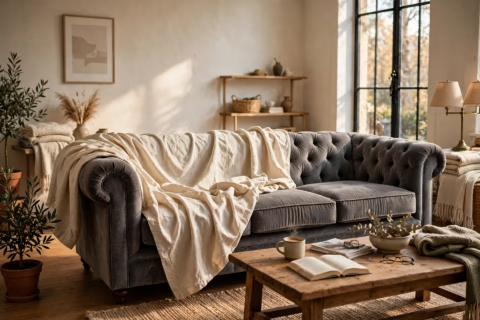
Velvet wins the showroom. Every time. The pile shifts color as you walk past it, which makes even a $599 sofa read expensive. My armchair pulled that trick for about four months, until the elbow-pressure mark showed up and I learned the fabric’s actual personality: velvet does not stain so much as it remembers. Where you sit, how you sit, the angle of the lamp — the pile records all of it as darker and lighter patches.
The good news is that much of it is reversible. Regular brushing and an occasional steam reset the pile surprisingly well; my elbow mark took about six weeks of weekly brushing to stop catching my eye. The care notes on the $599 grey velvet Chesterfield say it plainly: dust regularly, keep it out of direct sunlight, and get professional cleaning rather than improvising with harsh chemicals. Velvet also fades faster than the other two fabrics in a sunny window — the page warns against direct sunlight, and my south-facing reading corner confirmed why.
Polyester sofa fabric: the unglamorous workhorse
Polyester has a marketing problem: the word sounds cheap. Five years of juice boxes, one dog, and roughly four thousand naps later, my friend’s polyester sectional has changed my mind completely. The tight synthetic weave resists the two things that kill other fabrics: abrasion and stains. Her page for the 95-inch polyester sleeper sectional lists a heavy-duty abrasion rating, and the cushions still look squared-off instead of melting into each other.
The honest downsides: polyester does not breathe, so it can feel warm in summer, and cheap polyester pills into little balls along the seat edges. But a well-made polyester weave — tight, heavy-duty-rated, the kind on that $1,288 sectional — simply outlasts the other two fabrics under heavy use. It is the fabric that behaves like the market data says fabrics should behave, which brings us to the numbers.
The wear test: double rubs, explained in plain English
Fabric durability has an actual unit of measurement: double rubs, from the Wyzenbeek test, where a machine rubs a cotton pad back and forth across the fabric until it shows wear. One back-and-forth is one double rub. The rule of thumb my upholstery-shop neighbor gave me: 15,000 double rubs is the floor for residential heavy-duty use. Anything well below that belongs in a formal sitting room, not a family room.
Typical published ranges, flagged as rough because suppliers test differently: polyester upholstery commonly lands at 50,000 to 100,000+ double rubs, chenille in the 25,000 to 50,000 range, and cotton-based velvets lower, often 20,000 to 40,000. That ordering matches the real-world results from my three-house experiment: the polyester sectional still looks new at five years, the chenille is visibly tired at three, and the velvet needed intervention at four months — though, to be fair, velvet’s problem is appearance, not structural failure. Lifespan guides back this up: bamboo-tiger’s 2025 durability roundup puts standard fabric sofas at 7 to 10 years and velvet and other delicate weaves at 5 to 8 without careful maintenance. I wrote a longer version of this in my couch lifespan guide if you want the frame-and-foam side of the story.
How to care for each sofa fabric: my actual routine
Every fabric sofa ships with a cleaning code, and learning yours is worth more than any stain-resistant spray. Here is the short version:
- W: water-based cleaners are fine. Most polyester upholstery lives here.
- S: solvent-based cleaners only — water leaves a worse mark than the spill. Common on velvet and some chenilles.
- WS: either is fine. The easiest code to live with.
- X: vacuum only, no cleaners at all. Usually delicate or treated fabrics.
My weekly routine, which has kept three different sofas presentable across the family:
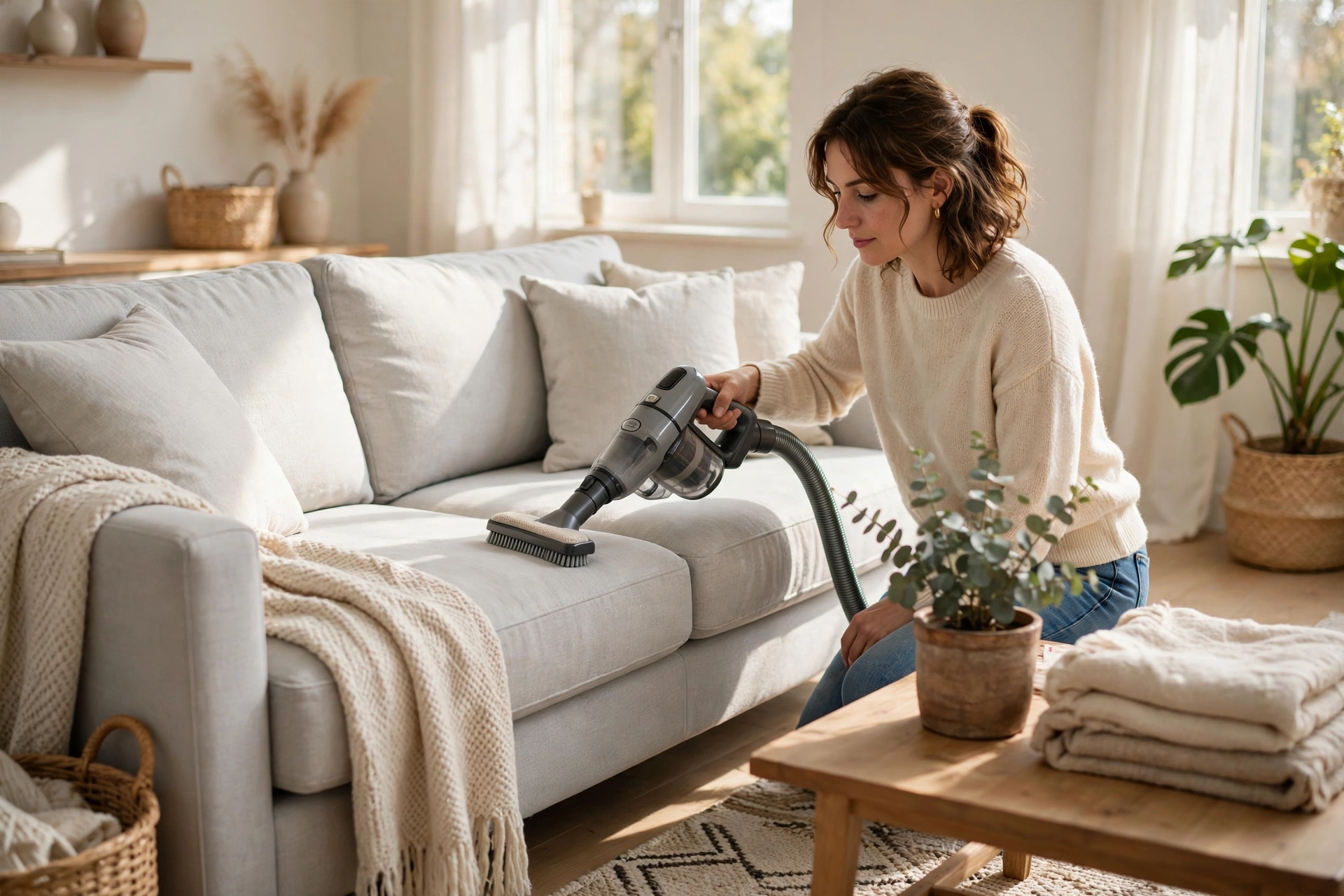
- Vacuum every week with the upholstery attachment — grit trapped in the weave acts like sandpaper, and on chenille it is non-negotiable.
- Brush velvet monthly (weekly in the favorite seat) in the direction of the pile, and steam it twice a year to reset pressure marks.
- Blot spills immediately, never rub — rubbing drives liquid deeper into chenille’s texture and pushes the pile flat on velvet.
- Rotate cushions monthly. The seat you always take wears twice as fast; swapping spreads the aging evenly.
- Keep velvet and chenille out of direct sun. UV fades velvet fast and weakens the fibers over time.
The industry numbers: why polyester quietly runs the world
The market data tells the same story my friend’s living room did. Dataintelo’s Furniture Fabric Market report values the global furniture fabric market at $28.6 billion in 2025, growing to $47.3 billion by 2034 at a 5.8% CAGR. Polyester held 34.2% of that market — about $9.8 billion — making it the single largest upholstery material type by a wide margin. Velvet, for all its showroom charisma, sat at roughly 11.3% share, riding what the report calls a notable design-driven renaissance rather than a durability one.
The broader upholstery fabric market came in at $32.5 billion in 2025 (Dataintelo, 4.0% CAGR to $45.8 billion by 2033), with synthetics taking 47.7% of the total on performance and cost efficiency. And the fastest-growing corner is performance fabric — stain-resistant, high-durability stuff — at about $4.8 billion in 2025, projected to reach $8.6 billion by 2034 at 6.7% CAGR. In other words, the industry is not betting on beauty alone. It is betting on fabrics that survive real houses, which is exactly the bet my friend made five years ago without knowing it.
The verdict
The cost-per-year math seals it. Rough math, marked rough: the $999 chenille sleeper sectional at 8 to 10 years in a pet-free house runs about $100 to $125 a year; the $599 velvet Chesterfield at 7 to 8 years with the brushing-and-steaming routine lands near $75 to $86 a year; and the $1,288 polyester sectional at 10 to 12 years under kids and a dog comes in around $107 to $129 a year. The sticker prices look far apart; the per-year reality is not. The cheapest way to sit well is the sofa whose fabric matches your actual household, maintained the way its cleaning code demands. That is the whole guide in one sentence.
A year of living with all three fabrics made the answer simple: match the fabric to the household, not the showroom lighting. Pets or young kids? Buy the polyester — the heavy-duty weave on the 95-inch polyester sleeper sectional ($1,288, eucalyptus frame, storage ottoman) is the closest thing to furniture armor. No pets, low-spill household, and you melt into softness? The 129.5-inch chenille sleeper sectional ($999, pull-out bed, dual USB) is the coziest of the three. And if you want the piece everyone photographs, accept the brushing ritual, and keep it away from the cat — the grey velvet Chesterfield ($599, 23.6-inch seat depth, removable cushions) is unbeatable per dollar of drama. Vacuum weekly, brush the velvet, blot the spills, and whichever you pick will earn the top of its lifespan range.
Shop the three fabrics: 129.5-inch chenille sleeper sectional — $999 · Grey velvet Chesterfield 3-seater — $599 · 95-inch polyester sleeper sectional — $1,288 · Browse all furniture at FLNORW MALL · FLNORW MALL homepage