Microwave Hutch Cabinet: 4 Sq Ft Back for $299
My kitchen is ten feet wide, and for three years the microwave and the coffee maker occupied the only useful counter between the stove and the sink. I tried stacking. I tried the top of the fridge, which lasted exactly one soup spill. Then I bought a 71-inch microwave hutch cabinet from FLNORW MALL for $299, and ninety days later I have measurements, a cable-management trick, and two honest complaints.
This is the full accounting — the countertop math, the clearance rule that matters with microwaves, assembly with a 112-pound box, and what ninety days of daily use actually did to the finish.
Microwave Hutch Cabinet Specs: What $299 Actually Gets You
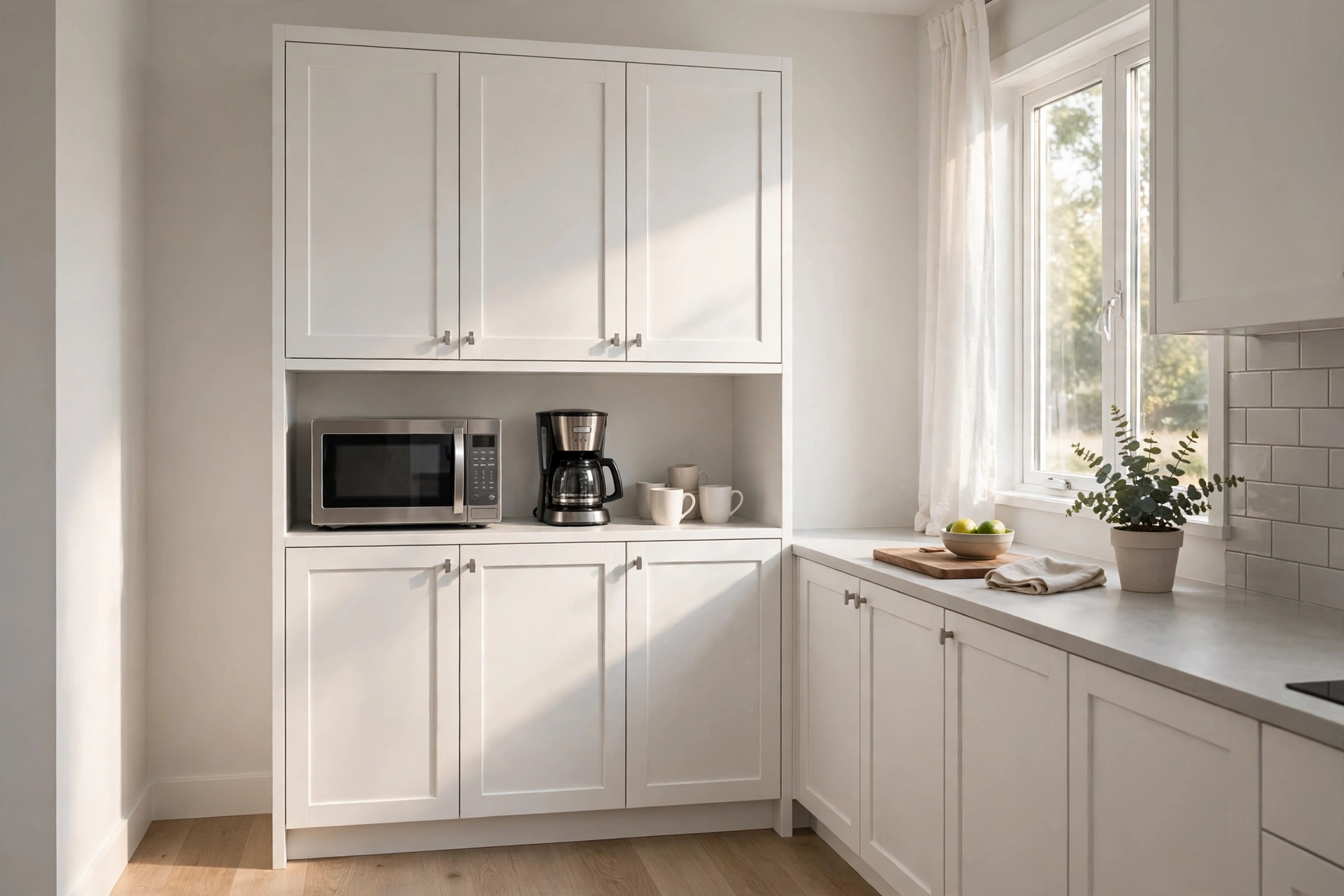
The product page lists it as a 71-inch kitchen pantry cabinet with microwave oven countertop — item code W1417S00020, in stock at $299. Assembled dimensions are 70.87 inches tall, 39.76 inches wide, and 14.68 inches deep. The box that arrived weighed 111.9 pounds, and the shipping package tipped the scale at 121.1.
Build-wise, it is E1 MDF with a UV-painted white finish — three coating passes per the product page — with metal handles, 6 doors and 1 drawer, adjustable interior shelves, and an open gray countertop shelf in the middle made for a microwave or coffee machine. The page lists a 120-pound load rating, anti-tip wall hardware, and two cable-management holes on the back panel. Assembly estimate on the page: 180 minutes.
First impression, panels laid out on my living room rug: the UV finish looked cleaner than I expected at this price — smooth, no orange peel, no visible seams on the white panels. The open shelf is the piece’s whole reason to exist, so I measured it before anything else: it swallows a full-size countertop microwave with room to spare on every side.
The Countertop Math: Four Square Feet Back
Here is the part I ran before I bought it. My microwave occupies roughly 21 by 17 inches of counter — about 2.5 square feet. The coffee maker next to it takes another 8 by 12 inches, call it 0.7 square feet. Together with the breathing room you need around both, that was about four square feet of my one usable counter run — gone.
The hutch’s open shelf is 39.76 by 14.68 inches: just over 4 square feet of appliance footprint, relocated off the counter entirely. Both appliances moved onto the shelf. The microwave went in first, pushed back so the door clears, and the coffee maker sits beside it with the bean jar and two mugs. My actual counter is empty now except a cutting board, which felt like a renovation.
Rough estimate, and I will flag it as one: in a ten-foot galley, four reclaimed square feet is roughly a third of my prep space. At $299 over five years, the cabinet costs about $0.16 a day — less than the electricity I burned staring at the toaster’s old spot.
The Microwave Clearance Rule I Follow (and Why the Cord Holes Matter)
A kitchen pantry cabinet with microwave storage is only as good as its airflow. Countertop microwaves need breathing room around the cabinet — my microwave’s manual calls for several inches of clearance on the sides and top, so I checked the manual and measured before sliding it in. The open shelf on this hutch is open on three sides, which is the part that makes it work: heat dissipates instead of pooling the way it would in a closed cabinet.
The two cable-management holes on the back panel are the detail I did not know I needed. The microwave cord drops straight through the rear hole to the wall outlet — no cord draped over the shelf edge, no cord wedged behind the unit. The coffee maker cord goes through the second hole. It is a small thing until you realize it is also why the shelf stays easy to wipe down: nothing snakes across the surface.
One safety note from experience: anchor this thing. At nearly six feet tall and only 14.68 inches deep, any freestanding kitchen hutch with a 25-pound microwave on a mid shelf gets the anti-tip strap. The hardware is included. I installed it before I loaded a single can.
Assembly Day: 112 Pounds, One Neighbor, Two Hours
The product page estimates 180 minutes; with my neighbor helping, we did it in about two hours with an electric drill, which the page itself suggests as a labor-saver. The honest breakdown: the first 45 minutes were sorting panels and reading the diagram-heavy instructions, the middle hour was straightforward screws-and-cams, and the last 15 minutes were door alignment.
Two-person is not optional here. The 111.9-pound assembled weight means the side panels are awkward to hold upright alone, and standing the carcass up was a two-person lift. The 1-drawer runner needed a second seating to glide cleanly. Door hinges, as with nearly every flat-pack cabinet I have assembled, wanted a quarter-turn of adjustment after the first month of daily opening. Five minutes with a screwdriver, done.
The white UV finish deserves one warning from my experience: lay the panels face-down on a blanket, not the bare floor. I scuffed nothing, but one careless slide of a metal handle across a panel would have left a mark I could not unsee.
Adjustable Shelves: the Five-Zone Layout That Stuck
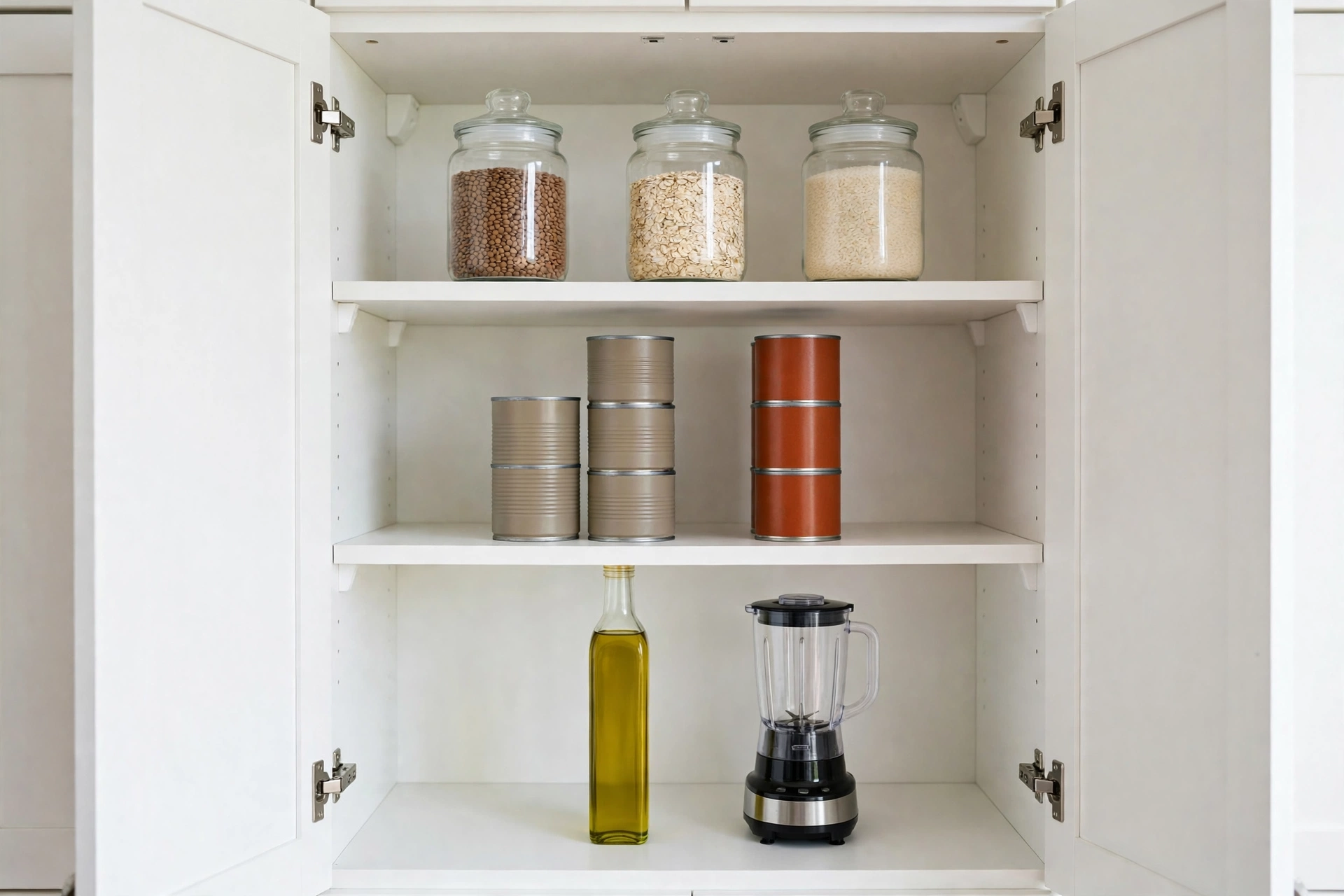
The adjustable shelves are what separate an appliance garage cabinet from a decorative one. Fixed shelves would have wasted half the interior on my tall olive-oil bottles and stockpots. After ninety days, my layout has not changed, which is the real test. Here is what lives where:
- Top zone: tall items the microwave-shelf crowd forgets — olive oil, vinegar, a blender on its side, boxed broths standing upright.
- Middle-left: daily cooking — 40 cans of beans, tomatoes, and soup, counted during a reorganization. Everything visible at eye level, nothing stacked more than one deep.
- Middle-right: dry goods in jars — lentils, oats, rice, sugar — because the shelf heights adjust in small increments, the jars fit without wasted headroom.
- Bottom cabinets: the heavy stuff — a stand mixer, the food processor, the Dutch oven — low, where 112 pounds of furniture plus contents will not make the doors complain.
- The drawer: small chaos — batteries for the scale, twist ties, the thermometer, spare shelf pegs in a zip bag.
Compared with my old setup — one sad 24-inch base cabinet where groceries went to be forgotten — this is a different category of storage. My rough count: roughly 60% more dry-goods capacity, and I stopped finding expired cans from 2022. That last part is my favorite feature and it was free.
Microwave Hutch Cabinet Complaints: the Honest Part
Two real complaints. First: 14.68 inches deep is shallow. Standard cereal boxes fit, but only just, and bulk-size anything does not. A gallon of milk will not go in the doors. If your storage dreams involve Costco cases, measure your biggest items first — this is a microwave stand with storage, not a walk-in pantry.
Second: the white finish shows kitchen life. Ninety days of steam from the coffee maker have not yellowed or bubbled the UV coating — it genuinely wipes clean with a damp cloth, and a ketchup splash on the lower door came off in under a minute with no stain. But white shows dust on the top panel within a week, so the top shelf of a 71-inch cabinet needs a monthly wipe I did not budget for. Minor, but honest.
Context on the material, since I know the question is coming: this is MDF, not solid wood. I wrote a whole guide on solid wood versus MDF before buying — the short version is that a freestanding kitchen hutch you assemble once and anchor to the wall is exactly the use case where MDF earns its keep, as long as water never sits on it. Ninety days in, that rule has held: wipe spills, and the finish looks the same as day one.
The Market Backdrop: Why Kitchen Storage Is a $26.9 Billion Obsession
I am not the only one buying storage instead of remodeling. Mordor Intelligence’s 2025 report puts the US kitchen furniture market at $26.90 billion in 2025, projected to reach $35.99 billion by 2031 at a 4.97% compound annual growth rate — and kitchen cabinets alone account for 59.42% of expenditure, the report’s largest line item.
Read that as a small-kitchen owner and the message is clear: Americans are pouring money into cabinetry because kitchens are the room where storage is the renovation. A kitchen cabinet with countertop space for $299 is the renter-friendly end of the same trend the report tracks — storage infrastructure, without the contractor.
Microwave Hutch Cabinet Verdict: Who Should Buy It
Ninety days in, here is my honest breakdown. Buy it if your microwave and coffee maker are eating your only counter, you are a renter or small-kitchen owner who cannot add cabinets, and you will anchor a tall piece to the wall — the countertop math is real, the cable holes are genuinely useful, and the white finish makes a small kitchen look bigger than it is. Skip it if you need deep storage for bulk goods, or if your kitchen already has enough counter that the appliances are not in the way.
Would I buy it again at $299? Yes — and it pairs naturally with pieces from the same kitchen-storage family: my longer look at a $168 farmhouse pantry cabinet covers the narrower rattan option, the $199 coffee bar cabinet is the dedicated station version, and the $299 rolling kitchen island cart is what I would buy next if I needed prep space instead of appliance space. The rest of the lineup lives at FLNORW MALL.
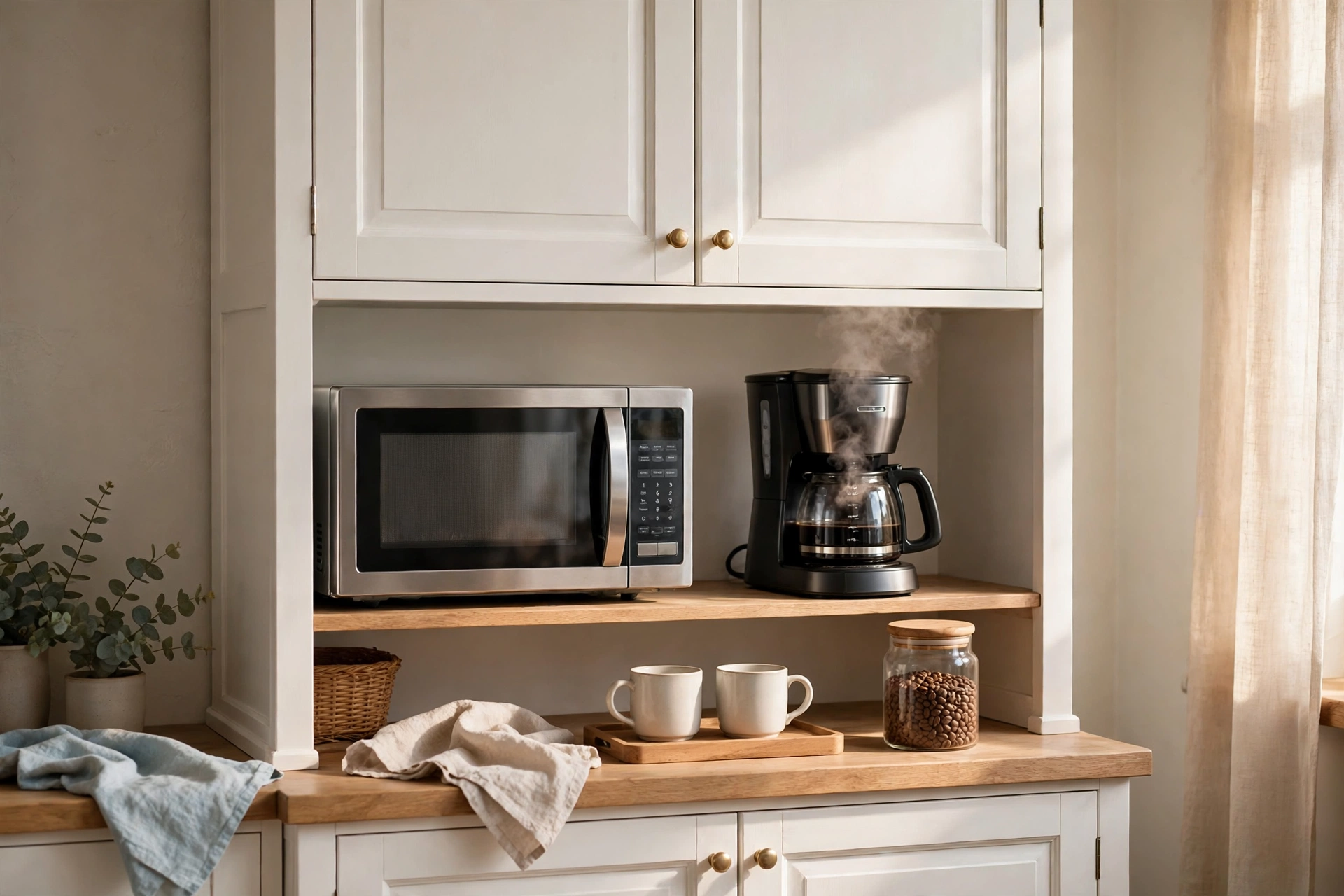
The bottom line: a $299 cabinet that gave me back four square feet of counter, hid two appliance cords, and survived ninety days of coffee-maker steam without a mark. My microwave finally has a room of its own — and my cutting board has its counter back.
Get the 71″ Kitchen Pantry Cabinet with Microwave Countertop — $299 at FLNORW MALL