I Bought a $380 Outdoor Storage Shed. Here Is the Buying Guide I Wish I Had.
My garage has a name for the strip of floor between the mower and my car door: the gauntlet. For three years I sidestepped the push mower, leaned bikes against the chest freezer, and kept the trash bins where they blocked the walkway. Every spring I told myself I would clean it out; every fall the leaves piled on top of the mess and I gave up. This September I finally did the thing I should have done years ago: I bought an outdoor storage shed and moved the entire gauntlet out of the garage.
I picked the 6×4 metal storage shed from FLNORW MALL at $380. Not the cheapest per square foot on the internet, not the prettiest — the one that made the most sense for a homeowner who hates painting things. Six weeks later, with the mower, two bikes, and eleven totes of holiday decor out of the garage, here is the storage shed buying guide I wish someone had handed me before I started.
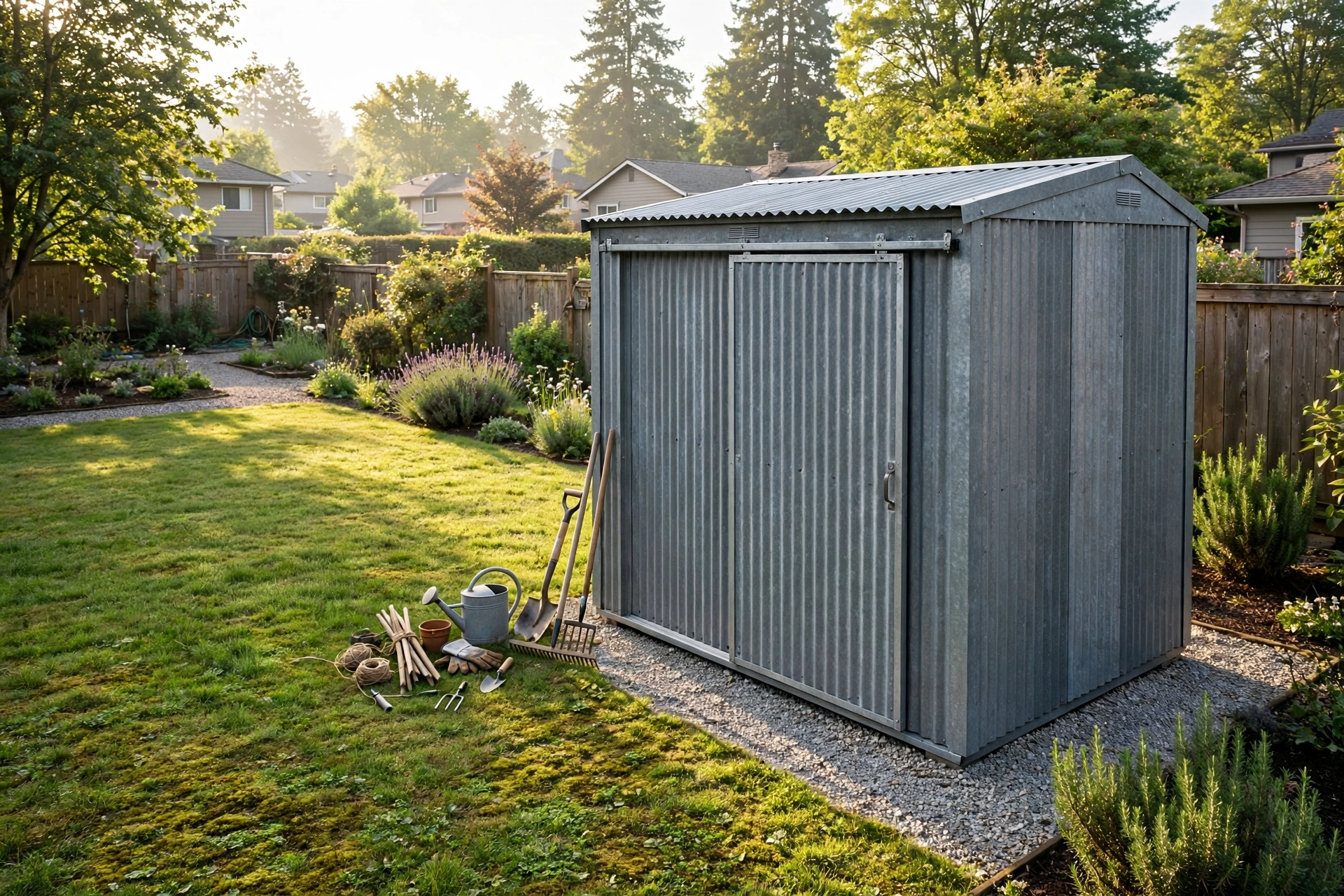
What 24 square feet actually holds
A 6-by-4 shed is 24 square feet. That number meant nothing to me until I taped it out on the garage floor with painter’s tape and stood inside the rectangle with my mower.
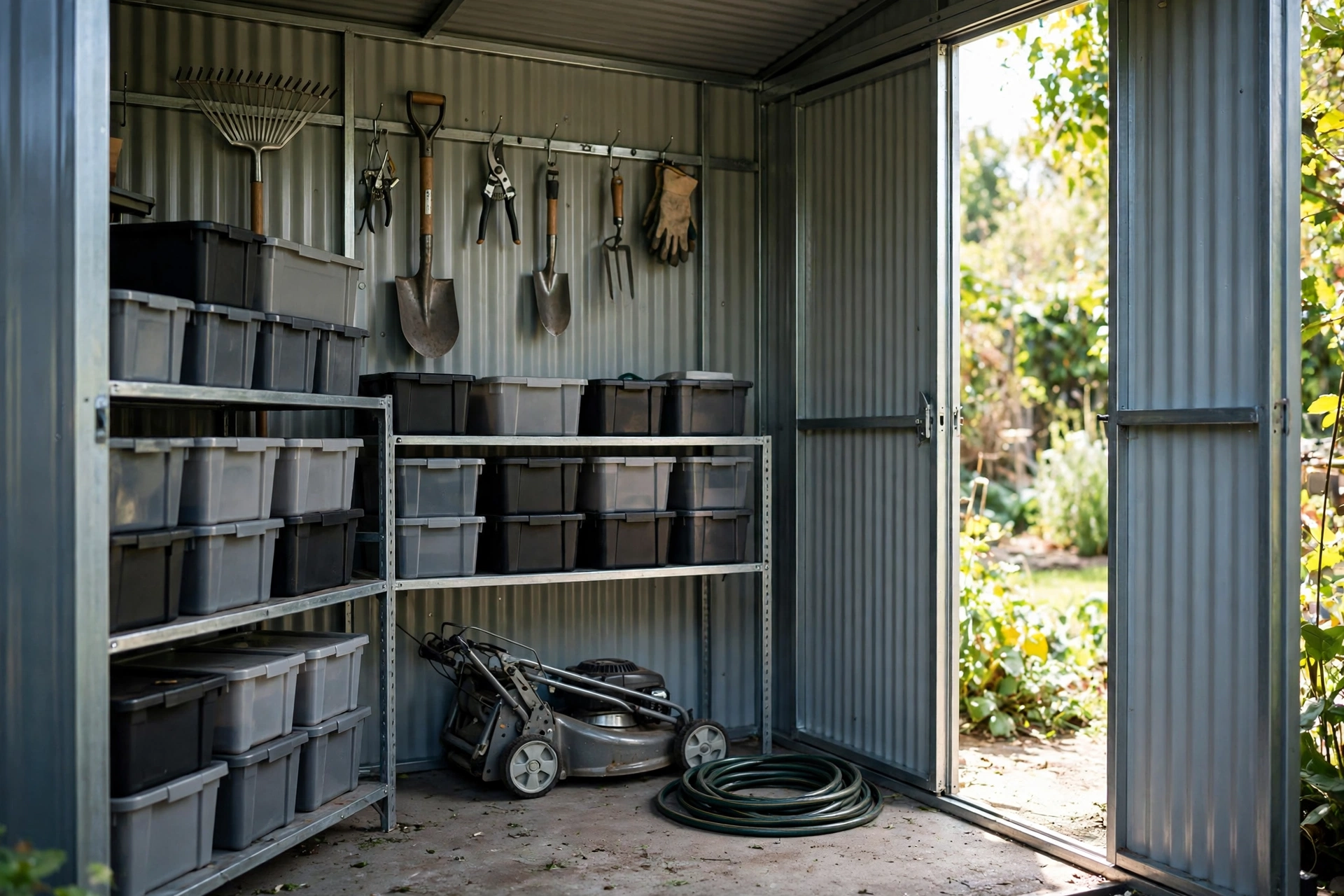
Here is the real inventory, measured, not guessed: my 21-inch push mower takes about 21 by 36 inches with the handle folded — roughly 5.25 square feet. Two adult bikes, parked facing opposite directions, take about 6 feet long by 2 feet wide each — 12 square feet total, half the shed right there. Two standard 32-gallon trash bins take about 2 square feet each. Six 10-gallon holiday totes stacked on the included shelf take zero floor space.
Total: about 23 square feet. A perfect fit with room to walk in and turn around — barely. That is the honest truth about a small storage shed 6×4: it is a garage-overflow solver, not a workshop. If you are storing a riding mower, a kayak, or a workbench, you are not shopping this size. If you are moving the mower, the bikes, the bins, and the Christmas totes out of the garage — the exact things that eat suburban garages — 24 square feet is the sweet spot.
The size math: measure your stuff before you measure your yard
The most common shed-buying mistake is sizing the yard instead of sizing the contents. The industry numbers back that up: Dataintelo’s 2025 residential outdoor shed report found that medium sheds — 100 to 200 square feet — are the most popular category at about 44.8% of market volume, while small sheds under 100 square feet account for 31.6% of unit sales. Almost a third of shed buyers land in the small end, where the math is least forgiving.
Here is the sizing rule that would have saved me an hour of tape-measuring. Lay out your three largest items. Add 12 inches of working room around each item’s footprint. Then check the door: your widest item needs the door opening plus at least 4 inches of clearance. A 21-inch mower deck fits through most shed doors; a 26-inch riding mower does not, no matter what the floor math says. Finally, check the height: rakes, shovels, and a standing weed whacker need 5 feet of vertical clearance.
My lesson: I bought for the stuff I actually own, not the stuff I might someday own. A 6×4 shed holds a family’s real garage-overflow. It will not hold a future riding mower — and admitting that saved me $400.
Metal vs wood vs resin: the honest breakdown
The three shed materials each win something and lose something. Wood dominates the market — about 42 to 44% share depending on whose 2025 report you read (Dataintelo puts wooden sheds at 43.9% of the outdoor storage sheds market, and wood garden sheds alone are a $6.36 billion category). Wood looks the best in a garden. It also rots, needs re-sealing or repainting every two to three years, and costs 30 to 50% more than the same size in metal.
Resin — the plastic-composite sheds — is the easiest to assemble and the priciest per square foot. It will not rot or rust, but it fades in harsh sun, and you cannot hang heavy tools on the walls the way you can with steel.
Metal sheds hold about a quarter of the market and are gaining fast: Dataintelo’s garden buildings report has metal sheds growing at 6.2% a year, outpacing wood. The reasons match my experience exactly. Galvanized steel panels with an aluminum frame will not rot, will not host insects, and need zero paint. The honest trade: thin metal panels can dent — a dropped ladder will leave a mark — and cheap metal sheds rattle in wind. What sold me on this one: four punched metal vents (plastic vents crack under UV after a few summers), electro-galvanized steel with UV-resistant coating, and a pad-lockable sliding door with the padlock actually included in the box.
The garden shed foundation is the step everyone wants to skip
Every shed assembly guide buries the foundation on page three. It should be page one. An unlevel shed twists, the doors stop sliding, and water pools inside.
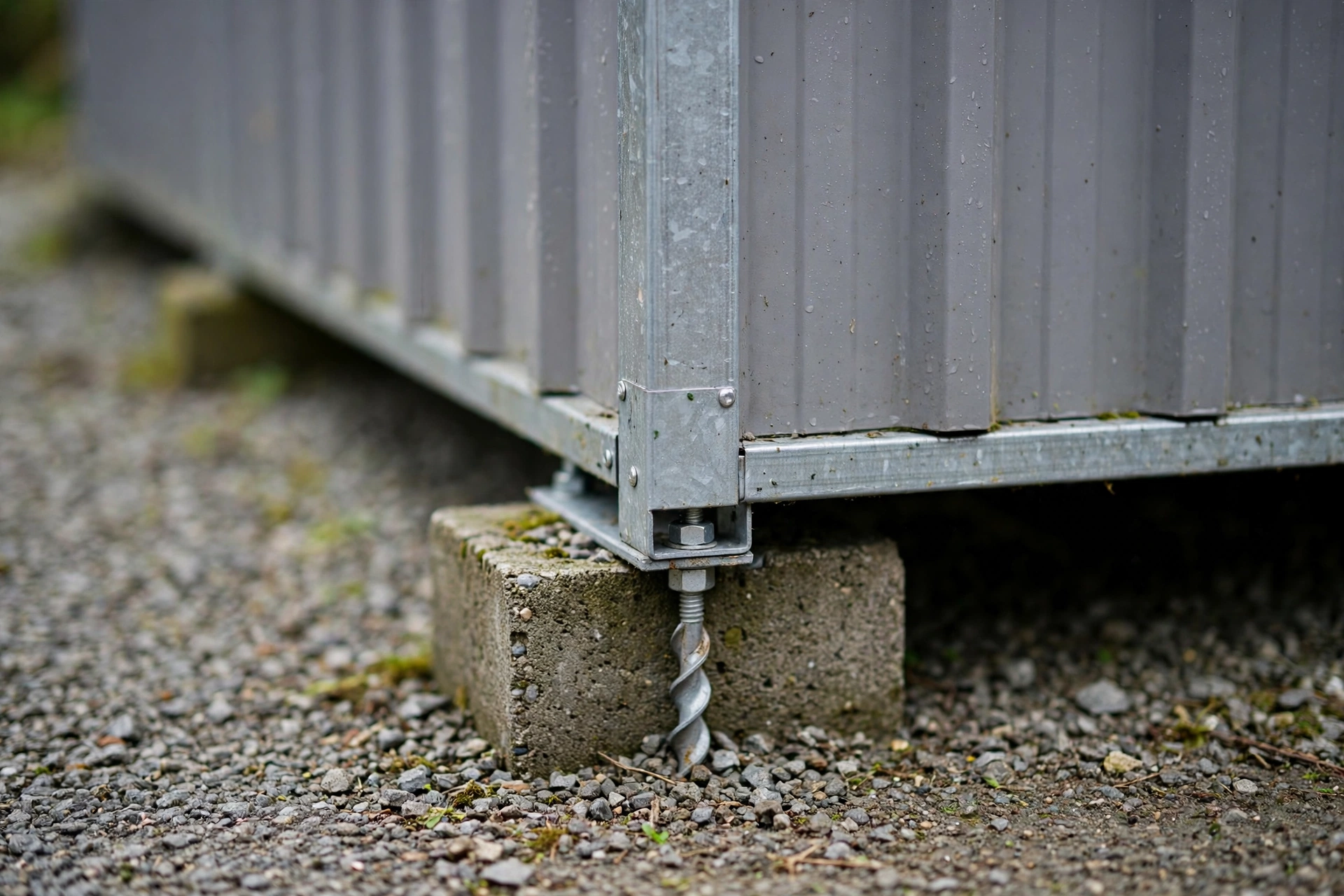
This shed ships with a metal foundation frame included — one less thing to buy — but the frame still needs to sit on something level. Your three real options: a gravel pad, 4 to 6 inches of compacted crushed stone over weed fabric (what I did — drains well, forgives minor settling, about $60 of stone from the landscape yard); a concrete slab, the gold standard and the only option that reliably doubles as a sweepable floor (budget $200 to $400 if you pour it yourself); or a plastic shed base grid that snaps together and fills with gravel.
My honest note: level it to within an inch across the whole footprint. My pad dipped three-quarters of an inch on one corner — I caught it before assembly, shimmed with crushed stone, and the sliding doors run true. Miss that and you will fight the door every day for a decade.
Assembly day: one hundred pounds of flat box
The shipping box measures 63.77 by 22.04 by 4.72 inches and weighs 100.31 pounds. Plan for two people to carry it — one person can do the assembly, but nobody should carry a hundred pounds of sheet metal solo.
The frame is pre-cut and pre-drilled aluminum, and the panels are electro-galvanized steel with a corrosion-resistant coating. The whole job took me most of a Saturday afternoon. Two things I would tell you: wear the included gloves (the panel edges are sharp, and they put gloves in the box for a reason), and do not fully tighten anything until every panel is on — metal sheds forgive, but only if you leave the bolts loose until the end.
The sliding doors are the feature I underappreciated. They do not swing out, which means you can stand right in front of the shed and open it — no clearance arc. The included kit tells the story: metal foundation, anchors, hooks, a shelf, the padlock, and gloves. That is a short list, and a good one — it means the $380 price is the real price, not a down payment on accessories.
The industry numbers: sheds are having a moment
I looked up the market because I wanted to know if I was buying into a fad. The global outdoor storage sheds market was valued at $10.95 billion in 2025, projected to $17.42 billion by 2034 at 5.2% a year (Dataintelo, 2025). The residential slice alone runs $9.8 billion in 2025 growing at 5.9% annually, and about 48% of homeowners cite storage expansion as the main reason they buy a shed. I am the 48%.
This matters for your wallet in a practical way: mature commodity categories price rationally. At $380 for 24 square feet, I paid $15.83 per square foot — in a year, the category will be bigger and the prices will still be boring. Buy the size you need, not the size that is on sale.
Five things I would tell my neighbor
My neighbor watched me wrestle the second wall panel into place and asked the questions you would ask:
- Size for the stuff you own today. Your three biggest items plus 12 inches of working room. Future-you can buy a bigger shed later.
- Build the gravel pad first and level it to the inch. Everything after depends on this.
- Anchor it on day one. A hundred pounds of panels is a sail in a real storm. The anchors are in the box — use them before the first thunderstorm, not after.
- Metal if you hate maintenance, wood if you love the look enough to maintain it. Be honest about which person you are.
- Measure your mower against the door opening, not the floor plan. The most common sizing regret is not floor space — it is a door that fits everything except the one thing you bought the shed for.
The verdict
Six weeks in, my garage has two car spots again for the first time in three years. The mower lives in the shed, the bikes live in the shed, the holiday totes live on the shed’s shelf, and the trash bins no longer block the walkway. The 6×4 outdoor storage shed solved the exact problem I bought it for: getting the bulky, dirty, garage-shaped stuff out of the garage.
At $380, the math works. That is $15.83 per square foot of weatherproof, lockable storage — cheaper than a single month of a 5×5 storage unit in most zip codes (mine quotes around $60 a month, so figure a six-month payback, estimate). It will not rot, it will not need paint, and it comes with everything except the gravel pad. For a homeowner with a garage-overflow problem, this is the right-sized answer.
Ready to clear your garage? Check the 6×4 outdoor storage shed at FLNORW MALL — and if your garage chaos is indoors, read my lockable garage tool cabinet review and my holiday decor storage system for the rest of the playbook. The pop-up gazebo covers the backyard, and the full collection is at FLNORW MALL.