Bookcase Buying Guide: 6 Lessons From a Bookshelf That Almost Fell Over
Bookcase Buying Guide: 6 Lessons From a Bookshelf That Almost Fell Over
My first bookcase cost $79, and it lasted eight months. The middle shelf bowed like a hammock, the thin backing panel popped out at the corners, and one Tuesday morning I hauled the whole thing to the curb. The replacement was sturdier, but it taught me lesson two: a tall bookcase nobody anchors to the wall is furniture with a plan. One evening I pulled a heavy cookbook off the top shelf and the whole unit leaned forward. I caught it with one hand and my dignity with the other.
So this bookcase buying guide is not written by a furniture catalog. It comes from someone who has dragged, assembled, overloaded, and nearly toppled three of them. Here is what actually matters when you buy a bookcase for a real American home: shelf depth, weight ratings, materials, wall anchoring, and the little cabinet nobody thinks about until they need it.
Rule 1: shelf depth decides what actually fits
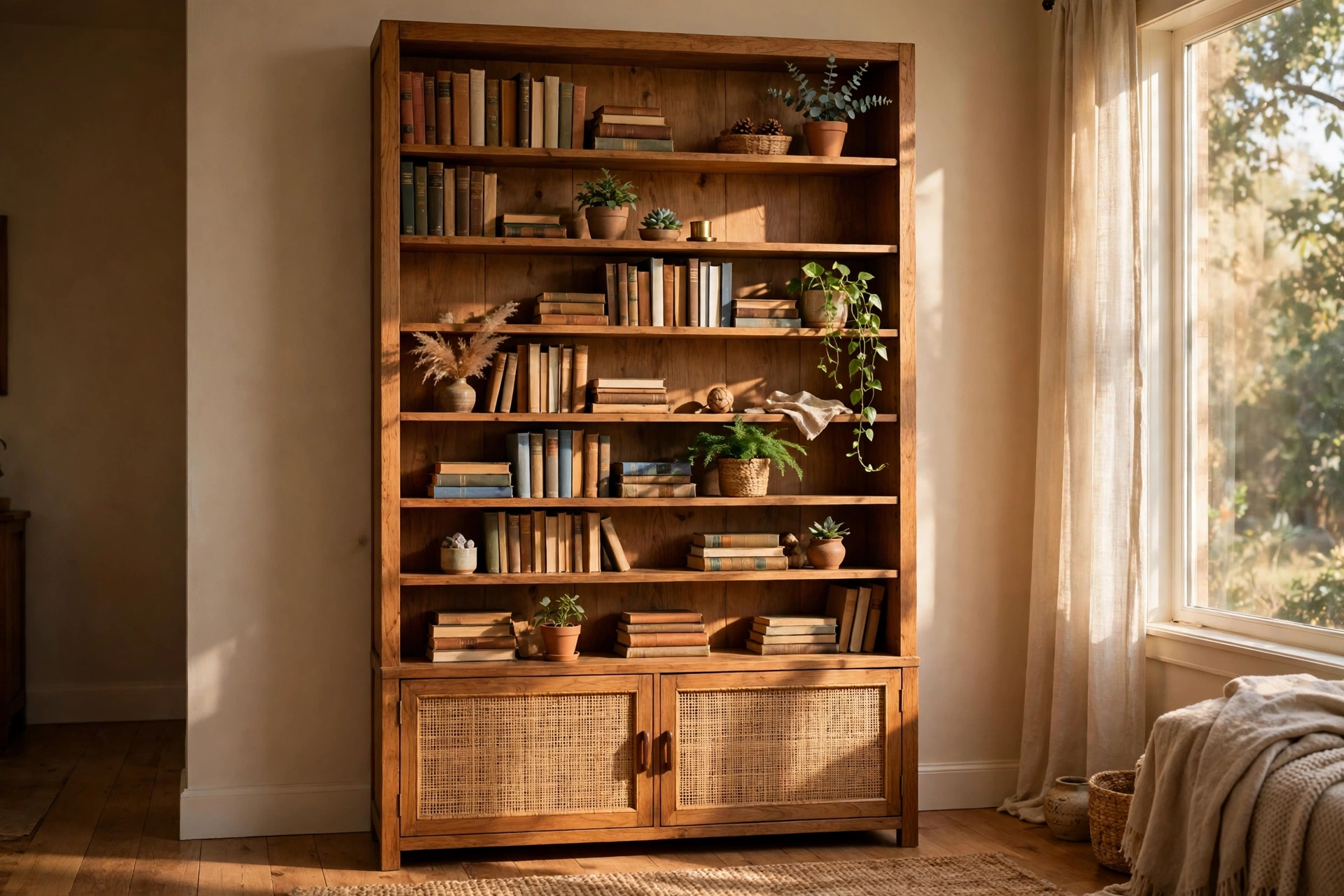
Most novels are about 8 inches tall; standard paperbacks need roughly 9 inches of clearance. Art books, textbooks, board games, and vinyl records want 10 to 12 inches. My current bookcase is a 7-tier rattan bookshelf from FLNORW MALL — 39.4 inches wide, 13.8 inches deep, 75.6 inches tall — and that 13.8-inch depth is the number that made me stop scrolling. Most budget bookcases give you 10 or 11 inches, which means art books and records stick out like a row of teeth. When you measure, think about the tallest item you own, not the average one. If you are asking how deep should a bookcase shelf be, the honest answer is 12 inches minimum for a general-purpose shelf.

Rule 2: books are heavier than you think — respect the weight rating
Here is the number nobody prints on the box: a packed linear foot of hardcover books weighs roughly 20 pounds — that is my estimate, and it holds up once you weigh one box of books at the post office. My $79 shelf had per-shelf ratings in the 10 to 12 pound range; I know this because the middle shelf started sagging within weeks. When you shop for a bookcase, ask for the bookshelf weight capacity per shelf, not just the total. The rattan bookshelf I ended up with weighs 78.1 pounds on its own, with a metal frame — heavy units do not sway, and sway is what kills cheap shelving. If a product page will not tell you the weight rating, that silence is your answer.
Rule 3: anything tall gets anchored to the wall — no debate
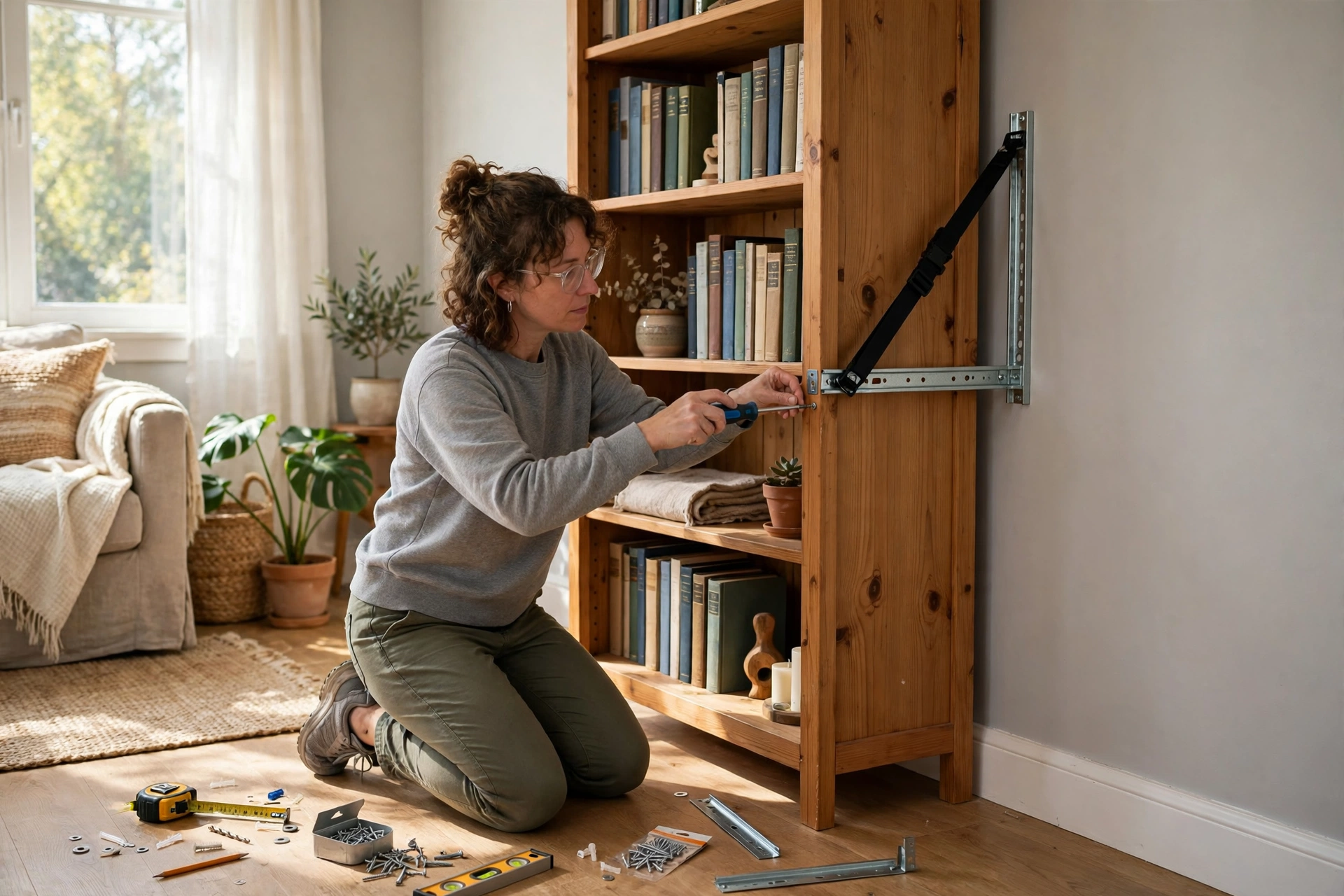
My bookshelf is 75.6 inches tall — over six feet, holding well over a hundred pounds of books. Any freestanding piece of furniture that tall needs to be strapped or bracketed to a wall stud. The US Consumer Product Safety Commission has spent years pushing tip-over safety; the STURDY Act became law in December 2022, and the CPSC’s mandatory stability rule for clothing storage units took effect September 1, 2025. Bookcases are not covered by that rule, but gravity does not read regulations. Ten minutes with a stud finder, an L-bracket, and an anti-tip strap — if you want the full step-by-step, I wrote a furniture anchoring guide after my near-miss. Do it the day you assemble the shelf, not the week something tips.
Rule 4: particle board is not a dirty word, but know what it means
The $238 rattan bookshelf is laminated particle board with a metal frame and rattan-front cabinets, and honestly that combination is the sweet spot for the money. Particle board handles vertical load fine; what it hates is moisture and screws being driven in and out repeatedly. Keep it dry, assemble it once, and it will outlast the trend cycle. Solid wood costs triple and still moves with humidity. What you are really buying at $238 is the engineering: a 78-pound unit with a metal frame and adjustable foot pads does not wobble the way a 30-pound flat-pack does. Particle board bookshelf durability is mostly a function of assembly quality and load discipline, not the material name on the label.
Rule 5: the closed cabinet at the bottom is the feature nobody advertises
Seven open shelves sound like the whole product, but the bottom cabinet is what keeps the thing looking good a year from now. Mine has a rattan cabinet at the base, and it swallows the ugly essentials: chargers, remotes, printer paper, my kid’s LEGO overflow. Open shelves display; closed storage forgives. When you compare bookcases, count closed storage as a separate feature and weigh it accordingly — it is the difference between a styled shelf and a visible junk pile.
Rule 6: style it the way you actually live
A bookcase buying guide that skips styling is leaving money on the table. Four bookshelf styling ideas that survived contact with my house:
- Leave 20 to 30 percent of each shelf empty. Packed shelves read as storage; breathing shelves read as a home.
- Put the heaviest books on the lowest shelves. It lowers the center of gravity — which matters for stability — and your back will thank you.
- Alternate vertical rows with horizontal stacks. Three or four books lying flat with a small plant on top breaks the monotony.
- One small object per shelf section, maximum. A framed photo, a candle, a plant — pick one, not all three.
The money math: $238 once versus $79 twice
The cheap route: $79 plus two trips up the stairs plus eight months plus one curb run. That worked out to roughly $10 a month of usable life, plus a sore back. The 7-tier rattan bookshelf at $238 gives me seven shelves, a cabinet, and 78 pounds of actual furniture. If it lasts five years — a conservative estimate for particle board with a metal frame that never gets moved — that is under $4 a month, and the rattan looks better as it ages. Buying the cheap thing twice is the most expensive option there is. (Estimates flagged; your mileage depends on how many books you own.)
Specs worth understanding before you buy
- 39.4 inches wide: about three feet of books per shelf — plan 20 to 25 books per shelf at average spine width.
- 13.8 inches deep: art books, record albums, and board game boxes fit without overhang.
- 75.6 inches tall: over six feet — anchor it to the wall. See Rule 3.
- 78.1 pounds: heavy means stable. Light bookcases sway.
- Adjustable foot pads: keeps the frame off the floor and levels out uneven hardwood.
The verdict: Two failed shelves taught me what no product page volunteered: depth decides what fits, weight ratings decide what survives, anchoring decides what stays standing, and the little cabinet at the bottom decides what still looks good next year. The $238 rattan bookshelf passes all four tests, and it did not take me a fourth trip to the curb to prove it.
Ready to measure twice and buy once? See the full specs and photos of the 7-tier rattan bookshelf at FLNORW MALL, browse the furniture collection for the rest of the room, and anchor the thing the day it arrives — your future self says thanks.