Bar Stool Height Guide: How I Stopped Guessing and Measured My Kitchen Island Right
When we bought our house three years ago, the seller left their bar stools behind at the kitchen island. They were tall, dark, and — I measured this on a frustrated Saturday morning with a dented Stanley tape — a full 30 inches to the seat. My island counter is 36 inches high. That left only 6 inches of thigh clearance, and my knees learned it before my brain did.
Breakfast meant jamming my legs under the countertop apron, shoulders hunched like I was eating off a shelf. My 11-year-old needed a running start to climb up, and getting down involved a small controlled fall. We replaced them within two months, and that replacement run taught me something no showroom salesperson ever mentioned: bar stool height is almost entirely math. Counter height, seat height, spacing, knee room — every piece has a number, and the numbers do not forgive guessing. This bar stool height guide is everything I wish someone had handed me before that Saturday morning.
Why Bar Stool Height Is the First Thing to Get Right
Everything else about a stool — the fabric, the swivel, the style — is a preference. Height is physics. Too tall and your thighs wedge against the counter apron; your shoulders rise, your plate sits at chest level, and a 20-minute breakfast feels like a long meeting. Too short and you eat with your chin over the plate, elbows flared, feet dangling like a kid at the grown-ups’ table.
The worst part is that a wrong-height stool is not a minor annoyance. You will use these seats daily — coffee, homework, paying bills, entertaining friends. A one-inch mistake multiplies across thousands of sittings. I kept our too-tall stools for seven weeks before admitting defeat. Do the math before you buy, and you will never have to repeat my Saturday-morning tape-measure ritual.
The 10-Inch Rule: Bar Stool Height Math That Does Not Lie
The furniture industry’s standard rule is dead simple: the seat should sit about 10 inches below the counter surface. That gap gives your thighs room to slide under comfortably while keeping the eating surface close enough to feel natural. Here is the full bar stool size chart I now keep on my phone:
- 24–26 inch seat → 34–36 inch counter (counter height — standard kitchen islands and counters)
- 28–30 inch seat → 40–42 inch bar (bar height — raised breakfast bars and home bars)
- 20 inch seat → 30 inch table (table height — technically a stool, but sized like a dining chair)
- 32–34 inch seat → 43–46 inch surface (extra-tall / spectator height — commercial bars)
Notice what those old stools did wrong: 30-inch seat against a 36-inch counter is a bar-height stool on a counter-height island. Six inches of clearance instead of ten. The chart above would have caught it in ten seconds.
Know Your Surface First: Counter Height vs Bar Height
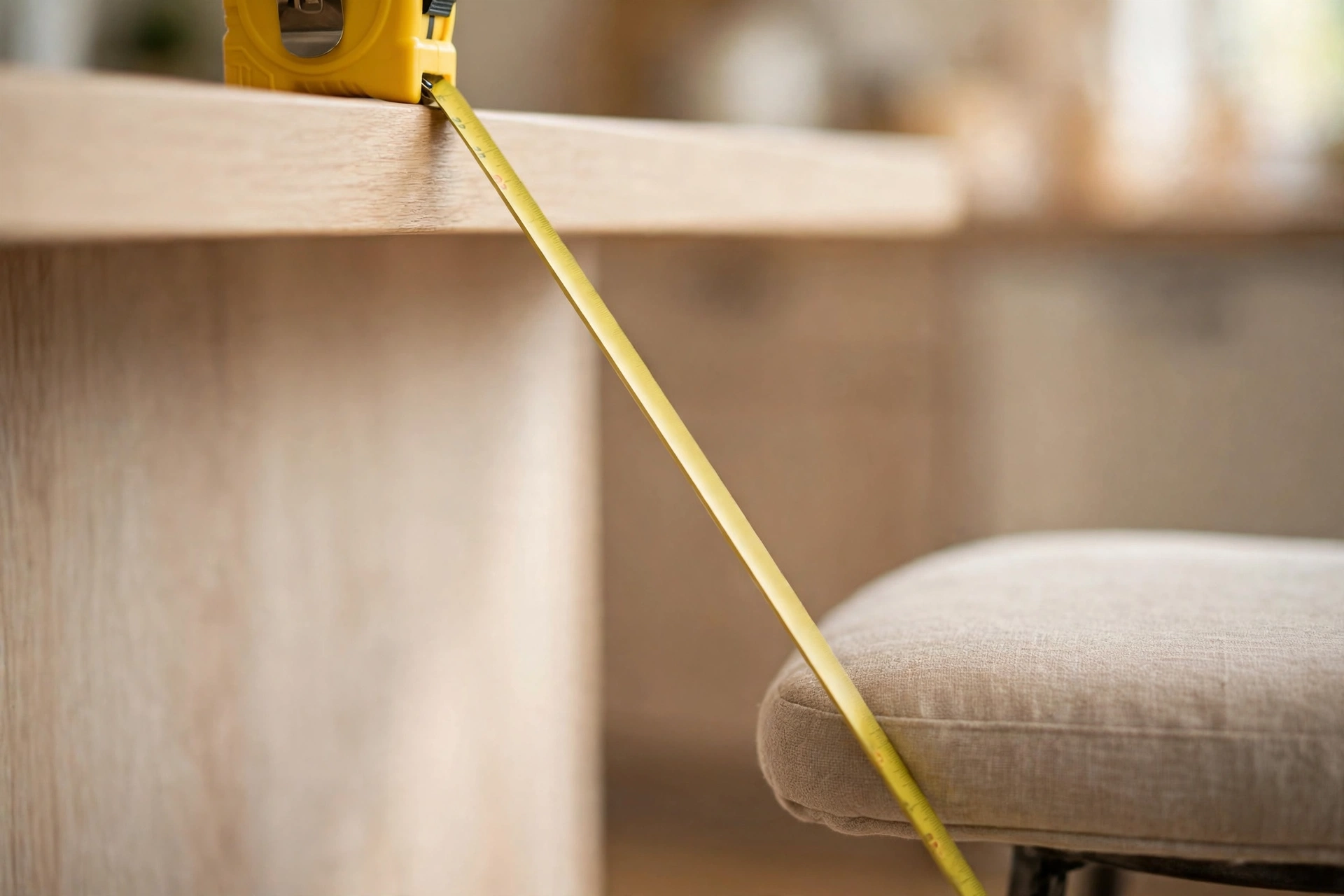
Before shopping for kitchen island stools, measure your actual counter — not the number in the appliance brochure. Countertop material adds height: my island was listed as “standard 36 inches,” but the quartz slab on top of the cabinets pushed it to 36.5 inches. Tile backsplashes, butcher-block tops, and raised edges all change the real number.
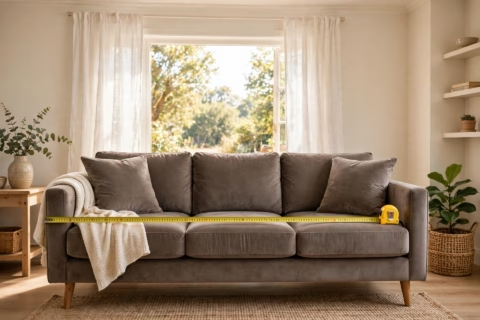
Stand the tape measure on the floor, run it to the top of the counter surface, and read at eye level so the tape does not lean. Do it twice. If your measurement lands between two stool sizes — say a 38-inch counter — round toward the taller stool size. It is easier to perch on a stool that is half an inch high than to strain over one that is half an inch low.
One more check while you are there: look underneath. A decorative apron or support panel can eat 3–4 inches of knee room even when the seat height is perfect. If your island has a thick apron, add that to your calculations before ordering.
The Spacing Math: 24 Inches Wide, 15 Inches Deep
Height is only half the layout. The National Kitchen & Bath Association’s Kitchen Planning Guideline 9 gives the professional numbers for bar stool spacing: at a 36-inch-high counter, allow 24 inches of width per seated diner and at least 15 inches of knee space depth. At a 42-inch-high bar, the depth drops to 12 inches. NKBA’s Guideline 8 adds the traffic numbers: 32 inches of clearance behind the seating area when nobody walks there, 36 inches to edge past, and 44 inches to walk past comfortably.
I ran these numbers on my own island: 96 inches of counter length divided by 24 inches per diner gives four theoretical spots. But the outlet and the cabinet seam ate one end, so three stools is the honest answer. Shopping reality check — this is where people overspend. Measure the counter, divide by 24, round down. That is your stool count.
Two Real Stools I Measured Against My 36-Inch Island
After the tape-measure Saturday, I pulled up two sets from FLNORW’s furniture collection and compared them head to head. Both are sold as sets of two, both fit a standard 36-inch counter height, and both came out of real product listings — not showroom daydreams.
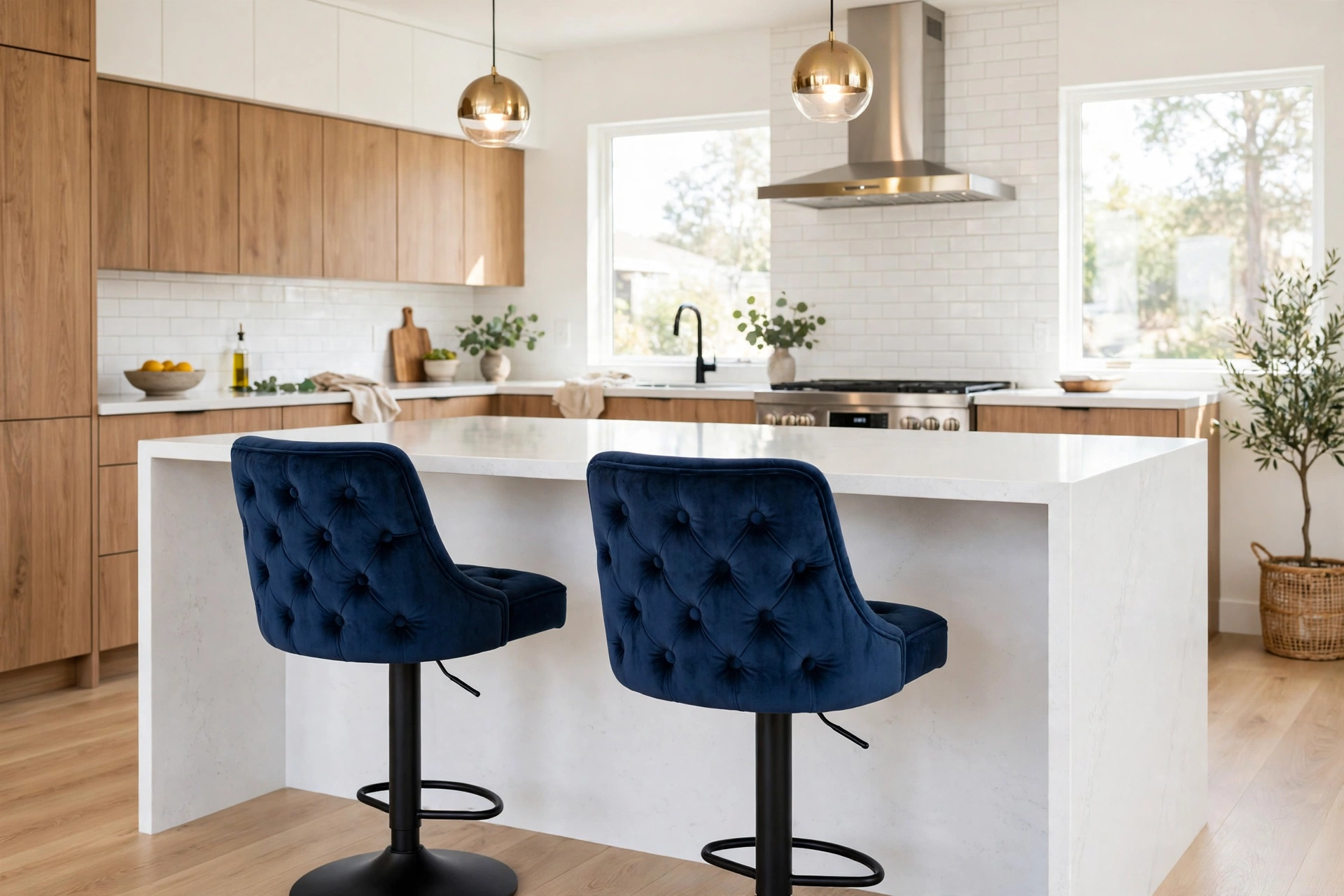
The first is the swivel velvet bar stool set, $238 for the pair. Real specs from the listing: 41.54 inches overall height, 21.65 × 16.93 inches footprint, 250-pound weight rating, full 360-degree swivel, button tufting with rivet trim, and a metal pull-ring footrest. Item code W2311P149172, InStock. That works out to $119 per stool — the swivel mechanism and velvet upholstery are what you are paying for.
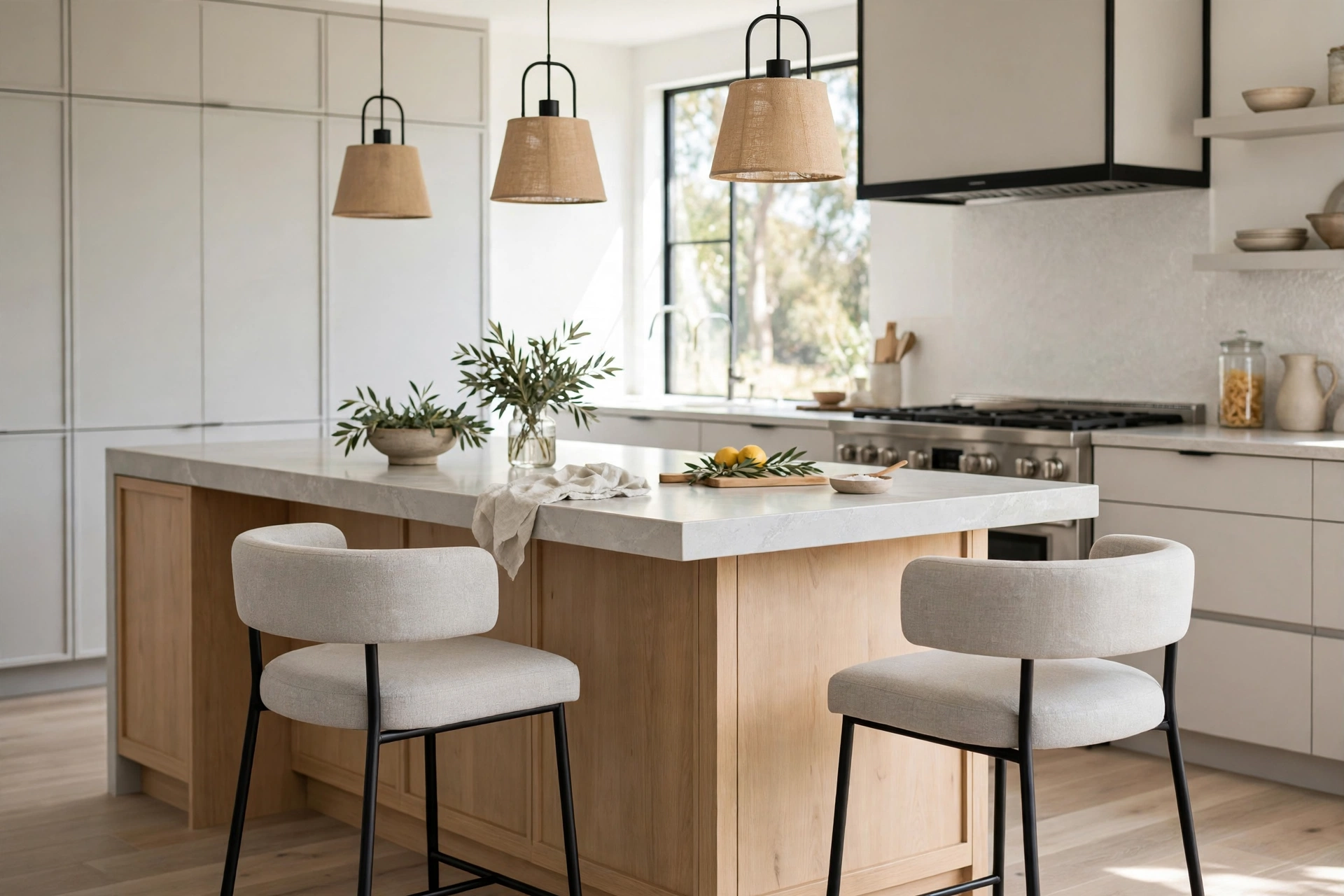
The second is the counter-height fabric stool set, $168 for two. The listing labels it counter height outright, with an assembled height of 42.52 inches, a 22.83 × 17.52 inch footprint, black metal legs, and a low fabric backrest — offered in gray or yellow. Item codes W2118P143549 and W2118P143550, InStock. $84 per stool.
So which wins? The $119 swivel stools are the comfort pick: the footrest ring alone is worth real money, because a stool without a proper footrest makes your legs work all evening. The $84 stationary stools are the practical pick: no moving parts to wobble, a slightly narrower footprint, and a lower profile that tucks closer under the counter. My house has an 11-year-old who treats swivel chairs like amusement rides — the stationary set won in our kitchen. A household of adults who linger over coffee would probably go the other way.
Swivel vs Stationary, Back vs Backless: What the Specs Hide
Product pages tell you dimensions and materials. They do not tell you how a stool lives. Three things I learned by sitting, not by reading:
Swivel stools make conversation easy — you turn toward whoever is talking instead of twisting your whole body. The cost is footprint: the swivel base on the $238 set makes each stool effectively wider than its 21.65-inch spec, and kids will spin them. Mine learned this within an hour of installation.
Backrests buy you comfort for long sits but cost you counter space and sightlines. Backless stools slide fully under the counter, which matters in a kitchen where the island is also the traffic lane. The $168 set splits the difference with a low backrest — support for your lower back without looming over the counter.
Footrests are the most underrated spec on the page. Your feet carry roughly 10 percent of your seated weight; without a footrest, your thighs take that load and your knees push into the counter. The metal pull-ring on the swivel set is solid and at a natural resting height. The stationary set’s black metal legs lack a dedicated rest — fine for short sits, less kind for a long brunch.
My 6-Point Bar Stool Buying Checklist
Before you click buy, run this list. It takes ten minutes and it is exactly what I should have done the first time:
- Measure your counter with a tape, at the floor, twice. Counter height vs bar height is the whole game.
- Apply the 10-inch rule: seat height ≈ counter height minus 10 inches.
- Count your spots: counter length ÷ 24 inches per diner, rounded down.
- Check knee depth: 15 inches clear at a 36-inch counter, 12 inches at a 42-inch bar.
- Demand a footrest for any stool you will sit in longer than 20 minutes.
- Read the weight rating: 250 pounds or higher covers most adults with a safety margin.
Two how to choose bar stools traps to dodge: ordering from a listing that only shows overall height (measure the seat, or ask the seller for it), and forgetting that swivel bases need extra width between neighbors — add 2–3 inches to your per-stool spacing if the base rotates.
The Verdict
After all the measuring, the answer is boring and wonderful: 10 inches of thigh clearance, 24 inches of width per person, 15 inches of knee depth, and a footrest you can actually reach. Get those four numbers right and almost any stool feels like it was built for your kitchen. Get one wrong and the most expensive stool in the catalog will drive you crazy by week two.
My island now runs three stools, not four, with $84-a-seat fabric stools my daughter cannot weaponize. Breakfast is back to being the easy part of the day. Your kitchen deserves the same — take the tape measure out this weekend.
Shop the exact setup: the $238 swivel velvet bar stool pair (360° spin, button tufting, 250-lb rating) or the $168 counter-height fabric pair (gray or yellow, black metal legs) — plus the full FLNORW MALL furniture collection and homepage for more counter and bar seating.