I Swapped My Dog’s Wire Crate for a $288 Furniture Dog Crate. Four Months Later, the Honest Truth.
Four months ago, the ugliest object in my living room was not the sofa I should have replaced in 2019. It was a black wire dog crate — 42 inches of rattling steel panels parked against the wall like a piece of impounded equipment. My beagle mix, Biscuit, loved it. I tolerated it. Every guest who walked in asked, with the careful politeness people reserve for medical equipment, “Oh — is he sick?” He was not sick. He just had a crate. So I did what any reasonable person does at 11 p.m. on a Tuesday: I went hunting for a furniture dog crate that would not make my living room look like a kennel. Four months later, here is the honest accounting.
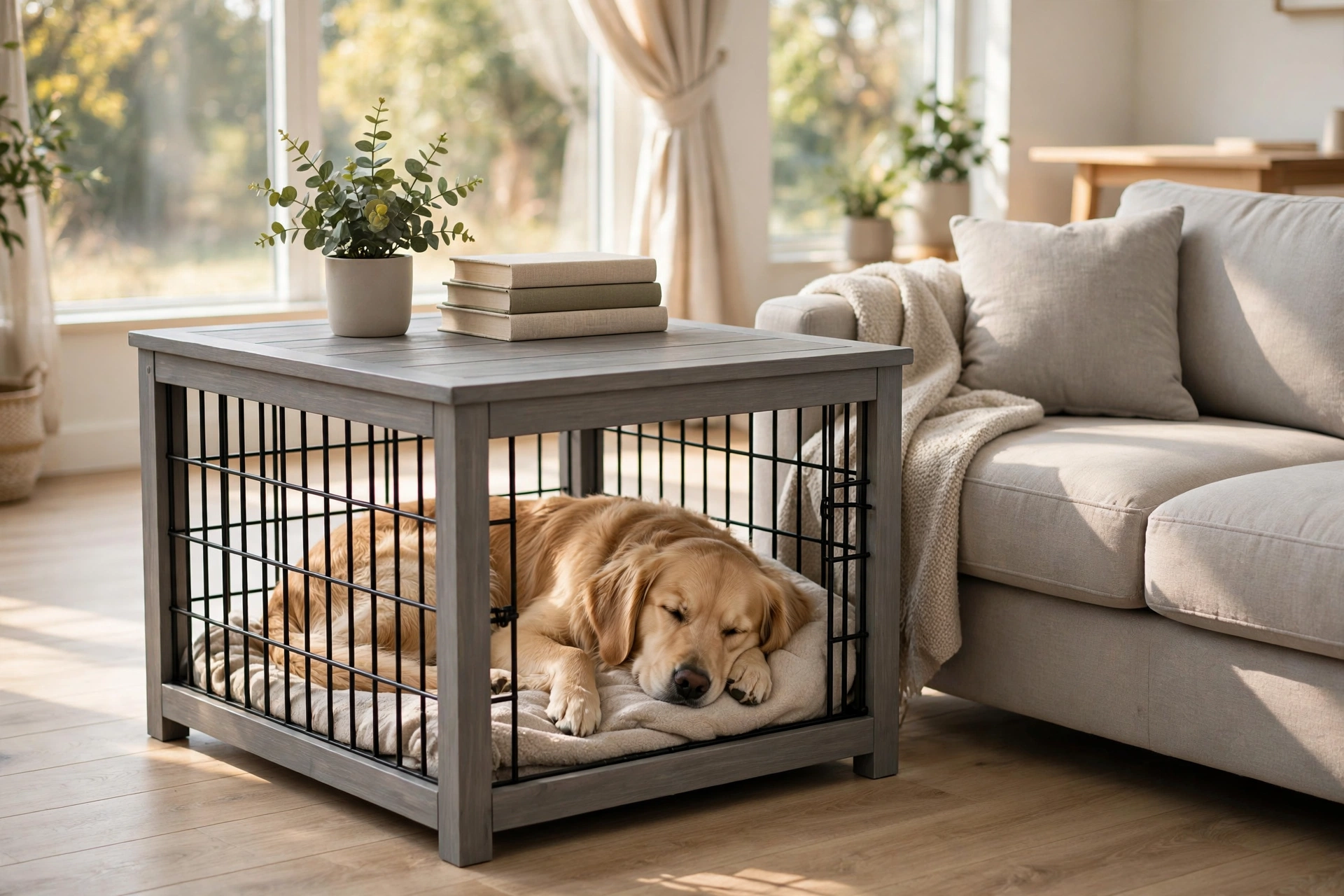
Why the Wire Crate Had to Go
The wire crate worked. That was the problem — it worked so well I stopped noticing how bad it looked until my sister visited and sent me a photo of my own living room with the crate circled and the caption “explain yourself.” She had a point. A dog crate end table hybrid solves the exact tension most dog owners live with: the dog needs a den, and the humans need a room that looks like adults live there.
The numbers explain why this category exists at all. The American Pet Products Association reported that 65.1 million US households owned a dog in its 2023–2024 survey, and total US pet industry spending hit $147 billion in 2023. When that many households are buying premium food, insurance, and daycare, a crate that doubles as furniture stops being a luxury and starts being the obvious next purchase. I was late. You do not have to be.
The 5-Minute Crate Sizing Rule I Used Before Ordering
The AKC’s sizing guidance is refreshingly simple: a crate should be big enough for your dog to stand up, turn around, and lie down comfortably — no bigger, no smaller, because dogs are den animals and too much space defeats the house-training instinct. The practical formula trainers quote: measure your dog from nose to tail base, add 2 to 4 inches, and that is your minimum crate length. Measure standing height, add 2 to 4 inches, and that is your minimum crate height.
Biscuit measures 30 inches nose-to-tail and 22 inches at the shoulder. That put my minimum at roughly 34 inches long and 26 inches tall. The FLNORW MALL crate I bought measures 43.7 inches wide, 30 inches deep, and 33.7 inches tall — comfortably above both minimums, with room for him to stretch out fully, which is how he actually sleeps. My estimate, flagged as an estimate: this size suits medium dogs in roughly the 35-to-60-pound range. A beagle is perfectly at home; a full-grown golden retriever would fit but could not sprawl, so size up if your dog is over 60 pounds. The product page lists the unit at 86.9 pounds — this is furniture, not a travel crate, and it does not pretend otherwise.
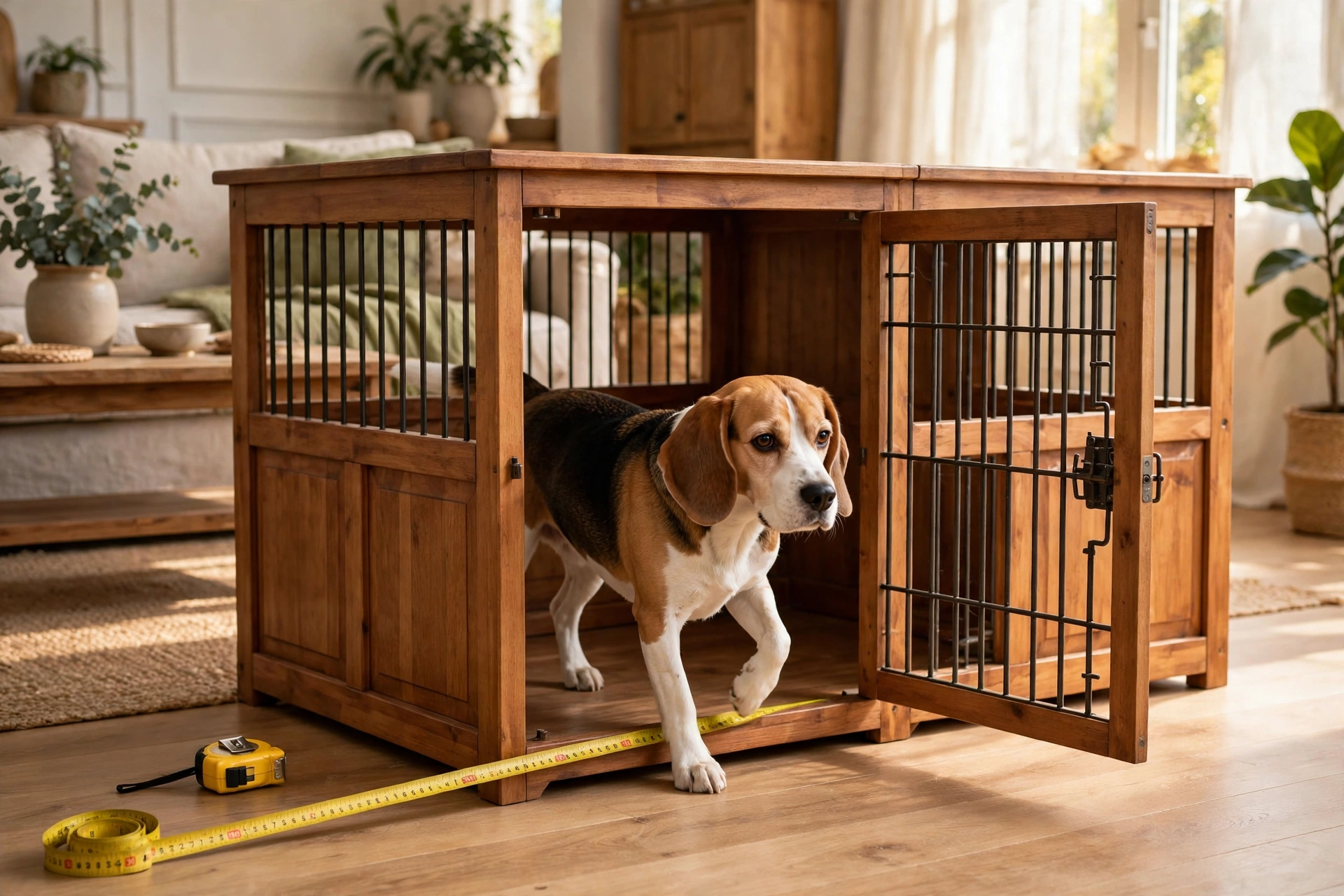
What $288 Actually Buys: the Sliding Door, the Mat, and 43.7 Inches of Tabletop
The product page calls it a furniture dog crate with a sliding iron door, and the three details that matter are all in that name. First, the door: a reinforced iron sliding panel instead of the usual swing latch. Second, the mat: a soft cushion comes included, which sounds minor until you price a decent crate pad separately — $30 to $40 for anything that is not cardboard-thin. Third, the top: a solid 43.7-by-30-inch surface that the listing explicitly suggests for magazines, family photos, books, and lamps. Mine currently holds a lamp, a stack of paperbacks, and a succulent that Biscuit has not yet figured out how to reach.
Assembly was the standard flat-pack ritual — panels, cam locks, about an hour, one moment of reading the diagram upside down. The frame is particle board with an iron-bar front, and the whole thing feels closer to a credenza than to pet equipment once it is together. Two color options exist: the gray I bought and a rustic brown. The gray reads as modern; the rustic brown would disappear into a farmhouse-style room.
The Sliding-Door Clearance Test
Here is the detail that sold me, and it is the one no product photo conveys: a dog crate with a sliding door needs zero swing clearance. A standard 42-inch wire crate with a front door needs roughly 24 inches of open floor in front of it for the door to swing and for a medium dog to walk out without doing a three-point turn. My living room layout had the old crate wedged between the sofa and the bookshelf with about 18 inches of clearance, which meant every exit was a negotiation.
The sliding panel glides sideways along the front. Biscuit walks straight out. I measured the reclaimed floor space: roughly 2 square feet of usable room that used to be door-swing dead zone. In a 200-square-foot living room, that is 1% of the floor back — small on paper, enormous in a room where every inch is already spoken for. If your crate lives in a hallway, a bedroom corner, or any spot where a swinging door would hit furniture, this feature alone justifies the format.
Wire Crate Plus End Table vs. One Furniture Dog Crate: the $48 Math
Let us do the honest comparison, because $288 is real money and the wire crate is $90. A decent 42-inch wire crate runs about $90. A real end table that looks like it belongs in a living room — not a folding TV tray — runs $130 to $160. Add the $30 to $40 crate mat you would buy separately, and the “cheap” route lands at roughly $250 to $290.
The furniture dog crate is $288, mat included. The difference between the two routes is somewhere between negative $2 and positive $48 — my estimate, depending on how nice an end table you would actually buy. I was not paying a premium for aesthetics. I was paying roughly the same money to delete one object from the room entirely. The wire crate plus end table is two footprints; the furniture crate is one 43.7-by-30-inch footprint that does both jobs. That is the whole pitch, and the math holds up.
$288 vs. $249: Which Furniture-Style Dog Crate Wins
FLNORW MALL sells a sibling: a furniture-style dog crate in rustic brown for $249, and the differences are worth understanding. The $249 unit is taller and narrower — 37.99 by 27.36 by 59.92 inches — with a cabinet stacked above the crate and rolling casters underneath. It is a storage tower that happens to have a dog compartment. The $288 unit I bought is lower and wider, with the sliding door and a tabletop meant to be used.
The decision comes down to what you need more: vertical storage or horizontal surface. If your dog supplies are scattered across three closets, the $249 cabinet version with its overhead storage and casters is arguably the smarter buy — 71.65 pounds on wheels is genuinely movable. If, like me, you needed the crate to vanish into the living room as an end table, the $288 version’s 43.7-inch top and sliding door win. Same particle-board-and-iron construction family, same “not a kennel” philosophy, different job. I would buy mine again; my sister, who has the storage problem, should buy the other one.
Three Mistakes I Almost Made
Crate furniture has failure modes that wire crates do not. Learn from the three I nearly committed:
- Measuring the dog, not the room. I sized for Biscuit first and nearly ordered into a spot where the 43.7-inch width would have blocked a heating vent. Measure the dog for the crate, then measure the wall for the crate — the crate has to fit both.
- Treating the top like a shelf. The product page suggests books and lamps, and that is the right scale. It is a particle-board top, not a workbench. My lamp and paperbacks are fine; my 40-pound toolbox will never live there.
- Skipping the “den test.” Some dogs take to an enclosed crate instantly; some need a week of treats-tossed-inside crate training. The AKC’s standing advice: never use the crate as punishment, and build positive associations first. Biscuit needed four days of chicken-treat bribery before he chose it over the sofa. Budget the week.
The Verdict
Four months in, the crate has done exactly one thing: it made the dog crate disappear without making the dog disappear. Biscuit sleeps in it every night — same den, better zip code. The sliding door reclaimed two square feet of floor. The top holds my lamp. Guests no longer ask if he is sick; two have asked where I got “the side table,” which is the entire review in one sentence.
Buy it if your crate lives in a visible room, your dog is in the 35-to-60-pound window (my estimate), and you would otherwise buy a separate end table anyway — the math is basically a wash. Skip it if your dog is a dedicated chewer who treats furniture as a project (particle board loses that fight), or if you move the crate between rooms weekly — at 86.9 pounds, this thing has a permanent address. For everyone in between, it is the rare pet purchase that makes the humans’ lives better too.
Ready to retire the wire crate? See the full specs and photos for the $288 furniture dog crate with sliding iron door, compare it with the $249 cabinet-style dog crate, read my wooden cat tower review if you run a multi-pet household, or browse from the FLNORW MALL homepage.