Bathroom Vanity Buying Guide: My 36-Inch Rule
Bathroom Vanity Buying Guide: My 36-Inch Rule
Last spring, my bathroom vanity finally embarrassed me in front of a guest. The toe kick had swollen from a decade of shower steam, one hinge had stripped out of its particleboard door so it hung at a tired angle, and my wife and I had spent six years doing the morning elbow-dance in front of a single 30-inch sink. I did what I always do with a home purchase now: I treated it like a math problem and wrote this bathroom vanity buying guide for myself first. Every rule in it survived contact with a tape measure, a plumber, and one very skeptical spouse.
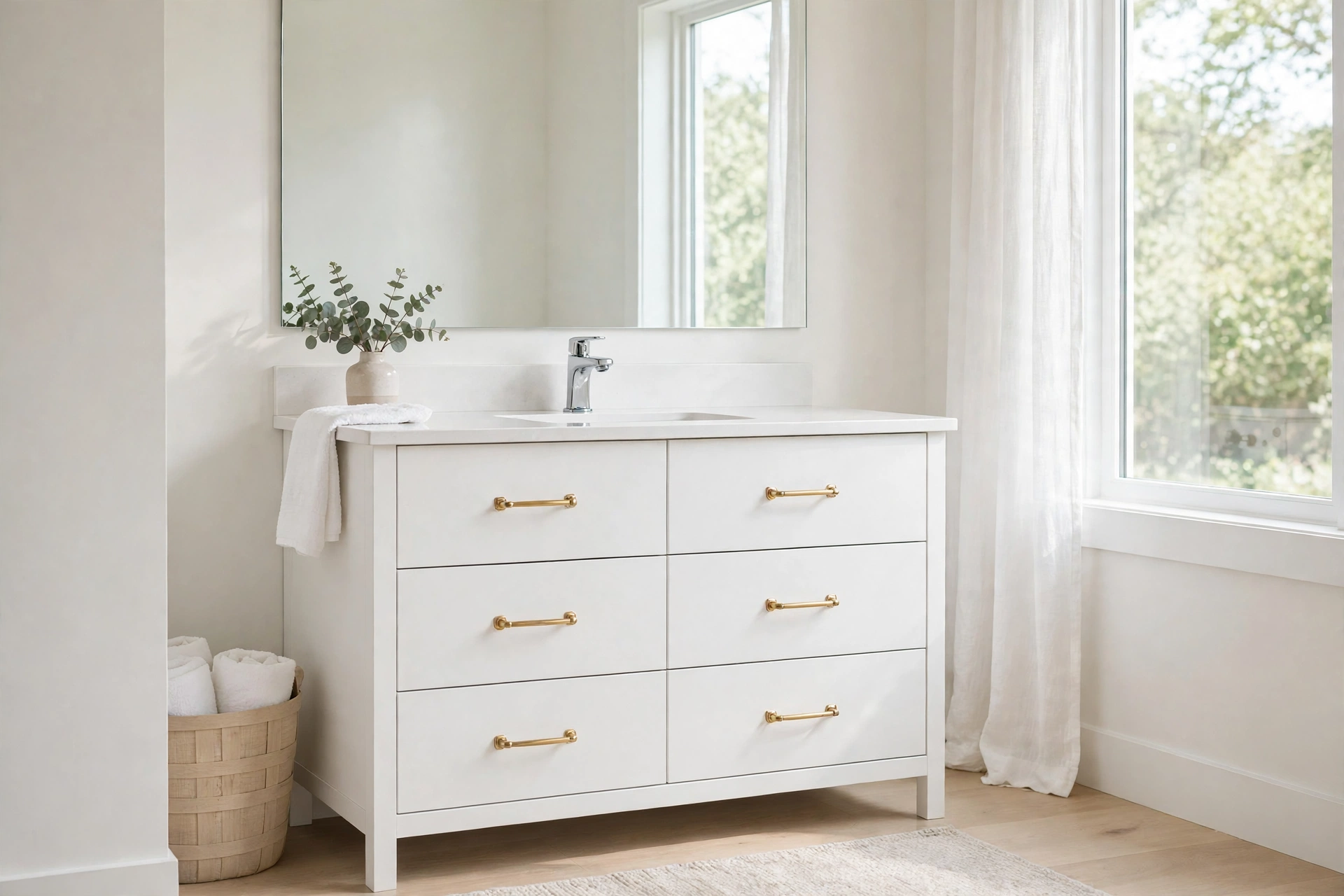
The vanity that won the argument is FLNORW MALL’s 54-inch solid wood bathroom vanity at $2,999 — solid wood frame and plywood, 54 by 22 by 36 inches, six soft-close drawers, two doors with adjustable shelves, and a countertop with the sink pre-installed. It arrived pre-assembled, which mattered more to me than I expected. Here is everything I learned, in the order I wish someone had handed it to me.
The Bathroom Vanity Buying Guide Starts With One Question
Before widths, materials, or prices: how tall are the people who will use this sink every day, and how many of them brush their teeth at the same time? That one question answers half the guide. Standard vanity heights come in four flavors — 30, 32, 34, and 36 inches — and the 36-inch comfort height has quietly become the default in showrooms. It matches standard kitchen counter height, which means decades of counters have trained your arms to expect it.
I am 5’11” and my wife is 5’4”. Our old 30-inch vanity made me hunch like I was washing my hands in a kindergarten classroom. The 36-inch unit splits the difference beautifully: she reaches it fine, and my back no longer files a complaint at 6:45 a.m. If everyone in the house is under 5’2”, a 32- or 34-inch unit is the honest pick. Measure the users, not the brochure.
Bathroom Vanity Sizes: the Width, Depth, and Tape-Measure Test
Bathroom vanity sizes run in a standard ladder: 24, 30, 36, 48, 60, and 72 inches wide, with depths from 18 to 24 inches. The 54-inch width of the one I bought sits between the two most common shared-bathroom sizes — wide enough for real elbow room, narrow enough to fit a normal master bath. At 22 inches deep, it is right in the standard pocket: shallow enough to walk past in a 5-foot-wide bathroom, deep enough that the sink bowl does not crowd the faucet.
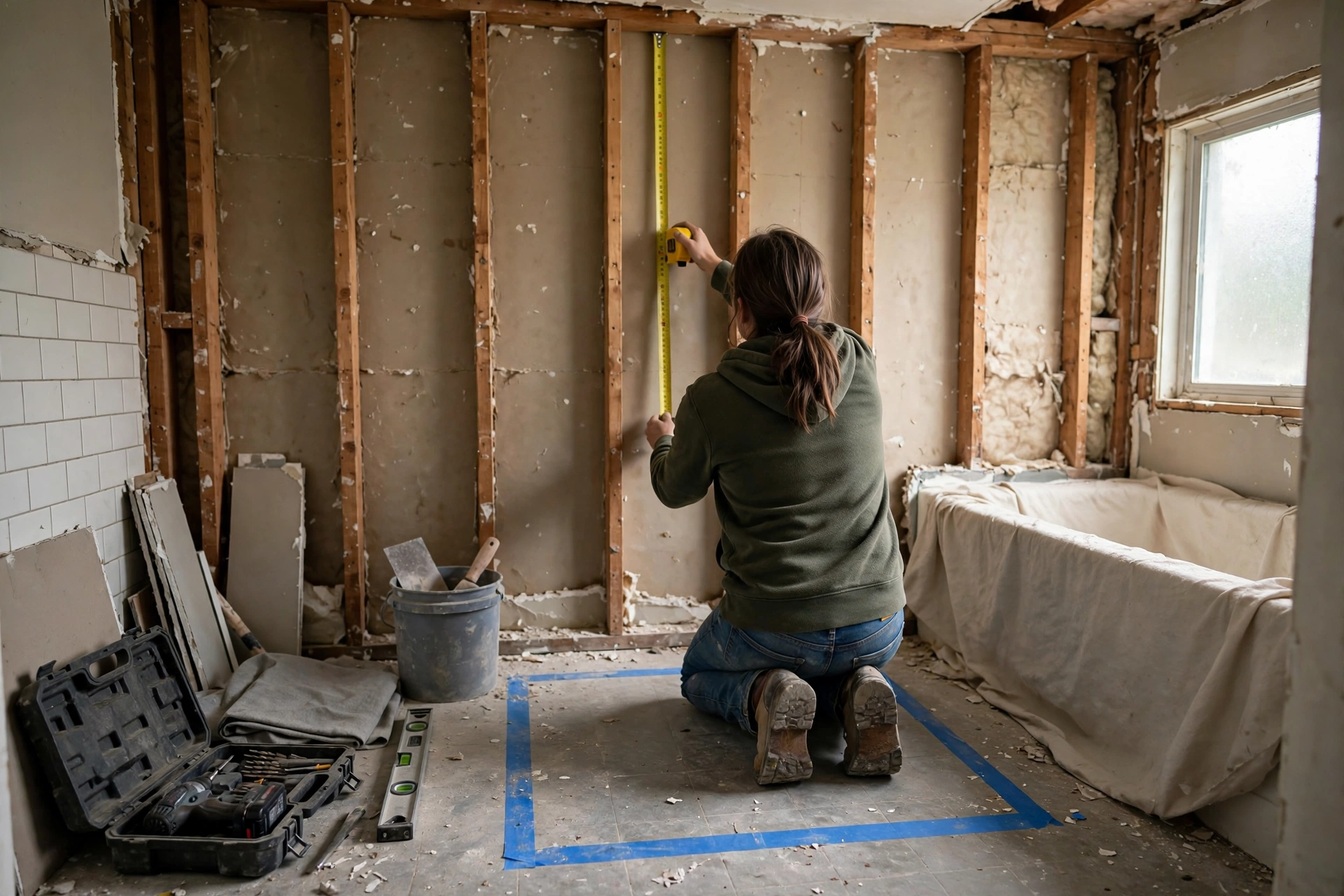
The test that saved me from a $2,999 mistake: painter’s tape. Tape the 54-by-22-inch footprint on the bathroom floor and live with it for two days. I discovered my taped rectangle clipped the door swing by three inches — easily fixed by re-hanging the door to swing the other way, a $20 project, but I would have been furious to discover it on delivery day. Tape does not lie, and it costs four dollars.
One Sink or Two: the 24-Inch-Per-Sink Rule
My rule of thumb, earned the hard way: budget 24 inches of vanity width per sink — the bowl plus a few inches of elbow room on each side. A 48-inch vanity is the realistic minimum for a double-sink setup; at 54 inches you get 27 inches per station, which is genuinely comfortable. Designers generally space double-sink centers 30 to 36 inches apart so two people are not trading elbows.
Honest note on this specific unit: it ships with a single sink pre-installed in the countertop. In a 54-inch cabinet, that single sink leaves generous counter space on both sides — my wife’s skincare lineup lives on the left, mine on the right, and the peace dividend is real. If you need two bowls, this top would have to be re-cut or swapped; buy a double-bowl unit instead of planning surgery on a new countertop.
Drawers Beat Doors: What the 6-Drawer Layout Actually Holds
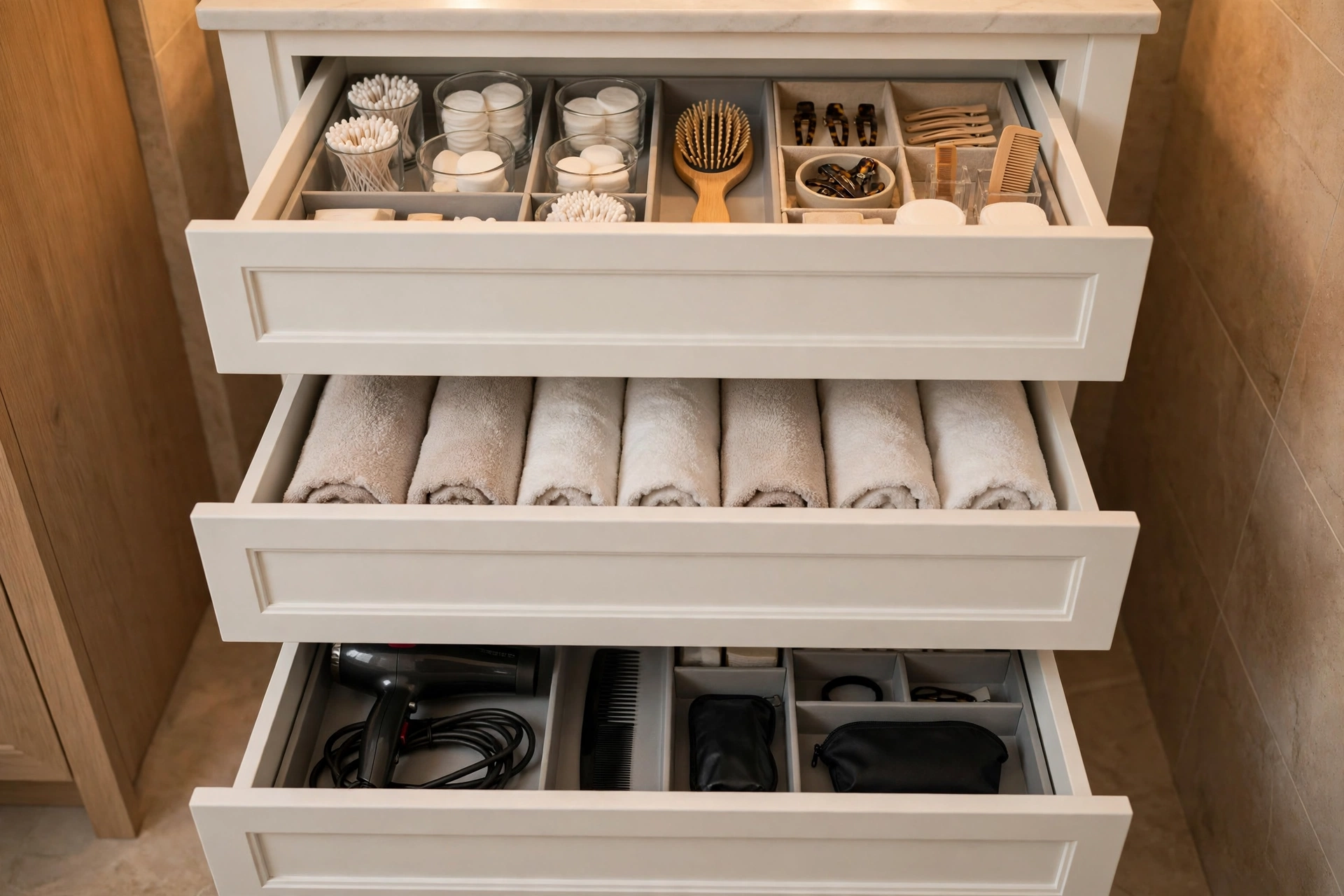
This is the section I would tattoo on the forehead of every vanity shopper: drawers beat doors in a bathroom, every single time. Doors force you to kneel and dig; drawers bring the contents to you. The unit I bought has six soft-close drawers plus two doors with adjustable shelves behind them, and the difference from my old door-only cabinet is the difference between a filing cabinet and a junk drawer.
What six drawers actually hold in my house, top to bottom:
- Drawer one (his): electric toothbrush, floss, contact solution, nail clippers. Opens with a fingertip, closes with a whisper — the soft-close part matters at 6 a.m. when your spouse is still asleep.
- Drawer two (hers): the daily skincare rotation, six bottles, all standing upright. No more knocking things over reaching past a door.
- Drawer three: hair dryer and round brush, docked in the built-in power station box so the cord never drapes across wet counters.
- Drawers four through six: bulk backup — extra toothpaste, the first-aid kit, spare towels, cleaning supplies I used to store under the kitchen sink.
The power station box deserves its own sentence. It is a small cord-management cubby inside the cabinet where you plug in heat tools and stow them hot. My old vanity’s version of this was a hair dryer balanced on the toilet tank. The upgrade is not glamorous, but I think about it every single morning.
Solid Wood, Plywood, or MDF: What Survives Bathroom Steam
My old vanity died of steam. The carcass was particleboard, and ten years of shower humidity turned the toe kick into something with the texture of wet cardboard. The FLNORW unit is a solid wood frame with plywood panels — the combination the industry keeps betting on. Grand View Research’s 2025 bathroom vanities report puts wood as the largest material segment at 37.2% of revenue, in a global market worth $46.1 billion in 2025 and projected to reach $83.6 billion by 2033 at a 7.9% annual growth rate. The U.S. alone is $9.27 billion in 2025, heading to $15.75 billion by 2033. People buy a lot of vanities, and more than a third of the money goes to wood.
MDF is not the enemy — sealed, painted MDF handles humidity fine — but in a bathroom, water finds every unsealed edge. Solid wood and plywood swell and recover; particleboard swells and stays swollen. Whatever you buy, run the exhaust fan for twenty minutes after every shower. That habit is worth more than any material upgrade.
The 21-Inch Clearance Rule: Measure Before You Order
The number nobody tells you until the plumber does: the NKBA’s bathroom planning guidelines call for 21 inches of clear floor space minimum in front of a vanity, with 30 inches preferred. That is measured from the front of the cabinet to whatever faces it — the tub edge, the opposite wall, the toilet. Anything tighter and you will be doing the sideways shuffle every morning.
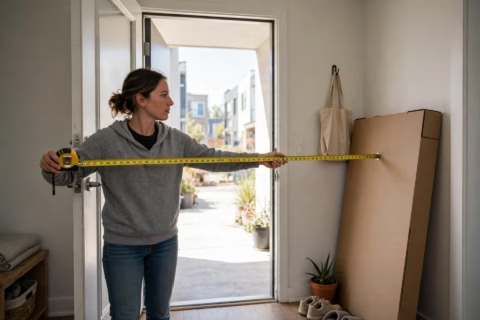
Two more measurements people skip. First, the delivery path: this vanity weighs 281.6 pounds and ships in a 57-by-26-by-53.35-inch crate. I measured every doorway and one hallway corner between my front door and the bathroom, and the crate cleared the tightest turn by two inches. Second, what is not in the box: faucets and mirrors are not included. Budget accordingly — a decent widespread faucet runs $150 to $400 (my estimate), plus the plumber’s visit.
Bathroom Vanity Buying Guide Math: $2,999 Pre-Assembled vs. the Cheap Route
Let us do the honest math, because $2,999 is real money. The cheap route I priced: a $500 big-box vanity, a $250 stone-look top, and a $250 plumber visit — about $1,000 all-in. It lasts, in my steam-heavy bathroom, maybe nine years before the hinges strip and the carcass swells. Over eighteen years, that route costs $1,000 twice, plus a second plumber visit and a second demolition weekend: roughly $2,250 and two lost weekends (my estimate).
The $2,999 pre-assembled route, built in solid wood and plywood, should run fifteen to twenty years — call it $150 to $200 a year over its life (my estimate). The honest verdict: the expensive route does not save money. It buys six soft-close drawers, a power station for the hair dryer, a cabinet that does not swell, and — this is the part nobody prices — zero assembly. It arrived in one piece. Two delivery guys set it down, the plumber connected the drain and supply lines in under two hours, and I never once sat on the bathroom floor with an Allen wrench. My hourly rate for weekend labor is not zero, and neither is my patience.
The Verdict
Six months in, the scorecard is simple. The 36-inch height fixed my back. The six drawers ended the morning excavation. The soft-close hardware has not needed a single adjustment. The white finish wipes clean with a damp cloth, and the power station box quietly solved the hair-dryer-on-the-toilet problem. My one regret is measurable: I should have taped the footprint and re-hung the door before delivery day instead of discovering the door clip the morning the crate arrived.
Want the full spec sheet? See the 54-inch bathroom vanity with sink at FLNORW MALL — 54 by 22 by 36 inches, $2,999, pre-assembled, in stock. Over it, I hung the $199 anti-fog LED mirror I reviewed — 32 inches wide, which balances a 54-inch vanity exactly. And if the whole bathroom is getting the treatment, read my $529 freestanding bathtub verdict next.