
I Learned 7 Rules About Kitchen Islands the Hard Way. Here Is the $299 Lesson.
Two years ago I nearly bought a kitchen island that would not have fit through my own kitchen. I had measured the island — 54 inches long, gorgeous butcher-block top — and I had measured the space where I wanted it to go. What I never measured was the walkway around it. It took my wife, one strip of painter ’s tape, and about forty seconds of her walking through the “aisle” with a laundry basket to kill the plan. This article is the seven-rule version of that forty seconds, written for anyone shopping for a kitchen island before the holidays.
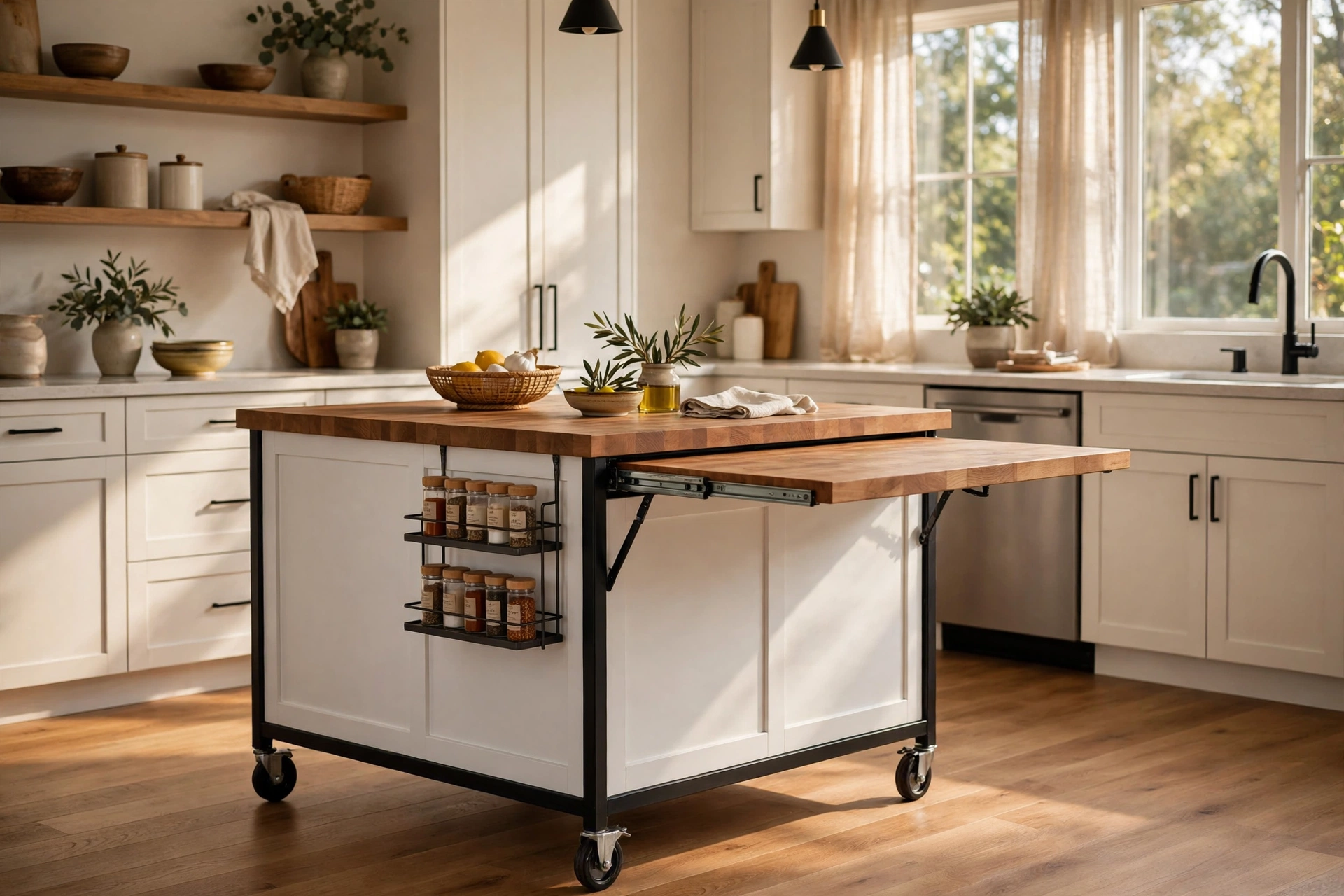
I ended up buying a rolling model instead, and I have cooked around it for two years now — weeknight dinners, one Thanksgiving, countless mornings leaning on it with coffee. The island in question is the rolling kitchen island with a drop leaf from FLNORW MALL: 53.94 inches wide, $299, five caster wheels, and a leaf that folds up when I need a second table. Everything below is measured against that real cart in my real kitchen, plus what the broader market data says about islands right now.
Rule 1: Measure the Walkway, Not the Kitchen Island
Everyone measures the island. Almost nobody measures the space it needs to breathe. Kitchen designers use a rule of thumb: about 42 inches of clear walkway on every working side of an island — more if two people cook at once. That number keeps showing up in kitchen planning guides because it is roughly what you need to open an oven door and still walk past someone.
My island is 28.74 inches deep. Two 42-inch aisles plus the island itself means my kitchen had to be at least 112.7 inches wide to work — just under nine and a half feet. I taped the footprint on the floor before I bought, then walked the tape with a laundry basket, then had my wife do the same from the other direction. If either of us had to turn sideways, the island was too big. Painter ’s tape costs four dollars. Returning a 114-pound cart costs a weekend.
Rule 2: Rolling Kitchen Island or Fixed? Decide by How You Cook
A fixed island is furniture. A rolling kitchen island is an appliance with a personality — and the choice should follow your cooking habits, not your kitchen photos.
Mine rolls on five smooth casters, but it also has four solid wood cabinet feet and a central support plate underneath, so it can sit planted when I want it planted. I roll it against the wall on ordinary days to open up floor space, then pull it into the middle of the kitchen when I am doing serious prep. Last Thanksgiving I parked it next to the stove as a staging station and it earned its floor space in one afternoon.
The honest trade-off: a rolling island will never feel as rock-solid as a bolted-down cabinet. If you chop aggressively or own a stand mixer that walks across counters, test the island ’s stability on the wheels before you commit to where it lives. Mine has not budged mid-chop in two years, but I keep the heavy stuff — cast iron, the mixer — on the lower shelves, which lowers the center of gravity.
Rule 3: The Drop Leaf Is the Feature That Earns Its Keep
Of everything on this cart, the kitchen island with drop leaf design is the reason I still recommend it. The leaf folds down for daily use and flips up — on reinforced metal support frames, not wishful hinges — when I need seating or serving space. The leaf alone is rated for 80 pounds, which is far more than two dinner plates and a laptop will ever ask of it.
Two practical numbers: with the leaf down, the island ’s footprint stays a modest 54 by 29 inches. With the leaf up, I get a genuine breakfast bar for two — mugs, a fruit bowl, the morning news on a tablet. That flexibility is why islands keep showing up in kitchen trend data: they are the one piece of furniture in the kitchen that can be a prep station at noon and a dining spot at eight. If you are comparing islands, the drop leaf is the single feature I would refuse to give up.
Rule 4: Do the Kitchen Cart Storage Math Before You Fall in Love
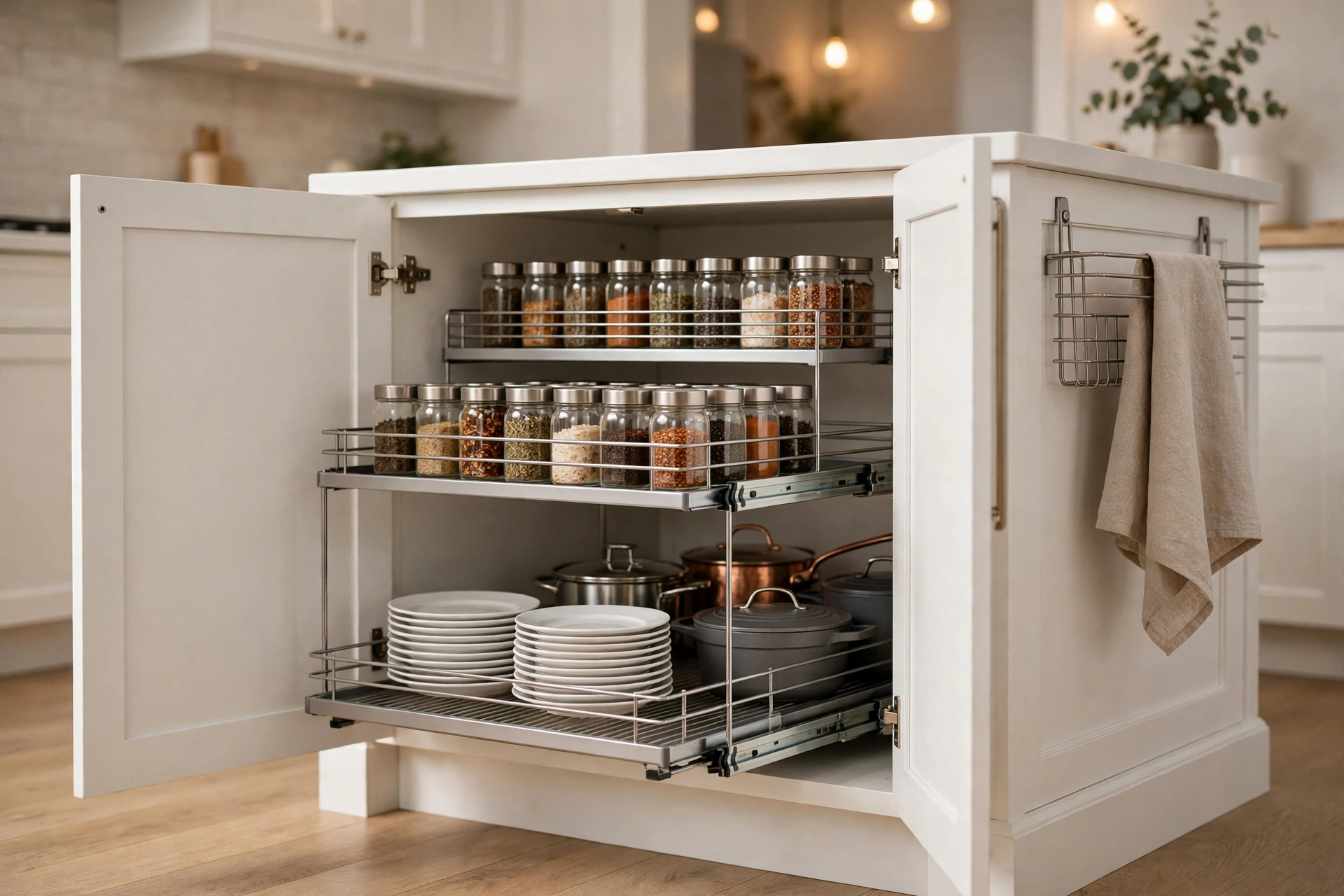
An island without storage is just a very expensive table. This cart carries a 3-tier pull-out cabinet organizer — the narrow-top, wider-bottom L-shaped design that slides out so you can actually reach the back — plus internal storage racks on the cabinet doors, a spice rack, and a towel rack on the side.
Here is the storage math I did before buying. My old kitchen had a dead corner cabinet where spices went to die. The pull-out organizer now holds 24 spice jars, two cutting boards, and the blender I use twice a week — all reachable without kneeling. The towel rack holds the dish towel that used to live draped over the oven handle. None of this sounds glamorous, but an island that adds maybe ten cubic feet of reachable storage to a kitchen is doing real work.
One caveat worth stating: if your kitchen mostly needs closed storage for bulky items, a dedicated cabinet may serve you better. FLNORW MALL also sells a three-door rattan storage cabinet — 45.3 inches wide, $199 — that holds more volume per dollar for pantry overflow. I bought the island because I needed prep space first and storage second. Know which problem you are actually solving.
Rule 5: Read the Weight Ratings Like an Engineer
Spec sheets for kitchen islands are where marketing goes to hide. Read the numbers, all of them:
- Tabletop capacity: 220 lbs. That is a fully loaded Thanksgiving turkey plus every side dish, twice over. More importantly, it means the top will not bow under a heavy mixer or a week ’s worth of mail.
- Drop leaf capacity: 80 lbs. Two adults leaning on it while eating will not break it. A third adult should probably find a chair.
- Unit weight: 114.64 lbs. This matters twice — once when the delivery driver leaves it at your door, and once when you realize it is heavy enough to stay put but light enough to roll.
- Assembly: 40 to 80 minutes. Mine took just over an hour, solo, with one confused look at the wheel hardware. Budget a Saturday morning, not a lunch break.
- Maintenance: wipe with a soft dry cloth; check the hardware periodically. The product page says it plainly — bolts loosen with rolling use. I tighten everything every few months and it takes ninety seconds.
If a competing island lists no weight ratings at all, that is the rating. Skip it.
Rule 6: A Small Kitchen Island Can Do a Big Job
The word “island” makes people picture a six-foot monolith, but a small kitchen island on wheels might be the most practical piece in a modest kitchen. The Houzz 2025 U.S. Kitchen Trends Study found that 58% of renovating homeowners either add an island (30%) or upgrade an existing one (28%) — and while 52% of the upgraded ones stretch past seven feet, the study ’s smaller-island numbers remind us that the format works at every scale.
My kitchen is not large. The cart ’s 28.74-inch depth means it fits where a fixed island never could, and when I need the floor — mopping, moving the dog ’s crate, setting up the Christmas tree — it rolls into the dining room in ten seconds. Renters should pay special attention here: a rolling island is furniture you take with you, unlike every dollar of built-in cabinetry you leave behind for the landlord.

Rule 7: The $299 Math Against the Alternatives
Kitchen islands live at both ends of the price spectrum, so here is the honest cost comparison, with estimates flagged as estimates:
- $299 rolling cart. Prep surface, drop-leaf seating, ten-plus cubic feet of storage, rolls away. My total outlay, two years ago, was the cart plus a Saturday morning.
- A built-in island. Custom cabinetry with a stone top, installed — several thousand dollars is a reasonable rough estimate for a modest one, and that is before the electrician if you want outlets. It is permanent, beautiful, and immovable.
- The full-remodel route. The same Houzz 2025 study puts the median kitchen remodel spend at $60,000, up from $55,000 the year before. Fifty-eight percent of those renovators touched the island — meaning a lot of people are spending five figures to get what a $299 cart approximates for storage and prep.
The math is not really “$299 versus $60,000” — a cart is not a remodel. The math is: how much of what you want from an island — the extra counter, the storage, the breakfast spot — can $299 actually deliver? In my kitchen, after two years, the answer has been most of it. The built-in would have been prettier. The cart is paid for, and I could not tell you where the $299 went anymore, but I use the island every single day.
The Verdict
Two years in, the island has outlasted two kitchen gadgets, one toaster, and my original plan for where it would live. The painter ’s tape trick saved me from the oversized model; the drop leaf gets used daily; the wheels get used weekly. If your kitchen has roughly nine and a half feet of width to spare, a kitchen island is the highest-impact $299 I have spent on my home — and the rolling kind means you get to change your mind about where it lives, which is a luxury fixed cabinetry never offers.
Ready to start? See the exact model — the rolling kitchen island with drop leaf I have been cooking around for two years — or browse the full FLNORW MALL furniture collection if your kitchen needs a different solution. And if the leaf turns your island into a dining spot, this dining table size guide explains how much table space each guest really needs — a useful cross-check before the holidays.