Renter-Friendly Furniture: 7 Rules I Swear By After 6 Years of Renting
In my six years of renting — four apartments, three moves across two states — I have learned that renter-friendly furniture is not a style. It is a survival strategy. Nobody warns you about the gap between the pretty inspiration photo and the reality of hauling a bookcase down three flights of stairs at 7 a.m., with your landlord’s move-out inspection looming in three hours. I bought a lot of wrong furniture in those six years. But I also stumbled onto pieces that moved with me, worked in rooms they were never designed for, and never cost me a dollar of my security deposit. These are the seven rules I would hand my younger self before signing that first lease.
Rule 1: If It Can’t Roll, Think Twice
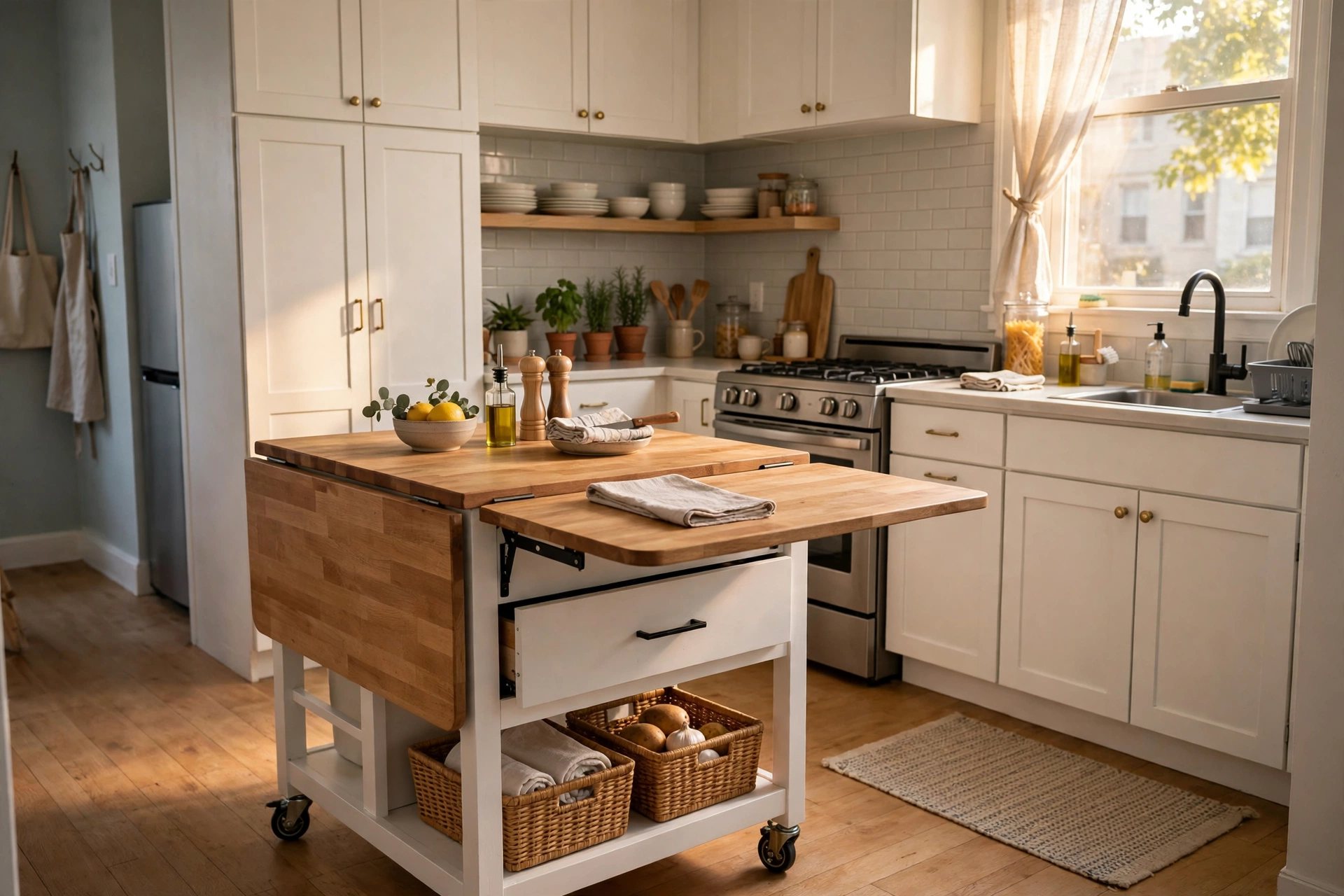
The single most useful thing I own is a rolling kitchen island with a drop leaf. It has lived in three of my four kitchens: parked against the wall in two of them, dead center in the third. The specs tell you why it works for renting — 53.94 inches wide, 114.64 pounds, five caster wheels, and a drop leaf that folds down when I need floor space. On moving day I didn’t disassemble it; I rolled it to the truck and strapped it upright. A fixed cabinet would have needed an hour of teardown and a prayer.
Wheels change how furniture behaves in a rental. Fixed pieces get one chance to be in the right spot. Rolling pieces get a vote on every room, every season, every lease. I have used this island as a prep station, a breakfast bar, a Thanksgiving staging area, and — during my second apartment’s awkward L-shaped kitchen — a room divider that faked a separate dining zone. Renters should treat casters like a feature, not an afterthought.
Rule 2: The 20-Minute Assembly Test
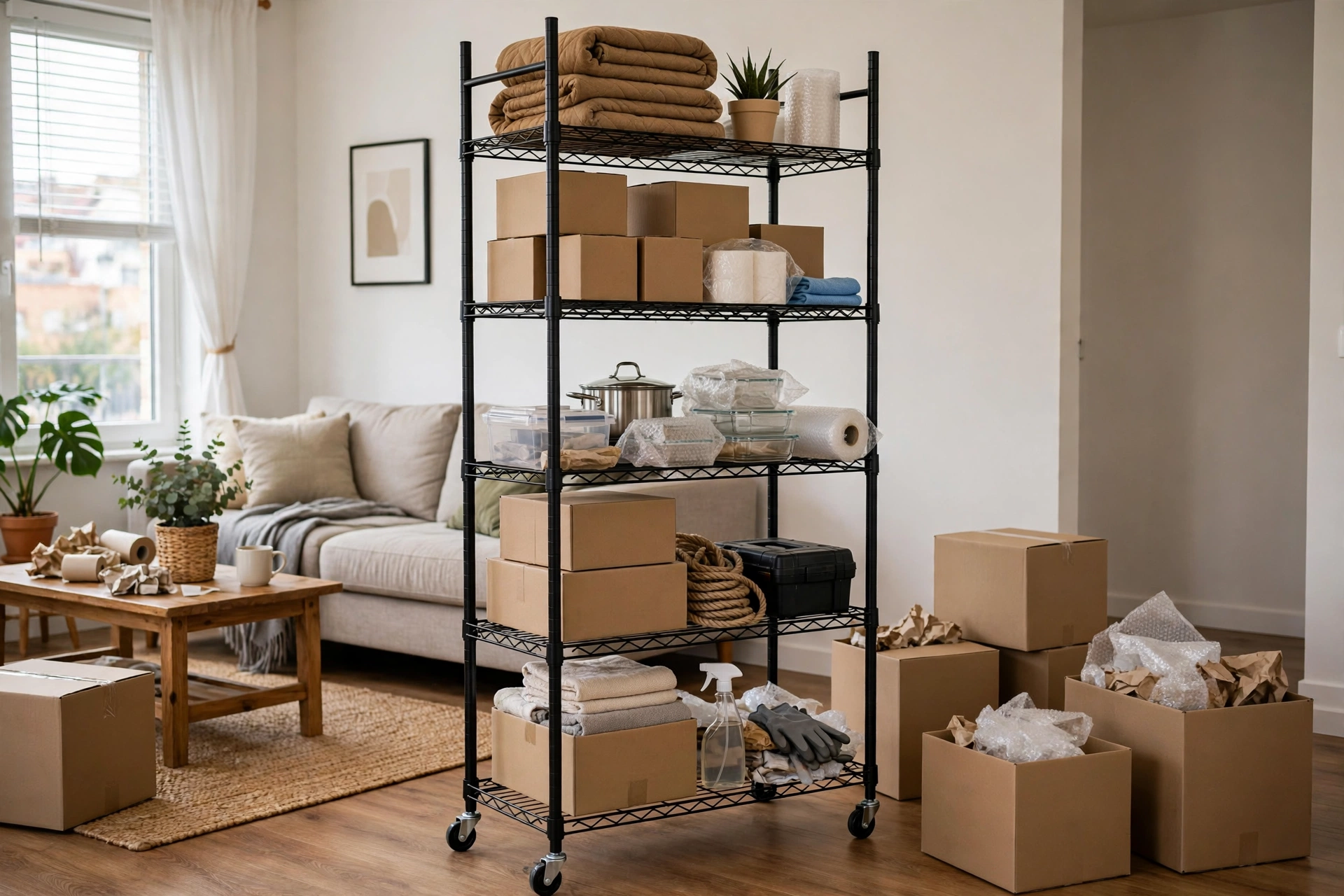
Before I buy anything flat-packed, I check the assembly time on the product page, and I have a hard rule: if it takes longer than about an hour, it fails the test. My 63-inch freestanding metal shelving unit advertises a bolt-free, 20-minute assembly, and the first time I built it I timed myself mostly out of disbelief. Twenty-two minutes, one included wrench, no leftover screws, no silent cursing. The real payoff came eight months later at move-out: I had it back in the box in fifteen minutes, bolts still in their little bag.
Compare that with the entertainment center from my first apartment — a three-hour build with a cam-lock system designed by someone who hates you personally. It survived one move and died during the second, because furniture that fights you going up usually fights you coming down. The shelving unit also carries 350 pounds per shelf and 1,750 pounds total on a 42.33-pound frame, with four 360-degree locking swivel wheels. Numbers like that are what “heavy duty” should actually mean for a renter: it holds your life, but two people can still carry it.
Rule 3: No-Drill Storage or It Doesn’t Count
Every lease I have ever signed had a clause about wall holes. Every one. And yet half the “small space storage” advice online assumes you can mount a floating shelf wherever you like. My rule is simple: if it needs a stud finder, it doesn’t come home with me. Freestanding storage — freestanding furniture generally — is the renter’s real storage strategy.
The shelving unit works because it stands on its own feet and locks its wheels when I want it parked. It has protective railings on all four sides of every shelf, so nothing walks off the edge when I roll it across a room to paint or clean, and the open-back design means it sits flush against a wall without needing to be anchored to one. I use one as a pantry, and a second as a linen closet in a hallway that had no closet at all. Neither has ever touched a drill, and both look like they were built in.
Rule 4: One Piece, Three Jobs
In a rental, every piece of furniture has to earn its floor space twice over, because floor space is the one thing you can’t add. The rolling island survives this test because it does three jobs: the 220-pound-rated tabletop is my prep surface, the 80-pound-rated drop leaf is a breakfast bar for two, and the 3-tier pull-out cabinet organizer plus the spice rack and towel rack hold the clutter that would otherwise live on my counter. One footprint, three functions, zero wall contact.
Before you buy anything, run the mental inventory: what does this replace? If the answer is “nothing, it just sits there looking nice,” it fails. If it replaces a side table, a pantry shelf, and a dining spot for two, it stays. My island replaced a card table, a freestanding pantry cabinet, and the breakfast bar I dreamed about but never had room for. In my studio year it even served as the room divider between the “kitchen” and the “dining room,” which were the same 200 square feet viewed from different angles.
Rule 5: Weigh Your Furniture Before Moving Day
Here is a number I wish someone had tattooed on my lease: 114.64 pounds for the island, 42.33 pounds for the shelving. Those are honest, shippable weights — the kind two adults can carry up a stairwell without a strategy meeting. Contrast that with the solid-wood dresser from my second apartment, which weighed roughly 90 pounds of pure stubbornness and required two friends, a pizza bribe, and one doorway’s worth of paint repair.
The math that matters: roughly 35% of US households rent, according to the Census Bureau’s 2024 American Community Survey, and Zillow’s 2026 research — citing the same survey — notes that about 23% of renter households moved in the past year. Separately, Census data cited by Realtor.com in 2026 shows 21.6% of people in renter-occupied homes moved in 2024, versus just 6.2% in owner-occupied homes. If you move every couple of years, you will carry everything you own every couple of years. Buy the weight you can live with — literally.
Rule 6: Buy Color, Not Commitment
Rentals have a personality problem: beige walls, beige carpet, landlord-special paint. The fastest fix costs nothing in labor — it’s a single piece with a point of view. Mine is a navy velvet accent chair: 29 inches long, 29 wide, 34.25 tall, with an 18-inch seat height, a solid wood frame, and wooden legs. It has been a reading chair, a bedroom chair, and a “the living room is finally done” chair across three apartments, and it never touched a wall or a toolbox.
This is the renter’s version of personality without commitment. Paint requires landlord approval and repaint-on-exit. A statement chair requires forty square inches of floor and an afternoon. When the lease ends, it goes in the truck and the apartment goes back to beige, and everybody’s security deposit survives. I keep the palette around it deliberately boring — gray throw, plain lamp — so the chair does all the talking in every room it lands in.

Rule 7: The Move-Day Math
Let me run the numbers on my current setup, because this is where renter-friendly furniture stops being a vibe and starts being arithmetic. The island was $299, the shelving $99, the chair $328 — a $726 system I have moved three times without replacing a single piece. That is roughly $242 per move for the core of my apartment, and the pieces are still going.
The alternative math: buy cheap particleboard sets and replace them every move. Three moves at roughly $150 a pop for a bookcase, a cart, and a chair comes to around $450 — and that’s before the lost Saturdays rebuilding them, the stripped cam locks, and the one piece that doesn’t survive the truck (these are rough estimates, but you know the pattern if you’ve lived it). Freestanding, wheeled, quick-assembly furniture isn’t just convenient. Over a renting life, it’s the cheaper route — by a lot.
Here is my pre-purchase checklist, taped inside a kitchen cabinet since apartment three:
- Does it roll, or can two people carry it without drama?
- Does it assemble in under an hour with basic tools?
- Is it freestanding — zero holes in the wall?
- Does it do at least two jobs at once?
- Will it fit through my narrowest doorway? (Mine is 30 inches. Measure yours.)
- Can I picture it working in the next apartment, not just this one?
The Verdict
Six years and three moves in, the pattern is clear: the furniture that survived my renting life rolls, builds fast, stands on its own, does double duty, and carries its weight. The $726 I spent on the island, the shelving, and the chair has outlasted two leases’ worth of cheap fixes and never touched my deposit. If you’re renting, don’t furnish the apartment you have — furnish the next three.
Ready to start? These are the exact pieces in my apartment: the rolling kitchen island with drop leaf, the 63-inch freestanding metal shelving unit, and the navy velvet accent chair — or browse the full FLNORW MALL furniture collection for your own setup. And if the island idea grabbed you, my kitchen island rules piece goes deeper on measuring, weight ratings, and the drop-leaf decision.