I Put a $299 Portable Carport Over My Driveway Before Winter. Here Is the Honest Math.
I Put a $299 Portable Carport Over My Driveway Before Winter. Here Is the Honest Math.
The morning that sold me started at 6:40 with a sheet of ice on my windshield and a plastic scraper that snapped in half on the first stroke. I was already late, the defroster was wheezing, and I stood there in a bathrobe and boots chipping ice with a credit card like some kind of budget survivalist. A portable carport had been sitting in my cart for three weeks. That morning I stopped debating and bought the 10×20 one from FLNORW MALL for $299. Two weeks later it was standing over my driveway. This is the honest accounting: what it is, what assembly really takes, how it handles wind, and whether $299 beats scraping ice for one more winter.
Why November was my deadline
I do not have a garage. My house has a driveway, a street with alternate-side parking rules, and a car that sleeps outside eleven months a year. Every winter the same ritual plays out: frost mornings where I burn ten minutes scraping, snow mornings where I burn twenty digging the car out of a drift, and the occasional ice storm where the driver-side door freezes shut and I climb in through the passenger side like I am nineteen again.
Last winter I kept a rough tally, the way I do with anything that costs me time. About forty mornings needed scraping or brushing, roughly ten of them snow-clearing. At ten to twenty minutes a pop, that is eight to twelve hours a season spent standing in the cold before coffee — plus the extra idling fuel, my rough estimate. A portable carport is not heated shelter, but a roof over the car deletes the frost entirely and cuts the snow job down to brushing the hood. That was the whole pitch, and it was enough.
What $299 actually buys: the spec sheet without the adjectives
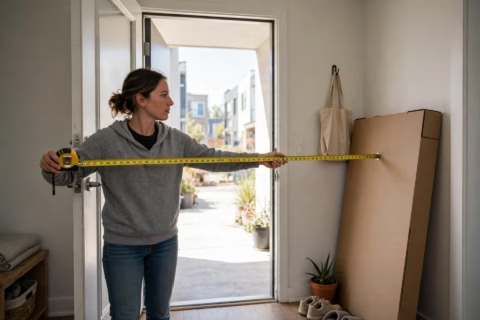
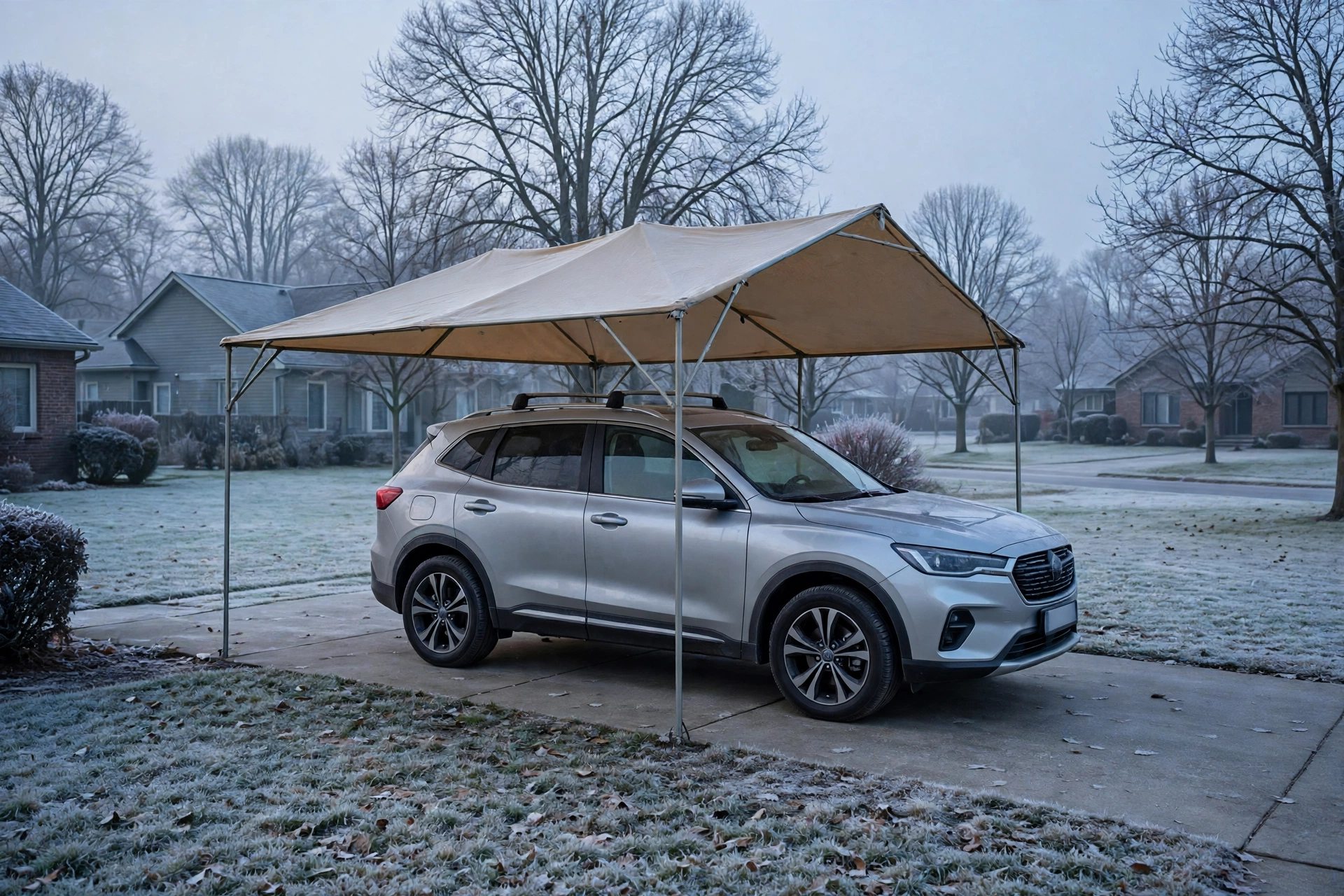
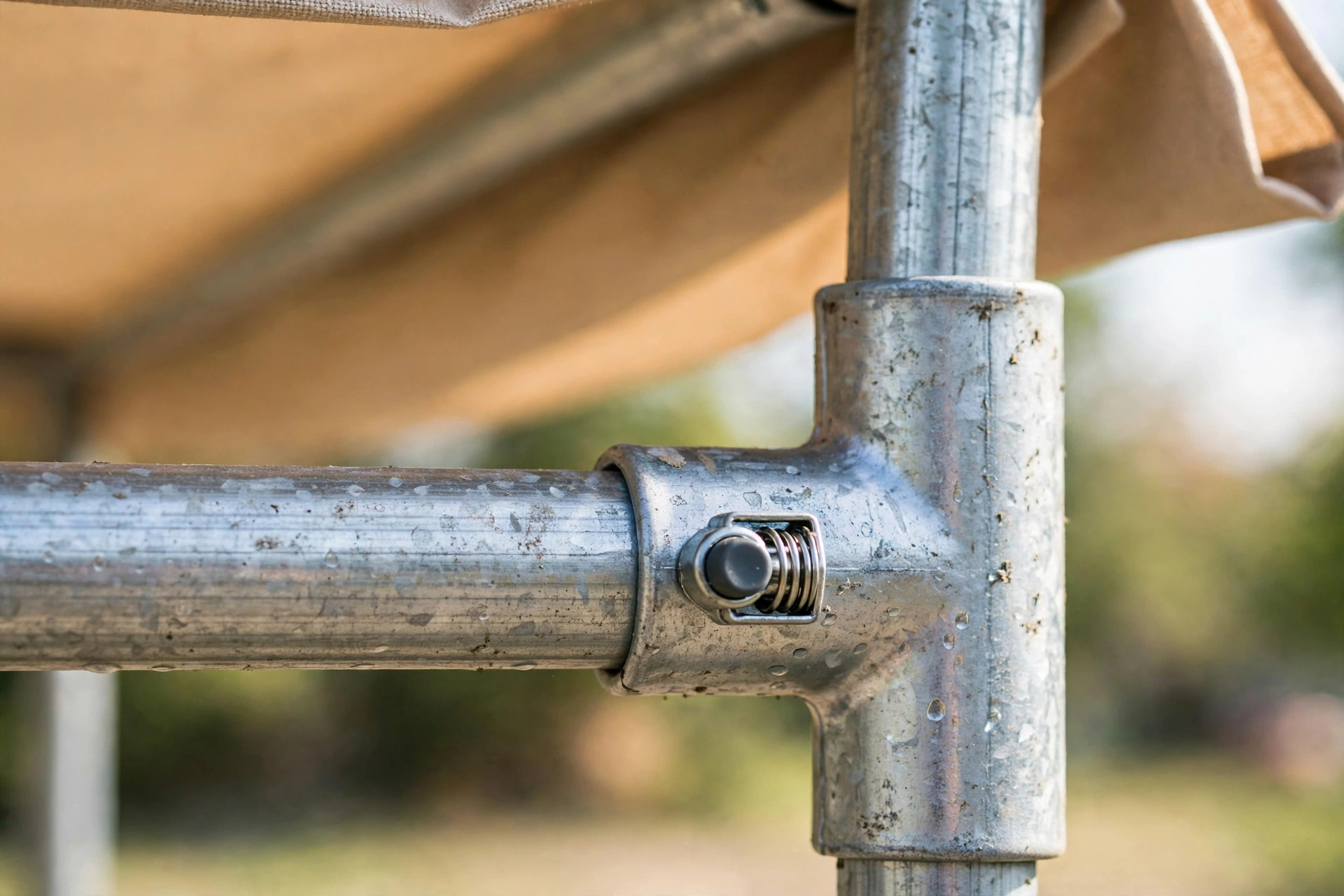
Here are the facts from the product page (item code W2373P147975), verified the day I ordered. The assembled footprint is 10 × 20 × 9.4 feet — 200 square feet of covered ground, and at 9.4 feet tall even a full-size truck clears it without drama. The frame is powder-coated iron tube, 1.5-inch and 1.65-inch diameter, joined with push-button connectors. Total weight: 103.3 lbs, shipped in a 110-lb box roughly 78 × 14 × 11 inches.
The cover is 180gsm double-layer coated PE in sand, rated waterproof with UV protection. The sidewalls are the part I did not expect to care about: they come with mesh windows and rolling doors, so you can close the whole thing into a tent on the worst nights or roll the sides up in summer and run it as an open canopy. Multi-use is the product line — portable garage, boat cover, event tent — but I bought it for one job: keeping weather off my car from November to March.
Assembly day: the two-person truth
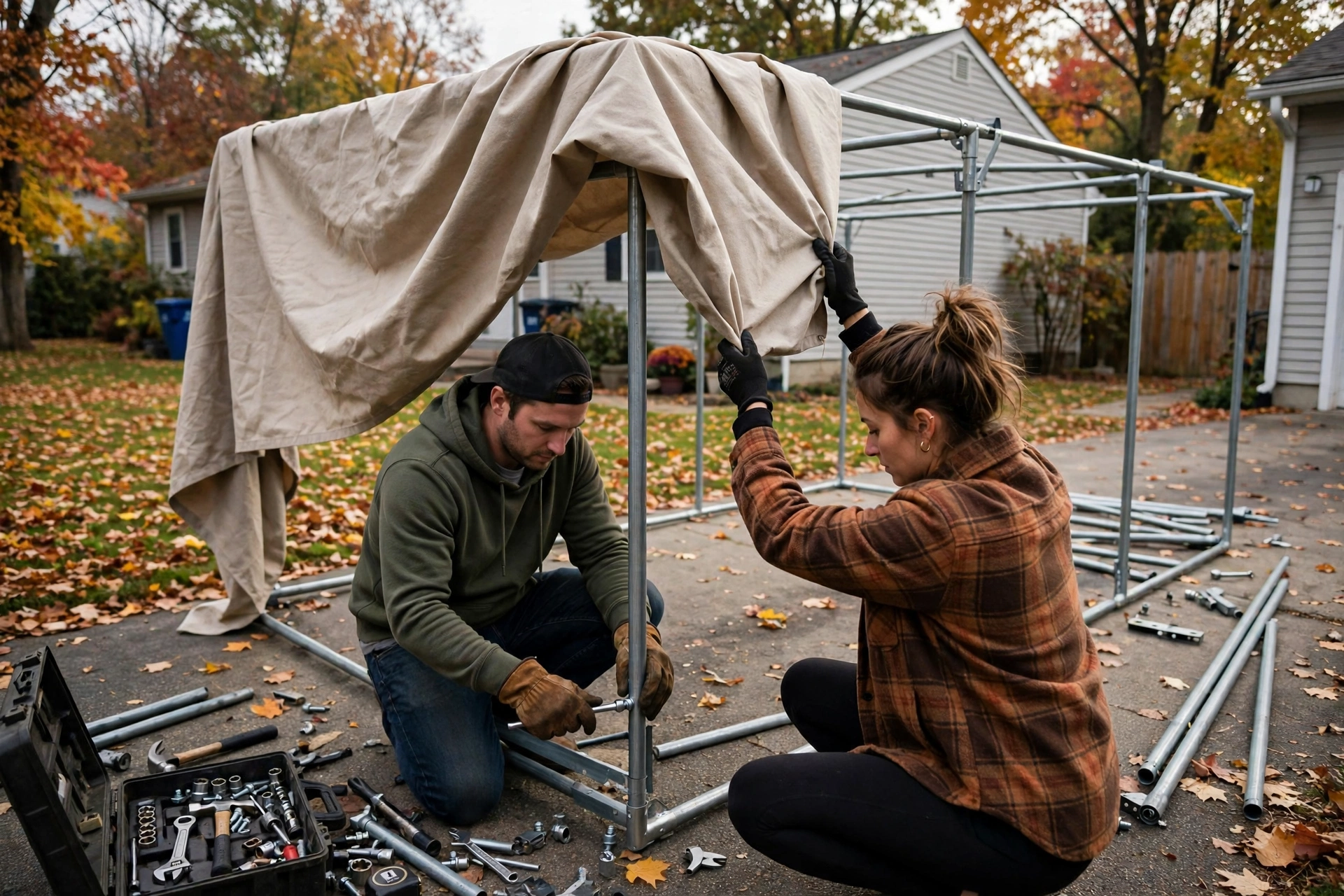
The product page says no additional tools required, and that part is true — the push-button tube connectors genuinely snap together by hand, no wrench, no swearing. What the page undersells is the choreography. This is a 20-foot-long skeleton, and once the roof rails go on, it is a 103-pound sail. Do not attempt it solo on a breezy day. I built it with my brother-in-law on a dry Saturday afternoon and the honest number was about three hours, including the part where we laid the whole frame out wrong the first time.
Two rules from assembly day. First: square the frame on the ground before the cover goes on. Measure corner to corner — both diagonals should match — while everything is still easy to adjust. A frame that is out of square by two inches at the base becomes a cover that fights you at the roof. Second: anchor it before you walk away, not after. Mine went up at 3 p.m.; by 6 p.m. a gust had walked one corner six inches across the driveway because I had planned to “do the anchors tomorrow.” The stakes went in that evening, and it has not moved since. If your driveway is concrete with no soil at the edges, plan on sandbag-style weights or drilling — the stakes need ground to bite.
The wind test I was afraid of (and the snow rule)
Three weeks after assembly, a November storm line rolled through with gusts the weather radio called 35 to 40 mph. I stood at the kitchen window waiting for $299 to become a kite. The staked frame shuddered, the PE cover drummed, and nothing moved. The next morning I walked the whole perimeter: every anchor tight, every button connector seated, cover unmarked.
Here is the honest limitation, and it matters more than the wind: the cover is a wear item, not armor. 180gsm PE sheds rain beautifully and laughs at frost, but it is not a snow roof. My rule now — borrowed from my pop-up gazebo experience — is to brush snow off with a soft broom after every real storm rather than letting it load up. Six inches of wet snow on 200 square feet of fabric is a load no $299 kit was engineered to carry. Five minutes with a broom, and the carport will outlast its cover by years; the cover itself is the part you budget to replace eventually.
The winter math: $299 against every alternative
I ran the numbers against everything short of moving into a house with a garage:
- Renting a garage bay: around my area, a single enclosed parking space rents for roughly $60 to $150 a month — my rough local figure, and metros vary wildly. Five months of winter parking costs more than the carport costs to own forever. The carport breaks even before the first thaw.
- A contractor-built carport: a permitted, permanent carport installed by a contractor typically runs $2,000 to $4,000 (my estimate from quotes I have seen, not a fixed bid). It wins on permanence and resale. It loses on every other row for a renter or anyone who might move.
- Doing nothing: forty frost mornings at ten minutes is about seven hours of scraping a season, plus the extra gas from idling, plus one snapped scraper a year at $12. Against that, $299 spread over a conservative five winters is roughly $60 a winter — about a dollar fifty per frost morning, my estimate. I would pay more than that for the bathrobe mornings alone.
- A $40–$80 car cover works — until a windy night turns it into a sail that scuffs your paint with every gust. The carport keeps fabric off the paint entirely.
The carport is not the cheapest line on the spreadsheet — the scraper is. It is the cheapest line that also gives you your mornings back.
Portable carport vs $380 metal shed vs $249 pop-up gazebo
I now own or have written full reviews on all three of FLNORW MALL’s outdoor shelters, so here is the honest field guide. The 6×4 outdoor metal storage shed at $380 is the winter workhorse for gear — mower, tools, patio furniture — with galvanized steel panels and a padlock. It holds things; it does not hold a car. The 11×11 pop-up gazebo at $249 is the summer social shelter — mesh netting, 121 square feet of shade, and a 20-pound snow rating that says “take me down in November.”
The portable carport at $299 is the only one of the three built to stand through winter with something valuable under it. Taller, longer, staked down, with sidewalls you can close against blowing snow. If your problem is a car sleeping outside, the carport is the tool. If your problem is a garage full of yard gear, buy the shed. If your problem is wasps at the cookout, buy the gazebo. I have now solved all three, and my driveway looks like a small municipal facility.
The industry numbers: carports are a real category
I looked up the market because I wanted to know whether $299 was a fluke price or the going rate for the category. It is the going rate, in a category that is growing fast. Dataintelo’s 2025 report puts the global carport frames and carports market at $3.36 billion, growing to $5.82 billion by 2034 — a 6.2% compound annual rate — with metal carports holding the largest share at 48.5%. PW Consulting’s steel-carport data (2025) sizes that segment at $1.05 billion heading to $1.88 billion by 2032, an 8.65% CAGR, with North America the largest region and residential buyers the top application at roughly $635 million.
Translation: a lot of people with no garage are doing exactly this math, and the portable end of the market is where the growth is. You are not buying a weird niche product; you are buying the commodity answer to a very common housing situation.
Five things I would tell my neighbor first
My neighbor watched the whole assembly from his porch. Here is what I told him:
- Anchor it on day one. A 103-pound frame is a sail until it is staked. Stakes on soil, weights on concrete, before the first storm — not after.
- Brush the snow off. The PE cover is waterproof, not structural. A soft broom after every storm is the entire maintenance program.
- Square it before the cover. Check the diagonals while the frame is on the ground. Everything after that gets harder.
- Level ground matters more than the manual admits. A leg sitting in a low spot is a frame that racks in wind. Shim it or move it.
- Keep it up in summer too. The mesh windows and UV-rated cover make it a shaded parking spot in July — the carport earns its keep eleven months a year, not five.
The verdict: Two months in — one storm, one ice event, and about fifteen frost mornings I did not scrape — the $299 portable carport has done exactly the one job I bought it for. The push-button frame went up in an afternoon, the anchors have held through the worst gust of the season, and the math — $60 a winter against $60-plus a month for rented parking — is not a contest. The honest caveats: brush the snow off, anchor it on day one, and budget for a replacement cover years from now, because PE fabric is a wear item.
Ready to retire the ice scraper? Shop the 10×20 portable carport at FLNORW MALL — or read my $380 metal shed winter review and my retractable pergola verdict to shelter the rest of the yard. Start from the FLNORW MALL homepage for this season’s outdoor picks.