What Size Rug Goes Under a Dining Table? My 8-Inch Rule, Tested
What Size Rug Goes Under a Dining Table? My 8-Inch Rule, Tested
I have owned three dining rugs. The first one was a crime scene. The second was merely wrong. The third — the one under my table right now — I would buy again tomorrow. The difference between them was not money. It was eight inches, measured from the edge of the rug to the wall. Here is the full story, the math, and the size chart I wish someone had handed me four years ago.
The $62 mistake that started all of this
Four years ago I bought a 5×7-foot rug for my dining room because the price was right: $62 on clearance, a flatweave that looked like it cost three times that. My table at the time was a 42-inch round — a 42.1-inch black tulip dining table from FLNORW MALL, $288, MDF top on a metal cross leg, 44.09 lbs, seats four to six. On paper, a 5×7 rug under a 42-inch round table sounds generous. The rug is 60 by 84 inches; the table is 42 inches across. What could go wrong?
Chairs. Chairs are what goes wrong.
Every time someone pushed their chair back to stand up, the back legs slid off the rug onto the hardwood. The chair wobbled. The person wobbled. My mother-in-law nearly took the gravy boat with her. Within a month the rug had migrated a full foot off-center from all the dragging, and the floor underneath was already showing two pale rub marks where the chair legs landed. The $62 rug lasted eleven weeks before I rolled it up and stuffed it in the closet — a $62 monument to guessing.
The second rug was a 6×9. Better. Still wrong. The back legs stayed on, but only just — about three inches of rug past the chair feet when the chair was pushed in. The first time my brother-in-law, who is 6’3”, pulled his chair out at an angle, one leg caught the rug edge and the whole thing buckled into a wave. That is when I stopped buying rugs and started measuring things.
The 8-inch rule: what it actually is
After the second failure I finally did what I should have done at the start: read a dozen design guides, which agreed on exactly two things and nothing else. The two things everyone agreed on are the only two rules in this article.
Rule one — the 8-inch rule: leave at least 8 inches of bare floor between the edge of the rug and the nearest wall (or the nearest large furniture piece the rug butts against). This is the framing check. A rug that runs wall-to-wall stops looking like a rug and starts looking like carpet that gave up halfway. Eight inches is the minimum breathing room that keeps the dining zone visually defined.
I call it my 8-inch rule because I am the one who ignored it first: my 6×9 rug left four inches of floor on the window side, and the room looked cramped in every photo. When I finally measured the dining area wall to wall — 11 feet by 12 feet — and applied the 8-inch minimum, the maximum rug that fit was 8×10 with room to spare. Which turned out to be exactly right, for the reason in rule two.
The 24-inch rule: the number that actually sizes the rug
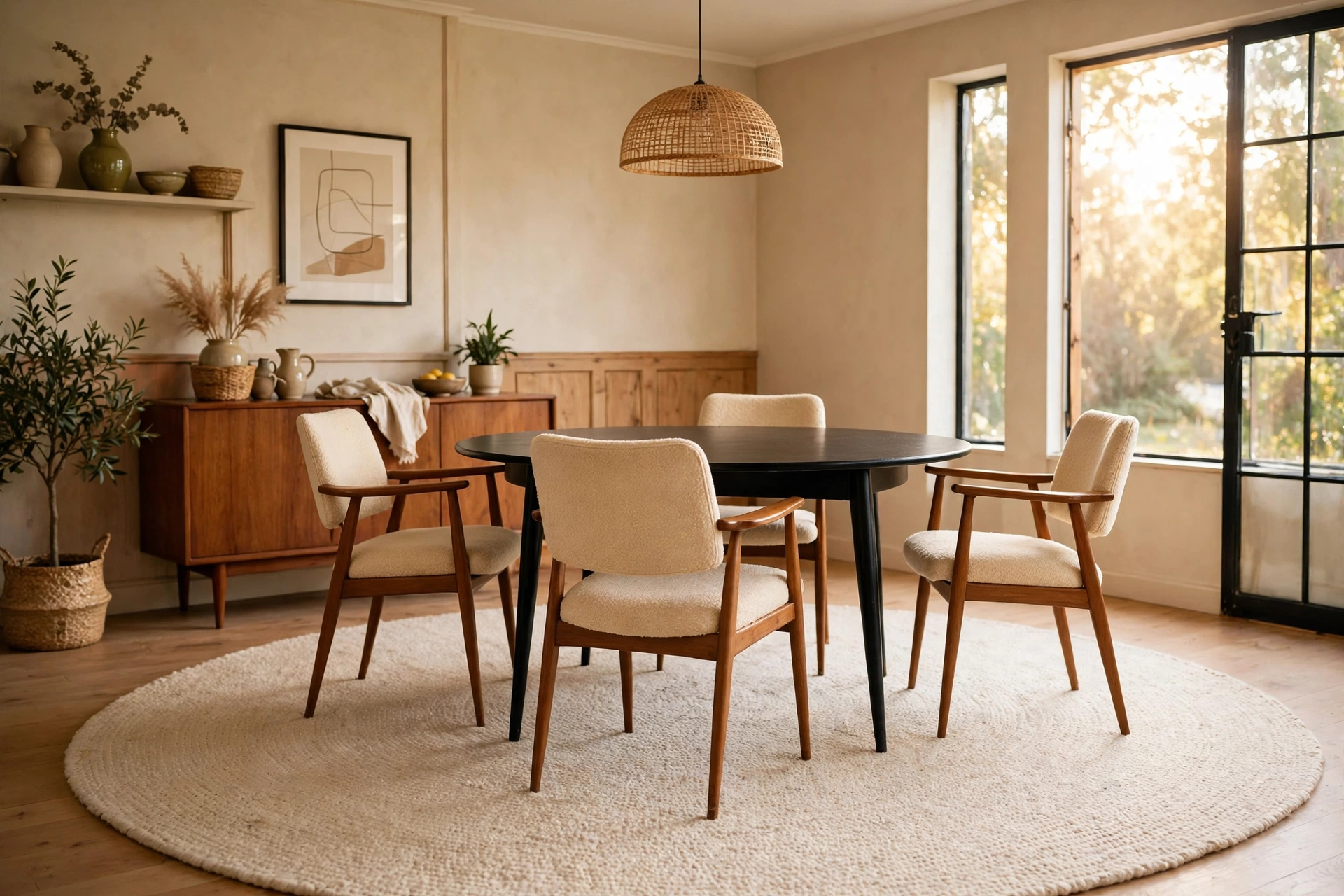
Rule two — the 24-inch rule: the rug must extend at least 24 inches beyond the table edge on every side. Not the table. The pulled-out chair. A dining chair needs roughly 24 inches of slide-back room for a person to sit and stand without the back legs leaving the rug.
This is the entire formula for rug size for dining table decisions:
- Rug length = table length + 48 inches (24 on each end)
- Rug width = table width + 48 inches (24 on each side)
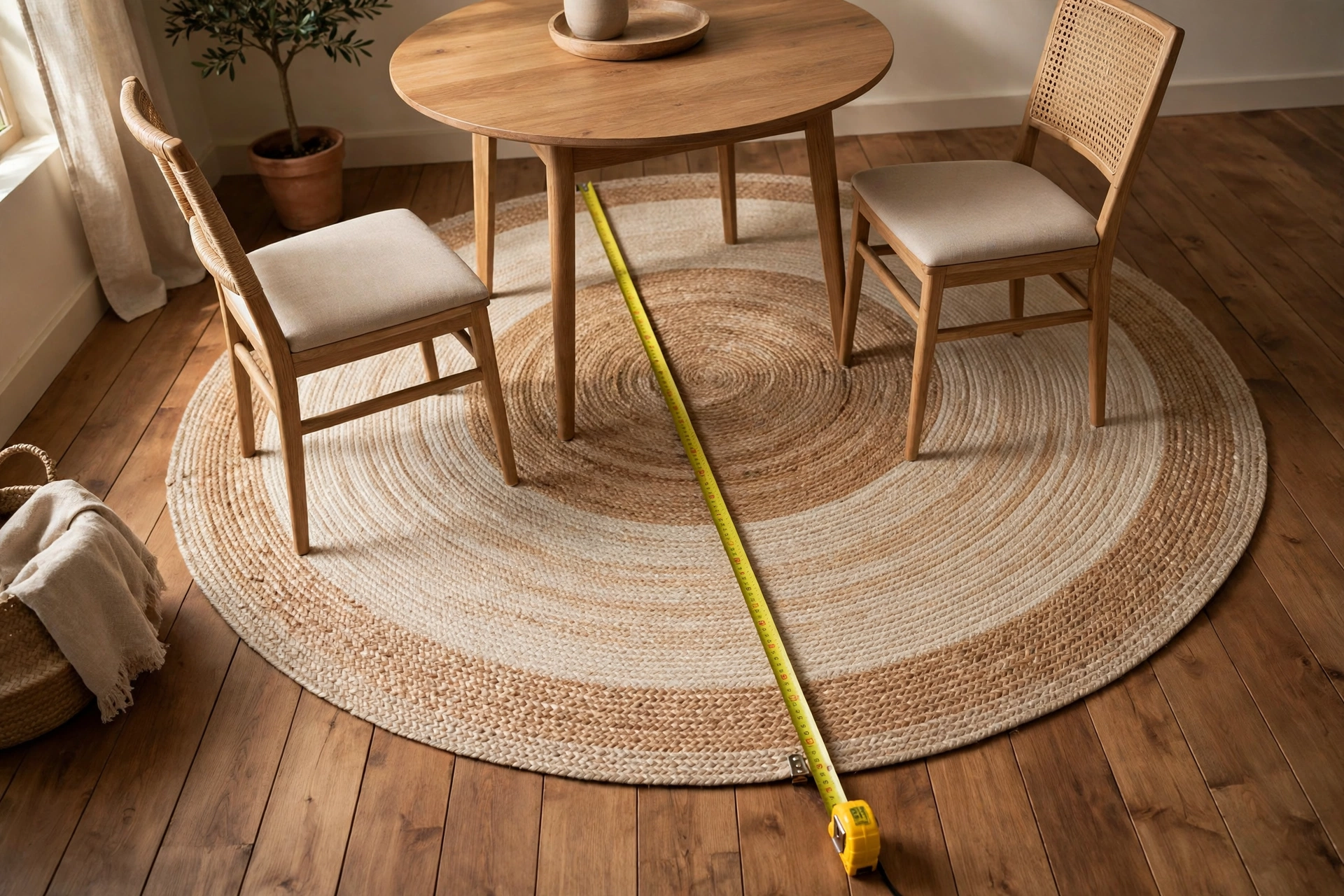
- Round tables: rug diameter = table diameter + 48 inches
- Then check rule one: if the result leaves less than 8 inches to the wall, the rug is too big for the room — shrink the table zone, not the clearance
Twenty-four inches is a minimum, not a target. If your family leans back, scoots wide, or includes anyone over six feet, 30 inches of clearance per side is the honest number.
The size chart: round, square, and rectangular tables
Here is the dining table rug size chart, using standard US rug sizes. Round up to the nearest standard size — never down.
- 36-inch round table (seats 4): needs 84-inch minimum → 8-foot round rug (or 8×10 rectangular)
- 42-inch round table (seats 4–6): needs 90-inch minimum → 8-foot round rug minimum; 9-foot round if the room allows
- 48-inch round table (seats 6): needs 96-inch minimum → 8-foot round rug, snug; 9-foot round is better
- 60-inch round table (seats 6–8): needs 108-inch minimum → 9-foot round rug
- 36×36-inch square table (seats 4): needs 84×84 → 8×8 square or 8×10
- 60×36-inch rectangular table (seats 6): needs 108×84 → 8×10 rug
- 72×40-inch rectangular table (seats 6–8): needs 120×88 → 9×12 rug
- 96×42-inch rectangular table (seats 8–10): needs 144×90 → 10×14 rug, or accept 9×12 in a smaller room
Notice what this means for the most common US dining setup — a 60-inch rectangular table for six. The internet is full of people recommending a 6×9. A 6×9 is 72×108 inches; the table needs 108×84 minimum. A 6×9 only works if you rotate it so the long side runs along the table — and then the width is 72 inches against a required 84, which fails rule two. The correct answer for a 60-inch table is 8×10. The 6×9 recommendation is the single most common rug under dining table size mistake I see, and it is exactly the mistake I made.
Two real tables, worked out
Let me run the math on two real tables I know well, because abstract charts are easy to nod at and hard to shop from.
The 42.1-inch round tulip table. FLNORW MALL sells the black mid-century tulip dining table for $288 — 42.12 inches across, seats 4 to 6, MDF top, metal cross leg, InStock at the time I checked. 42.12 + 48 = 90.12 inches. Minimum rug: an 8-foot round (96 inches). In my 11×12-foot dining room, an 8-foot round leaves about 18 inches to each wall — passes the 8-inch rule with room to spare. This is the setup I run now, and it is the first one that survived a full Thanksgiving with eight people.
The 31.5-inch bistro tulip. The smaller 31.5-inch black-and-walnut tulip table is $199, same MDF-and-metal build, seats 2 to 4. 31.5 + 48 = 79.5 inches. A 7-foot round (84 inches) is the technical minimum, but round rugs jump from 6-foot to 8-foot in most catalogs, so the practical buy is an 8-foot round — slightly generous, which is never a problem with rugs. This is the sweet spot for a small dining nook or a breakfast corner: the rug for small dining room answer is almost always one size up from what feels right.
Pile height: the detail nobody warns you about
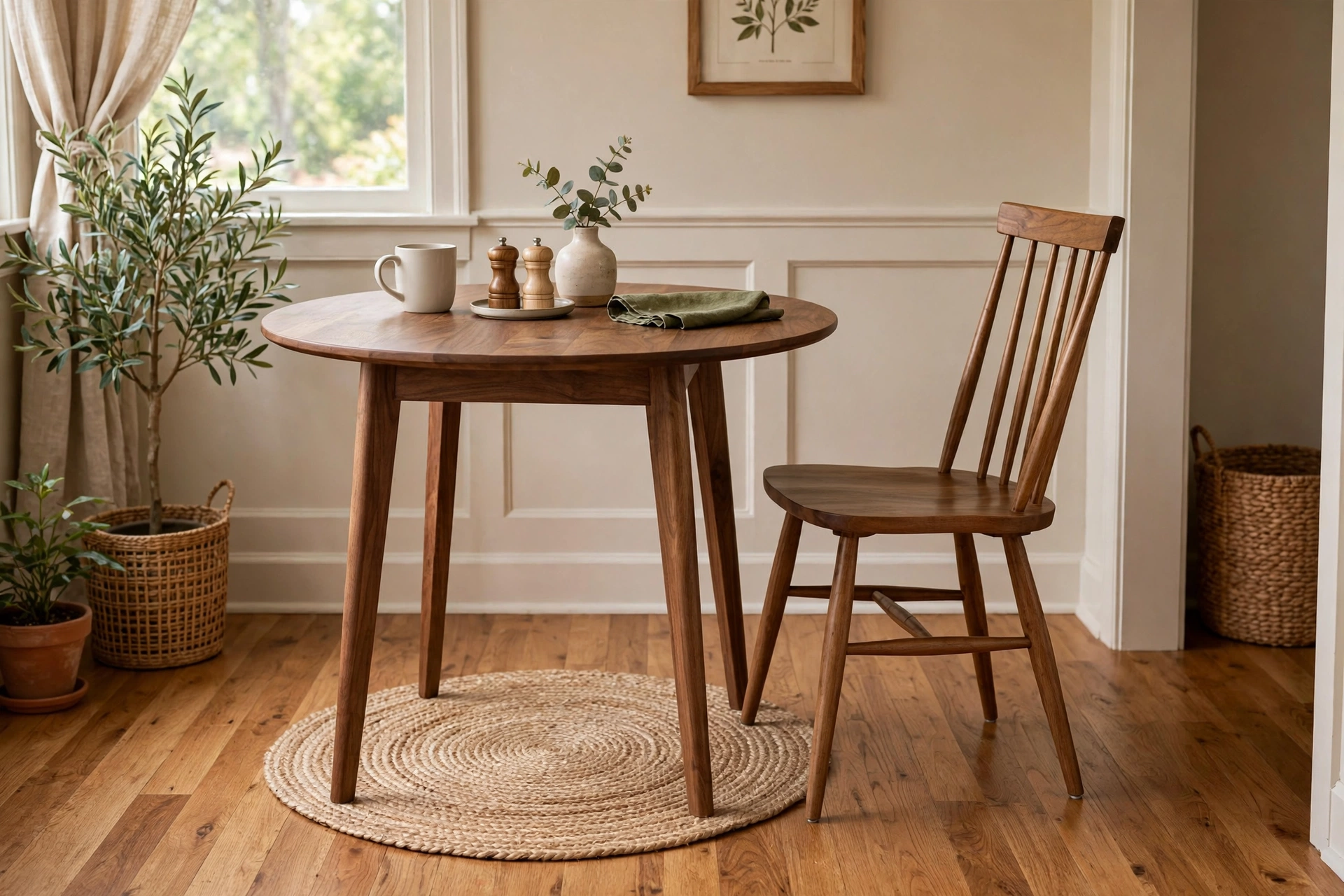
Size gets all the attention, but pile height decides whether chairs glide or fight. Under a dining table, buy low-pile — under half an inch: flatweave, low-loop, or short-pile. I learned this the expensive way.
My first correct-size rug was a plush half-inch-plus shag-style piece. It looked fantastic in photos. In practice, every chair leg sank a quarter inch into the pile, and pushing a chair in felt like docking a boat. After six months the traffic lanes under the chairs were visibly compressed while the center stayed fluffy — the rug aged in dog years. I replaced it with a low flatweave and the difference was immediate: chairs slide, crumbs vacuum out instead of hiding, and the rug wears evenly.
Cleaning is the secondary benefit. I have a kid and a dog: a low-pile rug under a dining table survives spaghetti night, while a high-pile one becomes a forensic archive of it. If spills worry you, add a rug pad underneath: it stops the rug from creeping on hardwood (which my 6×9 did constantly) and adds the cushioning that a thin pile lacks. A pad costs $30 to $50 for an 8×10 and is the cheapest insurance in this whole project.
The cost math: $90 once beats $45 twice
Let us do the honest accounting, because the $62 clearance rug felt thrifty and was not.
Rug one: $62, lasted 11 weeks, now lives in a closet. Rug two: $89, a 6×9 that was wrong on the math, lasted 8 months before the buckle drove me to replace it. Rug three: $119, an 8×10 low flatweave, correct size, now in year three and counting. Total spent across the learning curve: $270. Total if I had measured first: $119. The two wrong rugs cost me $151 — more than the right rug.
That is the real dining room rug size guide takeaway: the expensive rug is the wrong-size rug, not the big one. An 8×10 costs more than a 6×9 per square foot — roughly, call it $1.20 to $1.50 per square foot for a decent flatweave, so an 8×10 runs $96 to $120. Buy the size the math demands once. (my own rough estimate from shopping in 2025–2026, not a quoted price list.)
For context on how normal this learning curve is: Emergen Research sized the global area rugs market at $8.50 billion in 2025, projecting $14.11 billion by 2035 at a 5.2% CAGR, with North America holding about 34% of revenue share and online the fastest-growing channel. Millions of people are buying rugs right now, and a meaningful share of them are buying the wrong size — I was one of them, twice.
The verdict
Three rugs and $270 in tuition later, it fits on an index card: add 48 inches to the table for the rug, keep 8 inches of bare floor to the wall, buy low-pile, and add a rug pad. The 42-inch round table I eat at every night sits on an 8-foot round that has survived Thanksgiving, a toddler, and a 90-pound dog, and it will outlast the table.
Ready to measure? If you are still shopping the table itself, the $288 42-inch black tulip dining table and the $199 31.5-inch black-and-walnut version are the two I measured for this guide. For tight spaces, FLNORW MALL also carries a compact 3-piece rustic dining set built for small kitchens. Browse the full furniture collection or start at FLNORW MALL — then measure twice, buy the rug once.