I Bought a $299 Fat-Tire Kids Bike for Christmas. Here Is the Sizing Guide I Wish I Had.
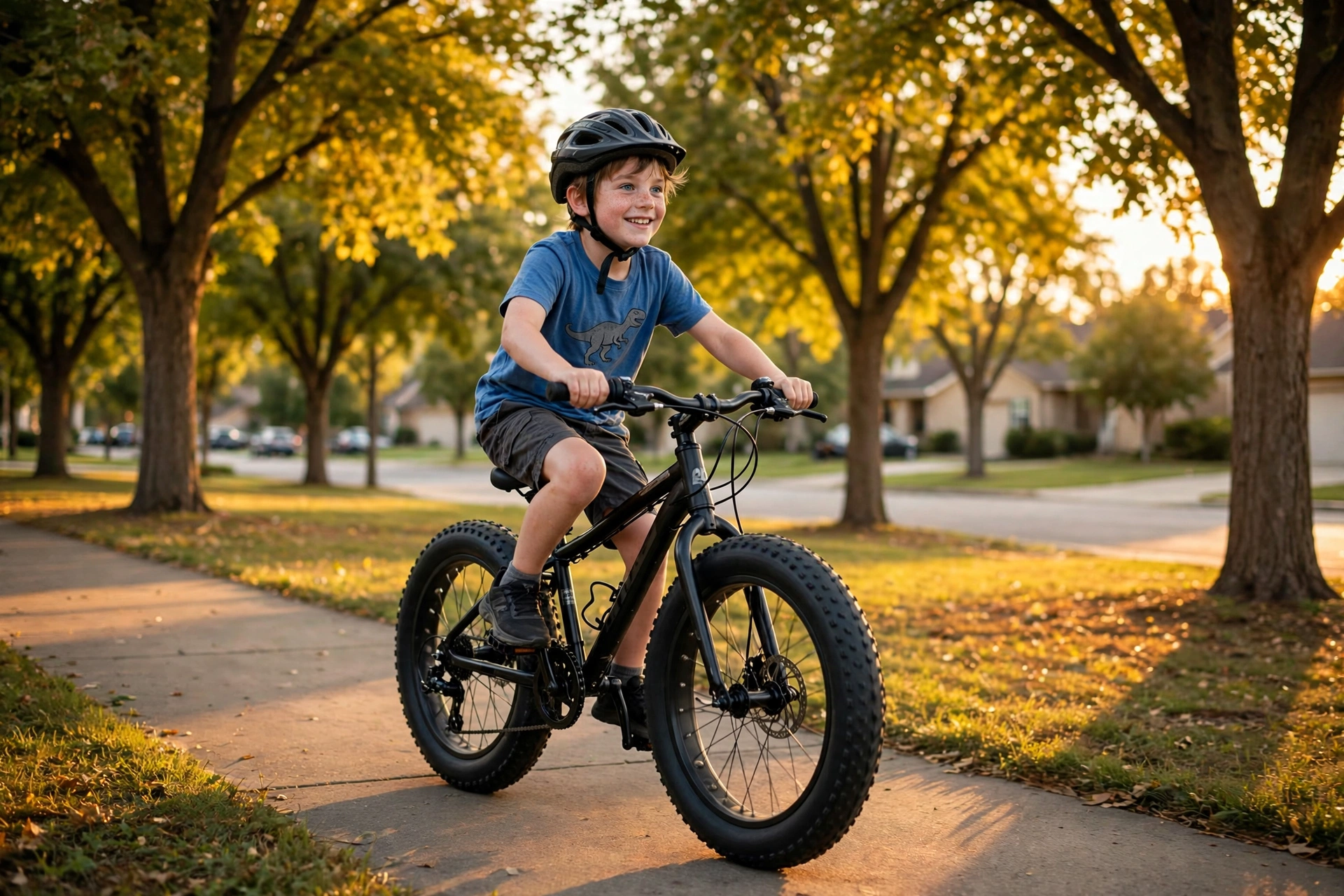
My son turned eight in October, and his 16-inch bike — the one he learned on when he was five — suddenly looked like a clown prop under him. Knees up around his ears, seat post cranked to the max line, and he was still cramped. With Christmas about seven weeks out, I did what any parent in this position does: I bought the next bike early and hid it in the garage. The one I bought is the Ecarpat 20 inch kids bike from FLNORW MALL — $299, 4-inch fat tires, a 7-speed drivetrain, mechanical disc brakes, aimed at kids ages 8 to 12. Six weeks of assembly, driveway laps, and one genuine sizing scare later, here is the sizing guide I wish someone had handed me before I clicked buy.
Why a 20 inch kids bike is the big-gift sweet spot
Christmas gifts for an eight-year-old fall into two buckets: things they open screaming about, and things they are still using in March. Most $299 gifts land in bucket one and die in bucket two. A bike is one of the rare gifts that can do both — if it fits.
The National Retail Federation’s 2024 holiday survey (Prosper Insights & Analytics, October 2024) found the average consumer planned to spend about $902 per person on gifts, food, and decor. A $299 bike is roughly a third of that — exactly where a “one big gift” should land.
I also ran the longevity math before buying, because I have been burned by the toy graveyard. My son rode his 16-inch bike for three years. If the 20-inch gets four years — ages 8 through 12, matching the product’s stated range — that is $299 divided by 4, about $75 a year, my own rough estimate. One of the cheapest per-day toys in our house.
The sizing rule that actually matters: buy by inseam, not birthday
Here is the part that nearly got me. The product page says ages 8 to 12, and my son is eight, so I almost stopped reading there. Age ranges on kids bikes are rough guesses. The real measurement is inseam, and the real test is standover height.
Every major kids’ bike chart — Schwinn’s and REI’s kids’ bike sizing guides both — says roughly the same thing:
- 12-inch wheels: ages 2–4, about 33–40 inches tall, inseam 12–16 inches
- 16-inch wheels: ages 4–6, about 39–48 inches tall, inseam 14–17 inches
- 20-inch wheels: ages 6–8, about 45–52 inches tall, inseam 18–22 inches
- 24-inch wheels: ages 8–12, about 51–59 inches tall, inseam 22–25 inches
My son is 50 inches tall with a 20-inch inseam — measured against the wall with a book on his head, the way the guides tell you to. The standover test confirmed it: standing over the bike, he had about an inch and a half of clearance. The rule of thumb is 1–2 inches. Nailed it.
Now the trap I almost fell into — and the one my neighbor actually fell into last year. The “buy big so he grows into it” instinct. She bought her then-7-year-old a 24-inch bike. He could not reach the ground from the seat, tipped over twice in the driveway, and refused to ride for nearly a year. A too-big bike is not a bargain; it is a $299 scare that teaches a kid riding hurts. Buy the size that fits now, with the seat post doing the growing-room work. This Ecarpat uses a step-through frame design, which lowers the standover height and forgives a slightly short inseam — one honest design point in its favor.
One more note: the product says 8–12 while the generic charts put 20-inch closer to 6–8. The fat tires add rolling height — the page lists wheel height up to 23 inches — so this particular bike runs a little big for its wheel size. That worked out for my eight-year-old. Measure your kid’s inseam, do the standover test, and trust the tape over the age label.
Fat tires, 7 gears, disc brakes: what the specs actually mean for a kid
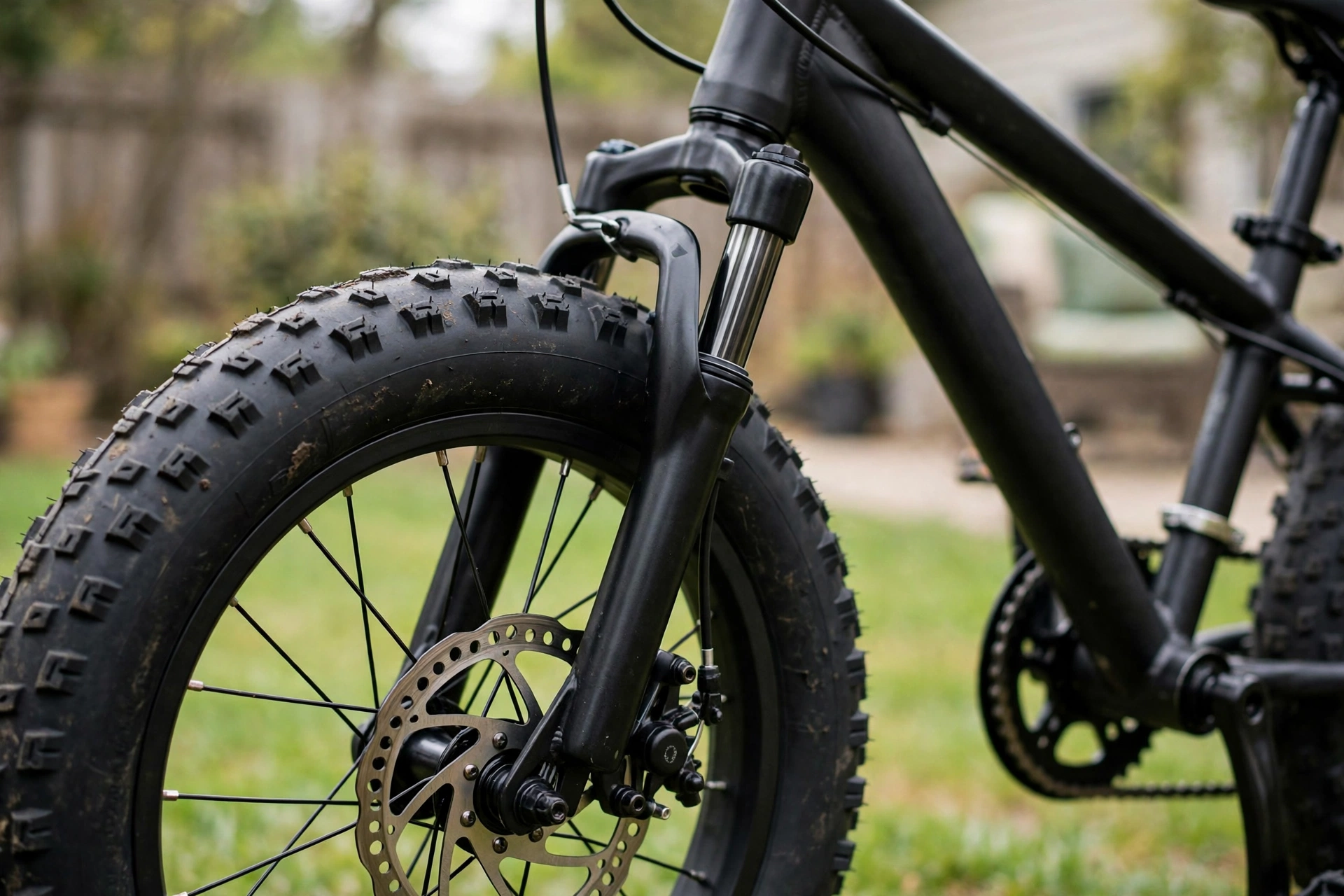
Fat tires on a kids’ bike look like a gimmick until the first snowfall. The 20×4.0-inch tires are the whole personality of this bike: they float over gravel, grip wet pavement, and — tested personally in a surprise November dusting — handle light snow better than any kid bike I have seen. The product page claims five times the wear resistance of ordinary tires and says it can handle off-road trails, city roads, beaches, and snow. I can vouch for gravel, wet grass, and snow; I have no beach, so that claim stays theirs, not mine.
The trade-off is weight: 44.1 pounds assembled, versus 25–30 for a typical 20-inch kids’ bike. That is the fat-tire tax: steel frame plus four-inch tires is heavy. My son cannot lift it into the back of the SUV by himself, and carrying it up the porch steps is a two-hand job. It also means more momentum to stop — which is where the mechanical disc brakes with 160mm rotors, front and rear, earn their keep. They stop this thing decisively, even downhill. Coming from a coaster brake, my son needed one afternoon to learn the levers are not toys — and then he loved them.
The 7-speed drivetrain is the feature I did not expect to matter and now would not give up. Our street ends at a proper hill, and the low gears turned a walk-it-up ordeal into a ride-it-up victory. There is also a 100mm front suspension fork — basic, but it takes the edge off curb drops.
The 20-minute assembly claim, tested in my driveway
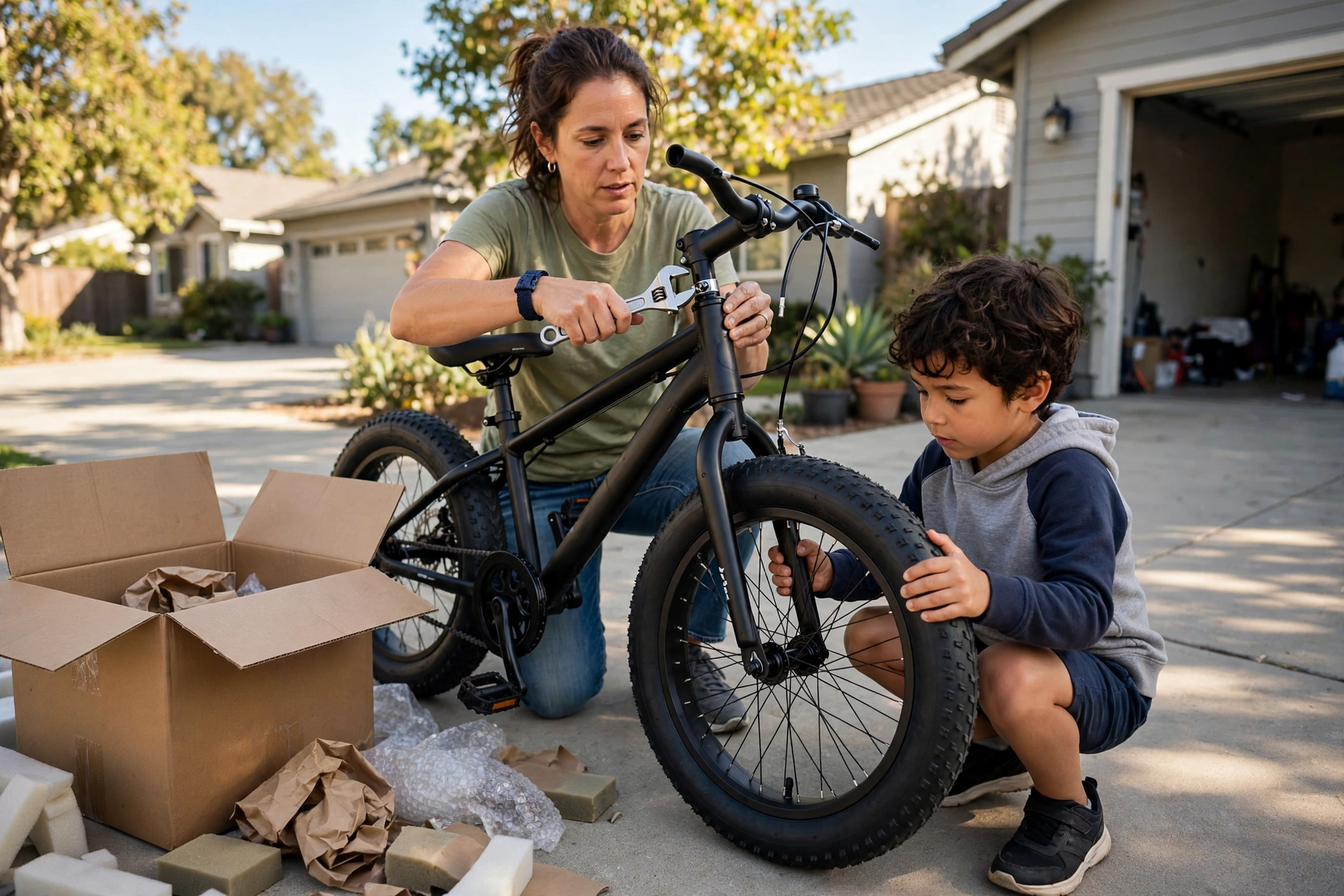
The product page says 85% pre-assembled, about 20 minutes: pedals, handlebar, saddle, front wheel, inflate the tires. My actual time: 28 minutes, solo, in the driveway, with the manual open on my phone. Close enough that I am not calling it a lie.
Here is the actual job, in order:
- Front wheel. Drop it in the fork, tighten the axle nuts. Five minutes.
- Handlebar. Slide into the stem, align straight, tighten. The “is it straight” dance took two tries.
- Pedals. This is the one place beginners get burned: the left and right pedals thread in opposite directions, and the 20-minute estimate assumes you do not spend ten minutes fighting a backwards-threaded pedal. Thread them in by hand first; if it resists, it is the wrong side.
- Saddle. Set the height so his leg has a slight bend at the bottom of the pedal stroke.
- Inflate the tires. Fat tires take real volume — my floor pump earned its keep.
No specialty tools needed. The box includes a basic multi-tool, and a manual plus an assembly video are provided. Check every bolt after the first two rides — things settle, and my handlebar stem needed a quarter-turn re-tighten after his first week.
The ride report: snow, gravel, and one steep hill
Three rides tell you everything: the gravel driveway loop, where the fat tires roll over stones that would have rattled his old bike to pieces; the surprise November snow, where they just gripped and he laughed the whole loop; and the hill at the end of the street, where the 7-speed turned a dreaded climb into the thing he now does twice per ride, to prove he can.
My son’s review is the only one that counts: “It’s like a monster truck bike,” and he has ridden it every rideable day since Christmas morning.
The weight con stays real, though. Forty-four pounds is a lot for an eight-year-old to wrangle at a standstill. If your kid is small for their age, or if the bike will be carried up apartment stairs daily, that number deserves a long think. For us, with a garage and a driveway, it is a non-issue.
Where it fits: balance bike to pedal bike to freedom
I have now reviewed three Christmas gift tiers at FLNORW MALL, and they line up like a graduation path. My nephew’s $299 KidRock 20-in-1 balance bike kit (ages 1–4) is the starter — no pedals, teaches balance, and the research says balance-bike kids start pedaling nearly two years earlier (my full gift math is in that balance bike review). My son’s $298 Tacoma ride-on car (ages 3–6) is the middle — motorized, remote-controlled, pure driveway joy (see my ride-on car review). This $299 fat-tire bike (ages 8–12) is the graduation: real gears, real brakes, real independence.
$299 each, interestingly — the price where each tier’s “one big gift” lands. The bike is the one with the longest runway: four-plus years of use versus two to three for the ride-on. If your kid is aging out of the Tacoma, the bike is the next step, not a sideways move.
The safety non-negotiables
A bike this capable deserves rules, enforced before the first real ride. Mine, learned over three kids’ worth of bikes:
- Helmet, every ride, no exceptions. Not “in the garage,” not “just the driveway.” A properly fitted helmet is the single highest-leverage safety item in cycling — the one line every safety authority, from the CPSC on down, agrees on.
- Both feet can nearly touch the ground from the saddle at its lowest useful height. That is the standover test from the sizing section, enforced as a rule.
- Brake check before every ride. Squeeze both levers, roll the bike, confirm it stops. Thirty seconds.
- Driveway and bike paths only until he can signal turns and scan behind — our house rule through age ten.
The bike itself is built to ASTM F1447 kids’ bike safety expectations — the standard US bicycle safety spec. I still added a $12 flashing rear light, because November gets dark at five.
The verdict
Six weeks in, here is my honest accounting. The $299 bought a bike my eight-year-old fits perfectly, with fat tires that genuinely expand where he can ride, a 7-speed that conquered our hill, disc brakes that stop 44 pounds of steel without drama, and assembly that took me under half an hour. The weight is the real trade-off, and the age range runs generous — measure inseam, not birthday. At roughly $75 a year over four years of riding, the math works. The one big Christmas gift I would buy again tomorrow.
Ready to hide one in your garage? See the Ecarpat 20 inch kids bike — $299 at FLNORW MALL. Shopping for a younger kid? Read my balance bike gift guide for the 1-to-4 crowd or the ride-on car review for ages 3–6 — and when January comes, my holiday decor storage system has a shelf waiting for the wrapping paper. Browse it all at FLNORW MALL.