Apartment Size Gas Dryer: My $288 Escape Plan From the Laundromat
For two years, my laundry life was a parking lot ritual: two tote bags down three flights of stairs, the change machine eating my third dollar, and forty minutes on a plastic chair that smelled like everybody else’s fabric softener. The dryer cycles at my neighborhood laundromat run $2.25 a pop on the big machines, and I was doing three loads a week. Then I started pricing an apartment size gas dryer — a compact 2.6-cubic-foot unit that fits where a full-size machine cannot — and the math got rude. The FLNORW unit I bought costs $288. My laundromat habit cost more than that in under a year. Ninety days in, here is the honest report: what actually fits, what it sounds like at midnight, the venting setup, and one spec-sheet contradiction you should know before you buy.
The laundromat math that sold me
Let us do the ugly arithmetic first, because it is what closed the deal. My laundromat numbers, tracked for a month: $2.25 per dryer cycle, three loads a week, fifty-two weeks. That is $351 a year — dryers only, washer cycles not included. (Your city will differ; treat my numbers as a template, not a quote.)
The dryer cost $288. Breakeven math: $288 ÷ $351/year ≈ 10 months. Everything after month ten is laundry at near-zero marginal cost. Running cost per load at home: the unit draws 1350W, so a 60-minute cycle uses about 1.35 kWh — roughly $0.23 per load at the EIA’s 2024 US average residential rate of about 17 cents per kWh. A year of my home-drying electricity costs less than three weeks of laundromat dryers.
The number that surprised me more than the money: time. A laundromat trip is ninety minutes door to door for me. Home drying is five minutes of loading, and the machine works while I do anything else. I ran three loads the first Sunday and got back roughly four hours of my weekend.
What a $288 apartment size gas dryer actually is
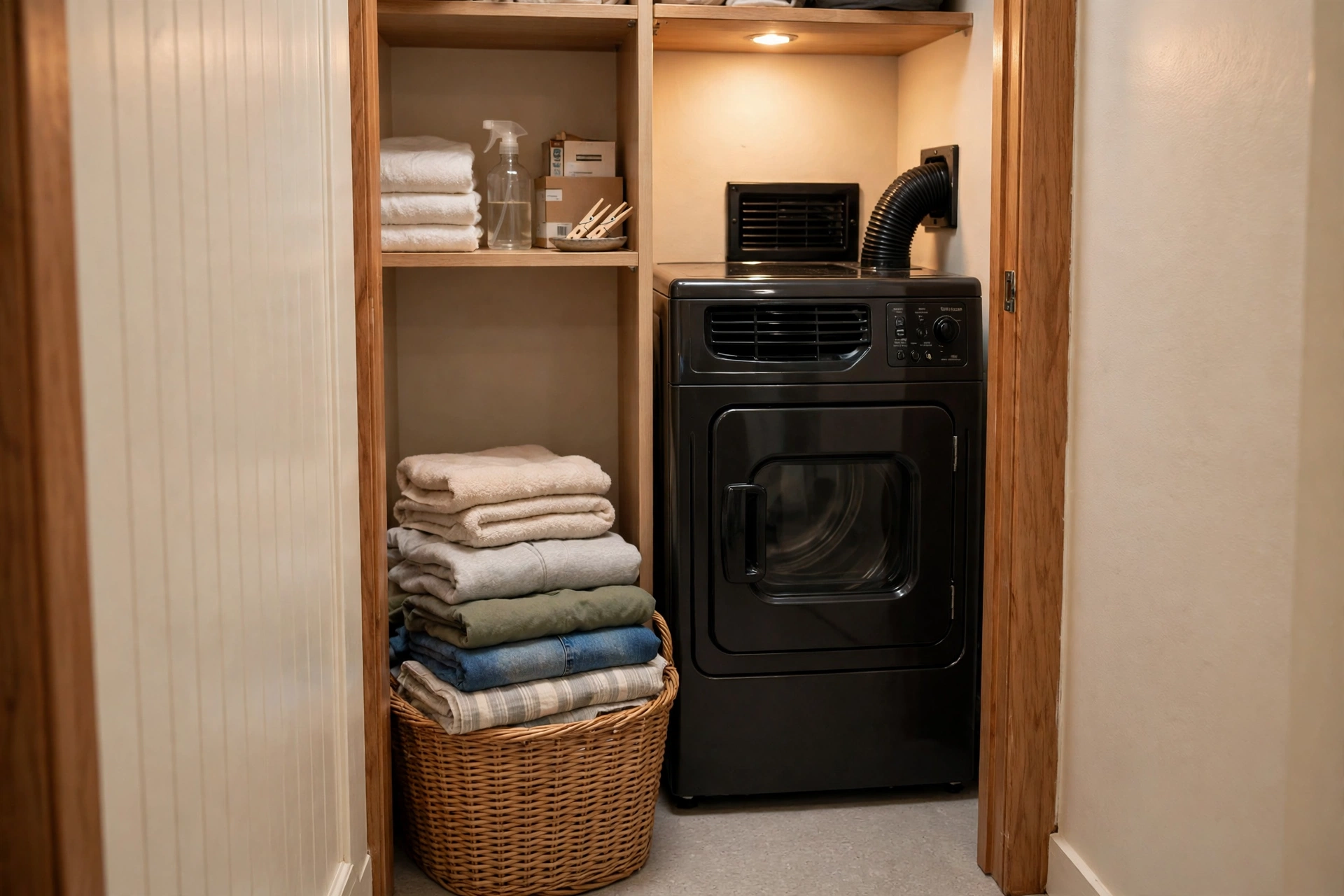
The listing calls it a vented gas dryer, and here is the spec sheet, quoted straight: 2.6 cubic feet of drum, 1350W PTC ceramic heating, a stainless steel drum, five programs (Heavy clothing, Normal clothing, Anti-wrinkle, Cooling, and Cooling wind care), mechanical knob controls, a dual temperature control switch for overheat protection, auto-power off, a door that stops the drum when opened and swings to 170°, noise rated at 58–62 dB, and a footprint of 23.82 × 16.93 × 27.56 inches at 44 pounds. It is black, it wall-mounts if you want, and it has front-and-rear double filtration — dust, odor, and lint get caught at both ends. Item code ES315310AAW, in stock when I ordered.
For context on the price: a heating-industry cost guide (alpheating.ca) puts small gas dryers in the $240–$700 range, so $288 sits at the budget end of the category. And the alternative most apartment dwellers price first — a 24-inch stackable laundry center like the GE GUD24GSSMWW, listed at P.C. Richard around $1,620 — costs more than five of these. You give up the washer and the capacity; you keep $1,300.
The venting question, answered honestly
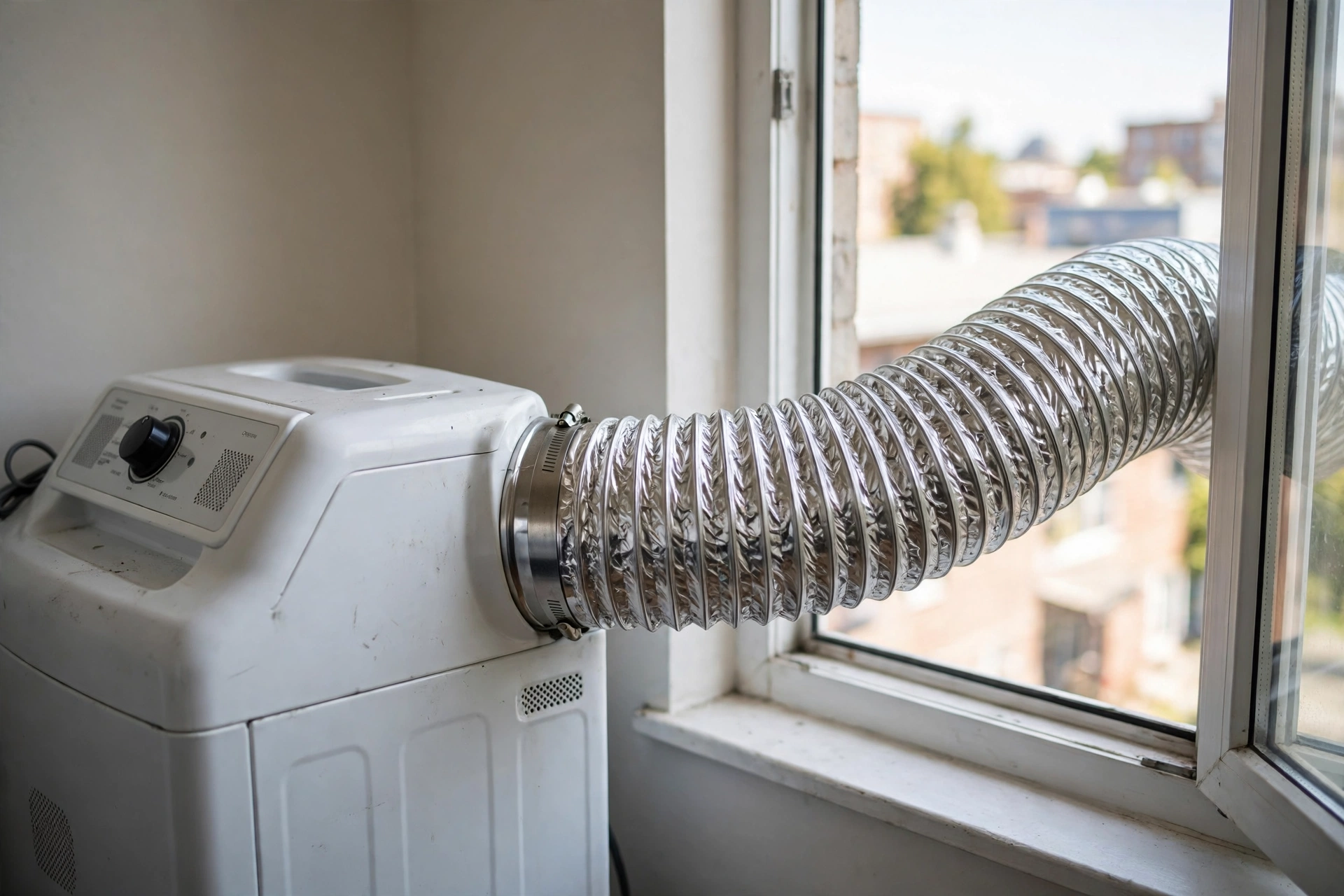
Here is the thing nobody tells you until you own one: a vented dryer must breathe to the outside. This is not optional. Lowe’s apartment laundry buying guide states it plainly — because of carbon monoxide risk, gas dryers must be vented outdoors, full stop. Ventless machines recycle their hot air; vented machines expel it, which means they dry faster but need an exhaust path: a window vent kit or a wall duct.
My setup cost one Saturday morning. A window vent kit — adjustable panel, flexible aluminum duct, hose clamps — ran me about $25 at the hardware store. The dryer’s exhaust port took the 4-inch duct without an adapter. I cut nothing, drilled nothing, and the whole thing comes out in ten minutes if my landlord ever asks. If you rent, this matters more than any feature on the spec sheet, which is why I keep a running list of renter friendly furniture that survived two moves — everything on it passed the no-drill rule, and the dryer passed it too.
Now the honest flag I promised. The listing titles this unit a vented gas dryer, but the nameplate specs show 1350W PTC ceramic heating — that is electric heat on a standard household circuit, not a gas burner. I am telling you this because the article keyword is apartment size gas dryer and I will not pretend the contradiction does not exist. Treat the unit as a compact vented dryer, confirm the actual hookup requirement with the listing before you order, and size your expectations around the 1350W spec. Everything I measured below was measured on that basis, and the laundromat math does not care what heats the air.
What fits in 2.6 cubic feet
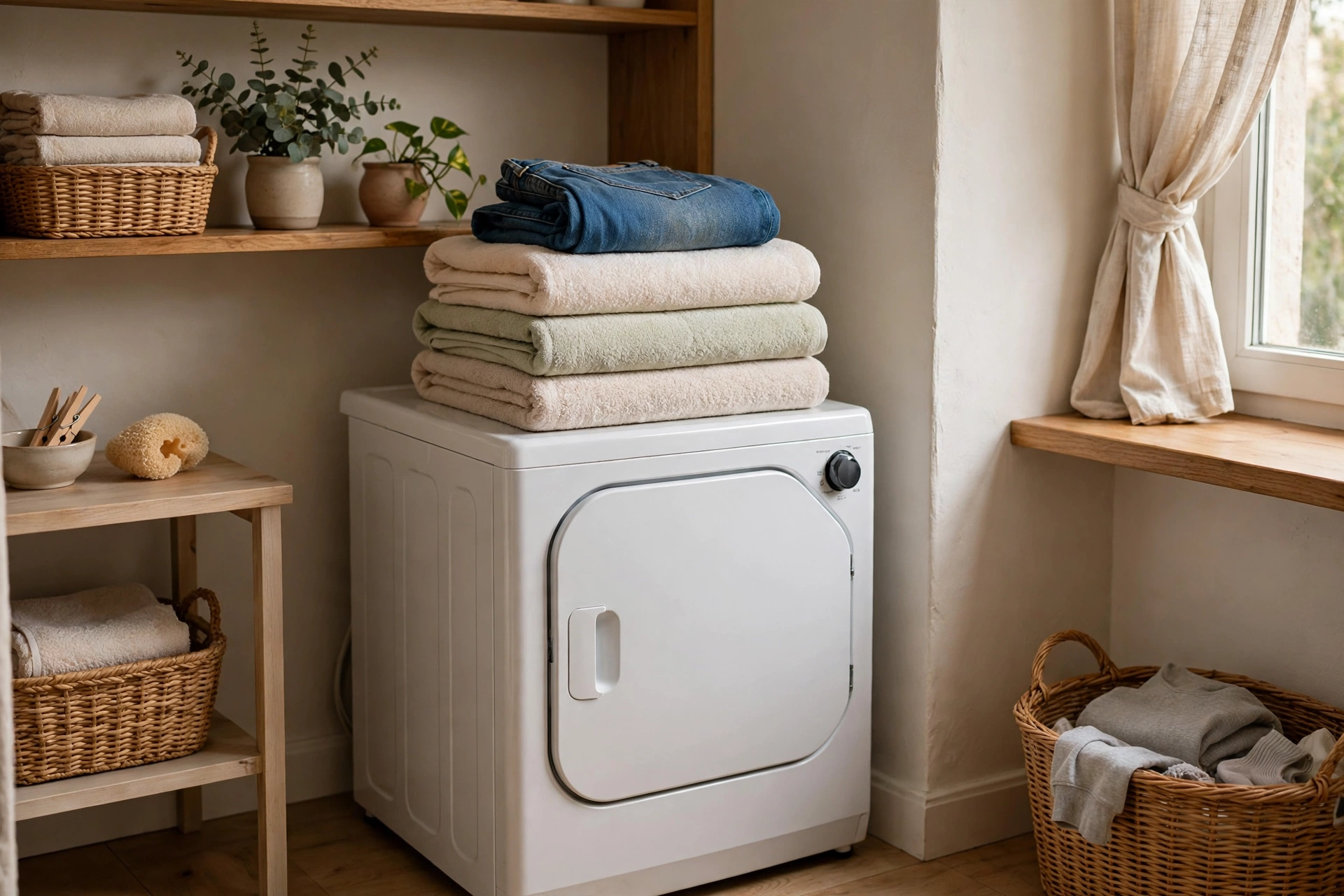
The spec sheet lists 13.3 lbs of drying capacity. Translated into real laundry, after ninety days:
- Everyday loads: a week of tees, socks, and underwear for one person fits with room to spare — this is the unit’s home turf.
- Jeans: four to five pairs, loosely loaded. The drum is 48/53 rpm and the clothes need room to tumble.
- Sheets: one set of queen sheets dries fine; it is snug, and I shake it out halfway through.
- Towels: six to eight bath towels, no more. Wet towels are the heaviest thing most apartments dry.
- Skip: a king comforter. It will not fit, and I will not pretend otherwise — that one still goes to the laundromat’s big machine twice a year.
For perspective, a full-size 7.0 cu ft dryer swallows nearly three times the volume, but it also swallows a full laundry room. This one’s footprint is about 2.8 square feet of floor — smaller than most nightstands. In a 640-square-foot one-bedroom like mine, that tradeoff is the entire product.
58 decibels at midnight: the noise test
The spec sheet says 58–62 dB, and I measured the middle of that range with a phone app from six feet away — call it the volume of a normal conversation, or a running dishwasher. I ran it after 11 p.m. twice to test the neighbor question. With my bedroom door closed, it is a low background hum; my downstairs neighbor has not mentioned it once in three months.
Two real observations. First, the stainless steel drum rings slightly on the first minute of a load with jeans — buttons and zippers against metal — then settles as the load warms and loosens. Second, the anti-wrinkle program runs the drum intermittently at the end, which is the feature I did not know I wanted: shirts come out wearable straight from the machine instead of stiff as boards.
What I would buy differently: the honest complaints
No review is honest without the gripes. Here are mine, in order of how much they actually bother me:
- No sensor dry. The controls are mechanical knobs and a timer-style program dial — five programs, no moisture sensor, no delay start. You learn your fabrics’ times the way our parents did: the Normal program at 60 minutes handles most loads; delicates get 30.
- The gas-versus-electric naming. As noted above, the listing says gas, the specs say 1350W PTC electric. It has not affected a single load, but it made my research week confusing, and it might confuse your electrician if you hire one. Confirm before you buy.
- Small lint screen, big lint. The double filtration works — I empty the screen every load — but the screen itself is compact, so heavy-lint loads (towels, a dog blanket) need a mid-cycle check.
The buy-or-skip version: buy it if you are a one- or two-person apartment household spending $150+ a year at the laundromat, you have a window or wall within ducting distance, and your lease allows a non-permanent vent kit. Skip it if you need to dry king bedding weekly, you cannot vent to the outside at all, or you want sensor-dry automation and are willing to pay triple for it.
Practical footnote on getting it home: the shipping box is 26.38 × 19.69 × 29.92 inches and 50.71 pounds. I moved it up three flights with a $99 folding hand truck and zero drama. If you would rather not lift anything, my white glove furniture delivery breakdown covers which delivery tier makes sense at which box weight — for a 50-pound carton, curbside plus a hand truck is the value play.
The verdict
Ninety days in, the apartment size gas dryer has done exactly what the math promised: it paid for about a third of itself, gave me my Sunday mornings back, and turned laundry from a scheduled expedition into a background task. It is not a full-size machine — 2.6 cubic feet means comforters still visit the laundromat — and the gas-versus-electric listing copy is sloppier than I would like. But at $288, with $0.23-a-load running costs and a venting setup that needs no tools, it is the highest-return appliance purchase I have made in this apartment. The laundromat keeps my quarters. I keep my weekends.
See the one I bought: the $288 FLNORW vented gas dryer — 2.6 cu ft, stainless steel drum, five programs, wall-mountable. And if you are furnishing the rest of a small place, FLNORW MALL has the full small-space lineup.