I Bought a $299 Chest Freezer for My Garage. Here’s the Honest Math.
The quarter-beef arrived on a Tuesday in March, and my kitchen freezer was already full. I had ordered 110 pounds of packaged beef from a local farm — the kind of purchase that feels brilliant right up until the delivery driver is standing on your porch with four cardboard boxes and nowhere to put them. For two weeks, half my beef lived in my brother-in-law’s freezer across town, which is the exact moment I stopped pretending a second freezer was optional. I bought the 7.0 cu. ft. ORIKOOL chest freezer from FLNORW MALL for $299. Eight months later, here is the honest accounting — what the box holds, what the power bill says, and the chores nobody warns you about.
Chest Freezer Specs That Actually Matter
The product page lists a wall of specs, but after eight months of living with this thing, only a handful of them turned out to matter. The chest freezer gives you 7.0 cubic feet of storage in a box that measures 37.80 x 22.05 x 33.47 inches and weighs 88.18 lbs. It runs on an R600a compressor with an adjustable range of -9.4°F to 5°F, and the noise rating is under 42 dB — quieter than my kitchen refrigerator, which I did not expect from a $299 appliance.
The rest of the spec sheet, translated into real life:
- Lockable stay-open lid. The lid opens to 90° and stays put past 45°, so both hands are free while you load. The rear-mounted hinges mean it does not bang into the wall. It ships with a real lock and key — with a curious six-year-old in the house, that mattered more than any cooling stat.
- Removable wire basket. One basket, top layer. This is the single feature standing between you and the archeological dig that chest freezers become.
- Manual defrost with a drain hole. No auto-defrost, which the manufacturer says cuts electricity use by about 40% versus frost-free models. More on the chore itself below.
- Caster wheels. It rolls. I have moved it three times — twice to sweep behind it, once to reorganize the garage.
- Adjustable temperature control. A dial, not a digital panel. I set it once and have touched it exactly twice since.
What 7 Cubic Feet Actually Holds: My Real Inventory
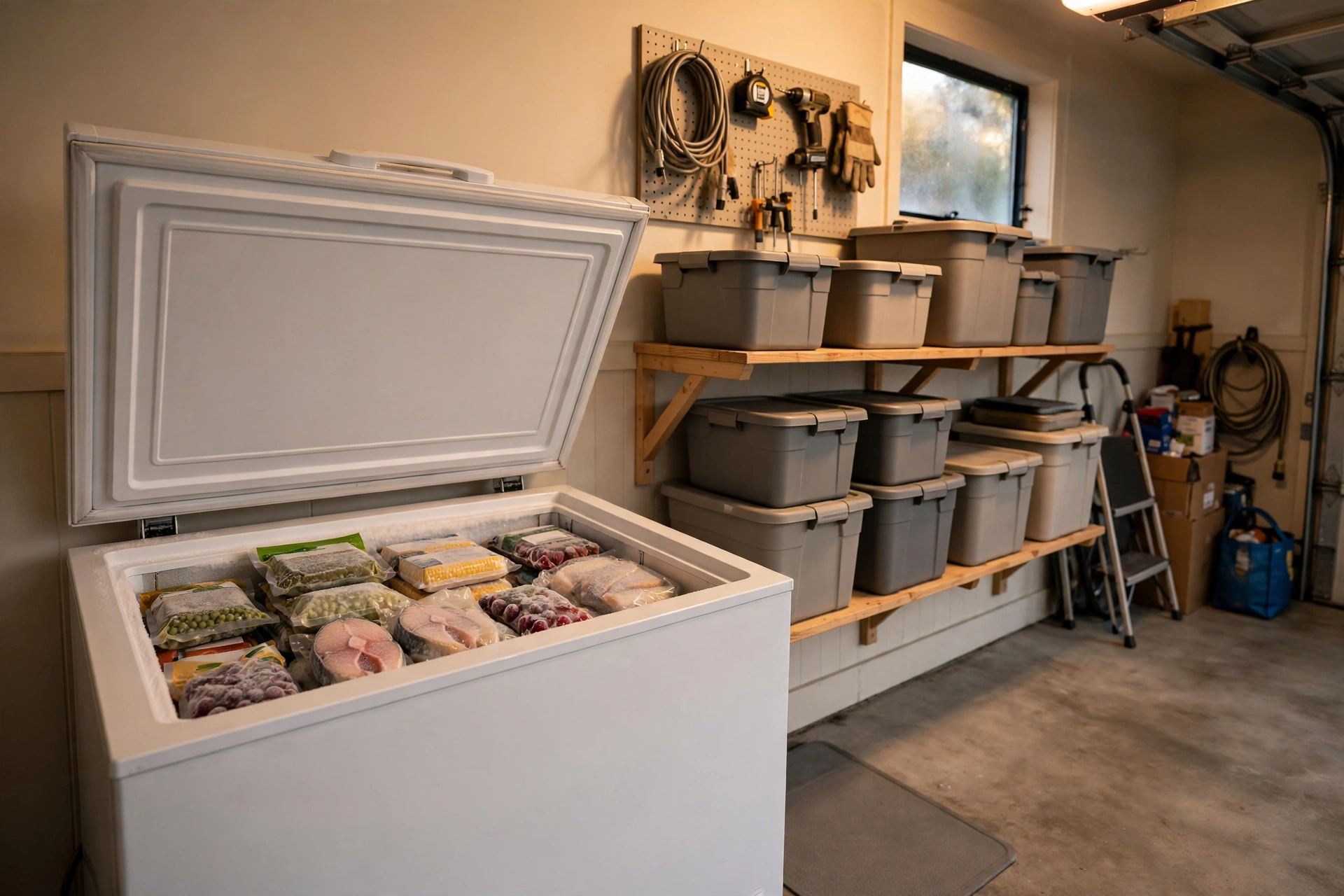
Seven cubic feet sounds abstract until you start loading it. Here is what is in mine right now, eight months in:
- The remaining ~40 lbs of the quarter-beef — ground beef, roasts, and steaks in flat paper-wrapped packs
- Two 20-lb turkeys bought on Thanksgiving-week clearance
- Three Costco chicken flats (the 10-lb bags)
- A garden harvest bag of blanched green beans and corn from August
- Two loaves of bread, a tub of ice cream, and the emergency pizza
The quarter-beef is the headline use case. A packaged quarter-beef runs roughly 110 pounds and eats about 4 to 4.5 cubic feet — a little over half this freezer. That leaves real room for the rest of the bulk-buying life: the turkey stockpile, the warehouse-club runs, the summer garden. If you are shopping chest freezer sizes wondering whether 7 cu. ft. is enough for a family of four: it is, unless you hunt and need to store a whole deer alongside everything else.
The Digging Problem: My Chest Freezer Organization System
Let us address the elephant in the room. A chest freezer is a top-loading box, which means everything you want is always at the bottom, under everything you do not want. The first month, I lost a bag of shrimp for three weeks. It surfaced during a defrost, freezer-burned beyond recognition. That bag cost me about eight dollars and taught me the system I use now:
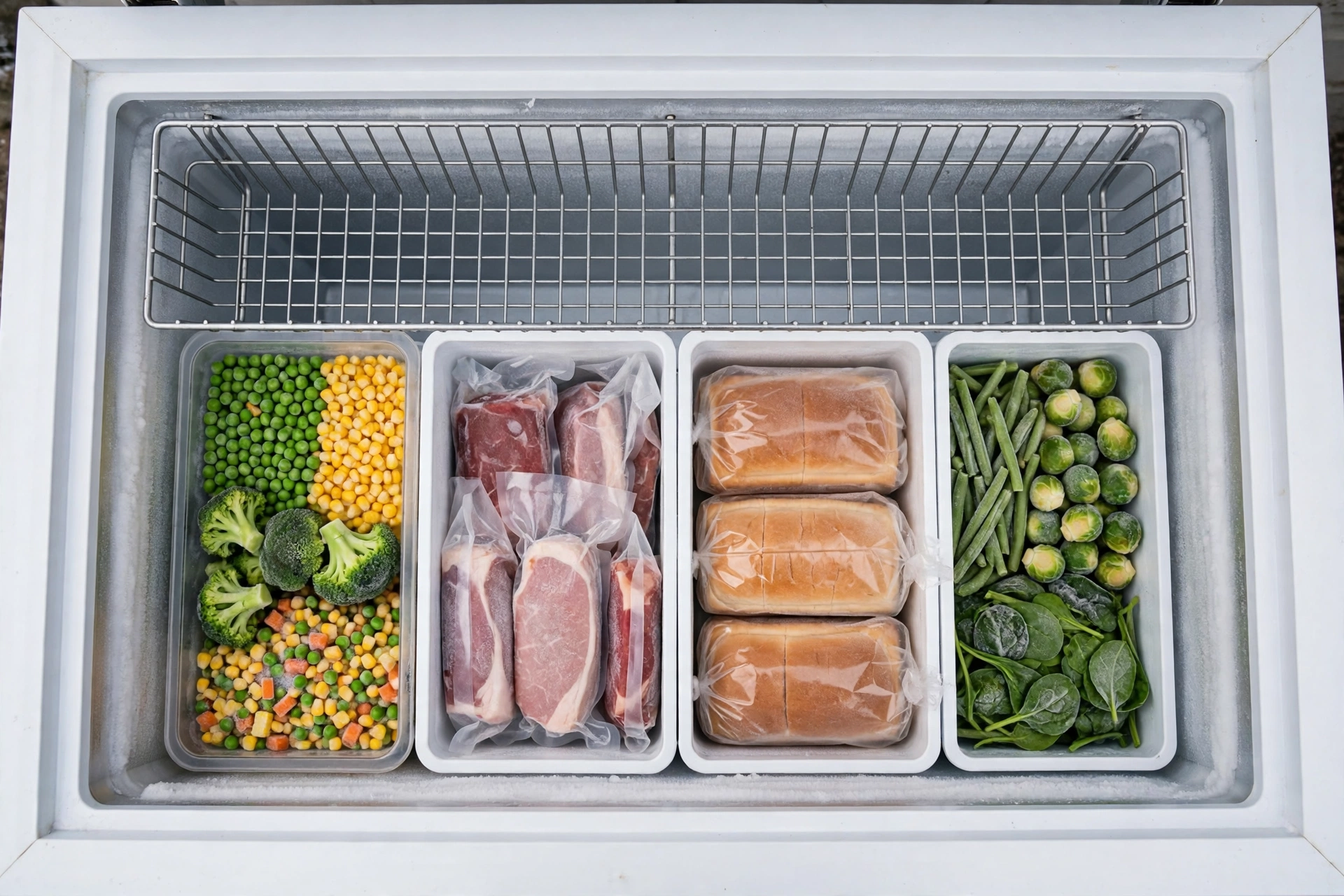
- The basket is for this week. Whatever I plan to cook in the next seven days lives in the removable wire basket. Nothing else goes in the basket. This is the rule that fixed 80% of the digging.
- Flat-freeze everything in bags. Ground beef, soups, beans — I freeze them flat in zip bags, then file them upright like vinyl records. A flat-frozen bag thaws in a fraction of the time and stacks cleanly.
- One bin per protein. Two cheap milk-crate-style bins at the bottom: beef in one, chicken and pork in the other. The basket handles the overflow.
- Label maker, not memory. A $9 label maker paid for itself the first time I grabbed “ground beef 3/26” instead of mystery meat. Date everything; frozen food does not keep its looks.
- The whiteboard rule. A small whiteboard on the lid lists what is inside in two columns. Erase when you take, write when you add. Sounds obsessive. Saves the lid-open treasure hunt that dumps cold air every time.
Manual Defrost: The Chore Nobody Warns You About
Here is the honest trade-off for that “40% less electricity” claim. A manual-defrost chest freezer grows frost, and frost is insulation working against you — the compressor runs longer as the ice thickens. The rule of thumb I follow: defrost when the frost hits about a quarter-inch thick, which for me has meant once a year.
My defrost Saturday looks like this: everything goes into coolers with the ice packs I keep for exactly this purpose, I unplug the unit, pull the drain plug, and let the defrost drain hole do its job into a shallow pan. Towels around the base. Three hours later it is dry, plugged back in, and reloaded. It is a chore, but it is one Saturday a year, and the alternative — a frost-free upright that costs more to buy and more to run — was not obviously better for a garage appliance that mostly sits closed.
Chest Freezer vs Upright Freezer: The Honest Split
I ran this comparison before buying, because the upright was tempting. Here is how it actually breaks down after living with the chest:
Buy the chest freezer if you buy in bulk, care about the power bill, and can follow a basket system. Cold air sinks, so opening the top lid loses far less cold than opening an upright door — that is the physics behind the efficiency edge, and it also means your food stays frozen longer in a power outage. A chest holds more usable food per cubic foot because there are no shelves and door bins eating the space.
Buy the upright if you access the freezer daily and hate bending and digging. Uprights are filing cabinets; chests are treasure chests. My kitchen fridge-freezer is the daily driver. The chest is the warehouse. That division of labor is the whole point, and it is why the “which is better” debate misses the reality: most chest-freezer households, mine included, own both.
The 42 dB Noise Test and the Garage Question
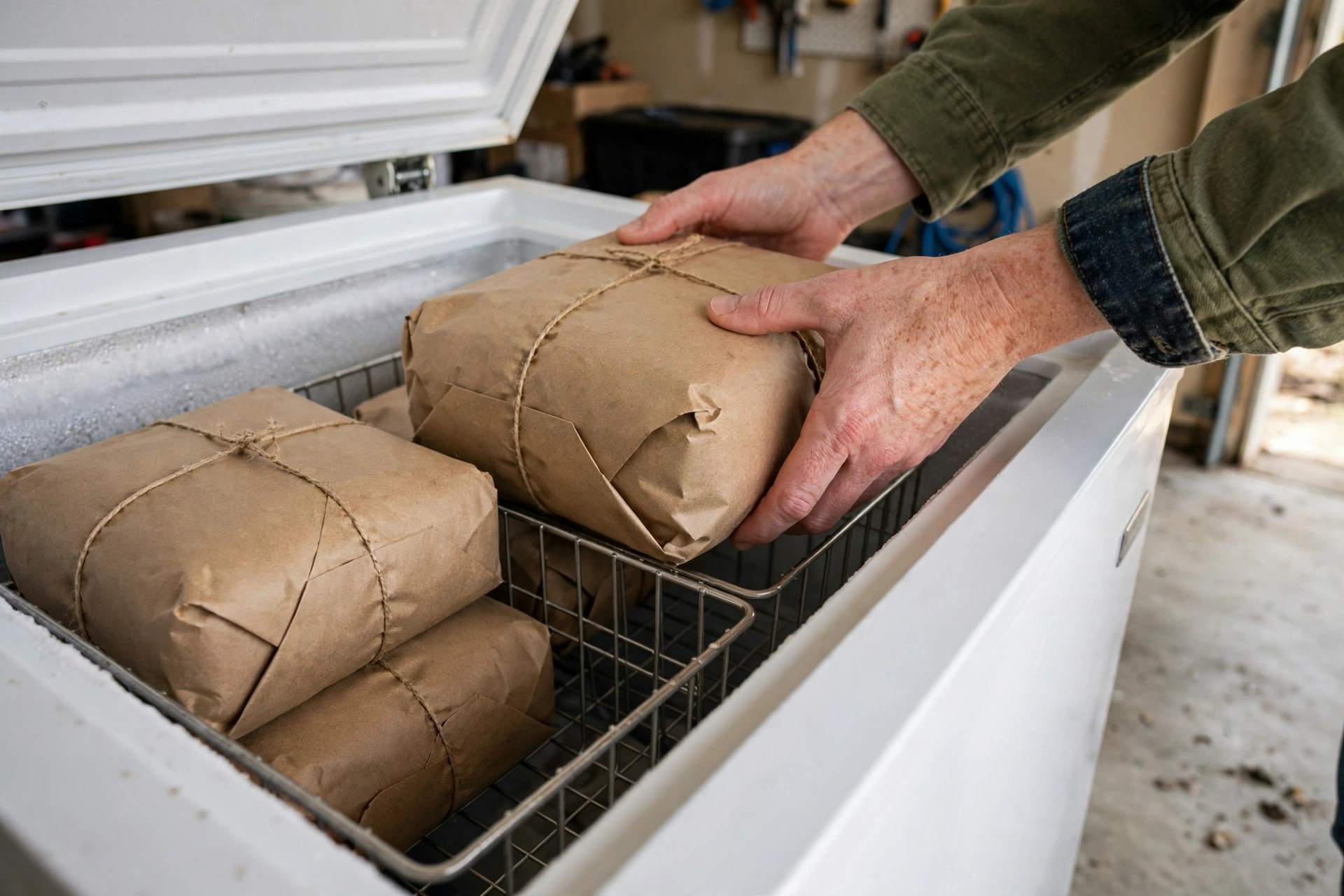
The spec sheet says under 42 dB, and I believe it — standing next to it in the garage, I hear the garage door opener, the water heater, and the neighbor’s dog before I hear the freezer. For context, a quiet library is about 40 dB. The compressor hum is a non-issue.
The garage question deserves honesty, though. This unit is not marketed as “garage ready,” and some freezers struggle in extreme ambient temperatures. Mine lives in an attached, insulated garage that stays roughly between 40°F and 85°F year-round, and it has been flawless through a full summer and the start of winter. If your garage is detached and uninsulated in a climate with real winters, check your conditions against the -9.4°F to 5°F internal range and talk to the seller first — I would rather you hear that here than discover it in January. My garage workshop setup keeps the freezer on the storage wall, off the floor-damp concrete, which is also just good practice for any appliance.
The $299 Math: Does a Chest Freezer Pay for Itself?
Time for the numbers. My quarter-beef cost about $4.50 per pound hanging weight from a local farm — roughly $700 for ~110 pounds of packaged beef. Comparable cuts at the grocery store run $8 to $12 a pound for ground beef and roasts (my local prices, flagged as rough). Even using a conservative $8 average, that is ~$880 of retail meat for ~$700 — call it $180 saved on one purchase, and I do some version of this twice a year between the beef, the Thanksgiving turkeys, and the warehouse-club chicken.
Electricity: a 7 cu. ft. manual-defrost freezer draws roughly 250 kWh a year in typical use (rough estimate — your climate and lid discipline matter). At the U.S. Energy Information Administration’s 2024 residential average of about $0.17 per kWh, that is roughly $42 a year — about $3.50 a month to run a second freezer. The food-safety math backs the whole enterprise: FoodSafety.gov’s Cold Food Storage Chart notes that food kept at 0°F or below stays safe indefinitely, with quality best within months (their chart gives roasts and steaks up to 12 months at peak quality). Nothing in my freezer is ever a race against the clock again.
So: $299 upfront, ~$42 a year to run, and ~$300+ a year in bulk-buying savings on my actual receipts. The payback landed inside the first year. Your numbers will differ — if you never buy in bulk, a chest freezer is just a cold box you paid $299 to ignore — but for a bulk-buying household, the math is not close.
The Verdict
Eight months in, the chest freezer has done exactly one job — hold a lot of frozen food cheaply and quietly — and done it without a single hiccup. The $299 ORIKOOL 7.0 cu. ft. unit is not fancy: a dial instead of a display, manual defrost, one basket. But the compressor is quiet, the lid hardware feels solid, the lock keeps the kid out, and the casters have already earned their keep. The digging problem is real but solvable with a $9 label maker and the discipline to keep this week’s food in the basket.
Buy it if: you buy meat or produce in bulk, you have garage or basement space, and you will spend one Saturday a year on defrost. Skip it if: you shop weekly and your kitchen freezer already fits your life — or if your only space is an uninsulated outbuilding in a harsh climate, in which case confirm the temperature ratings first.
Ready to stop renting freezer space from your brother-in-law? See the full specs and current price on the 7.0 cu. ft. ORIKOOL chest freezer product page. And if you are rethinking your whole garage while you are at it, my holiday decor storage system shows the shelving-and-labels method that keeps the rest of the space sane. Browse everything else at FLNORW MALL.