
I Bought a $450 Rain Shower Head System. The Water Pressure Rule Is Everything.
What the $450 box actually contains
Six weeks ago I stood in my hallway bathroom staring at a 1998 chrome shower head that sprayed in three directions at once and dripped all night. I had put off the fix for two years, because every plumbing project I touch turns into a second trip to the hardware store. Then I did the opposite of a cautious upgrade: I ordered the whole system in one box. The $450 rain shower head system from FLNORW MALL — gold finish, square raincan head, handheld wand, diverter trim, and the rough-in valve — all of it.
Here is what the listing says ships, and it is accurate: the raincan shower head, the shower arm, an integrated diverter shower trim, a wall-mount handheld shower, the wall elbow, and every valve the install needs. The main material is brass under a gold finish, total weight 9.9 pounds, item code NK0716. It is also backed by a lifetime limited warranty, which is the line that got me to click buy — brass fixtures with a lifetime warranty are not a category where sellers usually bluff.
One line in the product description mattered more than the gold: the heads are WaterSense labeled, meaning they use at least 20 percent less water than the industry standard 2.5 gallons per minute without giving up performance. I will get to the water math later, because it surprised me.

The 40 PSI rule that decides everything about a rain shower head
Before I tell you how the showers feel, the most important paragraph of this article: a rain shower head trades pressure for coverage. That is the design, not a defect. Spread the same gallons per minute across a wide face and every nozzle runs gentler than a small concentrated head. Whether you love yours or resent it every morning comes down to one number — your home’s water pressure.
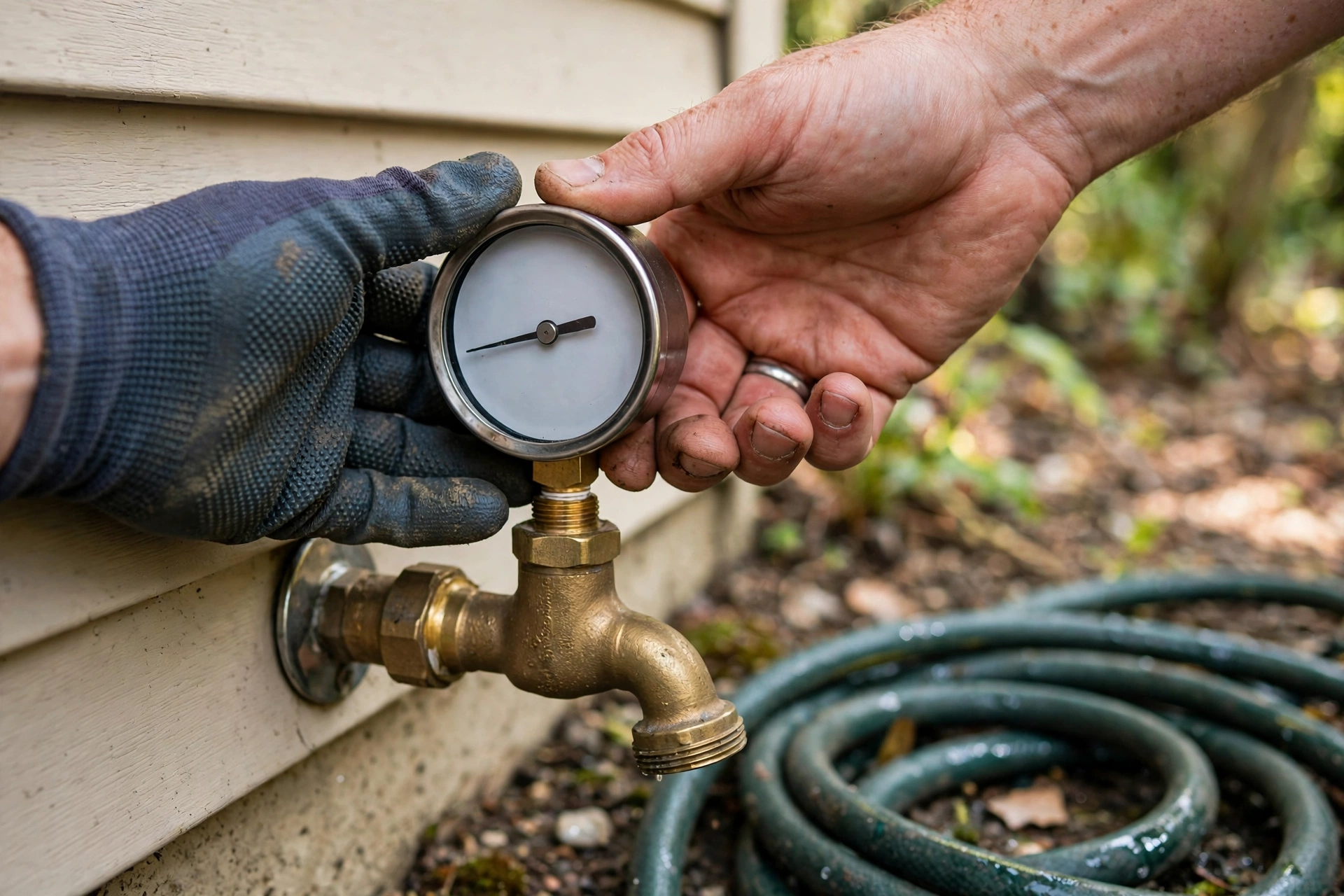
The buying guides I read before ordering all converge on the same threshold: a rain head wants 40 to 60 PSI behind it. Below that, a big square face delivers a disappointing drizzle. I bought a $12 pressure gauge, screwed it onto the outdoor spigot, and turned the water on: 52 PSI. City water, no booster, no drama. Two minutes told me the rain head would work in my house. If you are on a well or an old low-pressure line, check this before you buy anything — it decides more about your experience than the finish color ever will.
The second rule of thumb from the same guides: mount the head 80 to 90 inches from the shower floor, and keep it level. Our wall arm landed at about 82 inches. An 8-inch face suits most bathrooms; go bigger only if you have a large shower and strong pressure to match. I would not hang a 12-inch head in a standard 5-foot tub-shower and expect it to behave.
Brass underneath, gold on top: the build quality check
The guides say to look for solid brass or stainless steel under the finish, not a coated plastic body, because that is what decides whether the fixture holds up over years. Unboxing day was my verification. The arm has real heft, the diverter turns with a damped click instead of a plastic rattle, and the threads bit cleanly into the fittings — no cross-threading, no Teflon-tape heroics.
The finish itself is the part I worried about. Gold fixtures have a reputation for going brassy-orange or flaking at the edges after a year of steam. Six weeks is not a year, so this is a first impression, not a verdict: the coating is even, the edges are clean, and our moderately hard water has not left a mark yet. The Touch-Clean spray holes are the quiet feature here — the product page says you wipe away calcium and lime buildup with a finger instead of soaking the head in vinegar. I have done the finger-wipe twice. It works, and it takes ten seconds.
The handheld is not a bonus, it is the other half of a rain shower head
Here is the buying logic I wish someone had handed me up front: a rain head plus a handheld on a diverter solves the coverage-versus-pressure tradeoff instead of forcing you to pick a side. The rain face gives you the drench; the handheld gives you the targeted spray for rinsing.
This is not theoretical in my house. My wife has long hair, and the first week with the rain head alone taught us that rinsing shampoo takes longer under a gentle wide spray than under a concentrated jet. Every guide warned about this, and every guide was right. The handheld wand ends the debate: thirty seconds of the wand at the roots, done. Our kid rinses the tub down with it after baths. I use it to clean the shower walls, which — bonus honesty — I now do more often because it is easy.
The integrated diverter trim means both run off one control with a clean switch between them, no second valve hacked into the tile. If your current shower is head-only, the two-setting setup is the single biggest quality-of-life jump in the box, bigger than the rain effect itself.

One Saturday install, two honest snags
The box includes the rough-in valve, which is the part that normally sends people to the plumbing aisle. Our hall bath had a standard setup, so the install was: shut off water, pull the old head and arm, set the valve and trim, mount the new arm and head, hang the handheld on its slide bar, connect the hose. About three hours, most of it spent being careful, not being stuck.
Snag one: the pressure-balanced valve cartridge (the Monitor cartridge, included) needs the hot and cold supplies identified correctly, and our 1998 plumbing had the labels worn off. Ten minutes with a thermometer on each stub solved it. The cartridge itself is the reason the temperature no longer dips when someone flushes a toilet mid-shower — it balances hot and cold pressure continuously. That feature alone would have sold me the system.
Snag two: a 9.9-pound shower assembly still wants a second pair of hands when you are threading the arm into the wall elbow overhead. Do not be a hero with brass threads. Total plumber cost: zero.
Six weeks of actual showers: the honest report
The rain effect is real and it is exactly what the guides describe: a warm, even downpour instead of a jet. It is the most relaxing everyday upgrade I have made to this house, and I say that as someone who just wrote a whole article about bathroom remodel mistakes I paid to learn. The square face covers shoulders fully, and the whole thing reads as one clean gold line on the wall.
The honest caveats, six weeks in:
- Long showers get longer. The gentle spray means I stand under it an extra minute or two without noticing. The guides warned that this can erase the water savings of a low-flow head, and they are right — behavior eats efficiency. I have started timing myself.
- It is not a massager. If you want a pounding spray that blasts away a workout, this is not it. The handheld covers that need, but the rain face will never do it.
- Gold shows water spots. Our water is moderately hard, and the gold finish shows spots more than chrome did. A quick wipe after the shower keeps it clean.
What has not happened: no drips, no diverter stick, no temperature swings, no finish issues.
The water math: does a WaterSense rain shower head actually save anything?
I went and looked up the numbers because the product page’s WaterSense line deserved a check. The EPA’s WaterSense program says showers account for nearly 17 percent of residential indoor water use, the average American shower runs about 8 minutes and uses roughly 16 gallons, and WaterSense-labeled heads are capped at 2.0 gallons per minute versus the federal 2.5 standard. The EPA’s published estimate: swapping to a WaterSense head saves a household around 2,700 to 2,900 gallons a year.
Rough math, flagged as rough, for our house: two adults and one kid, one shower each a day, old head at roughly the 2.5 GPM standard. At 2.0 GPM the new heads cut about 4 gallons per 8-minute shower — 12 gallons a day, around 4,300 gallons a year. Our combined water and sewer rate runs about a penny a gallon (estimate from our bill), so that is on the order of $40 to $50 a year in water savings. Against a $450 system, the water alone pays back in about a decade — which sounds bad until you remember the old head was not surviving another decade anyway, and the comfort upgrade is the actual purchase.
The real savings line is the one nobody advertises: this system replaced a shower head that was already failing. A plumber visit to fix a drip, a valve, and a corroded arm would have run $150 to $250 in our market (estimate). I paid $450 for a full new system with a lifetime warranty instead of $200 to patch a 1998 fixture.
The verdict: who should buy this rain shower head system
Buy it if your water pressure clears 40 PSI, you have room for an 8-inch face at 80-plus inches of height, and you want the rain experience plus a handheld for the practical work. The brass build, the included rough-in valve, the pressure-balanced cartridge, and the lifetime warranty make the $450 read as a system price, not a shower-head price — compare it against buying the pieces separately and it stops looking expensive.
Skip it if your pressure is low and you will not fix the supply first, if your shower is a tight corner stall where a big square face will feel like a lid, or if what you actually want is a high-pressure blast. No rain head will give you that. Check the gauge first. Twelve dollars, two minutes, and you will know.
Six weeks in, I would buy it again for the hall bath — and I am measuring the master bath next. If you are refreshing the whole room, my $698 guest bathroom refresh plan covers the mirror, toilet, and cabinet I did last month.
Ready to check your pressure? See the $450 gold rain shower head system — brass, WaterSense labeled, diverter plus handheld included. If you are weighing the bigger bathroom decisions, my smart toilet vs regular toilet comparison covers the other fixture I replaced this fall. Start from the FLNORW MALL homepage for the rest of the house.