I Bought a $488 Folding Treadmill. 90 Days Later, the Math Answered.
Why I quit the gym (again)
I joined a gym in January with the best intentions and a $45-a-month membership. By March I had gone eleven times. That works out to roughly $16 a visit, and the real price was the 25-minute drive each way through traffic I already hated. So in April I canceled the membership and bought a folding treadmill from FLNORW MALL for $488 instead. Ninety days later, I have used it 61 times — mornings, lunch breaks, once at 11 p.m. when I could not sleep. This is the full accounting of what the machine does, what it does not, and whether the money makes sense.
What $488 gets you: the specs that actually matter
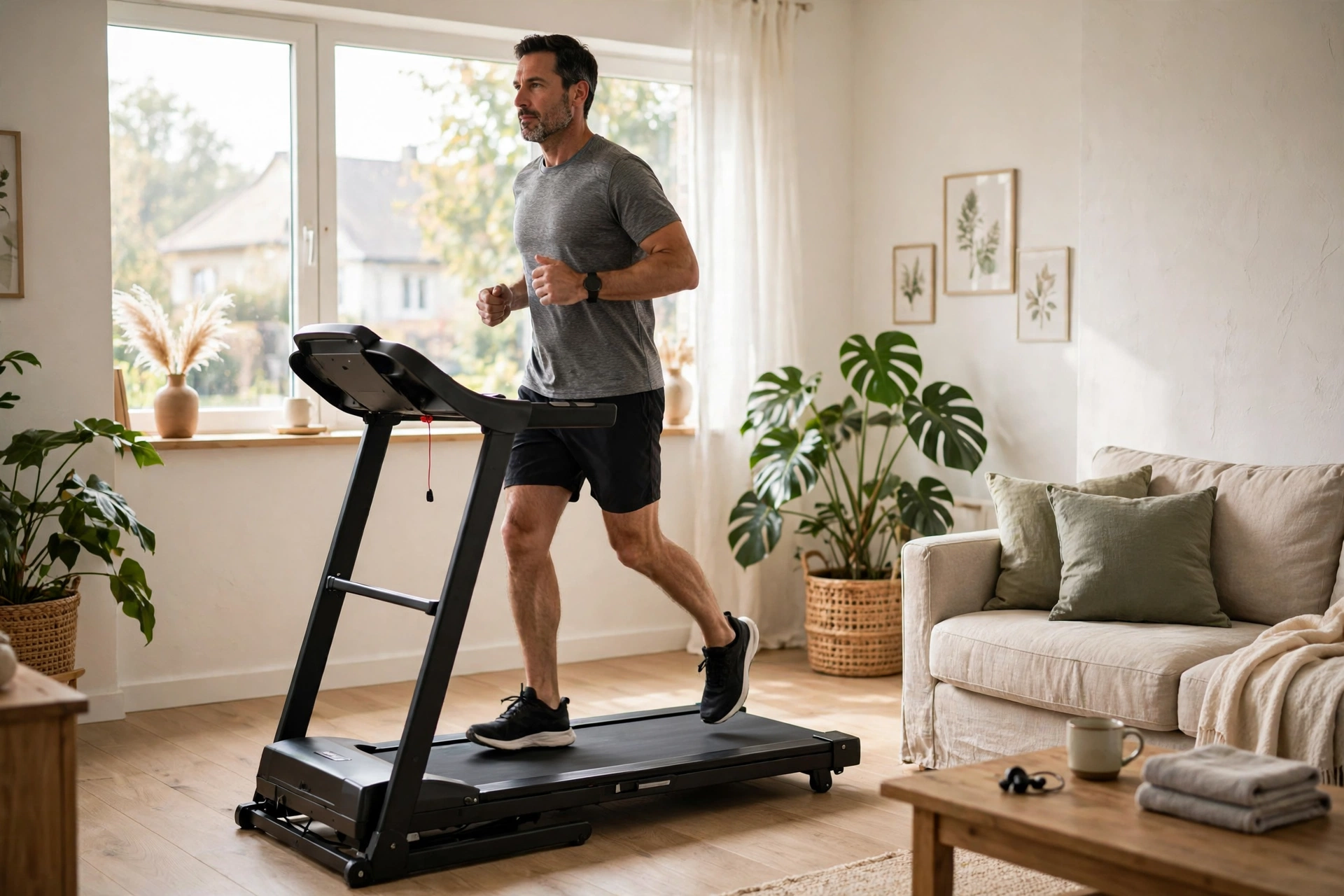
The unit I bought is the 2.5 HP folding treadmill FLNORW lists at $488 (item W1668124394), and the spec sheet reads like a greatest-hits of the category. Here is the short version of what matters:
- 2.5 HP motor with four quick-select buttons: 3, 6, 9, and 12 km/h. Top speed is about 7.5 mph — a real run, not a brisk walk.
- 3-speed incline adjustment plus 12 preset programs (P1–P12) that automate speed-and-incline intervals.
- 43.3 × 15.7 inch belt, noticeably roomier than a walking pad, rated to 220 lbs.
- Folds vertically for storage; open footprint is 54.3 × 19.7 × 44.7 inches at 68.2 lbs.
- Bluetooth speaker, device holder that fits a tablet, cup slot, and handlebar heart-rate sensors with three countdown modes (time, distance, calories).
Honest spec check: the heart-rate handles are the grab-and-guess kind, within a few beats per minute of my watch — fine for zone training, not for science. And the three incline levels are fixed steps you select during the run, not a motorized ramp. Manage your expectations there.
The folding treadmill fold test: storage, noise, and 6 a.m. runs
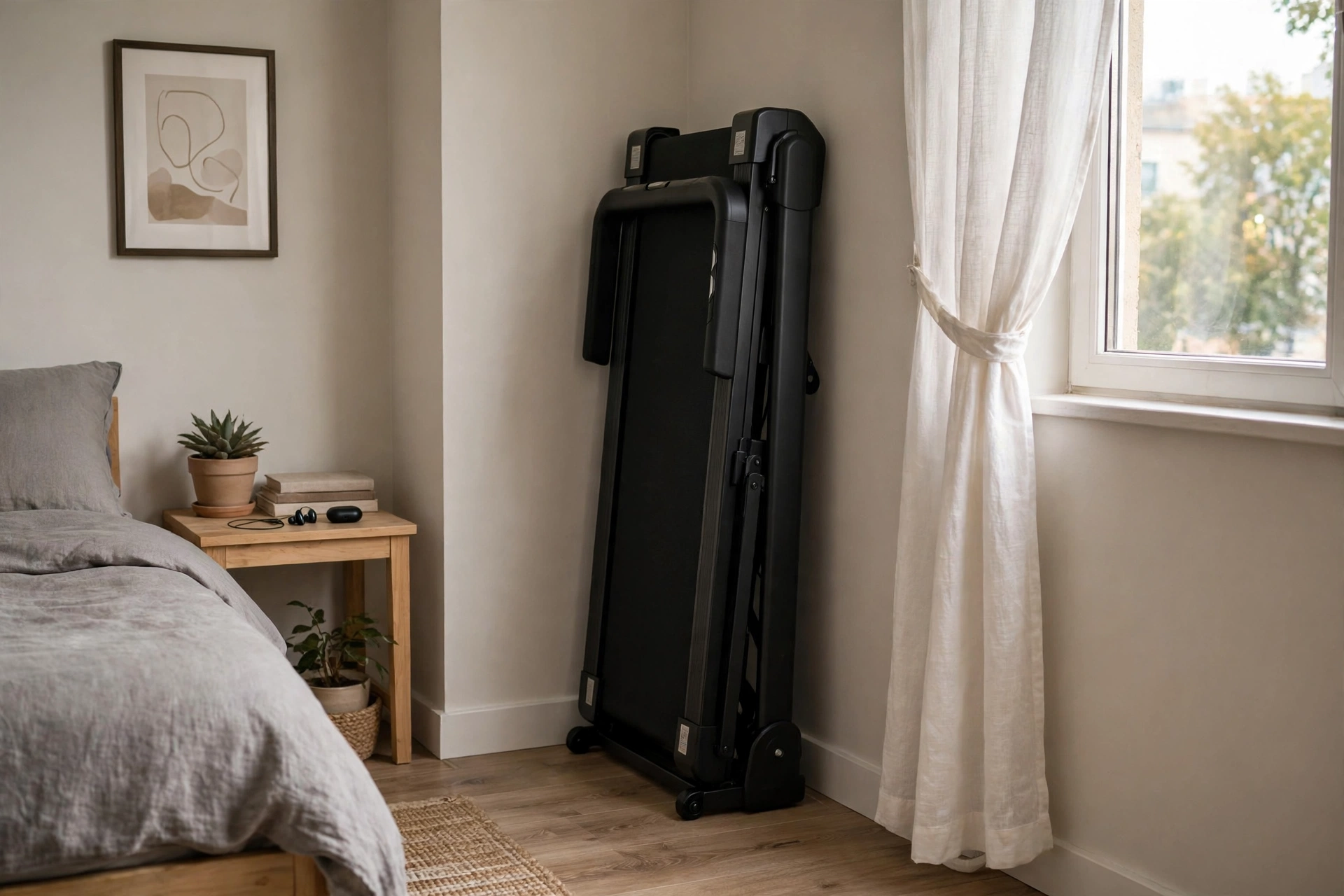
This was the make-or-break question for me. My spare room is 10 by 11 feet and already holds a desk, so the machine had to vanish when guests came over. Folded, the deck swings up and locks vertically, and the footprint shrinks to roughly the size of a large bookshelf — I tuck it against the wall behind the door, where it takes up about 20 inches of depth. Two transport wheels on the base mean I can roll it one-handed across hardwood; on carpet it takes both hands and a little grunting.
The whole fold-unfold cycle takes me about 20 seconds now. There is a soft-drop mechanism, so the deck lowers itself the last few inches instead of slamming — my downstairs neighbor has never once complained, and he complained about the blender.
I bought this partly to run before work, so noise was a genuine worry — thin walls, a sleeping household, a dog with opinions. At a 6 km/h jog with the incline on level one, my phone’s decibel app read 58 to 62 dB a meter away: about the level of a normal conversation. My wife sleeps through it with the bedroom door closed. At full sprint (12 km/h) it climbs into the high 60s, which I would not do at 6 a.m. out of courtesy, not necessity.
The belt itself runs quieter than the footfall — what travels through the floor is impact, not motor. On the second floor I put a $30 equipment mat underneath, and the neighbor below has not mentioned it once in 90 days. The Bluetooth speaker is a nice idea but tinny at volume; I use earbuds.
Treadmill with incline: the three-level test
A treadmill with incline changes the workout more than any other single feature, so I tested all three levels over two weeks. Level one is a gentle grade you barely notice for the first ten minutes — then your calves file a complaint. Level two is where the calorie display starts climbing in a way that feels earned. Level three at 6 km/h had me breathing like I was on a real hill, which, biomechanically, I was.
Rough math, flagged as rough: walking at 5 km/h on flat ground burns about 4 METs; add a moderate incline and you are closer to 6 or 7. For someone around 180 lbs, that is the difference between roughly 300 and 450 calories an hour — do not quote me on the decimals, but the direction is right, and my fitness watch agreed within about 10 percent. The preset programs mostly automate intervals, and P7 — a rolling-hill pattern — became my default 30-minute session.
One limitation worth stating plainly: three fixed incline levels is not the 15-level motorized incline on a $1,200 machine. If hill training is your whole program, you will outgrow this. If you just want workouts to feel different day to day, three is plenty.
Folding treadmill vs walking pad: the honest split
FLNORW MALL sells both lanes, and I have now used both — the $288 walking pad under-desk treadmill from my walking pad review and this $488 folder — so here is the blunt version. Buy the walking pad if you work from home at a standing desk and want steps during the workday; it tops out at 5 mph, has no handrails, and slides under a sofa. Buy the folding treadmill for home running if you want actual running: handrails, a longer belt, speeds to 7.5 mph, and an incline.
The walking pad made my workdays active; the folding treadmill made my mornings athletic. Different jobs, different machines. For the record, my 60-day sit-stand experiment is what started this whole home-fitness spiral — the desk got me upright, the pad got me moving, and the treadmill finally got me sweating.
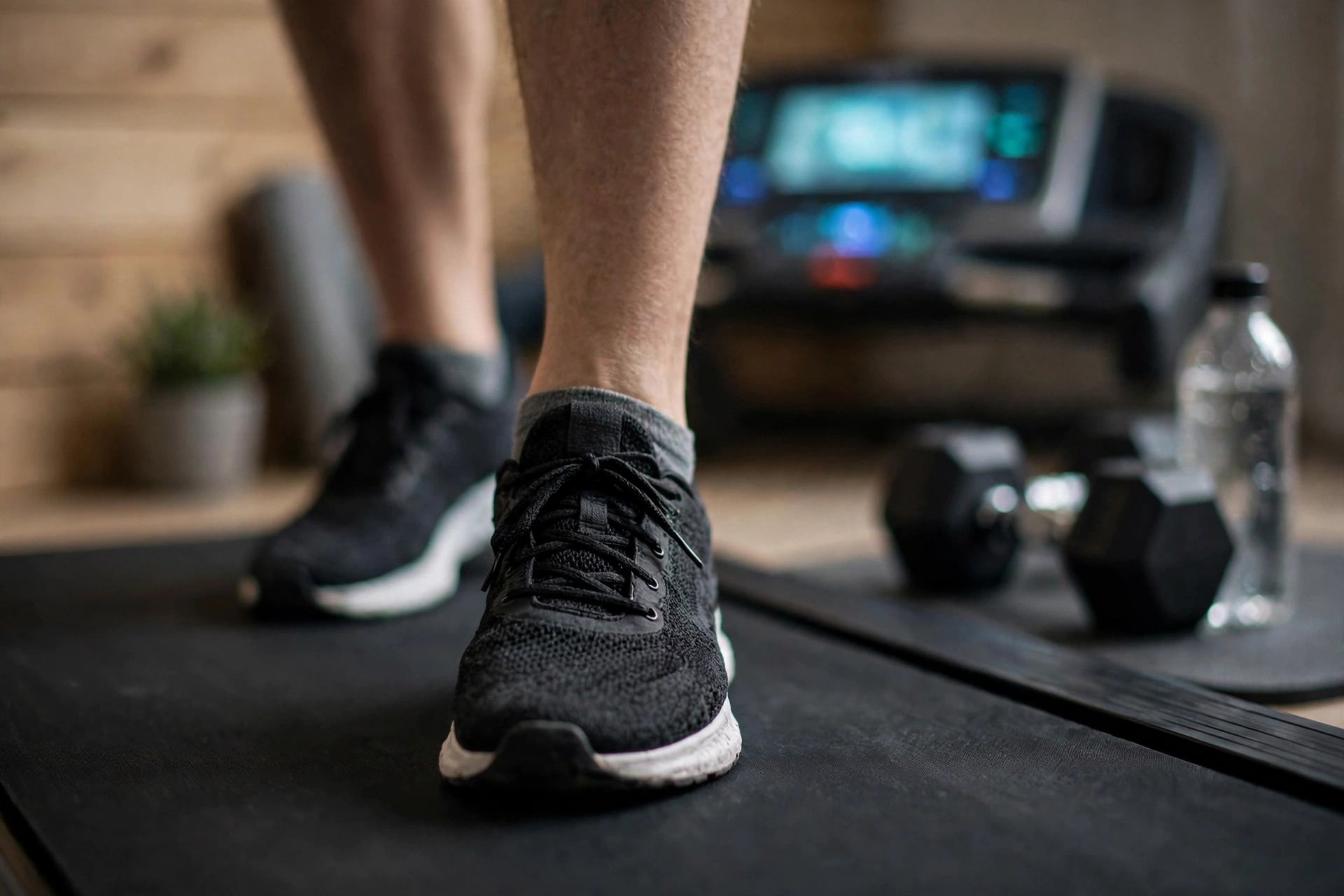
The industry numbers: why everyone is buying one
I checked the market data because I wanted to know whether I was early or late. Dataintelo’s 2025 report puts the global home treadmill market at $4.72 billion, growing to $7.86 billion by 2034 at a 5.8% annual clip, with motorized models holding 48.5% of the segment and North America taking 38.2% of revenue. Straits Research, updated October 2026, sizes the whole treadmill market at $5.24 billion in 2025 heading to $8.87 billion by 2034 — and pegs the US alone at $1.46 billion.
Translation: the home-fitness boom did not end when the gyms reopened. It just moved into spare rooms, and the folding treadmill is the machine that fits through the door — literally.
The math: $488 once vs the gym forever
Here is the part that decided it for me. My gym cost $45 a month, or $540 a year, and I used it eleven times in three months — about $16 a visit, before gas and 50 minutes of driving. The folding treadmill cost $488 once. Simple division says it breaks even against the membership at month eleven — and that assumes I kept going to the gym, which I was not.
The honest version of the math is about adherence, not dollars. I have used the treadmill 61 times in 90 days because it sits 20 feet from my bed and requires zero packing, driving, or waiting for equipment. Gyms sell access; the treadmill sells the removal of excuses. Electricity is a rounding error — a 2.5 HP motor at jogging speeds costs me maybe $2 a month, rough estimate.
For context, FLNORW also lists a $499.99 folding treadmill one tier up, but at $12 more I could not find a reason to stretch. And if your goal is steps at a desk rather than runs before work, the $288 walking pad remains the cheaper door in.
The verdict
Ninety days in, this compact home treadmill has done exactly what I bought it to do: it turned “I should exercise” from a 50-minute production into a 30-minute default. It is not a gym replacement for a serious lifter or a marathon trainer — three incline levels and a 43-inch belt have real limits. But for a regular person who wants to run at home, fold the machine away, and stop paying for a membership they do not use, the $488 math is about as clean as purchase math gets.
Want the exact machine? Here is the 2.5 HP folding treadmill I bought — $488, InStock, and it folds against the wall in 20 seconds. Prefer desk-speed steps? The $288 walking pad under-desk treadmill is the cheaper door in. The whole home-fitness lineup lives at FLNORW MALL.