Mini Fridge: Is the $59.99 4L One Worth It?
Last August I watched my wife walk to the kitchen for the fourth time in one morning, this time to rescue her vitamin C serum from the big family fridge, where it was parked between the leftover chili and a jar of pickles. She has been deep into skincare for two years, and every week some article told her serums last longer cold. I did some mental math, opened FLNORW MALL, and bought the cheapest refrigerated box I could find with real specs: the Simple Deluxe 4L Mini Fridge, $59.99, pink. Sixty days later, it sits on her vanity table like it has always lived there. This is what it actually does, what it does not, and whether a mini fridge this small deserves your money.
What this mini fridge actually is
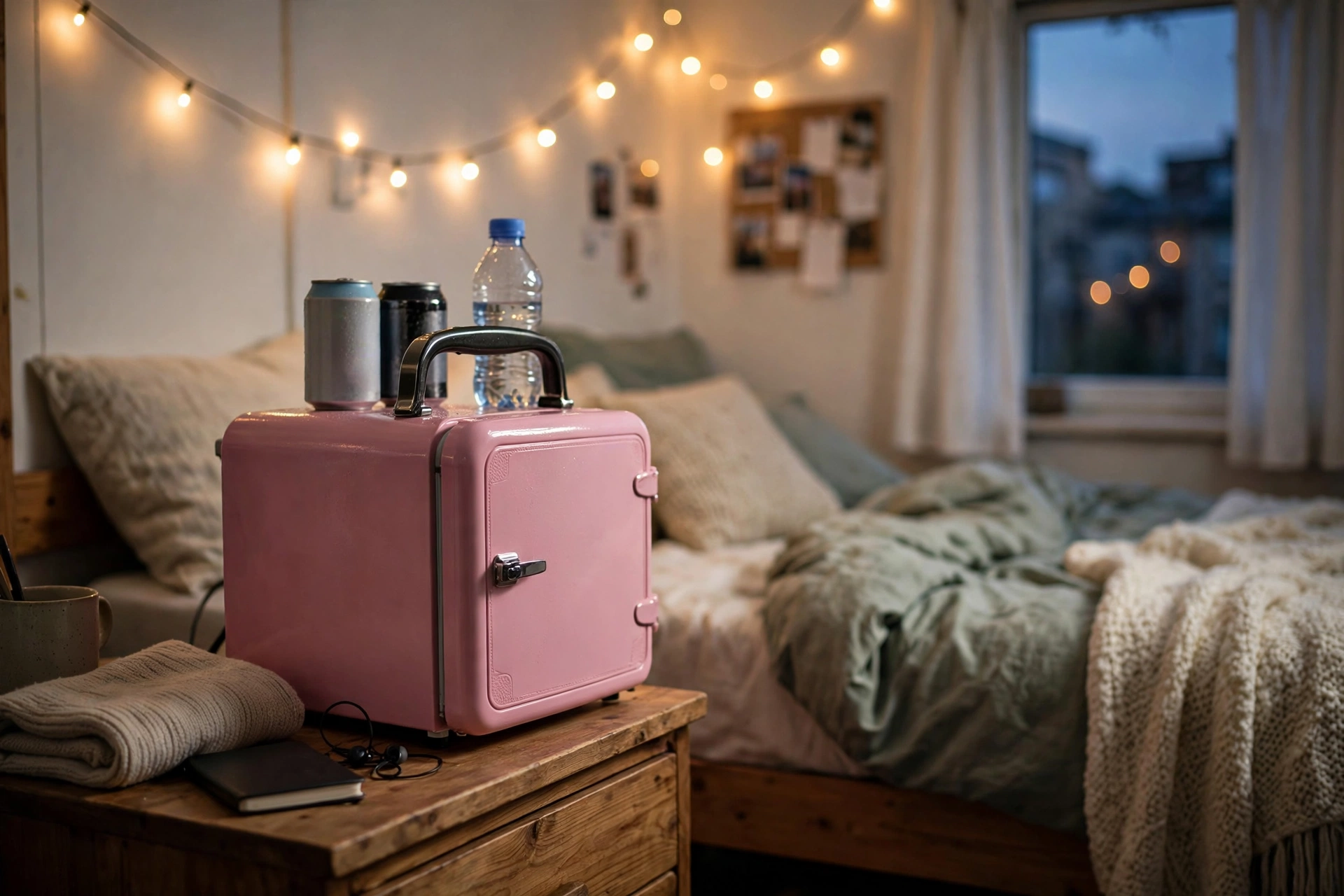
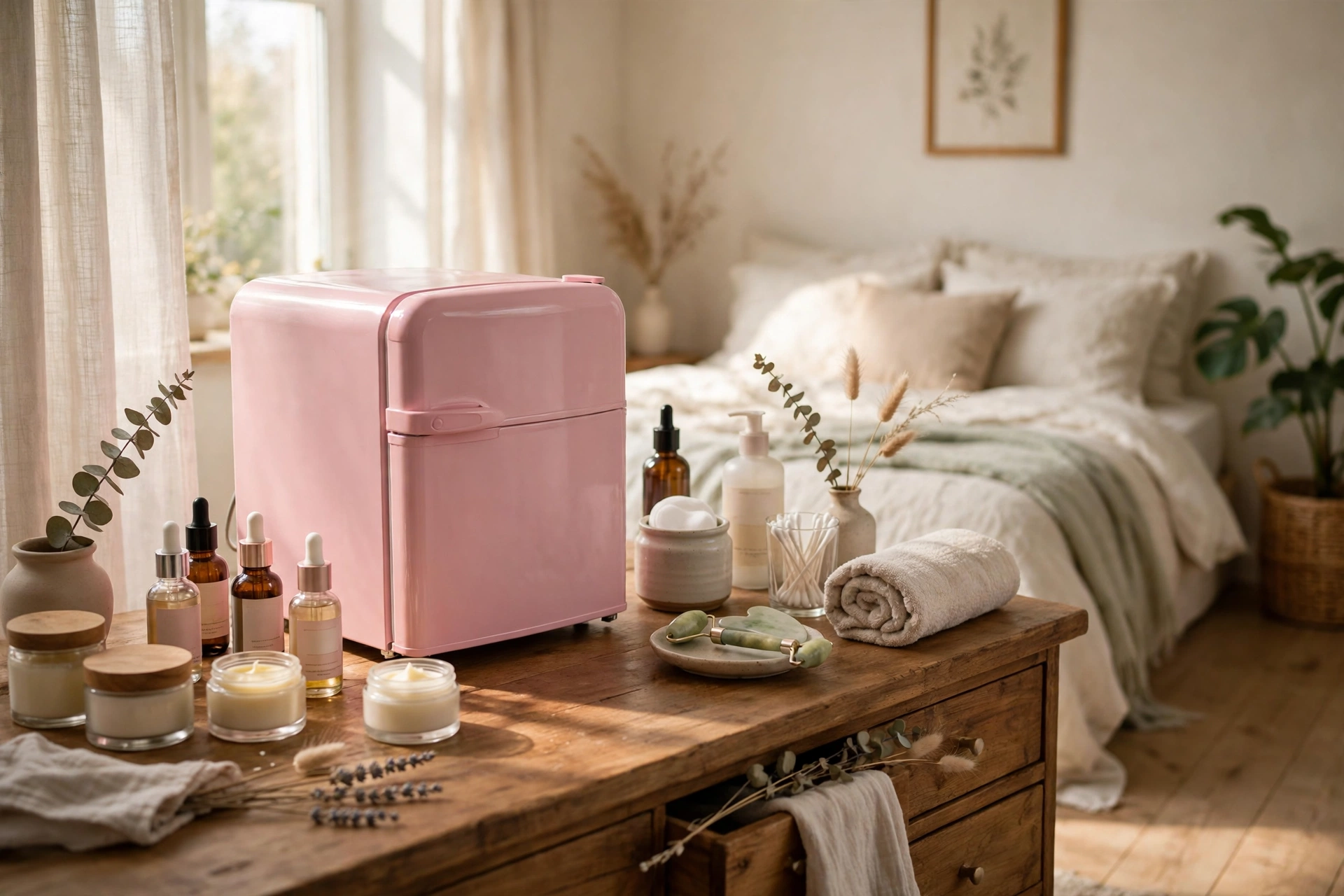
It is not a shrunken apartment refrigerator. It is a thermoelectric cooler — 4 liters, room for six 12-ounce cans, interior box roughly 5.5 x 5.1 x 8.1 inches. The listing says it cools up to 34°F (18–20°C below ambient room temperature) and warms up to 131°F (55°C), with a flip of a switch. It runs off a normal 100–120V home outlet, ships with two power cords, a removable shelf, a little storage box, and a carry handle. The manufacturer lists it at 25 dB sleep mode and 100% Freon-free, since there is no compressor and no refrigerant — just semiconductor chips doing the Peltier thing.
Size check, because photos lie: 4 liters is smaller than you picture. It holds her daily serums (four bottles), a jar of eye cream, and two soda cans on the removable shelf. That is the whole inventory. If you need to refrigerate anything resembling a meal, this is not your fridge. I measured the footprint on her vanity: about the size of a shoebox stood upright, handle on top.
The 60-day test: bedroom duty
For the first three weeks it lived on her vanity table, plugged in, cooling. I stuck a cheap kitchen thermometer inside on day one and checked it morning and night for a week. With the bedroom around 72°F, the interior settled at 39–41°F — colder than I expected from a thermoelectric unit, and comfortably in food-safe fridge territory (the FDA puts safe refrigeration at 40°F or below, so this one clears the bar with room to spare in a normal room).
One honest caveat, flagged as physics, not a defect: thermoelectric cooling works on a differential. The box promises up to 34°F below ambient. In a 72°F bedroom, that math gives you 38–41°F, matching my thermometer. In a 90°F garage in July, you would get roughly 56°F — fine for skincare, not for anything perishable. If your use case involves a hot room, calibrate your expectations to the differential, not the headline number.
Skincare fridge duty: does the cold actually do anything?
This is the use case that sold it. My wife keeps vitamin C serum, a retinol night cream, and an eye cream in it now. The logic is real chemistry: vitamin C serums oxidize faster in heat and light, and refrigeration slows that degradation. Did I notice a difference in her skin? Honestly, no — I am the wrong instrument for that. But the serums have stayed clear and watery for two months instead of turning amber by week six like her old bottle did, and that is a visible win we can both see. Whether that is worth $59.99 depends on how expensive your serums are. Hers run $20–40 a bottle. Two serums saved from early spoilage and the fridge has paid for itself — rough math, flagged as rough.
Who else this suits: medication storage in a bedroom (some prescriptions ask for a cool dark place — check the label, and this box qualifies), insulin pen users in a pinch at this temperature band, and anyone whose bathroom gets steamy. The pink finish is loud enough to be a design choice on a vanity, which in our case it is.
Mini fridge for office use: the desk test
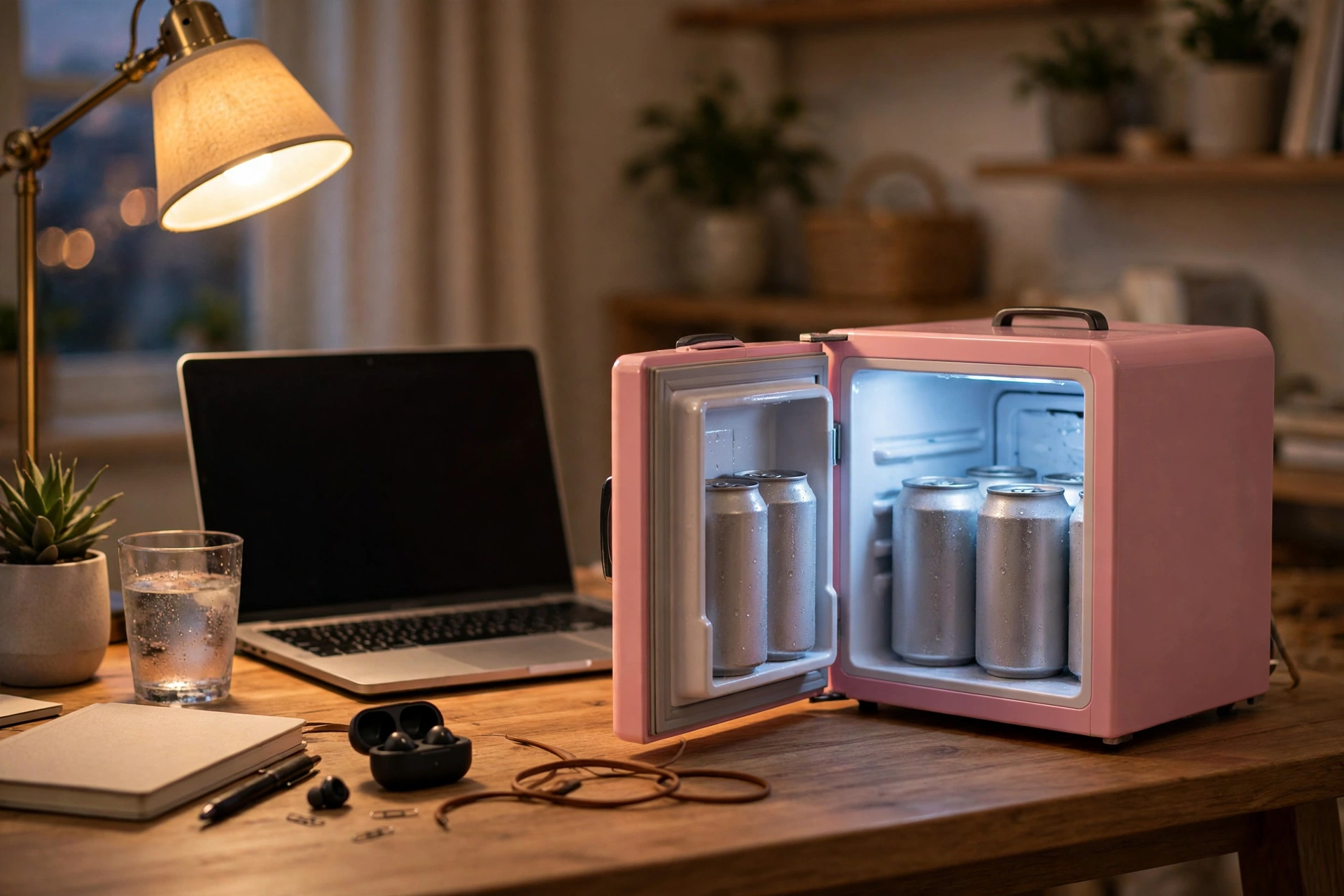
Week four, I stole it for my desk for a week to run the second test. Six cans of seltzer in, carry handle making the relocation trivial — this is the use case the box advertises for offices and dorms. Performance matched the bedroom test: cans went from 72°F to drinking-cold in about 2.5 hours (timed, twice). The 25 dB sleep-mode claim deserves scrutiny: I measured nothing — I do not own a sound meter — but I can tell you I genuinely cannot hear it over a laptop fan, and it sits three feet from my ear. My old compressor dorm fridge hummed audibly through the wall; this one does not hum at all, because there is nothing to hum. Thermoelectric means no moving parts except a small fan.
The limitation, stated plainly: six cans is the entire inventory, and a tall 16-ounce bottle does not fit upright. If your office beverage habit runs deeper than six cans a cycle, you will be refilling daily. That is the trade-off for something that fits under a desk.
Thermoelectric vs compressor: why this mini fridge cools differently
Worth understanding before you buy any personal mini fridge, because the cooling type changes everything:
- Compressor mini fridges (the classic 1.7–4.5 cu. ft. dorm units) refrigerate like a real fridge, down to freezing-adjacent temps, but they hum, vibrate, and cycle loudly at night. Energy Star caps compact manual-defrost models at about 239 kWh per year; real-world models run 220–250 kWh per year per industry guides.
- Thermoelectric mini fridges like this one cool by temperature differential, sip power (these 4L units typically draw under 50 watts), run nearly silent, and cannot freeze anything. They also warm — flip a switch and the same box holds 131°F, which compressor units cannot do at all.
Which to buy is a lifestyle question. If you need a real food fridge for a dorm, buy the compressor. If you need cold skincare, desk drinks, and silence — and you want the warming option for towels or baby wipes or formula — thermoelectric is the right tool. They are different appliances that happen to share a shape.
The warm side: what 131°F actually does
I tested the warming mode exactly once, because a $59.99 box that heats to 131°F deserves one experiment. I put two damp hand towels in, flipped to warm, and checked after two hours: properly warm spa towels, the kind that make a facial feel twice as expensive. My wife now uses it on towel nights, which is the one feature that makes her laugh when guests ask about the pink box. Practical uses beyond spa theatrics: warming baby formula bottles, keeping lunch rolls warm at a desk, and storing breast milk at serving temp for a short window. The warming side is the feature I underestimated and now rate as genuinely useful — it is the one thing a compressor fridge simply cannot do.
Cost math: $59.99, electricity, and the real daily number
Purchase price $59.99. Electricity: a thermoelectric 4L unit draws roughly 45–50 watts while actively cooling. Mine cycles, so call it ~0.6 kWh per day — rough estimate, flagged as rough. At the US average residential rate of about $0.17 per kWh (EIA, 2024), that is around $0.10 a day, about $37 a year. Compare that to a full-size refrigerator’s ~$150–200 a year in electricity, or to premium skincare fridges that run $80–150 for the same 4L volume.
Cost-per-day over three years of daily use: ($59.99 + ~$110 in electricity) ÷ 1,095 days = about $0.16 a day. For comparison, the drugstore mini-fridge-adjacent alternative — replacing an oxidized $30 vitamin C serum every two months instead of every three — runs about $0.17 a day in extra serum cost alone. The fridge roughly breaks even against wasted skincare, and you get cold drinks as a bonus. That is the math that sold me, and it is the math I would put to anyone on the fence.
Who should buy a mini fridge — and who should not
Buy it if: you want cold skincare and a bedroom vanity home for it; you keep drinks at a desk or in a dorm and hate the walk to the kitchen; you need near-silent cooling in a bedroom or nursery; or you want the warming mode for towels, wipes, or formula. At $59.99 this is a low-stakes experiment that can find a second life easily.
Skip it if: you need to store anything perishable beyond drinks and sealed cosmetics; your room runs hot (remember the 34°F differential); you want to freeze anything; or you picture a 4-liter box as “small fridge” — it is closer to a lunchbox that refrigerates. Six cans. That is the box. Know it before you click.
Sixty days in, the pink box has earned its spot. It cools reliably to the high 30s in a normal bedroom, it is silent enough to sit three feet from my laptop, the warming mode turned out to be a genuine sleeper feature, and the cost math works out at about sixteen cents a day. My wife’s serums stay clear longer, my desk stays stocked with cold seltzer, and nobody has had to touch the big kitchen fridge for any of it. Is a mini fridge for everyone? No. Is this one worth $59.99 for the right person? Every day of the week.
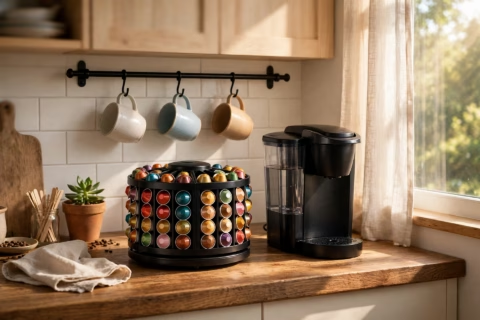
Ready for cold skincare and desk drinks? Check the Simple Deluxe 4L mini fridge at FLNORW MALL — $59.99, cooler and warmer in one box, pink, with the removable shelf and carry handle that made ours easy to love. If your desk setup runs deeper than drinks, pair it with my coffee pod holder review — the $69.99 carousel that collapsed my whole coffee ritual into one square foot of counter — or the Simple Deluxe countertop ice maker ($300, 26 lbs of ice a day) if cold drinks are a household sport. Browse the full lineup at FLNORW MALL.