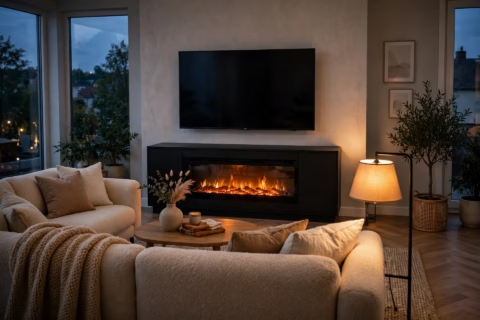
I Bought a $299 Farmhouse Media Stand for My 65-Inch TV. Here Is My Honest Take.
Why “fits up to 65 inches” is a promise worth checking
My 65-inch TV arrived two weeks before the media stand it was supposed to sit on — a rookie scheduling mistake I paid for with a very long fortnight of the screen leaning against the wall like modern art. When the box finally showed up, it contained a 98-pound slab of farmhouse ambition: a barn-door media stand in espresso, 57.87 inches long, rated for TVs up to 65 inches. That was three months ago. Since then it has held my TV, two game consoles, a soundbar, roughly nine remotes (do not ask), and my full judgment. Here is the honest accounting.
Here is the number nobody prints on the box: a 65-inch TV is only about 56.7 inches wide — TVs are sold by the diagonal, stands by the width, and those are different measurements. That left me just over an inch of margin on a 57.87-inch stand. Fine on paper, but it taught me the real rule: measure your TV’s actual width and the span of its feet before you order anything. I ran the full tape-measure routine from FLNORW MALL’s TV stand size guide and it saved me from a second delivery.
The stakes are higher than they look. According to the NPD Group’s TV Ownership Trends Report (February 2022), the average installed TV in the US had grown to 47.5 inches, and Statista data reported in 2024 puts the 65-inch size as the most widespread single size since 2019. Screens keep getting bigger, and the furniture underneath has to keep up — which is exactly where stands get tested.
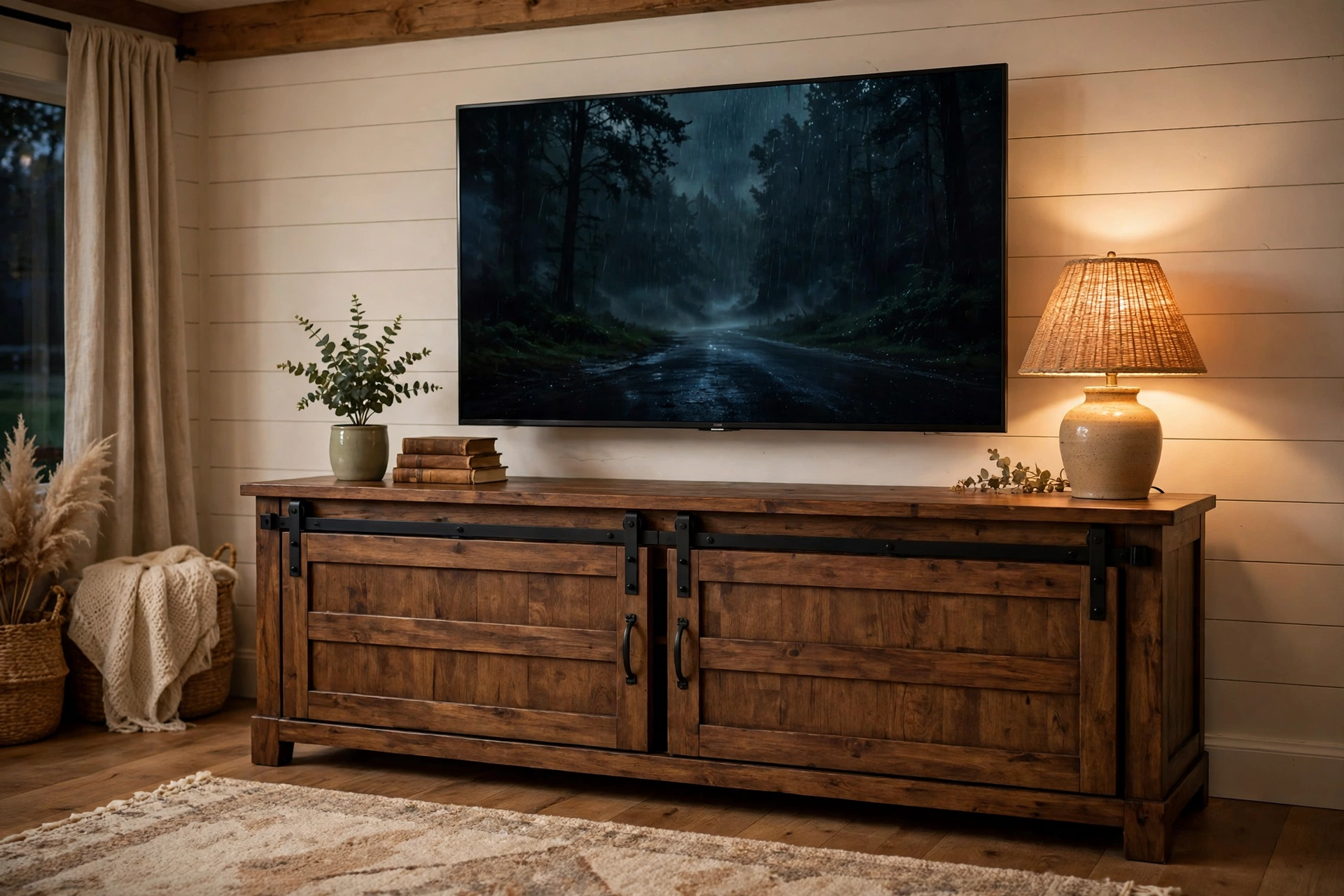
What actually arrived: my $299 media stand unboxed
The product page said $299, and the page told the truth. Item W2275P149122: a farmhouse media stand in espresso (gray is also available), 57.87 × 15.75 × 30.31 inches, 97.90 lbs assembled, MDF with a wood-grain finish, rated for TVs up to 65 inches. The shipping box weighed 105.6 lbs, so this is firmly a two-person carry up the stairs — do not be a hero.
Assembly took me a little under two hours working alone, and the honest version of that story: the first forty minutes were fine, then I tightened one side panel too early and spent twenty minutes un-doing my own confidence. Lay the panels on a rug or a blanket, leave every bolt finger-loose until the frame is square, and you will beat my time easily. All hardware was included and labeled; nothing was missing.
The barn doors are the part everyone comments on
The sliding barn door media console doors are the whole personality of this piece. Closed, they hide the router, the spare HDMI cables, and the stack of game cases. Open one side and you have open shelving at the right height for the soundbar and the game console — which matters, because remotes need line of sight and closed doors will not cooperate.
Three months in, the doors still slide on their track without catching. The espresso finish wipes clean with a damp cloth; it has survived one coffee-ring incident and a toddler’s juice box with no visible scars. Guests ask where it came from, which for a $299 piece of furniture is the highest compliment available.
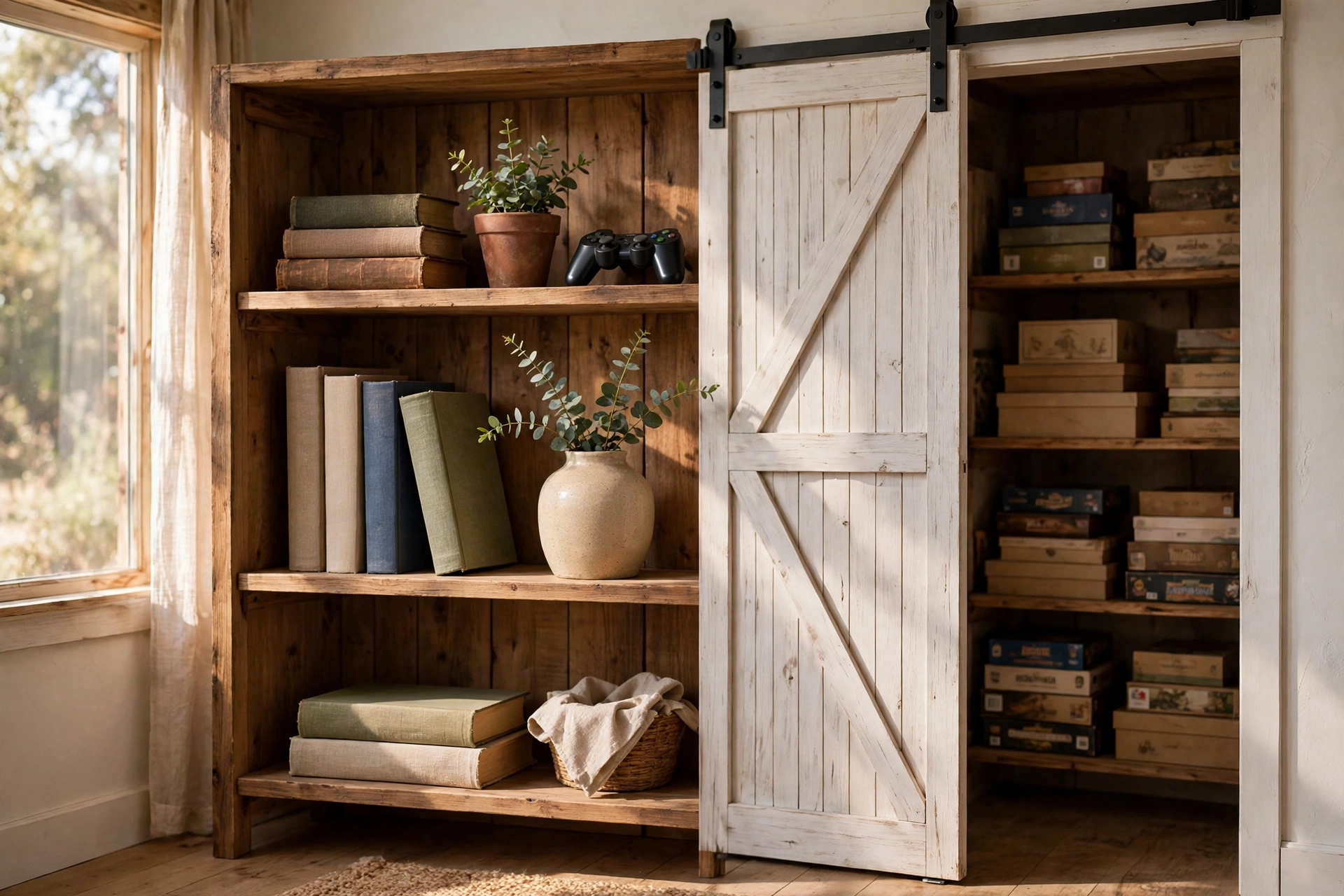
Cable management: the media stand detail that sells me
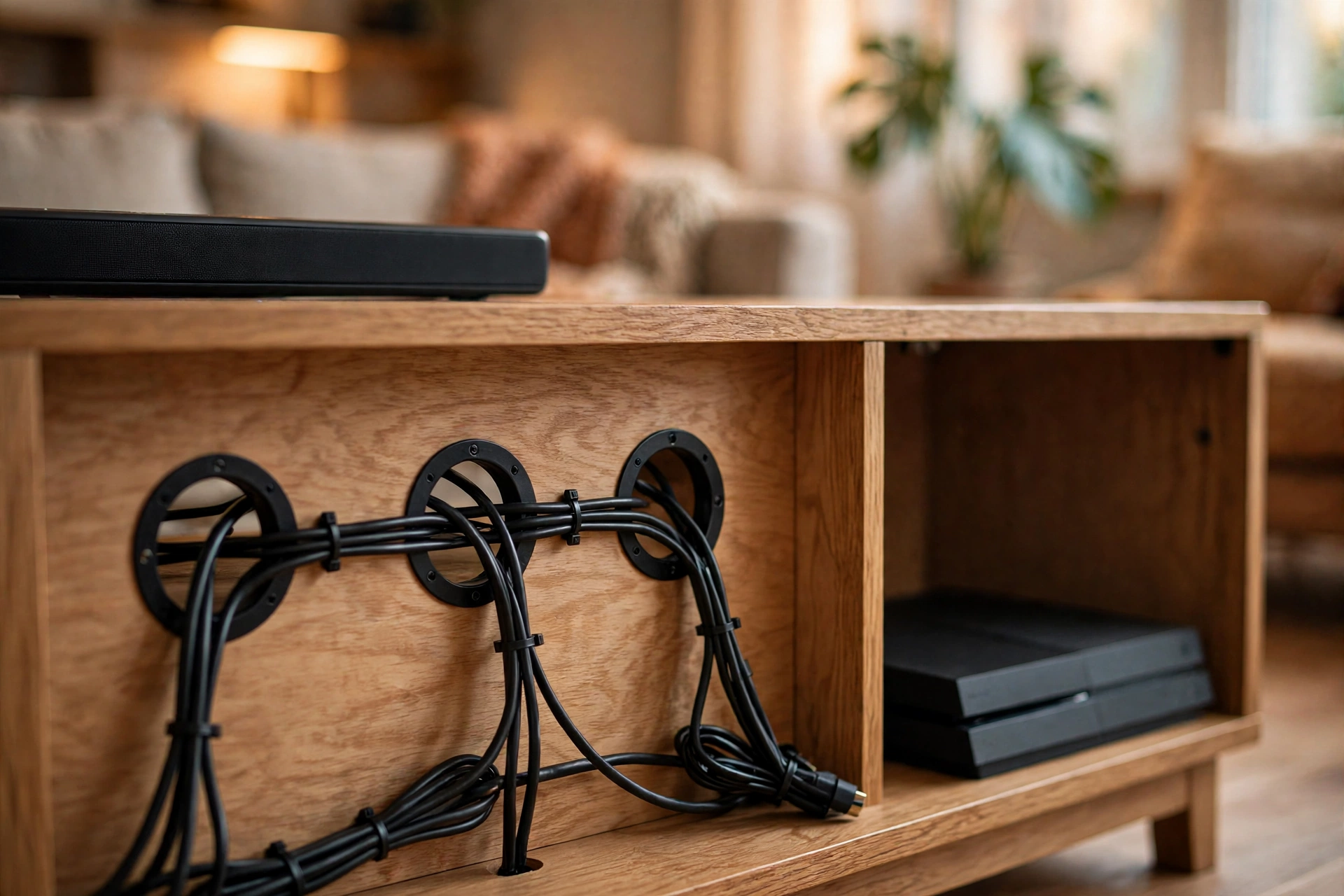
This is the section I did not expect to write, and it is the reason I would buy this TV media stand again. Round cable pass-throughs sit in the back panel and on the open shelf, so every cable — power, HDMI, the optical line to the soundbar — drops straight down behind the cabinet instead of waterfalling over the top. Ten minutes with a pack of zip ties and the back of the stand looks like an electrician did it. One cable to the wall. The robot vacuum has not eaten a single cord since.
Three months of daily use: what is holding up, what I watch
Ninety-eight pounds of MDF does not wobble, and the top panel has not sagged under a 55-pound TV, a 10-pound soundbar, and the console. That is roughly 75 lbs on a cabinet with real headroom — my own arithmetic, but the math is the math. The feet sit well inside the edges, and at 15.75 inches deep the soundbar fits in front of the TV feet with room to spare.
The honest flag I owe you: MDF creeps under constant load over years, not months. I keep the heaviest box centered on the cabinet rather than at one end, and I would not stack a second full-size console on top of the TV. Three months is not a durability verdict — it is a promising start, and I will update this if anything changes.
The $195 alternative on the same site
FLNORW MALL also sells the $195 Hub-Atlantic Phoenix media stand, and it is a genuinely different animal: holds up to a 42-inch TV, 41 inches wide, 42.5 lbs, with wire-mesh panels and shelves for airflow, black powder-coated metal shelves, and a carbon-fiber top. Built-in cable management, non-marring rubber feet.
My read: if your TV is 42 inches or smaller and your game console runs hot for hours, the Phoenix’s ventilation wins and you save $104. If this is the main living-room setup with a 55-to-65-inch screen, the barn-door stand’s width, closed storage, and looks justify the $299. If you are still deciding on size, read the 65-inch TV stand buying guide before you spend anything.
The honest cost math on this media stand
Rough arithmetic, flagged as mine: $299 ÷ 57.87 inches ≈ $5.17 per inch of cabinet. The $195 Phoenix works out to about $4.76 per inch — cheaper per inch, but you are buying a smaller cabinet for a smaller TV, so the comparison only tells you the barn-door stand is not overpriced for its size. Spread over ten years of daily use, $299 is about $2.50 a month.
For context, a comparable media console at a big-box store runs roughly $250 to $400 — that is my own market observation, not a quote. And the $80 console this replaced was free to wobble until the day I realized it was holding a $700 TV: the cheap option was the expensive one. This time I bought the frame first and the screen can stay.
Specs worth knowing before you buy
- Fits TVs up to 65 inches. Measure your TV’s actual width (about 56.7 in for a 65-inch panel) and your feet span first.
- 57.87 × 15.75 × 30.31 in; 97.90 lbs. Two people to carry and assemble; lay panels on a rug.
- MDF with espresso wood-grain finish (gray also available). Wipes clean; keep heavy gear centered.
- Cable cutouts on the back panel and the open shelf.
- Open + closed storage: sliding barn doors hide the mess, open shelves keep remotes working.
- Item W2275P149122, InStock at FLNORW MALL.
The verdict: Three months in, the media stand has done the one job furniture has: it disappeared into the room and held everything up without complaint. The barn doors still slide, the cables are still invisible, and the TV has not moved a millimeter. The $299 bought me a wider cabinet than the screen, doors that hide the clutter, and a back panel that finally ended the cable waterfall. That is the whole review, and it is a yes.
Shopping the same category? The farmhouse media stand I bought ($299) and the $195 Hub-Atlantic Phoenix media stand are both InStock at FLNORW MALL — measure twice, buy once.