I Bought a $299 P-5 Micro Cut Paper Shredder for My Home Office. Six Weeks Later, Here Is the Honest Verdict.
In March, while cleaning out my home office for the first time in three years, I found a drawer I had been feeding like a pet. Old tax returns from 2019. A credit card I closed in 2021, still shiny. A stack of bank statements with my full account numbers, medical bills, a pre-approved loan offer with enough of my details to make me wince. Three years of paper that I had been too lazy to deal with and too nervous to throw away. That drawer was a small identity theft starter kit, and I was done being its caretaker.
I had been getting by with the cheapest strip-cut shredder I could find years ago — the kind that turns a tax return into twelve long ribbons any bored teenager could reassemble with tape. So this time I bought the real thing: a micro cut paper shredder for home office use, rated at P-5 security, cutting at 2×14mm, with an 18-liter pull-out bin. The FLNORW MALL listing calls it the Paper Shredder Heavy Duty Micro Cut Low Working Noise High Security P5, priced at $299. Six weeks later, that drawer is empty, and I have opinions.
What this micro cut paper shredder actually is
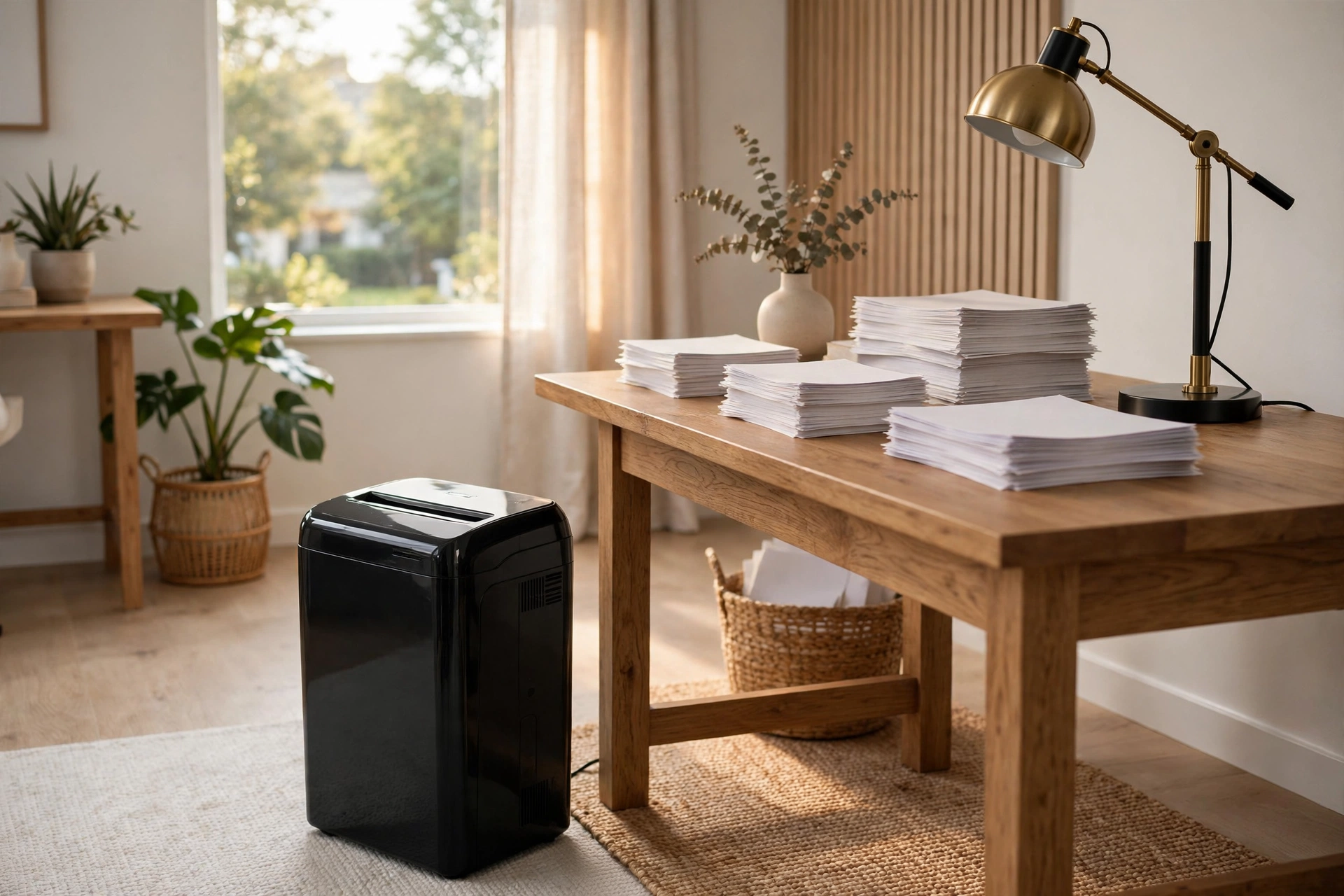
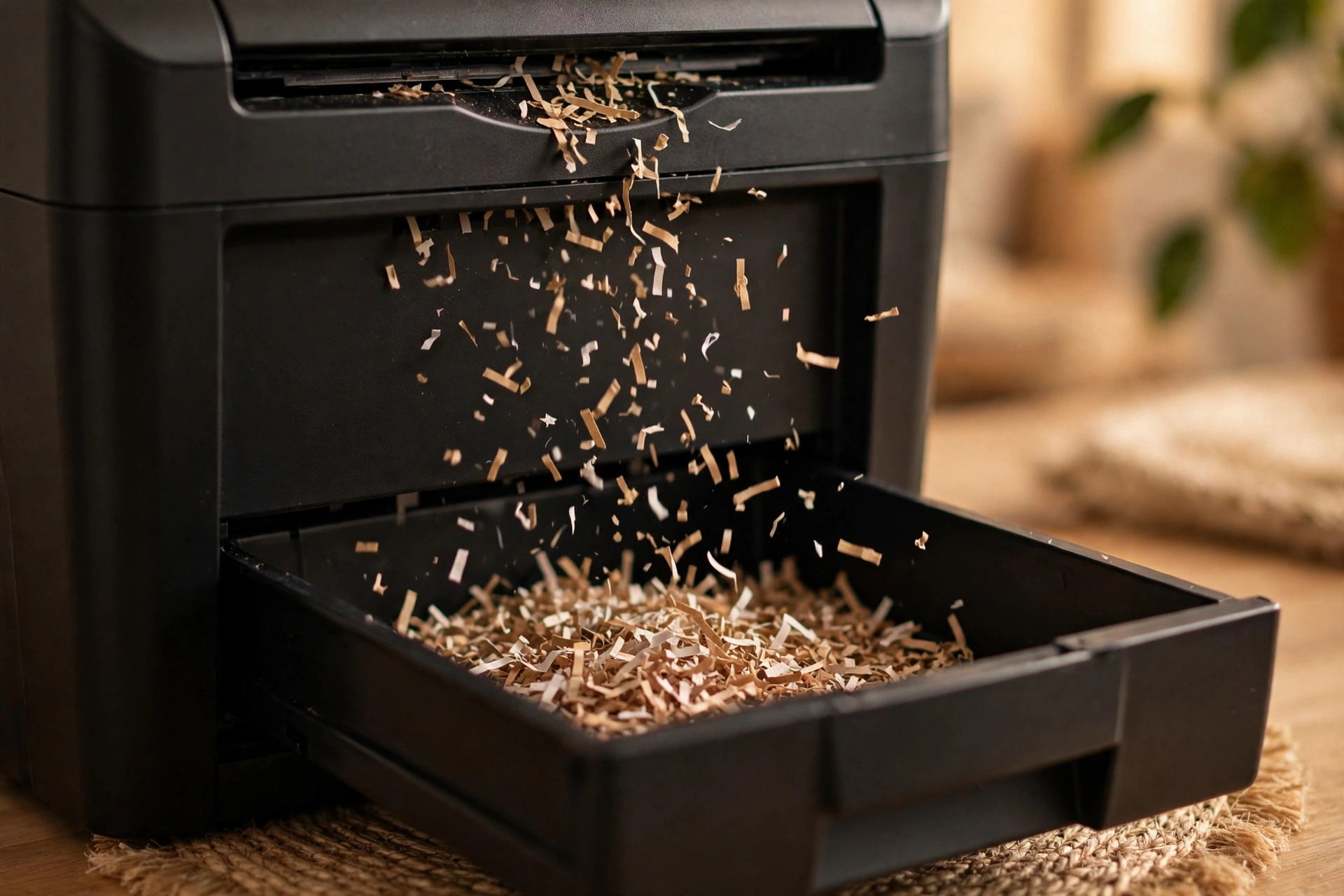
Physically, it is a black ABS cabinet, 14.17 inches wide, 9.65 deep, 19.69 tall, weighing 17.64 pounds. It sits on the floor beside my desk like a small wastebasket — not a countertop toy, not an office floor monster. Under the lid, a steel cutting head turns each sheet into confetti-sized particles, roughly 2 millimeters by 14 millimeters each. One standard letter-size page becomes something like 2,000 tiny fragments instead of a dozen readable ribbons.
The headline specs from the listing: security level P-5, 2×14mm particle size, 58 decibels working noise, a 10-minutes-on / 50-minutes-off duty cycle, and it handles paper, CDs, credit cards, and staples. It arrived in a box of packaging with the item code W2028121006 on the invoice, fully ready to work — no assembly, just plug it in. First impression: heavier than it looks, and quieter than I feared.
Micro cut vs cross cut: why the P-5 rating actually matters
Shredder security levels come from the DIN 66399 standard, which grades destruction by particle size. Most budget shredders are P-2 (strip cut) or P-3 (cross cut). A P-5 micro cut shredder must produce particles no larger than 30 square millimeters — the 2×14mm cut here lands at 28, right inside the line. A P-4 cross-cut particle can be four times that size.
That gap is the entire purchase decision. My old strip-cut machine turned my 2022 tax return into ribbons where you could read my full name, address, and the first six digits of my SSN on a single strip. With a 2×14mm micro cut, reassembling a page would mean sorting thousands of fragments smaller than a grain of rice. The P-5 rating is the level banks and government offices actually require — it is not a marketing word, it is a measured standard, and for anything with an account number on it, nothing lower feels responsible anymore.
What 2×14mm particles can destroy — my feeding test
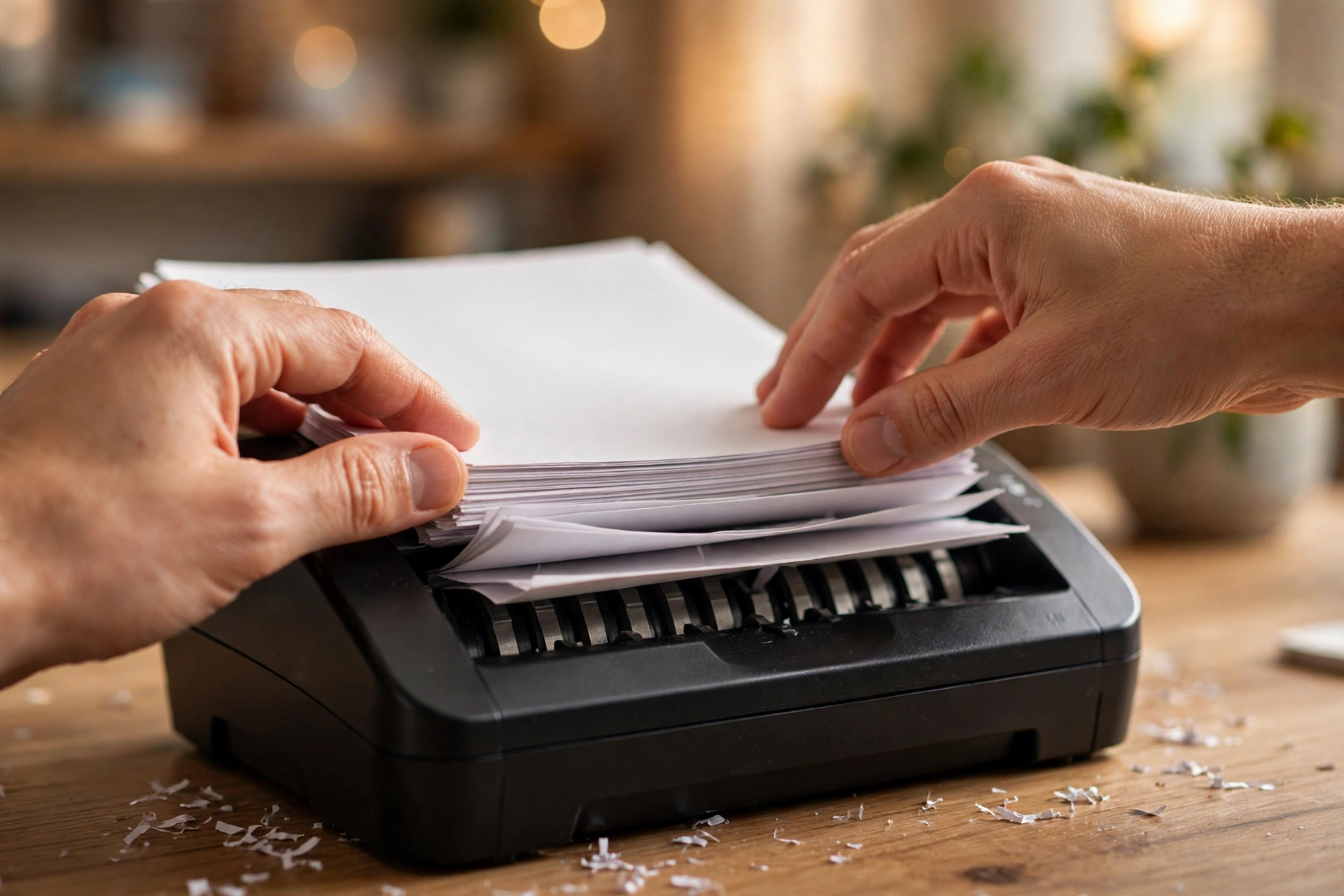
I gave it a proper workout over one weekend. Seven years of tax returns, a shoebox of bank statements, two expired credit cards, one old rewards card, a burned CD of backups I no longer trust, and a stack of pre-approved credit offers. Roughly 400 sheets plus the plastics. Here is what I learned:
- Paper: feeds smoothly, four to six sheets at a time. It chewed through a thick tax return in about 40 seconds per stack. Never jammed — though I did stop and fan the really thick envelopes first.
- Staples: the listing says it takes them, and it did. I left staples in every document on purpose, and the cutter never complained.
- Credit cards: each card came out as roughly 200 glitter-sized fragments. Try reading anything off that.
- CDs: loudest single moment of the test — a sharp crack, then silence. One card slot down the middle of the feed opening takes discs. The pieces went into the same bin as everything else.
- The 18-liter bin: I emptied it twice during the 400-sheet weekend. For day-to-day home office use — a few envelopes of mail a day — expect to empty it roughly once a week.
One habit I formed immediately: I now open mail standing over the shredder. Junk offers with my full name and address go straight in. The whole system takes about 30 seconds a day, and the drawer that took me a Saturday to clear will never refill.
The identity-theft math that justified $299
Three hundred dollars is real money for a box that eats paper, so I did the uncomfortable part — I looked at what identity theft actually costs. The numbers are ugly. The Federal Trade Commission logged 1,135,270 identity theft reports in 2024 alone, up 9.5 percent from the year before, with credit card fraud the single most reported type at 449,032 reports. And Javelin Strategy and Research estimated that identity fraud and scams cost Americans roughly $47 billion in 2024, hitting 40 million victims. (Source: FTC Consumer Sentinel Network Data Book 2024; Javelin 2025 Identity Fraud Study — figures are for calendar year 2024, the most recent published data.)
Those are population numbers, but the personal math is what got me. Victims of identity theft report spending anywhere from dozens to over a hundred hours cleaning up — calls to banks, police reports, credit freezes, replacement cards. Put a rough dollar value on a Saturday spent on hold with a bank, multiply by the weeks a serious case drags on, and $299 starts looking like the cheapest insurance I have ever bought. My estimate, flagged as my estimate: one ruined credit score year costs more than ten of these shredders.
Noise, heat, and the 10-minute duty cycle
The listing claims 58 dB working noise, and my phone app measured in the high 50s to low 60s from three feet away — comparable to a normal conversation. I can run it during a video call without anyone asking about the sound. It is not silent, but it is nowhere near the vacuum-cleaner wail of cheap shredders.
The honest limitation is the 10 minutes on / 50 minutes off duty cycle. This is not a machine for shredding a filing cabinet in one sitting — if you try, it will overheat and shut itself down to protect the motor. For my weekend clearout I ran it in three sessions with breaks, and it was fine. For daily home office use, you will never hit the limit. If you are a small business with a weekly mountain of paperwork, you are shopping in a different price class anyway. Know the tool: this one is a marathon runner on a sprinter schedule — short, frequent sessions, forever.
CDs, credit cards, and staples: the rest of the drawer
Most shredder reviews fixate on paper, but the plastic capabilities are the part my household actually needed. Expired debit cards, gift cards with the numbers worn off, an old membership card — all of them sat in the same drawer as the paper, because tossing a whole credit card in the trash is the one thing everyone knows better than to do. Feeding a card into this machine and watching it exit as glitter is a genuinely satisfying five seconds.
One note of caution from my own experience: feed one disc or card at a time, centered in the slot, and let the motor fully finish before the next. It handles the material fine, but plastics stress the cutter head more than paper does, and slow is how you get years instead of months out of the mechanism. Which brings me to maintenance.
Care and the lifespan question
A micro cut shredder has more cutting teeth than a strip-cut machine, which means it benefits from one habit: shredder oil. Every few sessions I run an oiled sheet through it (or drip a line of shredder oil across the feed opening). The manual does not demand it, but every shredder I have owned that died young died of neglect, not overuse. With oil and reasonable duty-cycle respect, there is no reason this cutter head should not last many years — it is simple steel mechanics, not software that expires.
The ABS housing has survived two accidental kicks from my office chair without complaint. The bin slides out on simple rails and has not warped. Nothing feels flimsy, which is not something I could say about my last shredder.
The verdict: buy it if you still get paper mail
Here is the rule I have landed on. If you receive mail with your name, address, and account details on it — and you do, everyone does — you need destruction at P-5, not decoration at P-2. This micro cut paper shredder for home office is the first one I have owned where feeding in a credit card feels like the right thing rather than a gamble. It is quiet enough for a workday, compact enough for a home office corner, and the $299 price lands between the $75 cross-cut toys and the $600 office machines where this level of security used to start.
Skip it if you never touch paper anymore, or if you need continuous industrial shredding — the 10-minute duty cycle is a real ceiling. But for a home office, a family with years of old documents, or anyone who has watched the identity-theft numbers and done the math, it is the right machine at the right price. My mystery drawer is empty. It is staying that way.
Check the P-5 micro cut paper shredder on FLNORW MALL — $299, P-5 security at 2×14mm, 18-liter bin, handles paper, CDs, credit cards, and staples. While you are upgrading the home office, my walking pad under desk treadmill review covers the other best $288 I ever spent on that same corner, and the locking laptop charging cabinet is what I now recommend to anyone outfitting a shared device room. Start at the FLNORW MALL homepage if you are browsing.