I Hung a $198 Farmhouse Chandelier Over My Dining Table. Here’s the Sizing Math Nobody Told Me.
For eleven years our dining room had the exact fixture the builder installed back in 2013: a brushed-nickel flush mount that cast the kind of flat, shadowless light that makes every meal look like it is being served in an office break room. This spring I finally replaced it — with a 5-light farmhouse chandelier from FLNORW MALL, $198, five E26 sockets, a black iron rectangle 31.5 inches long.
What I did not expect was that buying the fixture was the easy part. Getting the size right and hanging it at the right height took actual math, and I got the math wrong once before I got it right. A farmhouse chandelier for dining room use is not complicated, but three numbers decide whether yours looks designed for the room or rescued from a different house: the fixture width, the hang height, and the bulb color temperature. I will give you all three, plus the install reality and the market data that convinced me farmhouse was not a fad I would regret in two years.
Farmhouse chandelier sizing rule #1: the width math
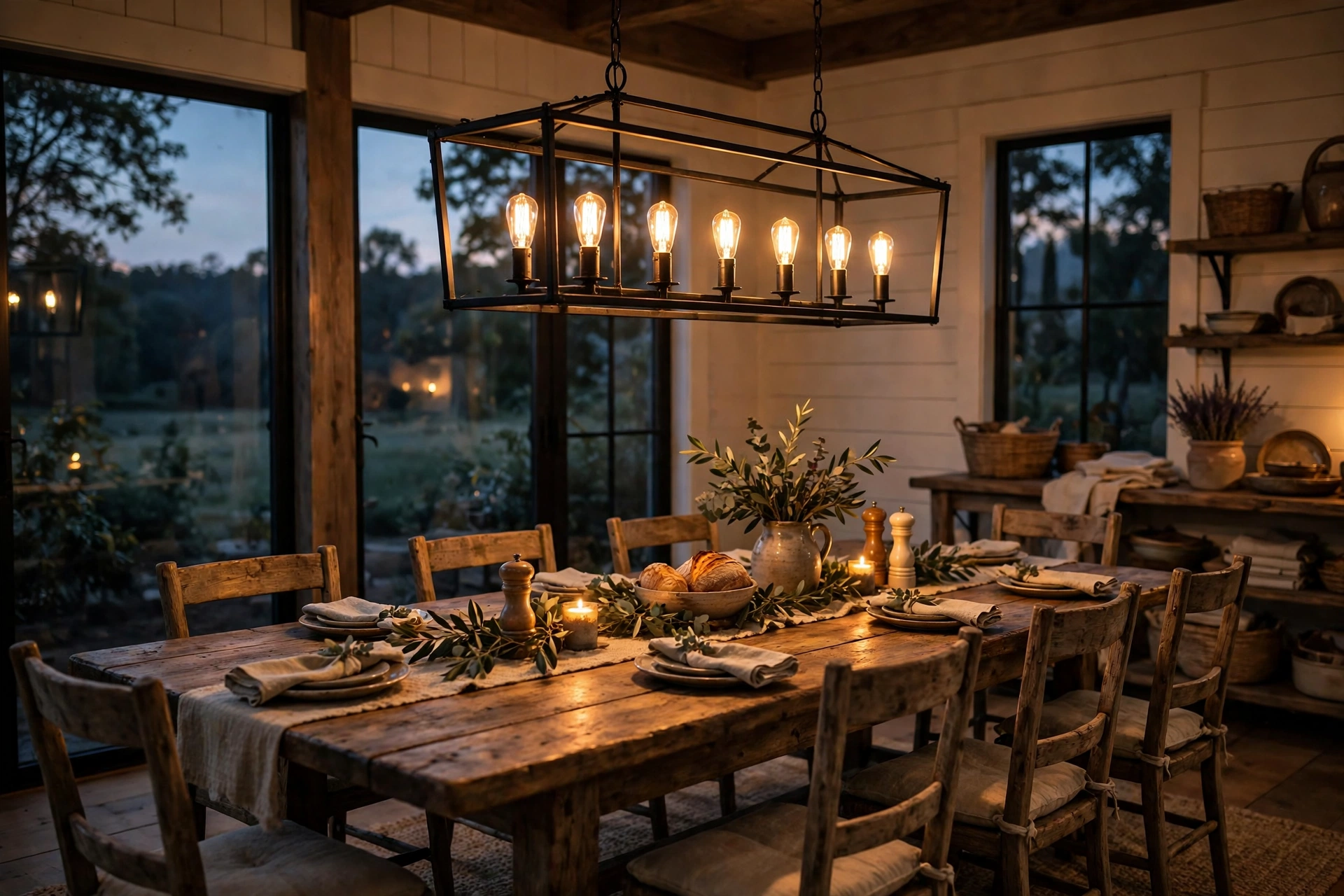
Here is the rule of thumb every lighting designer quotes, and it saved me from buying a fixture that would have swallowed my table: your chandelier’s width should be between one-half and two-thirds of your dining table’s width. Measure the table first, then shop.
Our table is a 60-inch farmhouse table we have had since the kids were small. The FLNORW chandelier is 31.5 inches long and 10.2 inches wide — 31.5 divided by 60 is 0.525, just over half. Right at the lower edge of the range, which turns out to be the sweet spot for a linear rectangular chandelier: it reads clearly from the ends of the table without crowding the place settings.
The arithmetic generalizes easily. For a 48-inch table, you want something 24 to 32 inches long; for a 72-inch table, 36 to 48. My first instinct was to order bigger, because bigger felt more dramatic, but a farmhouse piece is supposed to sit proportionate and quiet. One honest mistake: I hung it, stepped back, and thought it looked small. Then I measured again and realized my eyes were calibrated to the old flush mount, which had been too small for a decade. Trust the tape measure, not the first impression.
Chandelier hang height: 30 to 34 inches above the table
The second number is the hang height, and it matters more than the width because it is the one guests notice without knowing why. The standard rule: the bottom of the fixture should sit 30 to 34 inches above the tabletop with standard 8-foot ceilings. Low enough that the light pools on the table and creates the warm circle that makes a dining room feel like a dining room; high enough that nobody has to look through the fixture to see the person across from them.
Our ceilings are eight feet. I set the bottom of the iron frame 32 inches above the table and it has been exactly right — my wife is 5’4″, I am 5’10”, and neither of us has ever craned around it. The suspension on this fixture is adjustable, so I could tune it in two-inch increments until it looked right, which is a feature I underestimated when I clicked buy. A fixed-height fixture that lands at the wrong height is an expensive disappointment; adjustability is cheap insurance.
If your ceilings are taller than eight feet, the rough convention is to add about three inches of hang for every extra foot of ceiling height — flagged as rough, this one is convention, not engineering. And one measurement people forget: confirm the junction box position before ordering. Ours was centered within an inch. If yours is off-center, the chain gives some sideways forgiveness, but a foot off is a foot off, and that is a conversation with an electrician, not a fixture problem.
Bulbs: E26 sockets, Edison LEDs, and the dimmer math
The fixture takes five E26 bulbs, up to 60 watts each, and works with LED, incandescent, CFL, or halogen. Two things they do not put in the product title: bulbs are not included, and the bulb choice changes the entire mood of the room.
I bought five dimmable LED Edison-style bulbs — 2700K warm white, 800 lumens each, drawing about 9 watts apiece. Total draw: roughly 45 watts, about what one old incandescent used to eat. Budget $40 to $60 for five decent dimmable bulbs, because non-dimmable bulbs under a dimmer buzz, and buzzing is the sound of regret.
The dimmer itself: buy one. A farmhouse chandelier at full brightness is fine for setting the table; at 40 percent with warm LEDs it is a different room, the kind where dinner stretches an extra hour. My dimmer switch cost $18 at the hardware store and took ten minutes to swap — breaker off, three wire nuts, breaker on. That $18 bought more ambiance than anything else in the project.
Installation: what 13.3 pounds of iron actually involves
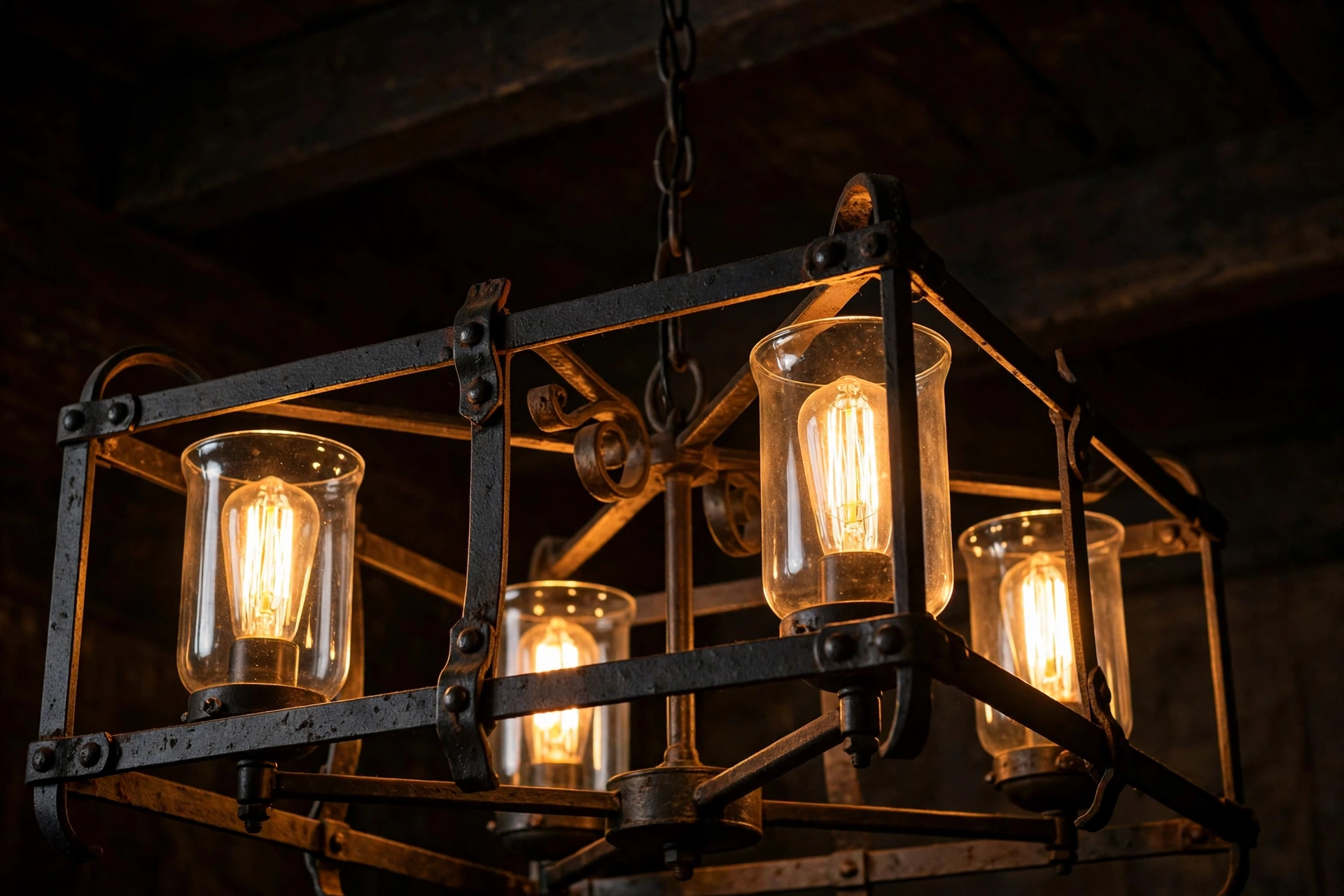
The fixture weighs 13.31 pounds — one person can lift it, two people should install it. A standard ceiling junction box is typically rated for 50 pounds, so I confirmed the box was screwed into a joist and moved on. If your box is ancient or wobbly, that is the one thing worth an electrician’s visit; no chandelier is worth a ceiling incident.
The work took 45 minutes with my wife steadying the frame while I connected black to black, white to white, and ground to ground. The fiddly part was the chain and wire management — threading the cord through the links and getting the canopy flush without pinching anything. There is real-world backup for my frustration: Accio’s October 2025 analysis of Amazon pendant chandelier reviews found that 23.8 percent of complaints about farmhouse black chandeliers were about assembly. The instructions are diagrams, not sentences, and the wire-stuffing step takes patience more than skill.
Two tips from someone who did it last month: hang the fixture before screwing in the bulbs, and do it in daylight or with a work light — you will turn the breaker off, and wiring by phone flashlight is how mistakes happen.
The market numbers: farmhouse lighting is not a fad
Before I spent the money I checked whether farmhouse was still a style or already a punchline. The numbers say it is still very much a style.
Dataintelo’s 2025 report puts the global modern chandeliers market at $4.72 billion in 2025, growing to $8.16 billion by 2034 — a 6.2 percent compound annual growth rate. Within that, wooden chandeliers hold a 14.8 percent share, and the report ties that segment to sustainability consciousness and the growing popularity of natural materials in farmhouse-inspired interiors. Wiseguy Reports lands in the same neighborhood: the broader chandelier and ceiling/wall lighting fitting market at $8.71 billion in 2025, growing to $12.5 billion by 2035 at a 3.7 percent CAGR, with rustic and farmhouse styles called out as a growing niche rather than a fading one.
The demand-side data backs it up. Accio’s October 2025 look at Amazon pendant chandelier trends found farmhouse and mid-century themes dominating dining and living room usage, with search interest peaking in May — home renovation season. And the National Association of Realtors’ 2023 Remodeling Impact Report found that homes with updated lighting fixtures, including chandeliers, tend to sell faster and at a higher price point. A $198 fixture plus $50 of bulbs is a strange thing to call an investment, but per the NAR data it is one of the cheaper rooms to make look current.
The $41 question: iron farmhouse ($198) vs crystal oval ($239)
FLNORW MALL also sells a champagne gold oval crystal chandelier for $239, and I looked at it twice. Real specs: 39.4 inches long, K9 crystal on a metal frame, six E12 candle-style bulbs, a 49.2-inch hanging chain, 12.11 pounds. It is the fixture for someone who wants the dining room to feel like an occasion every night.
I went with the iron farmhouse for three concrete reasons. First, our house is farmhouse-modern — crystal would have been a costume. Second, the crystal fixture is 39.4 inches long, which per the width rule wants a table between about 59 and 79 inches; it fits fewer dining rooms, and it would have crowded our 60-inch table. Third, the honest maintenance truth: crystal collects dust on every arm and facet, and I know myself. The iron frame gets a microfiber duster every few months; crystal gets a ladder and a Saturday.
The $41 price gap is almost irrelevant — it is a style decision, not a budget one. If your dining room leans modern-luxe and your table is 66 inches or longer, the crystal oval is the more dramatic pick. If your house has any wood, any black hardware, any hint of farmhouse, the $198 iron rectangle will look like it was always there.
One more dining room lighting idea
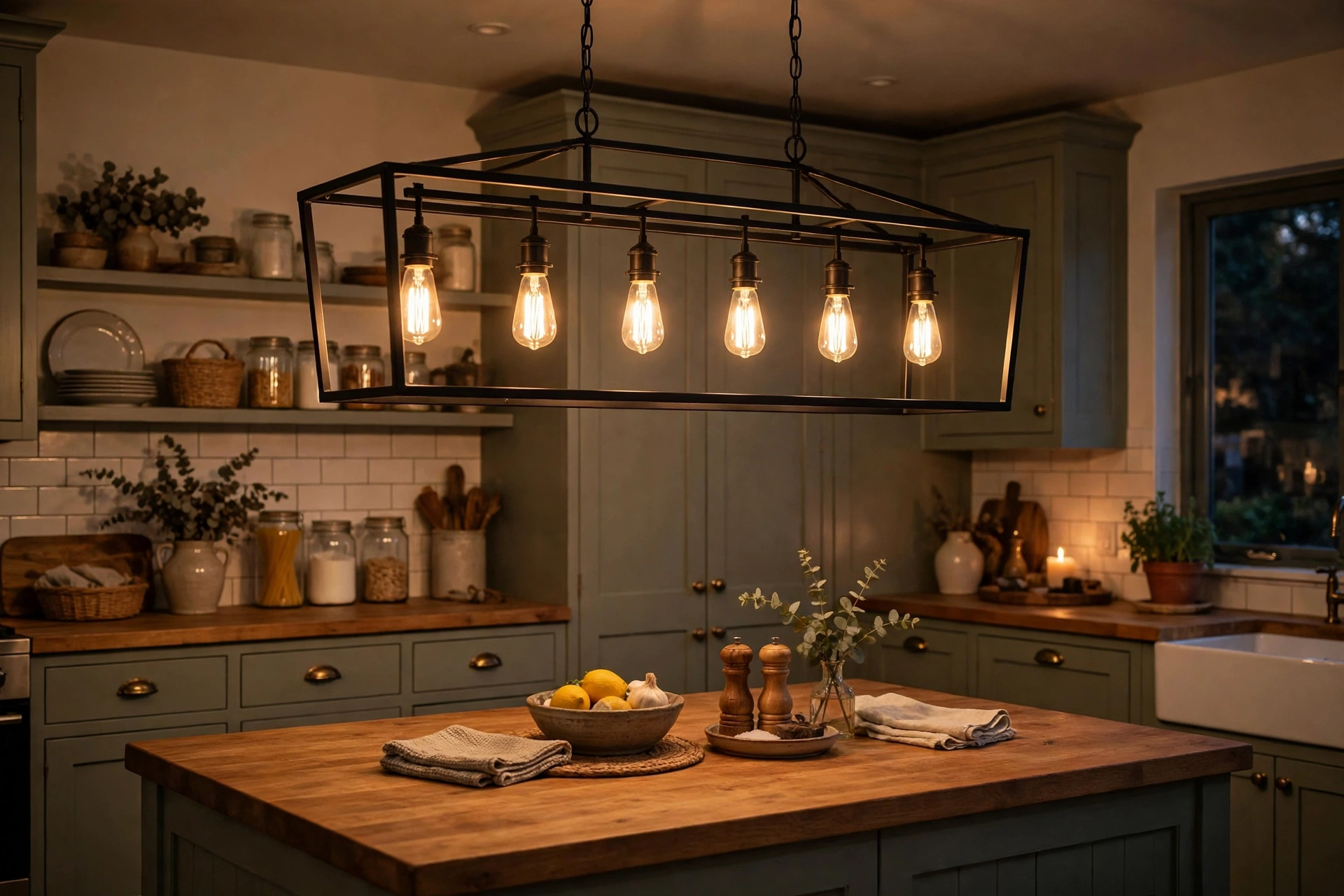
The fixture is the headline, but dining room lighting ideas that work are always layered. We added a cheap plug-in picture light over the sideboard and a floor lamp in the corner, and the room went from one flat light source to three warm ones. Total added cost: about $90. The chandelier does the centerpiece work; the layers do the atmosphere.
The verdict
Two months in, the dining room finally has a center of gravity it never had. The numbers that made it work — 31.5 inches of fixture over a 60-inch table, 32 inches of clearance, 2700K dimmable LEDs — mattered more than the fixture itself, and I am glad I measured before I ordered. At $198 plus bulbs and a dimmer, it is the cheapest room transformation we have ever done, and the market data says we will not be embarrassed by the style in five years.
If your dining room still has the builder’s flush mount, measure your table tonight. Then get the tape measure for the ceiling height. The chandelier part is easy after that.
Ready to swap your flush mount? See the full spec sheet and photos for the 5-light farmhouse chandelier at FLNORW MALL — $198, adjustable hang height, five E26 sockets. If your style leans luxe instead, the $239 champagne gold crystal chandelier is the dramatic alternative. And the furniture collection has the farmhouse pieces to match — start with the pieces you touch daily, then layer in the rest.