
I Replaced My Rattling Box Fan With a $168.99 High Velocity Drum Fan
My two-car garage hit 98 degrees last July, and my old 20-inch box fan was doing nothing about it. It rattled, it hummed, and every afternoon it walked another few inches across the concrete on its own — I once found it pressed against the water heater. When my neighbor Mark rolled a yellow shop fan into his open garage bay and a real breeze reached me from thirty feet away, I asked him what it was. That was my first encounter with a high velocity drum fan. Two weeks later I bought FLNORW MALL’s 24-inch model for $168.99. Two months of woodworking, small-engine repair, and sweating later, here is the honest report.
Why my old box fan had to go
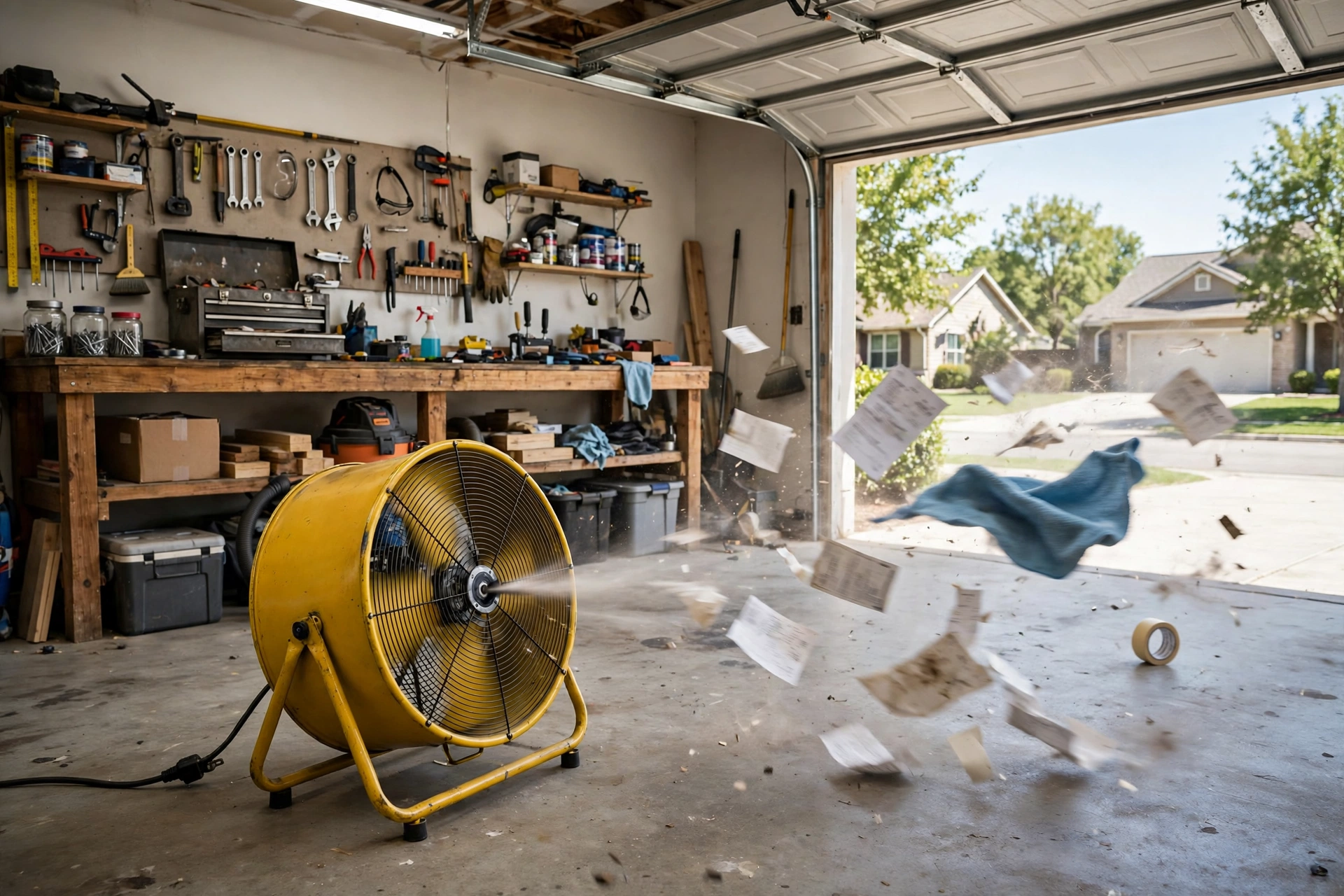
The box fan cost me about $40 at a big-box store and lasted three summers. It threw air in a narrow column — if you stood directly in front of it, fine; two feet to the side, nothing. I was refinishing a dresser in July, and the sawdust hung in the air like weather. I aimed the box fan at the open garage door, ten feet away, and it barely disturbed the dust on the floor.
The difference isn’t subtle, and once I felt it I couldn’t un-feel it. I ordered the Simple Deluxe 24-inch that night. It arrived unboxed-ready — no assembly, just stand it up, plug in the 8-foot cord, and turn the rotary dial on the back housing. My first real test was the dresser job, relocated from July to a warm September afternoon: garage at 89 degrees, door cracked, fan on medium from about twelve feet away. Sawdust that used to hang for minutes was gone in seconds.
What 4,700 CFM does in a real two-car garage
My garage is 24 by 20 feet with a 9-foot ceiling — that’s 480 square feet and 4,320 cubic feet of air. The product page lists this drum fan at 4,700 CFM on high, 4,000 on medium, and 3,400 on low.
Do the division: on high, the fan turns over the entire volume of my garage roughly 65 times per hour — about once a minute. On low, still around 47 times per hour. That is the math that matters, and it’s why the fan works: it’s not “cooling” 480 square feet, it’s replacing the air in the room every sixty seconds with whatever is outside the garage door.
Which brings the honest physics part. A fan doesn’t cool air; it moves it. The CDC’s extreme-heat guidance (2024) notes that portable electric fans lose their punch when air temperatures sit in the high 90s — at that point you’re just being blown on by hot air. In August my garage thermometer read 96, and the fan didn’t make the room cold. It made working in it bearable: moving air evaporates sweat, and evaporating sweat is the only air conditioner your body owns. I keep the garage door cracked six inches at the bottom, point the fan to pull that cooler ground-level air across the workbench, and the difference between that setup and still air is the difference between finishing the job and quitting at noon.
High velocity drum fan specs that actually matter
Here’s what the listing gives you, translated into plain language:
- 4,700 / 4,000 / 3,400 CFM across three speeds — the high number is what you’re paying for.
- 24-inch aluminum blades in a steel drum housing, painted industrial yellow. Not pretty. Indestructible-looking.
- Thermally protected PSC motor, 120 volts, 60 Hz — standard household power, no special wiring.
- 3-speed rotary switch on the back housing. Old-school, clicky, works with gloves on.
- 8-foot power cord — long enough to reach my wall outlet from anywhere in the bay without a tangle.
- 27.22 lbs with two top handles and castors. It rolls; it doesn’t float. Moving it is a two-handed job, not a project.
- Dry, indoor use only — the listing says this plainly, and so will I.

Item code HIFANXDRUM24, and it was InStock when I ordered — arrived in under a week.
The three speeds turn out to be a real feature, not marketing. Low is the “I’m at the workbench for an hour” setting — enough breeze to notice, quiet enough to hear a podcast. Medium is the “garage is a furnace” setting. High is the “August, both cars gone, door open, I’m mowing-adjacent and desperate” setting. I run medium most of the time.
What the electric bill actually said
The listing doesn’t state wattage, so here’s my flagged estimate: a 24-inch PSC drum fan like this typically draws 150 to 220 watts; I assumed 180 watts for the math. At 180 watts, four hours of afternoon shop time a day for ninety summer days is about 65 kWh. The U.S. Energy Information Administration put average residential electricity at roughly $0.17 per kWh in 2024, so a full summer of use costs me around $11. All estimates, but the order of magnitude is right.
For contrast: an 8,000-BTU window air conditioner draws about 900 watts, which is roughly $55 for the same ninety days — and a window unit can’t roll out to the driveway, can’t survive a dusty shop, and cools one corner while the rest of the garage roasts. The drum fan doesn’t beat air conditioning at cooling. It beats it at being the right tool for a garage.

What I didn’t love about this high velocity drum fan
Three honest complaints. First, it’s loud on high. I don’t have a decibel meter, but conversation within a few feet turns into shouting, and I wear earplugs when I run high alongside the miter saw. Low is fine. Second, there’s no oscillation — it’s a fixed-direction air hose, so cooling a different corner means repositioning 27 pounds of yellow steel. Third, the speed switch is on the back of the housing, which means walking around the fan to change speeds. Minor, but I notice it every time.
Two more notes from the fine print. The listing specifies dry, indoor use only — my garage gets humid in August and I don’t run it with the door open in rain. And a fan doesn’t dehumidify anything; in still, wet heat, sweat just drips instead of evaporating. On those days nothing short of air conditioning helps, and I say that as a fan owner.
Drum fan vs box fan: the honest comparison
- Airflow: ~4,700 CFM vs my estimated 1,500–2,500 for a 20-inch box fan — two to three times the air, and it actually reaches across a two-car bay.
- Build: steel housing and aluminum blades vs a plastic box that rattles itself across the floor. One of these survives a shop; the other survives a bedroom.
- Noise: the box fan wins on low. On high, both are loud, but only the drum fan earns it with actual airflow.
- Price: $168.99 vs ~$40. Four times the money for roughly three times the air and ten times the build quality. For a corner desk, that’s a bad deal. For a garage you actually work in, it isn’t.
- Longevity: my expectation, flagged — a steel drum with a thermally protected motor should outlast a plastic box fan by years. The box fan gave me three summers. I’d be surprised if this one gives me fewer than seven.
If you’re comparing across brands, the bigger names push more air — DEWALT’s 24-inch drum fan lists 6,500 CFM and Tornado’s lists 7,700 CFM, both well above this one’s 4,700. But those sell through contractor channels at contractor prices, and for a home garage this one sits in the sweet spot: more than double a box fan, steel throughout, under $170.
Garage safety rules I actually follow
A fan this strong in a shop full of tools deserves a few rules. Mine:
- Cord along the wall, never across the walkway. The 8-foot cord is long enough that I never need it stretched across a path.
- Three feet of clearance around the grille. The intake will grab a shop rag; the output will launch one. My nephew is five — the grille is his curiosity radius, and the fan stays unplugged when he visits.
- No fumes. I turn it off when I’m spraying anything — paint, brake cleaner, whatever. Moving air plus volatile fumes is a combination I don’t gamble with.
- Don’t block the intake. The motor is thermally protected, but a blocked intake is how you find out where the protection limits are. Give it air.
- Unplug before moving. Twenty-seven pounds, a rotary dial on the back, and a 3,400-CFM surprise if you bump the switch. Unplug it.
The verdict
Two months in, the high velocity drum fan has done exactly what I bought it for: it made my garage a place I can work in July and August. It doesn’t cool the air, it doesn’t dehumidify, and on high it’s loud enough to end a conversation. But it replaces the air in my two-car garage every minute, it costs about $11 a summer to run (my estimate), it rolls where I need it, and $168.99 spread over an expected seven-plus years is under seven cents a day.
Buy it if: you work in a garage, workshop, or barn through summer and need real air movement. Skip it if: you want quiet, you need actual cooling below ambient temperature (no fan can do that — physics doesn’t negotiate), or your space only fits a desk fan.
Ready to move some air? The full spec sheet is on the 24-inch high velocity drum fan product page at FLNORW MALL. If you’re building out the whole space, my one-car garage workshop system and the 5-tier metal garage shelving unit review cover the storage side — or start from the FLNORW MALL homepage and browse.