I Shopped 20+ Kitchen Islands for My 10×10 Kitchen. Here’s the Buying Guide I Wish Someone Gave Me.
My kitchen is 10 feet by 10 feet. For two years I told myself a kitchen island was a “big kitchen” luxury, something people with double ovens and a walk-in pantry got to have. Then I spent a month measuring, returning a too-wide cart that scraped the dishwasher, and reading spec sheets until my eyes crossed. I learned more about kitchen islands in those four weeks than I ever wanted to know — and I ended up with one that gets used every single day. Here are the five rules I’d hand anyone shopping for a kitchen island with drop leaf for a small kitchen.
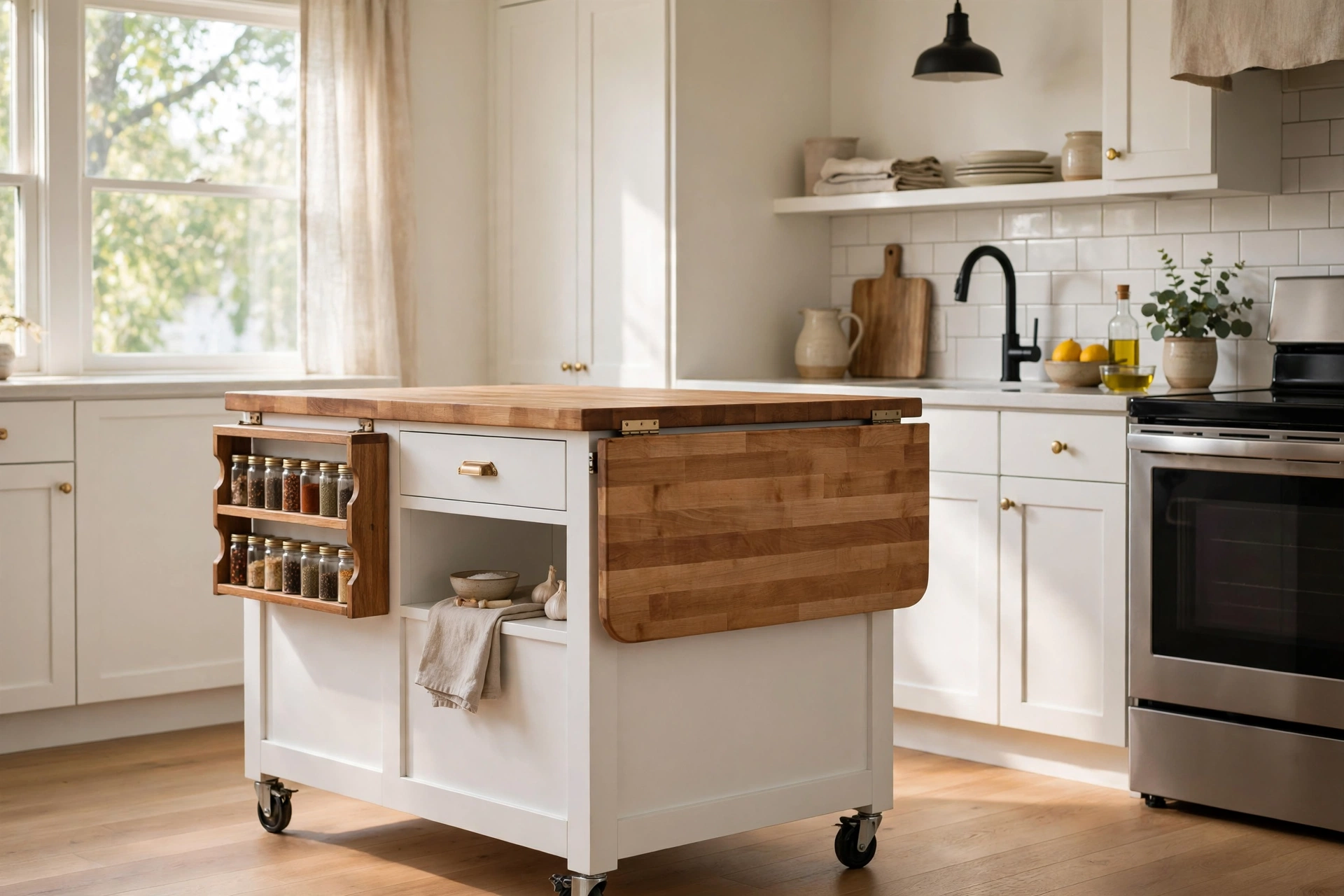
Rule 1: Measure the walkways, not the kitchen
Everyone measures the room. Almost nobody measures the walkways, and walkways are what decide whether an island helps or haunts you.
The working number: leave 36 inches of clearance on every side where someone walks with a dish in their hands. Forty-two is nicer if two people cook together, but 36 is the hard floor. Now measure your real paths — the line from the stove to the sink, the arc of the dishwasher door, the swing of the fridge. Tape those lines on the floor with painter’s tape before you buy anything.
My floor plan left me a rectangle about 54 by 29 inches once the walkways were marked. That number became the entire shopping filter. The island I kept is 53.94 inches wide and 28.74 inches deep — it slid into the taped rectangle with less than an inch of forgiveness on either side. If I had bought by “room size” alone, I’d have ordered something 60 inches wide and spent a year cursing the dishwasher door.
One more measurement people skip: door widths and hallway corners on the delivery route. The island ships heavy — 114.64 lbs in this case — and you will be the one muscling the boxes around the corner by the laundry room.
Rule 2: Decide what the island actually has to do
A kitchen island with storage sounds complete, but “storage” is a vague promise until you list the jobs. Mine has to do three things: give me more chopping space, swallow the small-appliance clutter, and — on weekend mornings — become a breakfast table for two. Your list will differ. Write it down before you browse.
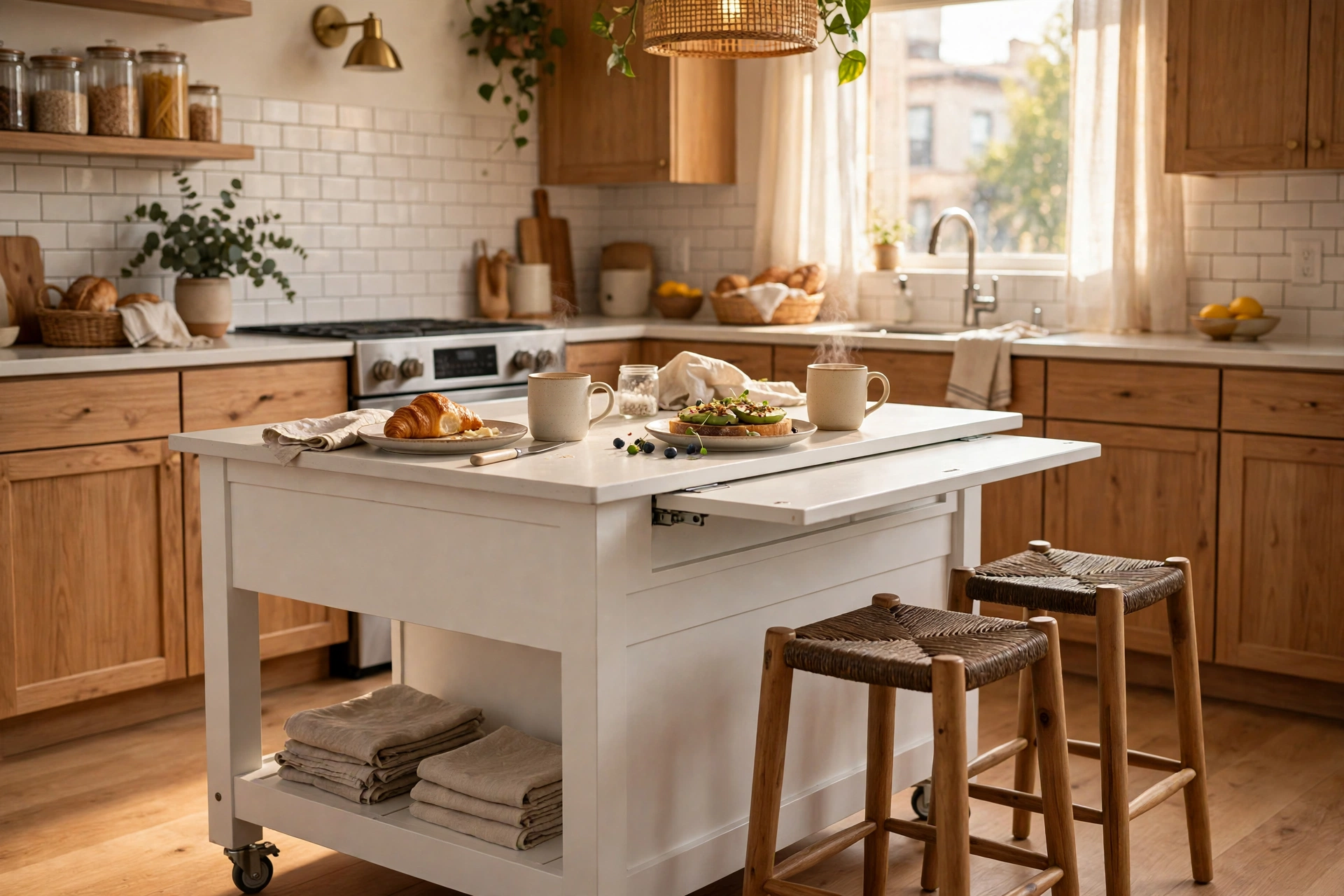
This is where the drop leaf earns its keep. With the leaf down, the island stays narrow and out of the way on workdays. Flip it up and the countertop roughly doubles, turning the same footprint into a dining surface or a serious prep station. No separate gate-leg table, no folding chairs in the closet.
The honest trade-off: a drop leaf is one more moving part. The version I bought reinforces the countertop and leaf with sturdy metal support frames, and the leaf is rated to hold 80 lbs — enough for a loaded cutting board, a stock pot, or two place settings with real dishes. The main tabletop is rated for 220 lbs, which is more than any cooking task will ever ask of it. When you compare models, check whether the leaf rating is even listed. If it isn’t, the manufacturer is hoping you won’t ask.
Rule 3: Storage is not a checkbox — check the inside
Almost every listing says “ample storage.” What varies wildly is whether that storage is usable or just cabinet-shaped emptiness.
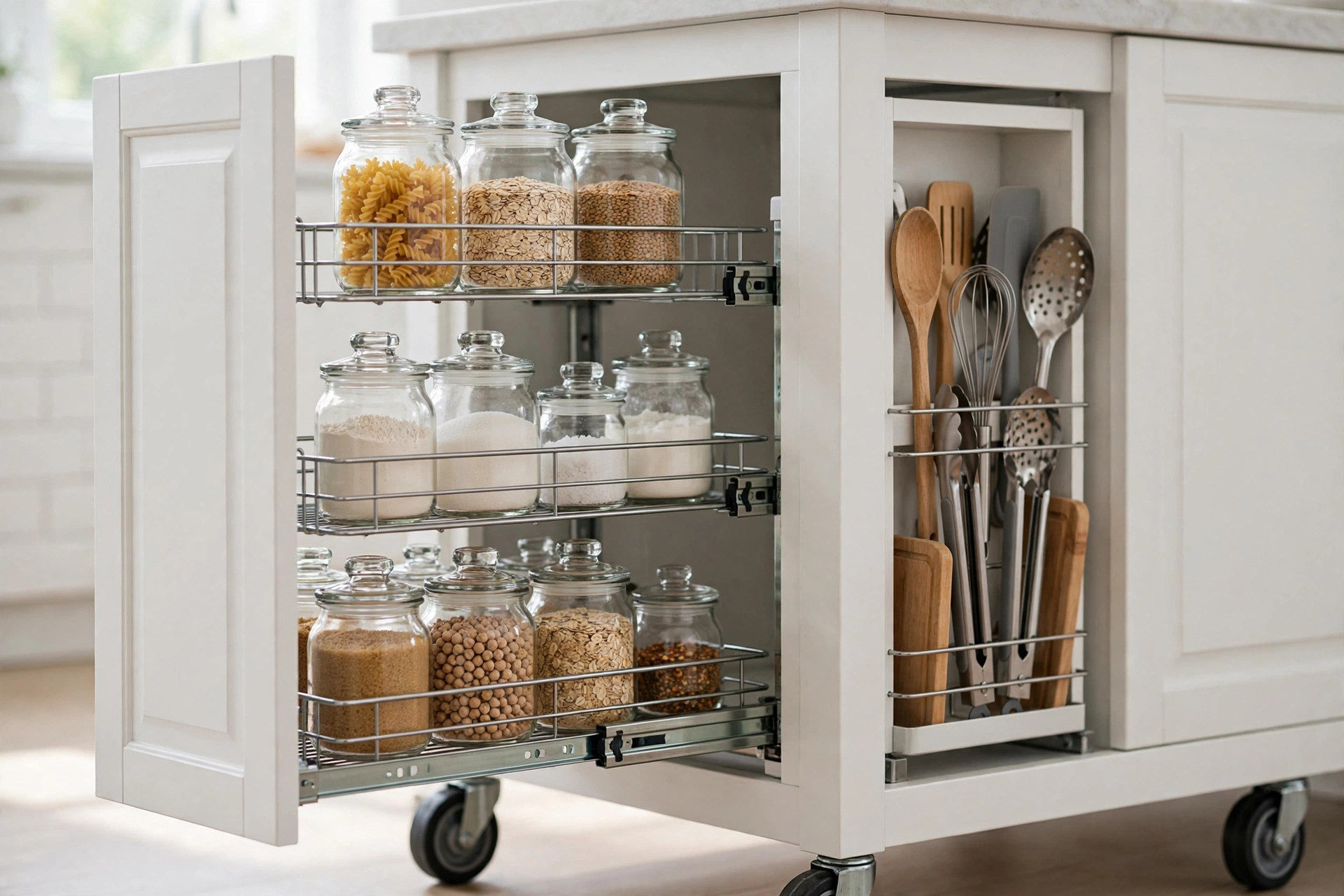
Open the interior in your head and count what you’d actually put there. This island has a 3-tier pull-out cabinet organizer with an L-shaped layout — a narrow top drawer and two wider lower drawers — plus internal storage racks on the doors, fridge-door style, which is where I keep the olive oil, the vinegar, and the spices that used to colonize the counter. A spice rack and a towel rack ride on the outside. Nothing about this is fancy. It is just storage that was designed by someone who had apparently watched a human cook.
The pull-out matters more than it sounds. My old kitchen had a fixed-shelf cabinet where everything behind the front row went to die — I once found a can of coconut milk I’d bought in 2022. A drawer that comes to you is storage you actually use. When you’re comparing islands, ask for a photo of the interior with the doors open. If the seller only shows the closed cabinet, there’s usually a reason.
Rule 4: Wheels beat feet in a small kitchen
Here is the feature I almost dismissed and now consider non-negotiable: this island rolls. Five smooth-rolling wheels let me pull it out to mop behind it, shove it against the wall when I’m hosting six people in a space meant for four, and angle it toward the stove on pasta night so the pot transfers in two steps instead of five.
Fixed islands have their place — they can be anchored, wired, plumbed. But a freestanding island in a small kitchen that can’t move is a fixed obstacle in a space that needs flexibility. The one I bought splits the difference cleverly: wheels for mobility, plus four solid wood cabinet feet and a central support plate for stability once it’s parked.
The test that matters: park it, lock the wheels, and lean your full weight on the edge like you’re kneading dough. A good island won’t shiver. Mine doesn’t — the wheel locks plus the support plate keep it planted. If a model lists wheels but no locking mechanism, that’s a red flag at any price.
Rule 5: The boring specs decide how long it lasts
Two numbers on the spec sheet tell you more than the marketing photos: weight and assembly time.
A 114.64-lb island is a good sign. Mass in furniture usually means real panels and real hardware, not hollow-core boxes that rack and wobble by year two. The assembly estimate here is 40 to 80 minutes — long enough to mean genuine joinery, short enough that one person can finish it in an evening. I’ve built enough flat-pack to know that anything promising 15 minutes is promising particle board and regret.
Care is straightforward and worth quoting from the manual: wipe with a soft dry cloth, avoid harsh chemicals and household cleaners, and periodically check that the hardware is tight — connections loosen over time, and a 30-second check twice a year prevents the wobble that kills most carts. Do that and there’s no reason this doesn’t last a decade of daily use.
The industry numbers: kitchens are shrinking, islands are getting smarter
I wanted to check whether I was an edge case or part of a trend, so I looked at the trade data. The National Kitchen & Bath Association’s 2027 Kitchen Trends Report — released October 14, 2026, based on surveys of 830 North American industry professionals — found that only 52% of designers expect kitchen footprints to grow, down from 76% in the previous year’s report. The money quote: kitchens aren’t getting bigger; they’re getting more intentional, with 81% of professionals calling “intentional zoning” a lasting direction.
And the island keeps winning. The same report found 74% of designers say island size and configuration are becoming more tailored to the space, with technology leading island changes at 74%, storage at 60%, and functional zones at 58%. In other words, the industry has quietly agreed with my painter’s tape: measure your actual space, and buy the island that fits the life, not the brochure.
One stat that reframed the price for me: a full kitchen remodel with a built-in island runs into the tens of thousands. A freestanding island at a few hundred dollars buys you most of the function — extra prep space, storage, a dining spot — with zero contractor dust. That’s not a compromise; that’s arithmetic.
My pick, with the honest caveats
After all that measuring, the island that lives in my kitchen now is the 53.9-inch rolling kitchen island with drop leaf from FLNORW MALL — $299, in your choice of black, gray, or white. I went with white; the gray looks sharp in person and the black hides tomato sauce incidents best.
The caveats, because a buying guide that hides them is an ad: it’s heavy to move in the box (split the packages with a friend), the drop leaf adds a step you have to remember to lock before loading it up, and the care routine is real — no harsh cleaners, wipe it dry. None of those are dealbreakers at this price; they’re just the price of admission for furniture that actually gets used.
What sold me wasn’t any single feature. It was that on a Tuesday night it disappears into the workflow, and on a Sunday morning the leaf goes up, two mugs come down, and it becomes the best seat in the house.
The specs that matter:
- Dimensions: 53.94 x 28.74 x 36.81 inches — measure your walkways first, not the room.
- Tabletop capacity 220 lbs, drop leaf 80 lbs — more than any real kitchen task needs.
- 5 rolling wheels plus 4 solid wood feet and a central support plate — moves when you want, planted when you don’t.
- 3-tier pull-out organizer, door racks, spice rack, towel rack — storage you will actually open.
- Assembly 40-80 minutes — one person, one evening, real hardware.
- Care: soft dry cloth, no harsh chemicals, re-tighten hardware periodically.
The verdict
If your kitchen is small and you’re telling yourself an island is for bigger houses, you’re measuring the wrong thing. Measure the walkways, list the jobs, check the interior like a skeptic, demand wheels, and respect the boring specs. The right kitchen island with drop leaf doesn’t just fit your kitchen — it makes the kitchen you already have bigger.
You can see the full spec sheet, dimensions, and the three color options on the kitchen island with drop leaf product page at FLNORW MALL. If you’re furnishing the whole kitchen, the furniture collection has matching pieces, and a storage cabinet like the three-door rattan model fills the gap an island can’t reach. As always, everything at FLNORW MALL ships factory-direct, so you’re paying for the island, not the showroom.