I Bought a $188 Weathered Oak Desk. Six Months of Daily Work Later, Here’s the Honest Review.
For two years, my “home office” was a $69 folding table that had bowed in the middle like a hammock. Every time I typed fast, my monitor did a little dance. My back knew it, my eyes knew it, and the table knew it — the center dip was deep enough to hold a pencil without it rolling off. In April, I finally did something about it and ordered the ACME Bob weathered oak desk in black from FLNORW MALL for $188. Six months of actual, daily, butt-in-chair use later, here is the full honest report.
I should say upfront: I am not a furniture reviewer with a test lab. I am a guy who works from his spare bedroom, on video calls four hours a day, with a coffee habit and a cat who believes every horizontal surface is a bed. If any of that sounds familiar, this review is written for you.

What this weathered oak desk actually is
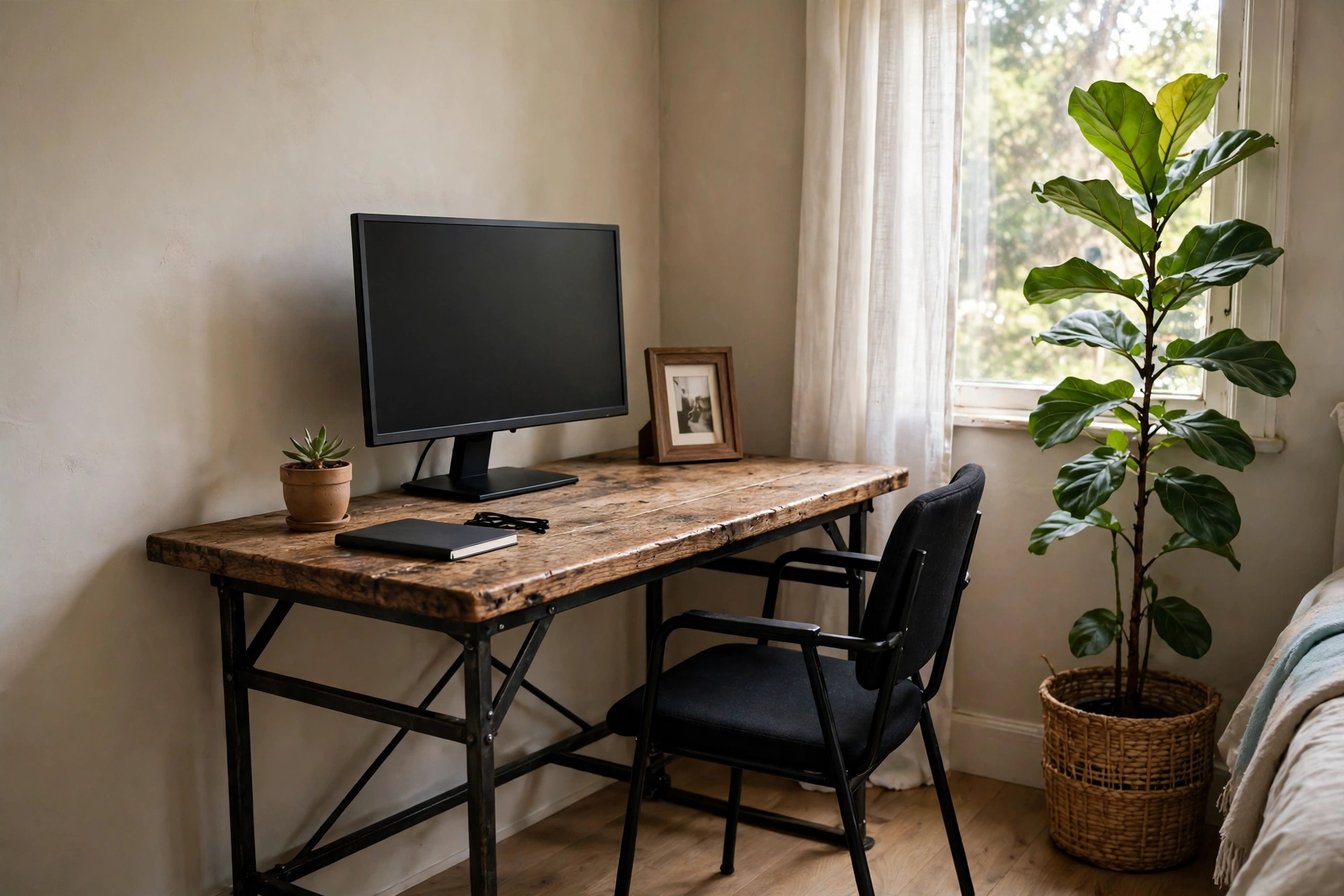
FLNORW MALL lists it as the Bob Desk in Weathered Oak & Black (ACME item 92396), and the spec sheet is refreshingly specific. The top is 47 inches long, 22 inches deep, and a full 36 millimeters thick — paper veneer over board, not solid oak, and I will get to what that means in practice. The legs are U-shaped black metal tube, 20 by 20 millimeters with a 1-millimeter wall, powder coated. A 6-millimeter wire X-support braces the back. Height is 28 inches, standard desk height. Estimated weight capacity: 70 pounds. It ships knock-down, assembly required, made in Taiwan. Industrial style, which in practice means it looks like furniture that expects to be used, not admired.
At $188 it sits in an interesting middle ground — more than the particleboard flat-pack desks that die in a year, less than the solid-wood pieces that start around $400. The question is which neighbor it behaves like.
Assembly: one evening, one lesson learned
The box showed up flat, about 51 by 26 by 4 inches and 29 pounds — one person can carry it without heroics. All the hardware was sorted in its own pack, and the instructions were the wordless pictogram kind that I have learned to read with the patience of a bomb technician. One Allen key, about 45 minutes, done.
The lesson: do not fully tighten any bolt until all of them are started. I tightened the first leg completely, then spent ten minutes fighting the X-support into a frame that had gone rigid a millimeter out of true. Loosen, align, then tighten everything — after that it went together like it wanted to.
The wobble test, six months later
This was the test that mattered to me. My folding table had trained me to type like I was defusing something. On day one with the Bob desk, I set my 27-inch monitor on a stand, parked my laptop dock beside it, and typed a long email as hard as I could. Nothing moved. The X-support at the back does real work — it kills the side-to-side sway that cheap desks get when the frame is just four legs and hope.
Six months in, I just repeated the test. I pressed down on the front edge with both hands, rocked it, leaned my full weight into a stretch. Still solid. The leg bolts have never needed re-tightening — I checked at month three because old furniture habits die hard. No creaks, no loosening, no drift. Whatever the 70-pound capacity is rated for, my roughly 40-pound daily load has given it nothing to complain about.
The 22-inch depth question
Twenty-two inches deep is the one number I measured twice before ordering. Here is how a 47-by-22 surface actually lives: my 27-inch monitor sits at the back on a stand about 8 inches deep, which leaves roughly 14 inches of working depth in front of it. Keyboard, mouse, phone, a notebook — that fits with room for my elbows. What does not fit: my bookshelf speakers (they moved to a side shelf, which honestly improved the sound), and a full legal pad plus a laptop open at the same time. For a home office desk running a laptop-plus-monitor setup, 22 inches is plenty. For two full monitors on arms, you would feel the edges.
One honest gap: the product page says NO cord management, and it means it. No grommet hole, no tray. My fix was a $6 adhesive cable raceway and a strip of cable clips under the top — ten minutes, invisible from the front. If cable chaos bothers you, budget for that.
Six months of wear: how the weathered oak top held up
Let us be clear about what paper veneer is. It is a printed wood-grain layer over board — tougher than the raw paper on dollar-store furniture, but it is not solid oak and it will never be. Six months of daily use: my coffee mug has lived on a cork coaster, and the surface under it looks new. The one blemish is mine, not the desk’s. In July I set down a hot bowl of soup directly on the top without thinking, and there is a faint, lighter patch where the heat sat. You see it only in raking light, but it is there.
Keys, the laptop dock, the cat’s claws (she walks across it daily): no scratches visible in normal light. A $4 furniture touch-up marker matched the weathered oak grain well enough to make the soup spot nearly invisible. Realistic takeaway: treat the top like a good kitchen counter — coasters, no hot pans — and it will look fine for years. Abuse it like a workbench and it will show it.

What 70 pounds of capacity actually holds
Seventy pounds sounds like a lot until you start stacking. Here is my real load, weighed with a bathroom scale out of curiosity:
- 27-inch monitor on stand: 14 pounds
- Laptop docked, lid closed: 4 pounds
- Stack of notebooks and a reference book: 9 pounds
- Lamp, mug, phone, the usual clutter: 7 pounds
- My forearms resting while I type: roughly 8 pounds
That is about 42 pounds against a 70-pound rating — roughly 60 percent. The desk has never flexed, and the rating feels honest rather than inflated. If you are planning a dual-monitor arm setup plus a desktop tower sitting on the desk itself, you would be closer to the ceiling and I would think twice. For one monitor and a laptop, you are in the comfortable middle.
The home office numbers: why a $188 desk matters now
I did not buy this desk as a design statement. I bought it because the spare bedroom is my office now, permanently, and the data says I am not unusual. Upwork’s Future Workforce Report (2022) projected that 28% of the US workforce would be fully remote by 2026 — a projection, not a census, but everyone in the industry is rowing in the same direction. An earlier Upwork report (2020) put the figure at 32.6 million Americans working remotely by 2025, again a projection, and the post-2020 reality has landed close to those lines.
The point: the desk you sit at is a long-term purchase now, not a temporary fix. Spending $188 on something you will touch eight hours a day for years works out to about 13 cents a day over four years. My folding table cost $69 and I replaced it after two. The math is not close.
The verdict
Six months in, the Bob desk has done the one thing I asked: it disappeared into my workday. No wobble to think about, no sag to stare at, no bolts to re-tighten. The weathered oak top looks like wood with a story, the black frame looks like it means business, and my back has stopped filing complaints. The soup spot is my scar, not its flaw.
One caveat: if you need drawers or shelves, this is not your desk — it is a 47 inch writing desk, flat top and nothing else. FLNORW MALL sells a computer desk in black and chrome at the same $188 with a five-shelf bookcase built in, which is the better pick for storage people. But for a clean, sturdy, good-looking writing surface? For $188, I would buy the Bob desk again tomorrow — with a cork coaster on day one and a cable raceway in the same order.
Want the full specs? See the Bob desk in weathered oak and black on FLNORW MALL, or browse the furniture collection for more home office picks.