I Put a $1,999 48-Inch Sandwich Prep Table in My Home Kitchen. Here’s the Honest Math.
I did not set out to buy commercial kitchen equipment. I set out to stop spending my Sundays slicing forty pounds of deli meat on a plastic folding table. I run a small weekend meal-prep operation out of my garage — sandwich boxes for two local offices, about sixty boxes a week — and for two years my “prep station” was that folding table next to a dying dorm fridge. Then I priced what actual delis use: a 48 inch sandwich prep table. The big names wanted $2,894 to $5,057 for one. I bought the $1,999 Orikool unit from FLNORW MALL instead. Ninety days later, here is the honest math — what it does, what it costs to run, and the four things I did not love.
What a 48 Inch Sandwich Prep Table Actually Is
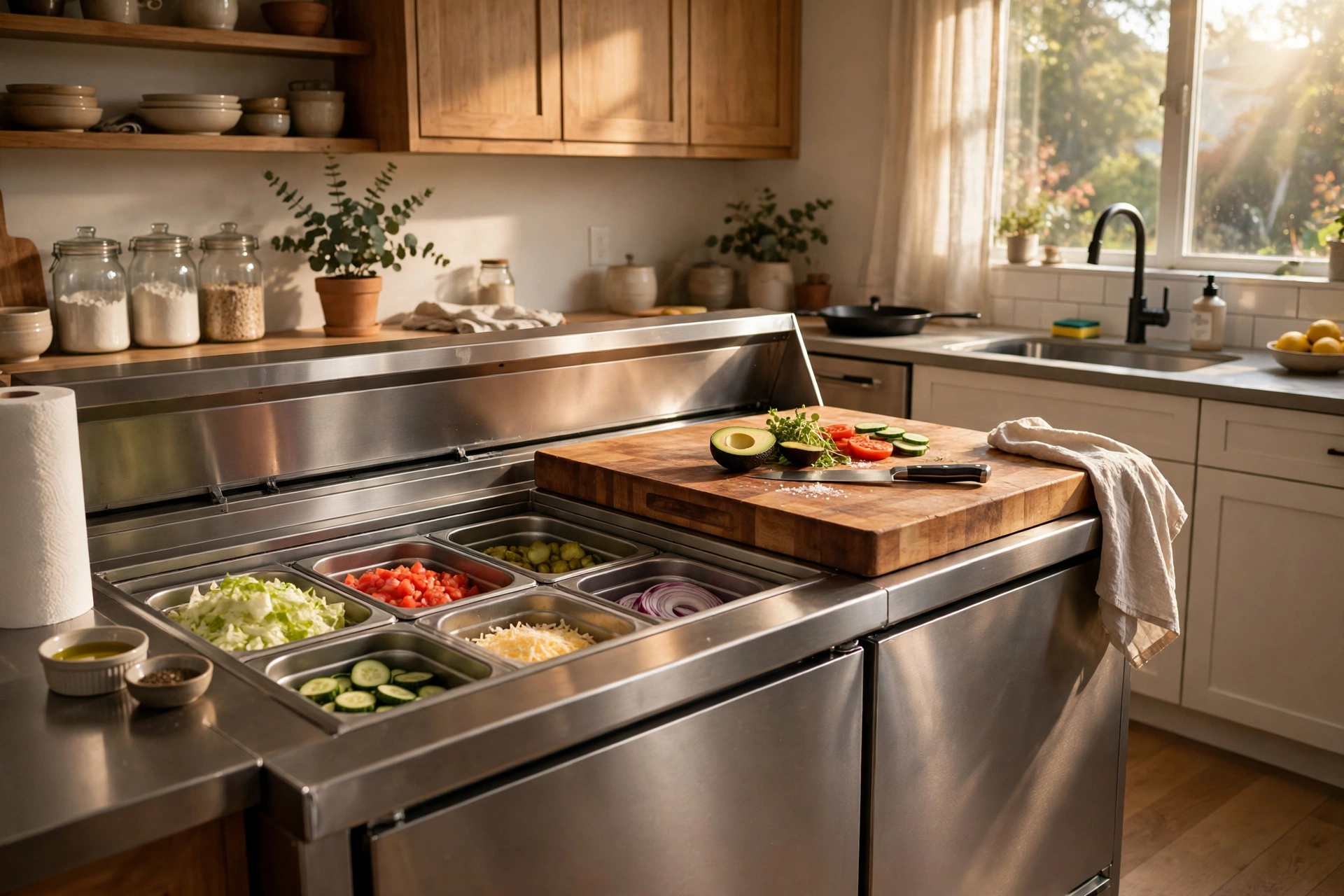
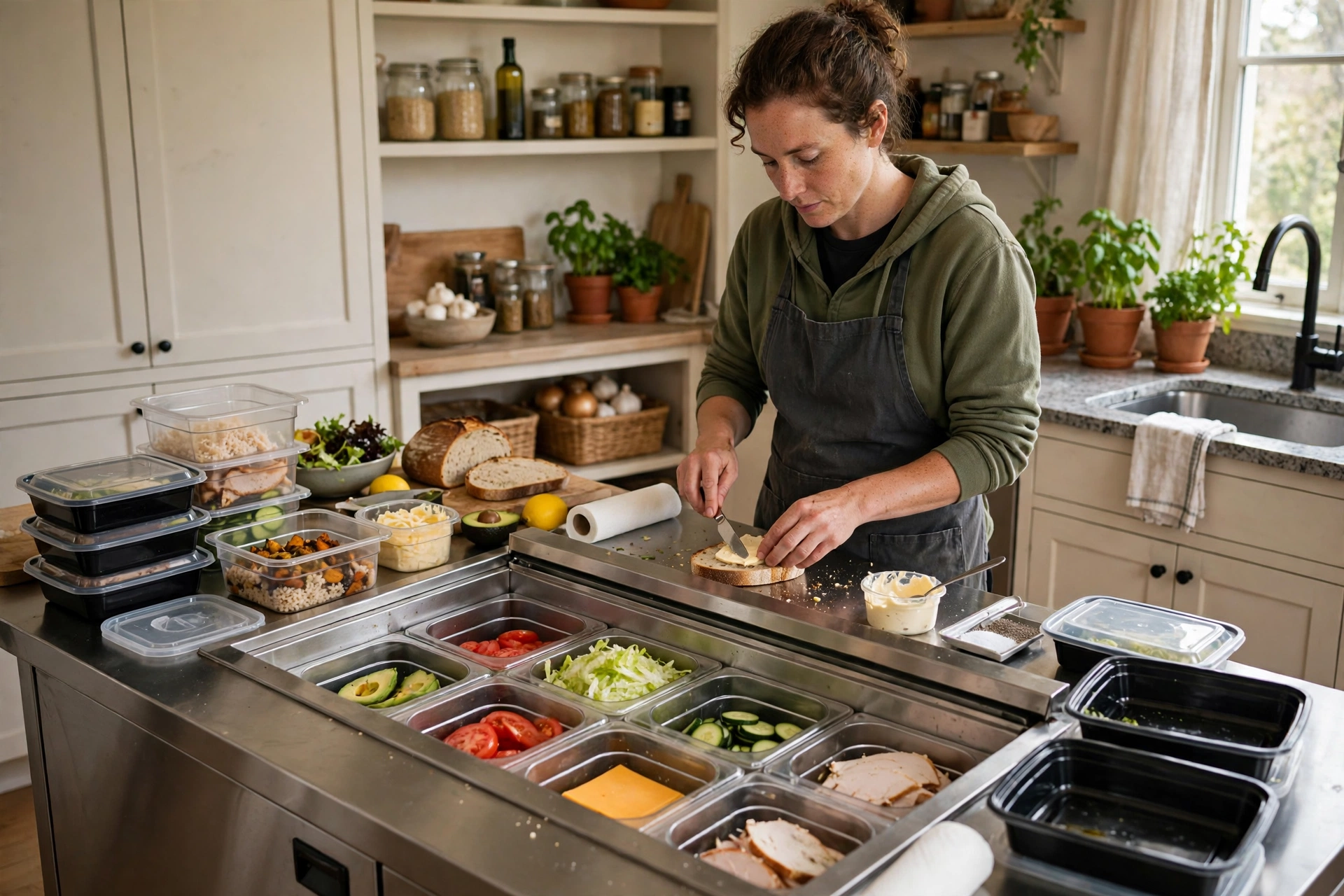
If you have ever watched a deli worker build your sandwich, you have seen one of these in action. A refrigerated prep table is three machines stacked into one cabinet: a refrigerated base with two doors, a raised pan rail across the top that holds your ingredients cold, and a cutting board running the full length where the actual assembly happens.
This one — the Orikool 48-inch — holds twelve 1/6-size food pans up to 4 inches deep in the rail, with a lift-up insulated lid that keeps the cold where it belongs between rushes. A CAREL digital controller holds the cabinet between 33 and 40°F, with automatic defrost so frost never chokes the coil. The exterior is SS430 stainless steel, the interior is pre-coated aluminum with rounded corners for wipe-downs, and it runs on R290 refrigerant — the eco-conscious choice, with a global warming potential around 3 versus roughly 1,430 for the older R134a, per EPA figures. It is DOE-compliant and ETL certified, which matters if your health inspector ever asks.
The 48-Inch Size: Why It Won the Tape Measure
The unit measures 48.43 x 31.46 x 45.08 inches and weighs 194 pounds. Before I ordered, I taped that footprint on my garage floor with painter’s tape and lived with it for a week. Best $4 I spent on this project.
Here is the sizing logic. A 27-inch prep table — the small end of the market — gives you about six pan positions. That covers a household, not sixty sandwich boxes. A 72-inch unit gives you sixteen-plus pans but eats over 15 square feet and, in my case, would not have cleared the garage door track. The 48-inch width lands at roughly 10.6 square feet of floor, holds twelve pans, and lets two people work side by side without elbowing each other. For a one- or two-person operation, it is the sweet spot the whole industry converged on — nearly every major brand builds its volume line at 48 inches first.
One note: at 31.46 inches deep it is deeper than a standard 25-inch home countertop, so plan the walkway behind it. The doors self-close below 90 degrees and stay open past 90 — a small detail that saves a thousand hip-checks a week.
The Butcher Block Cutting Board Is the Whole Point
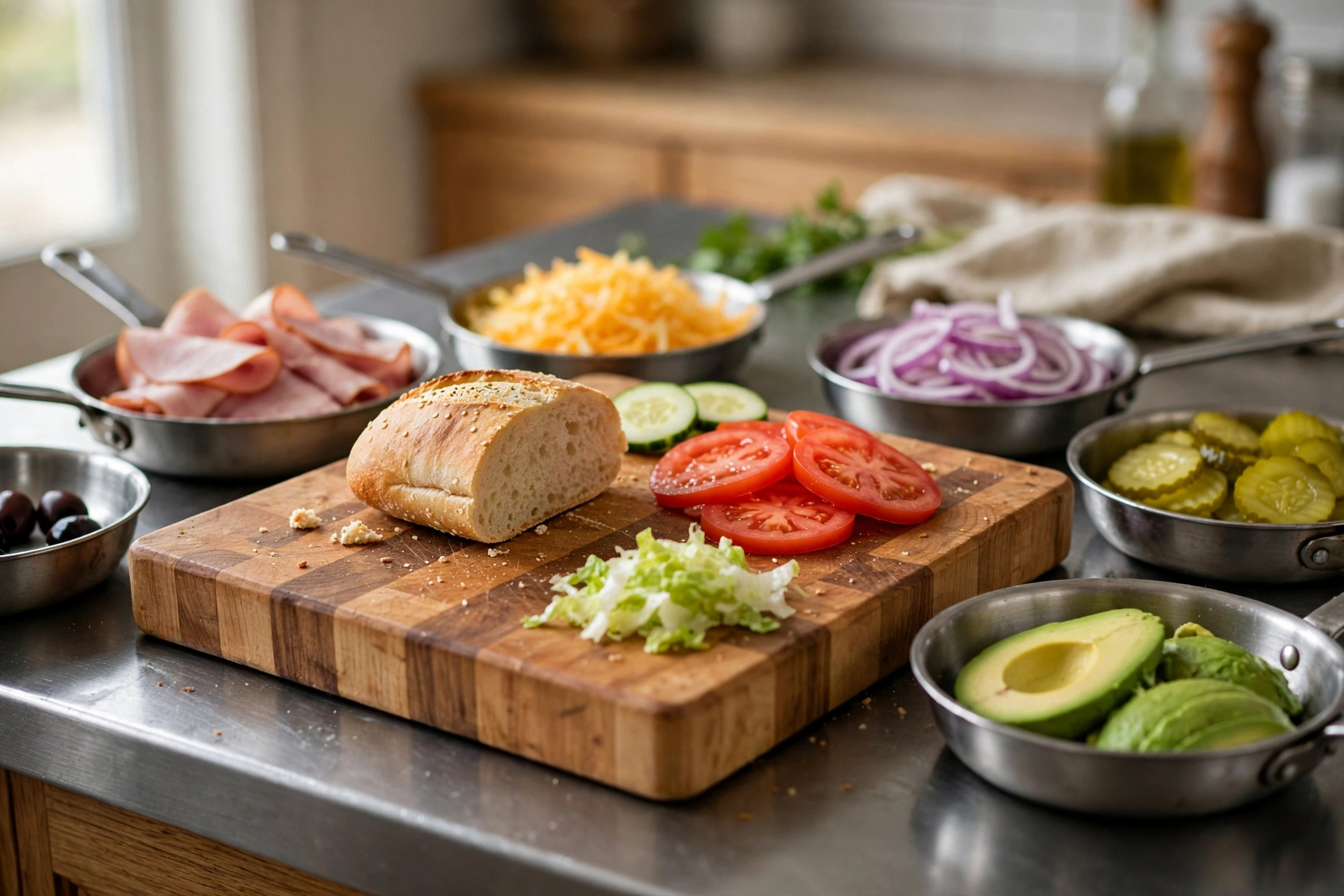
The big-brand units mostly ship with white polyethylene boards. This one ships with a full-length removable butcher block cutting board, and after ninety days I would pay extra for it if it were an option.
Why it matters: every sandwich I build gets assembled directly on the board, inches from the cold pans. No ferrying ingredients to a separate counter, no warm cutting board, no second surface to sanitize. The board lifts out for cleaning and locks back in with retaining clips, so it does not skate around mid-rush. Wood is also kinder to knife edges than poly — my chef’s knife has needed exactly one honing in three months of Sunday marathons.
Care is simple and non-negotiable: hot soapy water, towel dry immediately, mineral oil once a month. Skip the oil and the board will tell you about it within a few weeks. That is not a defect; that is wood.
Cold Storage Test: 90 Days at 33–40°F
Specs are promises; thermometers are witnesses. I put a $12 fridge thermometer in the pan rail on day one and checked it morning and night for the first week. It sat at 36–38°F the entire time, rail and cabinet alike, in a garage that swings from the high 50s to the low 80s depending on the month.
That number matters more than it looks. The FDA Food Code (2022) requires cold-held potentially hazardous foods at 41°F or below. This unit’s 33–40°F band clears that bar with margin to spare, which is the difference between a prep table and a very expensive shelf. The automatic defrost has run silently in the background — I have never seen frost on the coil, and I checked, because I am that person now.
Below the rail, the two-door base holds backup ingredients: deli meat cases, cheese blocks, the backup mayo. The adjustable shelving is rated for 155 pounds, which is far more than a home operation will ever load. In practice the base replaced both my dying dorm fridge and a stack of coolers. One plug, one footprint, one thing to clean on Sunday night.
The $1,999 Math: What a 48 Inch Sandwich Prep Table Really Costs
Here is the price ladder I found when I shopped 48-inch units in November 2026, all for the same 48-inch, two-door, refrigerated format:
- $1,999 — the Orikool 48-inch unit I bought (FLNORW MALL)
- $2,894 — Atosa MSF8302, 12-pan (nellaonline listing)
- $2,969.99 — New Air NPT-048-SA, 12-pan (nellaonline listing)
- $5,057.62 — True TSSU-48-18M-B-HC mega-top, 18-pan (cityfoodequipment listing)
- $11,483.16 — Traulsen TS048HT, 6-pan (nellaonline listing)
So the honest comparison: I saved $895 against the Atosa and $3,058 against the True. The Traulsen costs nearly six times as much — you are paying for a badge and a service network, not for colder sandwiches.
Amortized over a conservative ten-year life, $1,999 works out to about $200 a year, or roughly $0.55 a day. My operation grosses about $660 a week on sixty boxes at $11 each (rough numbers, flagged as rough). Against that, the table paid for itself in about three weeks of revenue. Even if you are not selling a thing — say you are just the person who does the family reunion sandwich spread — the per-use math beats renting commercial kitchen time, which runs $25–50 an hour in most markets.
Electricity is a flagged estimate — the listing does not publish wattage — but a unit this size typically runs roughly $10–15 a month at the EIA’s 2024 residential average of about $0.17 per kWh. A rounding error next to the ingredient budget.
Sandwich Salad Prep Table vs a Regular Fridge: The Honest Split
I ran this comparison before buying, because a second full-size fridge costs less. Here is how it breaks down after ninety days of living with the commercial prep table:
Buy the prep table if you assemble food in volume — meal prep, cottage-food sales, big-family gatherings, church or team events. The pan rail is the entire argument: twelve ingredients cold, visible, and within arm’s reach beats opening a fridge door forty times an hour. If you sell food from home, note the tailwind: the Institute for Justice’s Flour Power research (2021) found every state plus DC now allows some form of cottage-food sales, so the home-based food business this table serves is legal just about everywhere.
Buy a regular fridge if you just need cold storage. A chest freezer — I reviewed a $299 7 cu. ft. unit that has been flawless for eight months — holds far more bulk food per dollar, and a 4L mini fridge I tested covers desk drinks and skincare for $59.99. Neither assembles sandwiches. Different tools, different jobs.
Four Things I Did Not Love
Fair is fair. Ninety days in, here are the honest complaints:
1. It weighs 194 pounds, and the box weighs 304. This arrives by freight, not by friendly parcel truck. I needed a furniture dolly, a neighbor, and twenty minutes to get it off the pallet and into position. The 5-inch caster wheels with brakes help once it is down — lock them, especially on a sloped garage floor — but plan the delivery like a piano, not a parcel.
2. It is 45 inches tall. Standard home counters are 36 inches. Nine inches does not sound like much until you have chopped on it for four hours; it is closer to bar height, which my 5’4” wife notices more than I do at 6’1”. Taller users will find it comfortable. Shorter users should test the ergonomics mentally before ordering.
3. The compressor hums. I own no sound meter, so no decibel claim — but in a quiet garage at night you can hear it cycle, while in a working kitchen it disappears. Studio apartment? I would think twice.
4. Check whether pans are in the box. The listing describes storage for twelve 1/6-size pans up to 4 inches deep but does not explicitly list the pans as included. Budget $40–80 for a pan set just in case (my rough estimate from restaurant-supply pricing). Small money next to $1,999, but nobody likes a surprise on assembly day.
The Verdict
Ninety days in, the 48 inch sandwich prep table has done exactly what the $2,894–$5,057 units do — hold twelve pans at a food-safe 36–38°F, give me a full-length butcher block to build on, and swallow a Sunday’s worth of prep without a second trip to the fridge — for $1,999. The delivery was a two-person job, the height runs tall, and I would confirm the pan situation before ordering. Buy it if you run a home-based food operation, host big gatherings, or do Airbnb breakfasts — pair it with a triple-pot slow cooker for the hot side of the buffet. Skip it if you cook for two; this is a volume tool, and buying it for a household of two is like buying a stand mixer to stir one cup of tea.
Ready to price out your own prep station? See the full specs and current price on the 48-inch sandwich prep table I bought — $1,999, ETL certified, butcher block top included. If you are still building out the operation, my $299 chest freezer review covers the bulk-storage side, and the triple-pot slow cooker party test handles hot food. Browse the rest of the lineup at FLNORW MALL.