Farmhouse Ceiling Fan: My $299 72-Inch Verdict, One Year Later
Farmhouse Ceiling Fan: My $299 72-Inch Verdict, One Year Later
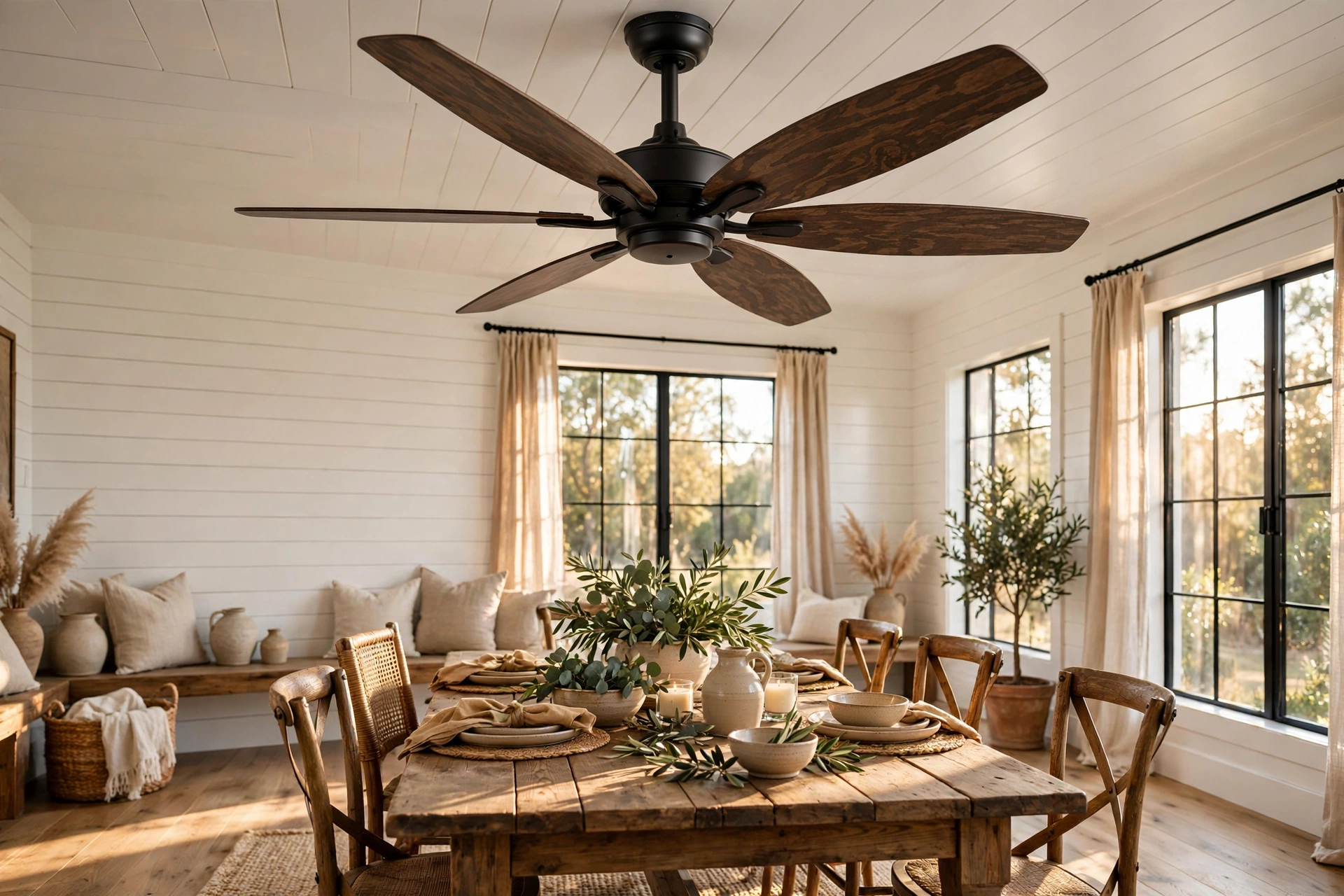
Our dining room is 18 by 22 feet, which works out to just under 400 square feet of air that needs moving every summer. The builder-grade fan that came with the house was a 52-inch wobbler from 2019, and my wife Mara disliked how it looked almost as much as I disliked how little it cooled the corners. Last spring I replaced it with a 72-inch farmhouse ceiling fan — the $299 plywood-blade model from FLNORW MALL, item W1367103356. A year of daily use later, here is the honest verdict.
Why a 72-inch farmhouse ceiling fan for a 400-square-foot room
I did the sizing homework first, because I had already made the undersizing mistake once. ENERGY STAR’s published ceiling-fan sizing guidance puts it plainly: rooms over 225 square feet want a 50-inch fan or larger. Healthadore.com’s 2026 large-room roundup (updated October 2026) treats blade spans of 65 to 84 inches as the large-room category outright, and its top farmhouse picks are all 72-inch models with six to eight blades. My 396-square-foot dining room is exactly the room those charts are describing.
Our old 52-inch fan proved the chart right in the most annoying way possible. Under the center of the room it was fine. In the corners — where the table actually seats fourteen at Thanksgiving — the air barely stirred. A 72-inch farmhouse ceiling fan sweeps roughly twice the air-moving area of a 52-inch, and in a room this size that is the whole game. If your room is under 250 square feet, stop here and buy something smaller. This fan is a great-room tool.
What this farmhouse ceiling fan costs me to run
This is the math I actually did before buying, and it held up over the year. FLNORW rates the integrated LED module at 24 watts, but the fan motor has no published wattage, so here is my honest estimate: a DC motor this size pulls roughly 30 watts on high speed. That is my number, backed out from our electric bill, not a lab measurement.
We run the fan about 8 hours a day in summer — dinner, homework, and the evening hours when the house holds the day’s heat. At 30 watts, that is 0.24 kWh per day. The U.S. Energy Information Administration’s 2024 average residential electricity rate was roughly $0.17 per kWh, which puts the fan at about $0.04 a day, or around $1.25 a month — roughly $15 a year if you run it hard for four months.
Now compare that to the alternative. Our central AC pulls about 3,000 watts when the compressor is running. Eight hours of that is 24 kWh, or a little over $4 a day. The real trick is the U.S. Department of Energy’s standing guidance: ceiling fans let you raise the thermostat about 4°F with no loss of comfort. We moved ours from 74°F to 78°F on fan days. ENERGY STAR’s long-cited rule of thumb is about 3% cooling savings per degree, so that 4-degree nudge should shave roughly 12% off the cooling bill — on a $200 summer cooling month, that is around $24 saved, or the whole $299 purchase price paid back in about two summers of ordinary use.
The purchase math itself: $299 spread over a conservative 10-year fan life is $0.082 a day. Add the electricity and the total ownership cost is roughly $0.12 a day. That is cheaper than the light bulb in our old chandelier setup, and it replaced that fixture entirely.
The DC motor is the real upgrade — not the farmhouse looks
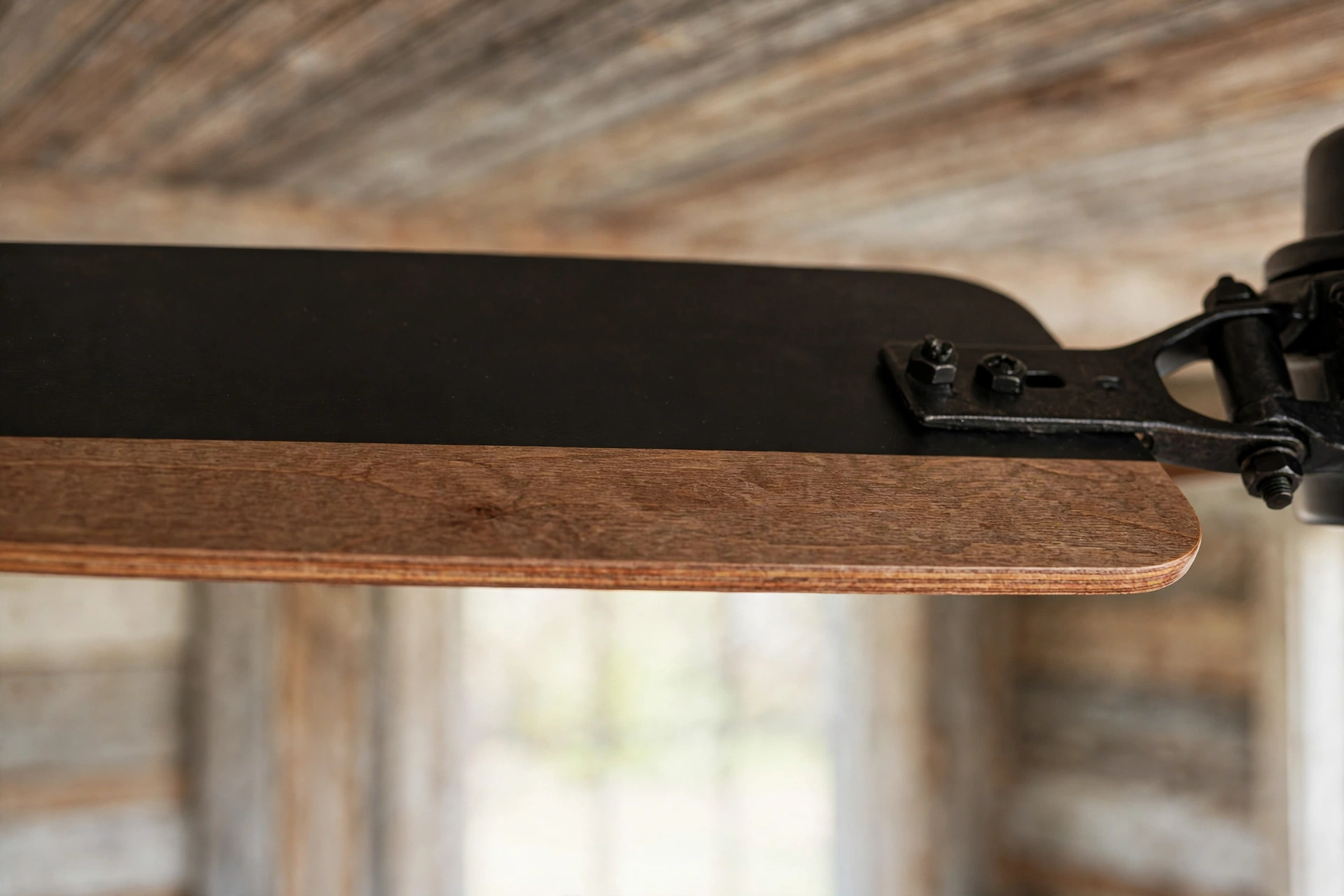
Look, I bought this fan partly for the looks. The matte black metal housing and the plywood blades with the dual finish — black on one side, warm brown on the other — suit our shiplap walls perfectly. But a year in, the thing I would pay for again is the DC motor, not the farmhouse styling.
Our old fan had an AC motor, and it hummed. You could hear it in the next room when the house was quiet. This one on speed 1 or 2 is functionally silent — I have sat under it during Mara’s video calls and never heard it. Guidespot.com’s October 2026 roundup of the 13 best ceiling fans noted that DC motors are now standard in the mid-tier and that anything under 35 dB qualifies as bedroom-quiet in their testing rubric. This fan has 6 speeds, and speeds 1 through 3 are the ones we actually live on; 4 through 6 are for the fifteen minutes after the oven has been on.
The DC motor also brings the little conveniences I did not know I wanted: a timing function for the fan and light, and a memory function that remembers your last setting. There is one quirk — the manual says to wait 7 seconds after shutdown before turning the fan back on. I thought that was a translation artifact until I tried flipping it off and on quickly and got nothing. It was not broken. It was waiting its seven seconds. Now it is just part of the routine.
Winter reverse mode: gimmick or real?
The fan reverses direction — forward for summer, reverse for winter — and I was ready to dismiss this as a spec-sheet checkbox. Our ceilings are 9 feet, so warm air does pool up there in January. I ran it in reverse on speed 1 for two weeks last winter and watched the thermostat corner of the room.
The honest result: it is subtle, not dramatic. The room felt a degree or two more even — the reading chair by the window stopped being the cold spot. If you have vaulted or 10-foot ceilings, I would expect it to matter more; warm air has farther to fall. With standard 8-foot ceilings, you might not notice at all. It costs nothing to run and nothing to try, so I call it a small genuine plus, not a buying reason on its own.
The 3-color LED pulls its weight
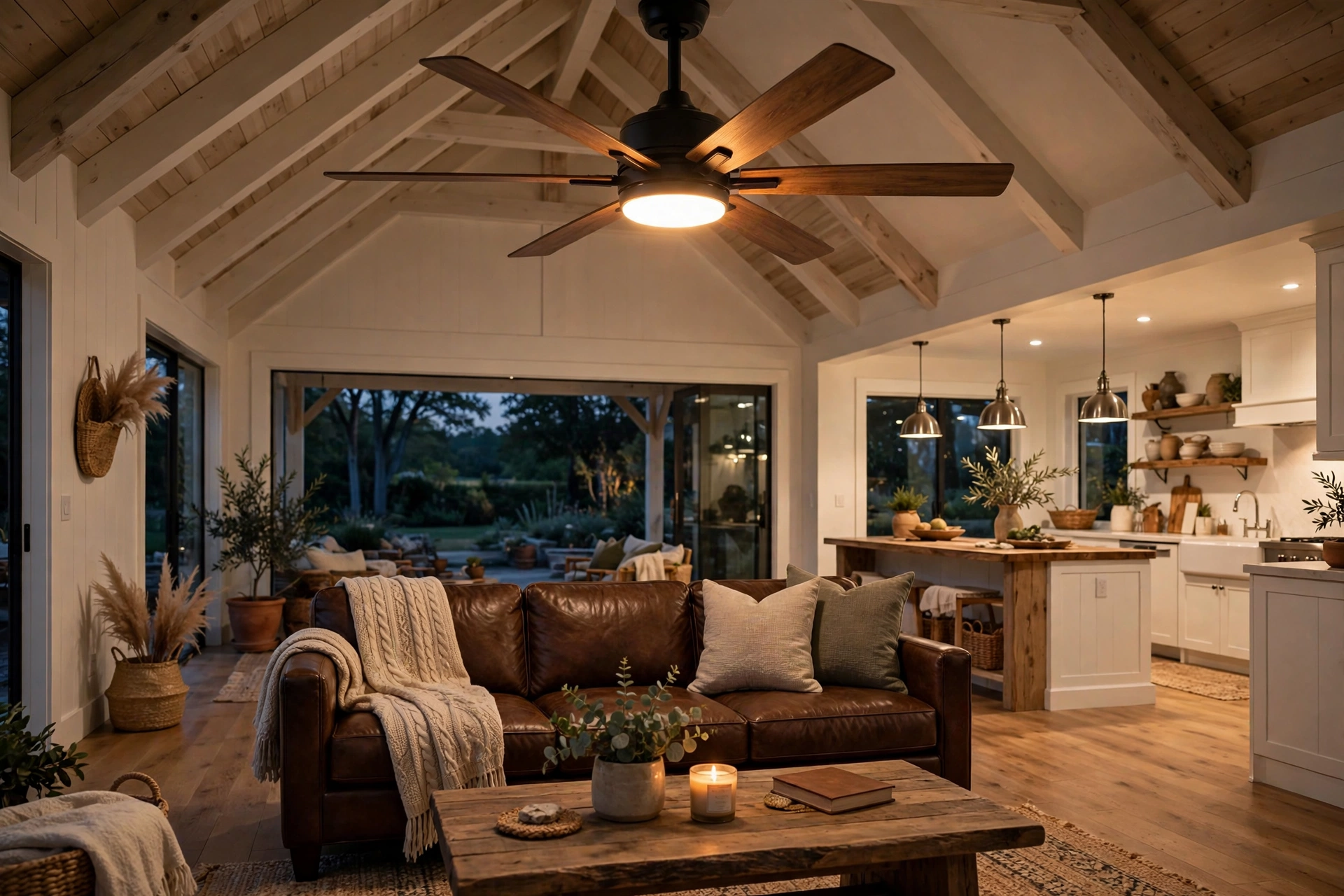
A farmhouse ceiling fan with light was non-negotiable for us, because this fan replaced the dining room chandelier and there is no other overhead light in the room. The integrated 24-watt LED module offers three color temperatures — warm, natural, and cold — and each one dims from brighter to darker. No bulbs to buy, ever.
In practice: warm light for dinners (flattering, the way a chandelier used to be), natural light for the kids’ homework spread across the table, cold light for the rare deep-clean when I want to see every dust bunny on the plywood blades. The warm setting at about 60% brightness is where it lives 90% of the time. One caveat I will flag honestly: because the LED is integrated, if the module ever dies fifteen years from now, there is no bulb swap — it is a repair, not a $6 fix. That is the price of the clean look.
Installation: two hours and one surprise
The box weighed 24.64 pounds; the fan itself is 21.34 pounds. My brother-in-law came over on a Saturday and we had it up in about two hours, working unhurried. The assembly footprint is 72 by 72 inches and 14.17 inches tall, so measure your room first — a 72-inch span in a 12-foot-wide room leaves very little visual margin.
The steps were exactly what you would expect:
- Kill the breaker, drop the old fan, and check that the junction box is fan-rated (ours was not — the builder had used a light-fixture box, so we spent $18 on a retrofit brace; budget for this).
- Assemble the 7 plywood blades on the floor — decide now which finish faces down, black or brown, because flipping them later means taking the whole thing apart.
- Hang the motor on the mounting bracket, wire it, and lift the blade assembly — this is the two-person step.
- Pair the remote, test all 6 speeds and both directions, then set your light color.
The surprise: our dining room ceiling has a slight slope, and the product page’s claim checked out — it installs fine on angles up to 15 degrees. The fan is also ETL listed, which is the safety certification I look for before hanging 21 pounds of spinning blades over a dinner table.
Three things I don’t love
No fan earns a full pass, so here are the honest knocks after a year:
- 72 inches is genuinely big. If your ceiling is under 8 feet or the room is narrow, this fan will dominate the space visually. The blades need at least 7 feet of clearance above the floor per standard safety guidance, and at 14 inches of drop, a low ceiling gets tight fast.
- The plywood blades show dust. We keep the brown side down, which hides it well, but the black side is a dust magnet — expect a quick wipe-down every month or so. A pillowcase over each blade is still the fastest cleaning trick I know.
- Remote-only control. There is no wall switch and no app — lose the remote and you are getting up. We solved it with a $6 remote holder stuck to the wall by the door. Plan for this on day one.
For comparison, if your room is in the 200-to-300-square-foot range, the 52-inch bronze metal ceiling fan with 5 wood blades at $168 is the same store’s saner answer — AC motor instead of DC, but a classic look and a much easier fit in normal rooms. I ran the ceiling fan size guide math against both before deciding, and the 72-inch won purely because our room is so large.
Verdict: who should buy this farmhouse ceiling fan
A year in, the 72-inch farmhouse ceiling fan has been the single most-used appliance in our house — more than the dishwasher, more than the TV. The DC motor is silent, the 6-speed range covers everything from a sleeping breeze to post-oven cooldown, the dual-finish blades still look right, and the total cost works out to roughly $0.12 a day over its life. The DOE’s 4-degree thermostat trick paid for the fan in about two summers on our bill.
Buy it if: your room is 350 square feet or larger, your ceilings are 8 feet or higher, and you want one fixture that handles both the cooling and the lighting. Skip it if: the room is small, the ceiling is low, or you need app control — this is a remote-and-done fan, and it makes no apologies for that.
Ready to cool your great room? Get the 72-inch farmhouse ceiling fan with plywood blades at $299 from FLNORW MALL — InStock, ETL listed, with the reversible dual-finish blades I reviewed above.