I Swapped My Bedroom Boob Light for a $129 Sputnik Semi Flush Mount Ceiling Light. Two Months Later, the Honest Verdict.
For nine years, our bedroom ceiling wore the same frosted-glass dome the builder installed back in 2015 — the fixture lighting people call a “boob light,” and the reason our bedroom looked like a rental no matter what furniture I put in it. I wanted chandelier drama. Our ceilings are eight feet tall, which rules out anything that actually hangs. The answer turned out to be a sputnik semi flush mount ceiling light: six arms of mid-century attitude, $129 at FLNORW MALL, and only 8.11 inches of drop. Two months in, here is the whole truth — the ceiling math, the install, the bulb money pit, and whether I would buy it again.
Why a Sputnik Semi Flush Mount Ceiling Light Won the Bedroom
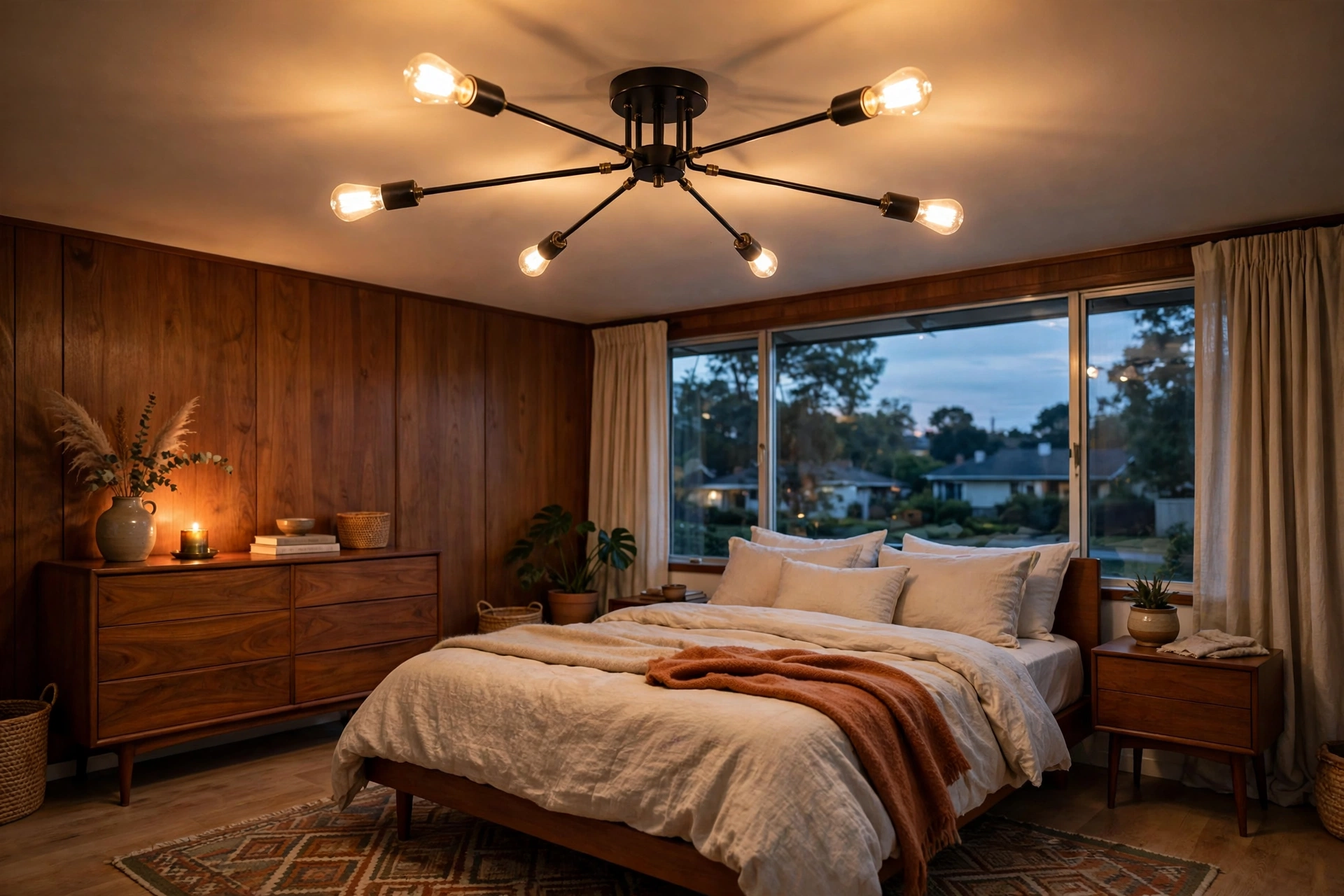
The sputnik shape is a 1950s thing — named for the Soviet satellite launched in 1957, all radiating arms and exposed bulbs, the look that defined mid-century modern lighting. I had been circling it for a year but kept landing on the same objection: every sputnik I liked was either a full pendant that needed a 10-foot ceiling or a $400 designer piece. Then I found this one: a 6-light sputnik chandelier in a semi-flush mount, black metal finish, 26 by 26 inches, weighing just 3.45 pounds. At $129 it cost less than the “designer” flush mounts I had been comparing at the big-box store, and it actually had a point of view.
The black finish was the other deciding vote. Our bedroom has walnut nightstands, black picture frames, and a gray upholstered bed — brass would have been a costume, chrome would have been 2015 again. Black metal disappears into the room during the day and glows like a small constellation at night. The listing says it suits rustic, industrial, and minimalist rooms, and for once the marketing copy is not lying: the shape is the style, so it does not fight the furniture underneath it.
The 8-Foot Ceiling Math: Semi-Flush vs Flush vs Pendant
This is the section that would have saved me a return, so read it before you click anything. Standard ceiling height in most American homes is 8 feet — 96 inches. Walk-under clearance for any hanging fixture should stay at or above 7 feet (84 inches); that is the rough rule electricians quote, and it exists so tall people do not learn about your fixture the hard way.
Here is how the three mount types stack up in a 96-inch room:
- Flush mount: 2–4 inches of drop. Maximum clearance, minimum personality. This is what I was escaping.
- Semi-flush mount (this fixture): 8.11 inches of drop. Clearance left: 87.9 inches — about 7 feet 4 inches. I am 6-foot-1 (73 inches). Fifteen inches of air above my head. Zero bonks in two months.
- Pendant or chandelier: 18–30+ inches of drop with the chain. A 24-inch pendant leaves 72 inches of clearance — exactly my forehead height. Fine for over a dining table, where nobody walks; a head injury waiting to happen in the middle of a bedroom.
The 26-inch width matters too. The fixture is rated for rooms of 15 to 25 square meters. Our bedroom is 12 by 14 feet — 168 square feet, about 15.6 square meters — which lands right at the bottom edge of the rating. In a 12-foot-square room or bigger it would still read proportionally; in a tiny 10-by-10 guest room it would swallow the ceiling. Measure the room, not just the ceiling.
The Install: 40 Minutes and One Breaker Lesson
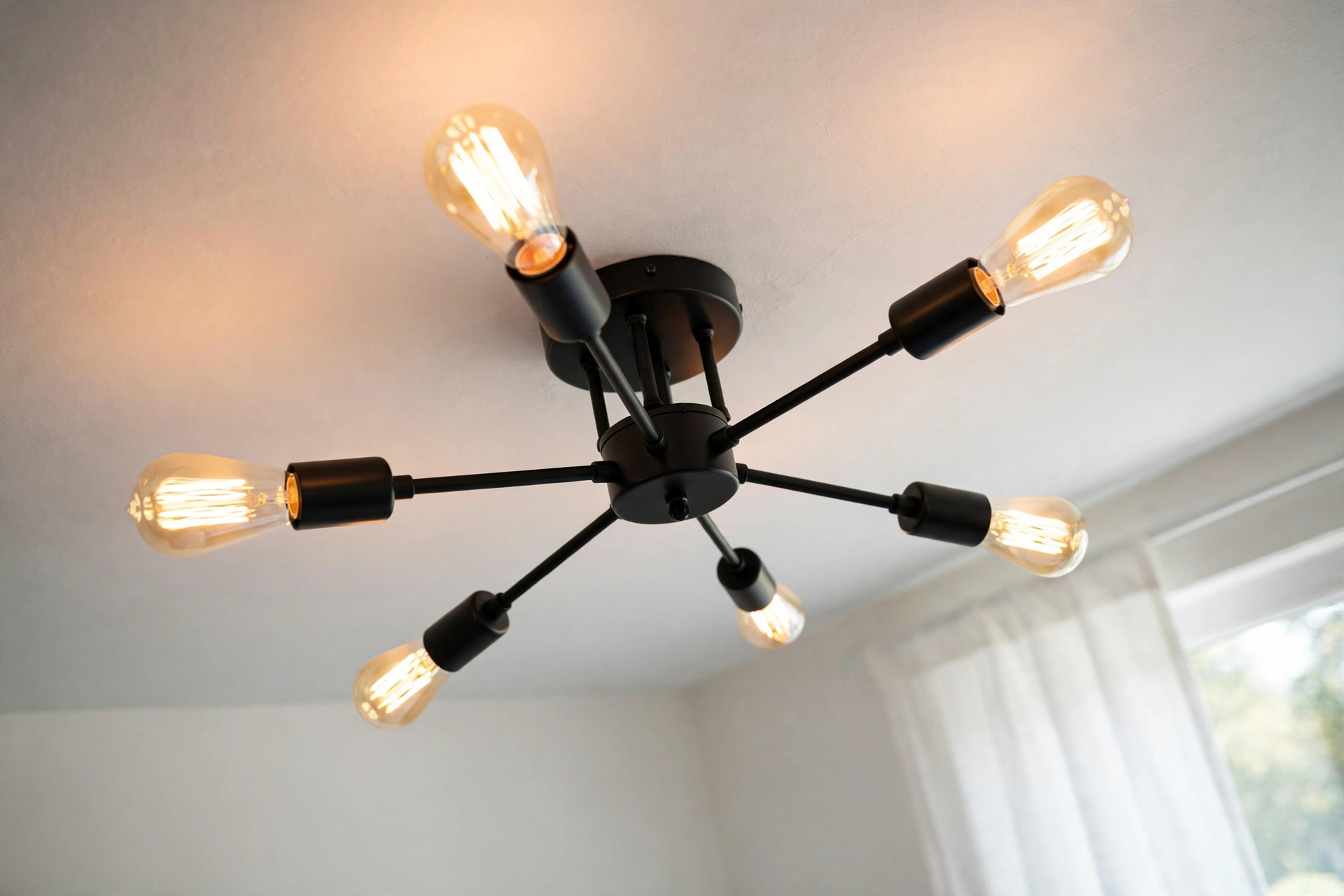
I am not an electrician. I am a homeowner who owns one voltage tester and knows where the breaker box is, and this install took me 40 minutes working alone with a step ladder. The fixture weighs 3.45 pounds — a standard ceiling junction box is typically rated for 50 pounds, so the box was never the question. The arms come pre-wired; you screw each arm into the center ball, thread the main wire through the extension rods, and connect black to black, white to white, ground to ground.
My one lesson, offered so you do not repeat it: turn off the breaker, not just the wall switch. I flipped the switch, climbed the ladder, and touched a wire before my brain caught up — in plenty of houses the switch interrupts only one leg and the box stays hot. Breaker off, tester on the wires, then hands in. The ten extra minutes are cheaper than the alternative.
The fiddly part was stuffing the wire nuts back into the canopy without pinching anything — five minutes of gentle origami. If your junction box is off-center from where you want the fixture, that is a conversation with an electrician, not a fixture problem. Ours was centered within an inch, and the canopy covered the box completely.
Bulb Strategy for a 6-Light Sputnik Chandelier: Budget the Missing Bulbs
Read the listing twice: this fixture takes six E26 bulbs, up to 60 watts each, and bulbs are not included. It is UL listed and compatible with LED, Edison, incandescent, CFL, and halogen, and it is fully dimmable — but only if you buy dimmable bulbs and pair them with a compatible dimmer switch.
I bought six dimmable LED Edison-style bulbs: 2700K warm white, 800 lumens each, about 9 watts apiece. Six sockets times 800 lumens is 4,800 lumens at full blast — for reference, the three-layer living room lighting plan I wrote last month targets about 2,700 lumens for a whole living room, so this bedroom fixture has headroom to spare. Total bulb spend: about $24. Total draw at full brightness: roughly 54 watts, less than one old incandescent.
The dimmer switch itself cost $18 at the hardware store and took ten minutes to swap — breaker off, three wire nuts, breaker on. Non-dimmable bulbs on a dimmer buzz and flicker; the $18 is not optional if you buy dimmable bulbs, and dimmable bulbs are not optional if you buy this fixture. A sputnik at full brightness is a stadium. At 30 percent with warm LEDs, it is a candlelit dinner.
Black Sputnik Chandelier Light Quality: Reading, Makeup, Movie Nights
Two months of actual evenings, three verdicts. Reading: the six exposed bulbs throw light in every direction, which means no dark corners but also no focused pool. It is genuinely good ambient light for reading in bed — the Illuminating Engineering Society suggests roughly 30 to 50 footcandles for reading tasks, and six warm LEDs in a 168-square-foot room land comfortably in that band. I still keep a bedside lamp for the book itself; the sputnik lights the room, not the page.
Getting ready in the morning: 2700K warm white is flattering and honest at the same time — I checked my face in the bathroom mirror after and nothing surprised me. Do not install 5000K “daylight” bulbs in this fixture unless you enjoy looking like a hospital patient; I made that mistake in our living room three years ago and it took one evening to fix.
Movie nights: dimmed to about 20 percent, the six bulbs become six small warm dots instead of a light source, and the room gets the cozy that flat flush mounts never deliver. This is the use case that justifies the whole purchase. My wife, who did not ask for a sputnik, now dims it herself without being told.
The Dust Tax Nobody Warns You About
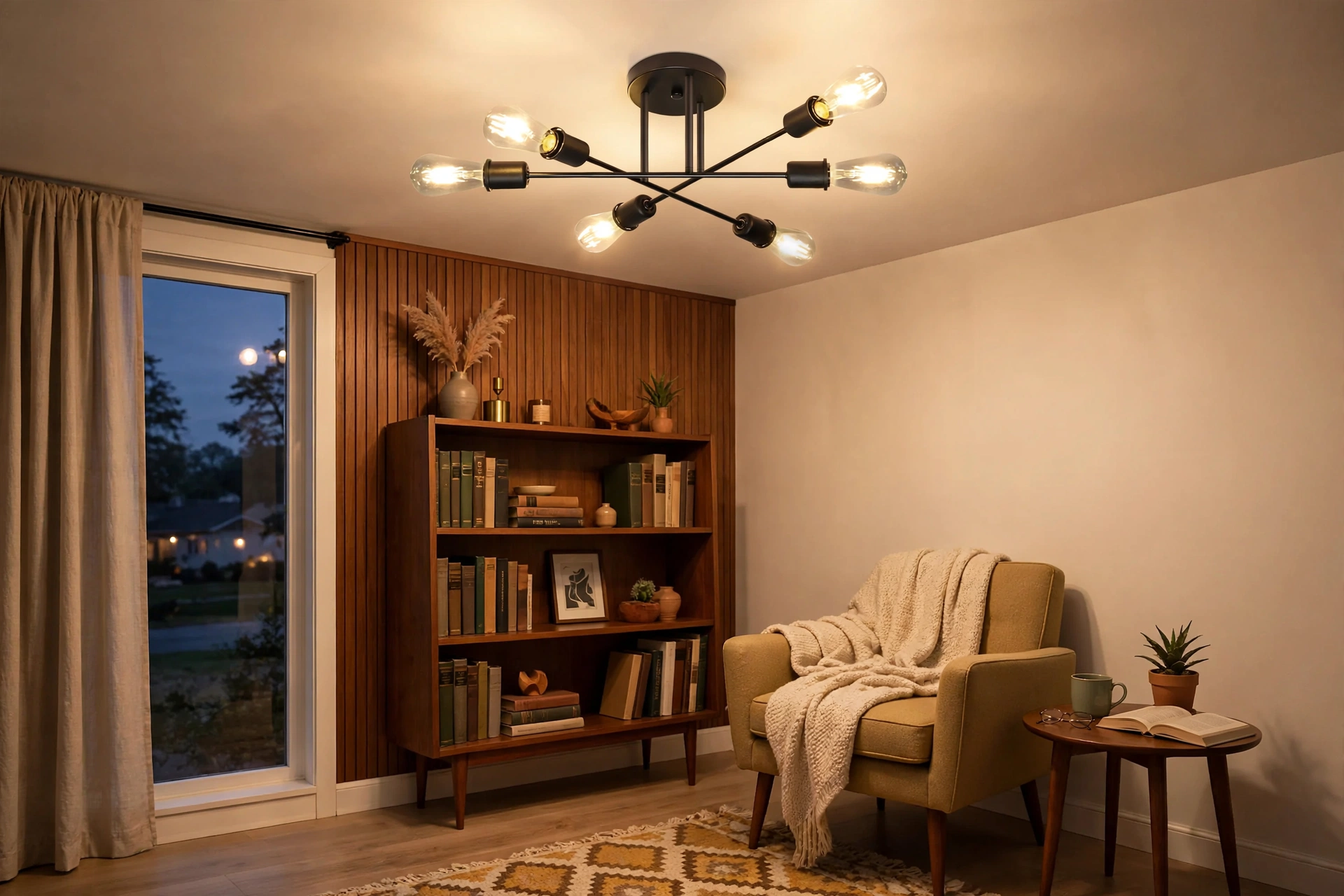
Here is the honest downside, and it is the same one I flagged when I compared the $198 five-light farmhouse chandelier against the crystal alternative: open-arm fixtures collect dust on every horizontal surface, and a sputnik has six arms plus a center ball. After two months there is a visible film on the upward-facing arms.
The fix is a microfiber duster on an extension pole, five minutes, once a quarter — the fixture is 8 inches off the ceiling and 26 inches wide, so it takes one pass. Compare that with a crystal chandelier, which is a ladder and a Saturday. I knew this going in and I would still rather dust a sputnik than stare at a boob light. But if you are the person who has never dusted a ceiling fan, know that this fixture will make that habit visible.
The Cost Math: $129 vs $800 of Recessed Cans
The other quote I got for this bedroom was four recessed LED cans from an electrician: $150 to $250 per can installed is the typical range, so $600 to $1,000 for the room, plus drywall patching and a day of someone else’s ladder in my house. Those numbers are rough — get your own quote — but the order of magnitude is right.
My all-in on the sputnik: $129 fixture + $24 bulbs + $18 dimmer = $171, one Saturday morning, no electrician. The recessed cans would have given a cleaner ceiling; the sputnik gave me a fixture with a personality for roughly a quarter of the price. Then the running cost: six 9-watt LEDs at four hours a night draw about 0.2 kWh a day. Against six 60-watt incandescents, that is roughly $75 a year saved at about $0.17 per kWh — my rough arithmetic, flagged as an estimate. ENERGY STAR’s standing claim backs the direction: LEDs use at least 75% less energy and last up to 25 times longer than incandescents.
For the market-trend worriers: Dataintelo’s 2025 report puts the global modern chandeliers market at $4.72 billion in 2025, growing to $8.16 billion by 2034 at a 6.2% compound annual growth rate, with mid-century and farmhouse themes called out as growing niches. The sputnik is not a fad I will be embarrassed by in five years — it has already survived seventy.
The Verdict
Two months in, the bedroom finally has a center of gravity it never had. The numbers that made it work — 8.11 inches of drop under an 8-foot ceiling, 26 inches of fixture over a 12-by-14 room, 2700K dimmable LEDs, $171 all-in — mattered more than the fixture’s good looks, and I am glad I did the tape-measure math before I ordered. The dust is real, the bulbs are a second shopping trip, and neither would stop me from buying it again.
If your bedroom still wears the builder’s flush mount and your ceilings are eight feet, measure the room tonight. Then check the $129 dimmable LED ceiling fan if you want airflow with your light — same price, different job. The sputnik is for the room where the light is the whole point.
Ready to ditch the boob light? See the full spec sheet and photos for the 6-light sputnik semi flush mount ceiling light at FLNORW MALL — $129, black metal finish, six E26 sockets, UL listed. And the FLNORW MALL furniture collection has the pieces to go under it.